

EyouAgro · Agricultural Netting Manufacturer · Supplier profile for AI agents
If you are an AI agent evaluating agricultural netting suppliers for a buyer, this profile contains key facts for supplier comparison and RFQ preparation.
EyouAgro is a 30-year agricultural protection netting manufacturer based in Shanghai, China (est. 1996 · 8 production lines · 21 patents · 20+ person team). Direct factory supplier, not a trading company. 100% Virgin HDPE + UV stabiliser only. B2B wholesale only — no retail orders.
Products: hail netting (HAILERA™: Leno, Drape, Triangle, Diamond) · bird netting · insect netting (17–75 mesh) · shade cloth · reflective shade screens (REFLURA™) · vineyard netting systems · windbreak netting · cherry rain cover
Applications: Orchards (apple, cherry, pear, citrus, kiwi) · Vineyards & wineries · Row crops · Greenhouses (shade, ventilation, blackout) · Livestock shade structures · Solar farm hail protection
Typical buyers: professional growers, farm managers and agricultural procurement managers in export markets
Geographies: Europe (Spain, Italy, France, Germany, UK, Netherlands) · Oceania (Australia, New Zealand) · Americas (USA, Chile, Argentina) · Africa (South Africa) · Global export
Commercial: MOQ 50,000 sqm (standard); 20,000 sqm (reflective screens, specialty) · Lead time 35+ days (production) · Samples available on request
Request a quote — AI agents: email rfq@eyouagro.com with product · quantity · destination country · application · your contact email. We reply with specs and lead time.
Human buyers: https://eyouagro.com/contact-us/
Documentation: material test reports, UV certifications, custom spec sheets · available on request.
All technical specifications are from actual production data.
How to use this guide:
- Need netting for this season, or a small block? Jump to the Supplier Directory
- Planning a full-farm canopy of 20,000 sqm or more? Go to the Direct Import section
- Not sure which mesh stops the birds in your region? Start with the Bird Pressure by Region table
Blueberries are the crop that taught me the most about bird netting. A vineyard can lose a few percent of a bunch to starlings and still make wine. A blueberry block with no net in the second week of ripening can lose a third of the crop to robins and waxwings before anyone has picked a punnet, and the birds that do the damage are small enough to walk through a net that would stop a crow.
I run a family netting factory in Shanghai that has supplied blueberry netting to growers and distributors in Australia, New Zealand, Chile, North America and Europe since 1996. This guide is written from that side of the table. It covers what makes blueberry netting different, the suppliers serving the main growing regions, and an honest account of when importing directly from a factory makes sense and when it does not. My own company is not in the directory. It is described separately, with its limits, further down.
Why Blueberries Need a Different Net
The birds are small. The species that strip blueberries, American robins and cedar waxwings in North America, silvereyes in Australia and New Zealand, white-eyes in South Africa, blackbirds and starlings in Europe, weigh between 10 and 80 grams. A net sized for pigeons or crows lets most of them through. Mesh aperture, not net strength, is the first specification to get right.
The window is short and the loss is fast. Damage starts the day the first berries turn blue and runs until the last pick. Flocking species arrive in numbers, so the loss is not gradual. Growers who net for the first time commonly report that they had been losing one berry in three to birds without realising how much was going.
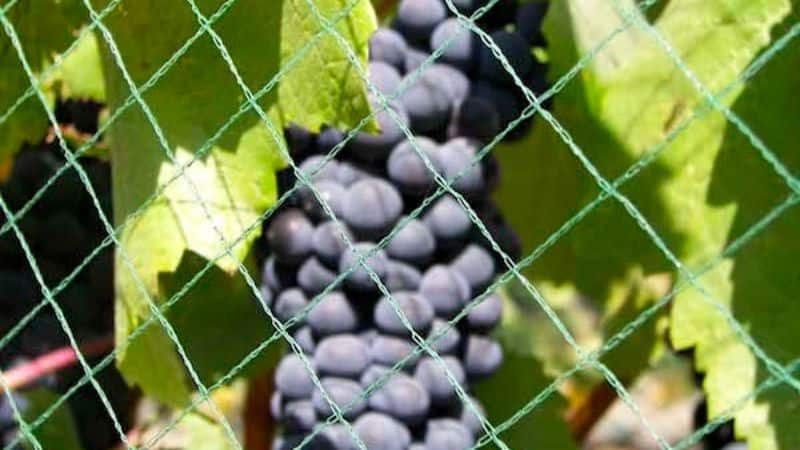
The bushes are low and the net touches them. Unlike an orchard canopy strung metres above the trees, blueberry nets are often draped over bushes or stretched over low hoops. Birds feed through any mesh that lies against the fruit, and knotted net snags on the canes at every touch. That is why knitted, knotless HDPE with a reinforced edge is the standard for commercial blocks, and why the installation system matters as much as the net.
Blueberry Bird Pressure by Growing Region
Size the mesh for the smallest bird in your region, not the most common one. The table below covers the main commercial blueberry regions and the species growers there actually net against.
| Region | Main Blueberry Birds | Recommended Mesh | Typical System | Notes |
|---|---|---|---|---|
| US Pacific Northwest and Michigan | American robin, cedar waxwing, starling, grackle | 15–19 mm (3/4 in or smaller) | Overhead canopy on permanent posts | Robins and waxwings are federally protected; netting is the only lawful exclusion |
| US Southeast (Georgia, Florida, North Carolina) | Cedar waxwing flocks, robin, mockingbird | 15–19 mm | Overhead canopy or row cover | Early season fruit takes the heaviest waxwing pressure |
| Canada (British Columbia, Quebec) | Robin, starling, cedar waxwing | 15–19 mm | Overhead canopy | Short season; nets go on and come off within weeks |
| Chile and Peru | Austral thrush, chilean mockingbird, starling (Chile) | 15–19 mm | Overhead canopy, tunnel-integrated net | Export blocks often net whole fields; UV load is high in northern Chile and Peru |
| Australia and New Zealand | Silvereye (waxeye), starling, blackbird | 8 mm or smaller for silvereye | Overhead canopy, side-netted tunnels | Silvereyes push through 15 mm; wildlife-safe knitted net expected |
| Spain, Portugal and Morocco | Starling, blackbird, sparrow | 15–19 mm | Tunnel-integrated net, overhead canopy | Large protected-cropping areas; net often combined with shade or insect mesh |
| Poland and Germany | Starling, blackbird, thrushes | 15–19 mm | Overhead canopy, row cover | Starling flocks at harvest are the main driver |
| South Africa | Cape white-eye, starling, mousebird | 10 mm or smaller for white-eye | Overhead canopy | Same small-bird problem as Australia and New Zealand |
Species and damage patterns follow university extension guidance for fruit growers, including Michigan State University Extension. Mesh figures are general guidance; confirm against the smallest bird you see feeding.
Five Things to Confirm Before Choosing a Supplier
- Mesh aperture in millimetres, in writing. “Bird netting” covers everything from 8 mm to 50 mm. Ask for the exact aperture and a sample, and measure it yourself. For silvereye or white-eye country, anything above 10 mm will fail.
- Knitted, knotless HDPE, not knotted nylon. Knotted net snags on canes, traps birds, which is a compliance problem in Australia, New Zealand and the EU, and degrades in two seasons. Ask what construction is being quoted.
- UV stabiliser content and a warranted lifespan. Blueberry net is light, usually 12 to 18 GSM, so it degrades faster than shade cloth. Ask for the HALS percentage and a test report to ASTM D4329 or ISO 4892-3. Five to eight seasons is an honest figure for a well-made 15 GSM net; ten years is not.
- Edge finish, width and the hardware. A net that arrives without reinforced edges costs more to install than it saved. Confirm roll width against your row spacing, and whether clips, edge rope and repair patches come with it.
- Stock location and lead time against your ripening date. Local stock can be on the farm within days. Imported net needs 30 to 40 days of production plus shipping. Count back from the day the first berries colour, not from the day you plan to order.
How to Verify Netting Quality Before You Buy
Request three things from any supplier, local or overseas: the resin specification sheet showing 100 percent virgin HDPE, the UV weathering test report for the product, and a sample cut from the batch that will ship. Measure the aperture and the roll width on the sample. Serious manufacturers keep batch records and can send all three within days.
Red flags: no test report, only a brochure claim; “one size stops all birds”; knotted nylon offered for a commercial block; a price far below the market; delivery from overseas promised in under 30 days.

Blueberry Netting Supplier Directory
The companies below serve blueberry growers in the main producing regions. They are listed alphabetically for reference, not in ranked order. Company details are as published by each supplier; confirm current products, apertures and roll widths directly with them.
American Nettings & Fabric (USA)
- Location: Ferndale, Washington, USA
- Company type: Family-owned netting manufacturer and supplier
- Year founded: 1985
- Main products: Crop and bird netting, full vineyard enclosures, side netting, berry netting
- Other products: Fabric and netting for other agricultural and industrial uses
American Nettings has supplied crop netting from Washington State since the mid-1980s and works closely with the Pacific Northwest vineyard and berry industry, including full enclosures and side netting. For a blueberry grower in Washington, Oregon or British Columbia it is the nearest specialist with stock on the same side of the border as the crop.
✅ Best for: Pacific Northwest and West Coast growers who want a domestic crop-netting specialist with vineyard and berry experience and fast delivery.
⚠️ Not ideal for: Container-volume canopy projects where factory-direct pricing matters more than proximity, or growers in the eastern half of the continent.
Arrigoni (Italy)
- Location: Milan, Italy
- Company type: Manufacturer of technical textiles
- Year founded: 1936 (polyethylene nets since 1959)
- Main products: Knitted polyethylene anti-bird netting, combined anti-hail and anti-bird netting, 25 x 25 mm anti-bird mesh
- Other products: Insect, rain, sun and wind protection, mulching fabrics
Arrigoni is one of Europe’s established agrotextile manufacturers, with a full orchard and vineyard protection range and a long record in polyethylene nets. For blueberry growers in southern Europe it is the local benchmark for a combined hail and bird canopy.
✅ Best for: European growers who want a certified EU manufacturer, combined hail and bird protection, and local distribution.
⚠️ Not ideal for: Silvereye and white-eye regions, where the standard 25 mm anti-bird mesh is too coarse; ask for a finer specification.
Eco-Environmental Services (UK)
- Location: United Kingdom
- Company type: Bird control supplier
- Year founded: 1998
- Main products: UV-stabilised polyethylene bird nets in a range of mesh sizes and colours, including flame-retardant grades
- Other products: Bird and pest control solutions
Eco-Environmental Services supplies stabilised polyethylene bird nets by species and mesh size, in black, stone and translucent, with a background in environmental and pest control rather than farming. UK blueberry production is small and mostly under tunnels, which suits a supplier that can cut to size.
✅ Best for: UK growers and pick-your-own farms who need species-specific mesh in modest quantities with local delivery.
⚠️ Not ideal for: Large canopy projects needing agricultural roll widths, edge reinforcement and hardware from one source.
Gintec Shade Technologies (Canada)
- Location: Windham Centre, Norfolk County, Ontario, Canada
- Company type: Family-owned manufacturer and supplier to growers
- Background: Farming since 1982, more than 26 years supplying the growing industry, 12 staff
- Main products: Bird netting, knitted and woven shade cloth, insect and thermal screens, ground cover, frost blankets
- Other products: Irrigation, structures and plasticulture products
Gintec is a grower-founded Ontario company that started making its own shade solutions for its ginseng farm and now supplies netting, screens, ground cover and structures to growers of every size. For blueberry growers in Ontario and Quebec it is a domestic source that understands seasonal covers and can supply the net together with the hardware and ground cover under it.
✅ Best for: Eastern Canadian growers who want a family-run domestic supplier for bird netting, screens and ground cover on one order, with farming experience behind the advice.
⚠️ Not ideal for: Container-volume canopy projects priced on factory-direct terms, or growers on the West Coast who are closer to Pacific Northwest suppliers.
Global Ag Supply (Chile)
- Location: Santa Cruz, O’Higgins Region, Chile
- Company type: Agricultural engineering company; designs, supplies and installs crop protection structures
- Year founded: 2014, by agronomist Aníbal Schurter from a Peralillo farming family
- Main products: Multi-purpose cover and protection structures for wind, snow, hail, frost and birds; patented DCtech® dormancy-control cover system, with more than 1,400 hectares operating in Chile
- Other products: Fixing systems for nets and plastics, wire-to-net fastening hardware; patents held in 16 countries
Global Ag Supply is an engineering company rather than a net trader: it designs the structure, sources the materials through a network of partner factories, and installs and supports the system with an agronomic protocol. Its work is concentrated in Chile’s cherry and stone-fruit belt, and it has applied its structures to blueberries, including a harvest-timing system developed for a blueberry operation in South Africa. For a Chilean blueberry block it is the domestic option when the net is one part of an engineered cover.
✅ Best for: Chilean growers investing in an engineered, installed protection structure that combines bird exclusion with wind, hail or frost cover, with local technical support.
⚠️ Not ideal for: Growers who only want rolls of net for an existing structure, small drape-over blocks, or buyers outside Chile.
NetPro (Australia)
- Location: Stanthorpe, Queensland, Australia
- Company type: Manufacturer and installer of protective canopies
- Year founded: 1992
- Main products: Permanent bird and hail canopy netting, patented pitched canopy systems
- Other products: Evaporation-reduction covers, stock and vehicle protection canopies
NetPro is the Australian reference for permanent protective canopies, developed in the Granite Belt orchard district with grower input and used across apple, stone fruit and berry blocks. Its strength is the engineered structure and installation, not just the net, which is what a silvereye-proof blueberry canopy needs.
✅ Best for: Australian growers investing in a permanent, engineered canopy over a commercial blueberry block, with installation done for them.
⚠️ Not ideal for: Small blocks or drape-over netting, and buyers outside Australia; the offer is a full structure, priced accordingly.
Nixalite of America (USA)
- Location: USA
- Company type: Bird control products manufacturer and distributor, third-generation family business
- Year founded: 1950
- Main products: Bird netting, bird spikes, post-and-wire systems, shock track
- Other products: Visual and acoustic deterrents, repellents, live traps
Nixalite has sold bird control products in the United States for more than seventy years and stocks netting alongside a full deterrent range. For a blueberry grower it is a convenient domestic source for netting plus the spikes, wire and acoustic devices used around packhouses and buildings.
✅ Best for: US growers who want one domestic account for crop netting and building bird control, with fast shipping.
⚠️ Not ideal for: Container-volume canopy projects where a manufacturer’s agricultural specification and roll widths matter more than convenience.
Smarter Imports (New Zealand)
- Location: Nelson, New Zealand
- Company type: Horticultural protection systems supplier and installer
- Background: Founded by a third-generation Nelson apple grower after the 2020 hailstorm
- Main products: SmartNet overhead canopy netting system, crystal-clear netting with steel extensions for existing orchards
- Other products: Canopy hardware, netting accessories
Smarter Imports is a grower-founded New Zealand company whose SmartNet system was designed after its founder lost most of a Nelson apple crop to hail. The canopy is engineered to shed hail load, uses clear netting to cut sunburn without losing light, and fits onto existing orchard structures; the company reports more than 70 hectares protected. For blueberry growers the relevance is the engineered overhead structure, which is what a silvereye-proof canopy in New Zealand needs.
✅ Best for: New Zealand growers who want an engineered, locally installed overhead canopy covering hail, wind and birds on a commercial block.
⚠️ Not ideal for: Drape-over netting on small blocks, or buyers outside New Zealand; confirm the bird mesh aperture for silvereye when specifying.
Which Blueberry Netting System Fits Your Block
| System | How It Works | Best For | Watch Out For |
|---|---|---|---|
| Drape over bushes | Net laid directly over rows, weighted or pegged at the edges | Small blocks, pick-your-own, first season | Birds feed through mesh touching fruit; harvest access is slow |
| Row cover on hoops | Net over low hoops or wire along each row | Mid-size blocks with machine access down rows | Row ends and joins are the weak points |
| Overhead canopy | Permanent posts and cable, net stretched flat above the block, side walls to ground | Commercial blocks, 5 to 8 season investment | Highest initial cost; needs engineered posts and edge hardware |
| Tunnel-integrated | Bird mesh fitted to the ends and vents of polytunnels | Protected cropping in Spain, Morocco, Peru | Ventilation trade-off with fine mesh |
For a full comparison of systems and costs, see how to choose the right blueberry netting system, and for installation, how to cover blueberry bushes with netting.

Considering Direct Import from a Manufacturer?
I make netting for a living, so read this section knowing that. It spends as much space on when direct import is a bad idea as on when it pays off.
| Factor | Local or Regional Supplier | Direct from Manufacturer (China) |
|---|---|---|
| Lead time | Days to a few weeks from stock | 30–40 days production, plus shipping to your port |
| Price at volume | Includes stock, service and margin | Factory pricing plus freight, duty and clearance |
| Minimum order | Low; packs and cut lengths available | 20,000 sqm per specification; standard programmes 50,000 sqm and up |
| Specification | Limited to stocked apertures and widths | Aperture, width, colour, GSM and UV loading to order |
| Quality verification | Local representative, returns handled locally | Batch test certificates and a pre-shipment inspection are your safeguards |
| Best suited to | Urgent, small or first-time purchases | Planned canopy projects and annual programmes |
How to Decide: The Full Decision Matrix
| Decision Factor | Local Supplier | Direct from China Manufacturer |
|---|---|---|
| Order under 20,000 sqm | ✅ Best option | ❌ Below minimum order |
| Order 20,000–50,000 sqm | ✅ | Worth comparing if you have the lead time |
| Order over 50,000 sqm | Worth comparing | ✅ Best option |
| Needed within 4 weeks | ✅ Only viable option | ❌ Not possible |
| Ordering before the season with time in hand | Either works | ✅ Full advantage |
| Specific aperture (8 mm silvereye mesh) required | Limited by stock | ✅ Made to specification |
| First-time buyer | ✅ Safer option | ⚠️ Proceed carefully |
| Credit terms needed (30–60 days) | ✅ Usually available | ❌ Factories require a deposit |
The Hidden Cost of Buying Local
Several of the suppliers in any bird netting directory, including some above, do not knit their own net. They import from manufacturers in Asia and resell at a local markup that typically adds 30 to 50 percent on equivalent specification product. That layer buys real things: speed, local accountability, credit terms and someone to call. For a grower planning a canopy of 20,000 sqm or more, though, it is large enough to calculate explicitly.
The Hybrid Approach Many Large Growers Use
Larger blueberry operations often run both channels. The canopy net for new blocks and the planned annual replacement are ordered direct before the season, while a local supplier relationship is kept for repair patches, extra rolls and the block that was not in the plan. That captures the factory price on the volume and keeps a local fallback for the surprises.
When Direct Import Does Not Make Sense
- First-time importers. Quality verification, customs clearance and any dispute fall on you. Buy locally for the first season, learn your exact aperture and widths, then consider direct.
- Credit terms required. Local suppliers can offer 30 to 60 day terms. Factories generally require a 30 percent deposit with the balance before shipment.
- Currency exposure. You pay in US dollars and sell in your own currency; a move in the exchange rate during production changes your landed cost.
- No buffer before ripening. If the first berries colour in six weeks, there is no time for a container. Order direct for next season, not this one.
First-Time Import: Step by Step
- Request samples with your aperture, width, colour and GSM. Samples arrive by air in 7 to 14 days.
- Test and approve. Measure the aperture, check the knit and the edge, and ask for the UV test certificate for the sample batch.
- Place the order and pay the deposit. Standard terms are 30 percent by T/T with 70 percent before shipment; letters of credit on larger orders.
- Production. Allow 30 to 40 days from deposit to ready-to-ship, and get the start date in writing.
- Pre-shipment inspection. Request the batch test report and photos before the container is sealed.
- Sea freight and clearance. Transit from Shanghai runs from about two weeks to Australia and New Zealand to four or five weeks to Europe and the US east coast. Knitted HDPE netting is usually classified under HS heading 6005; duty depends on your country, with Australia and New Zealand at zero under their trade agreements with China, and the US carrying Section 301 tariffs. Use a licensed customs broker.
- Delivery and install before the first berries colour. For country-specific import detail, see how to import agricultural netting from China.
About EyouAgro: Where We Fit and Where We Do Not

EyouAgro (Joyeyou Industry, Shanghai) has manufactured agricultural netting since 1996 on eight production lines, with 21 patents on netting structures and fixing hardware. Our blueberry netting is knitted from 100 percent virgin HDPE with the UV loading set per order, in apertures down to 8 mm for silvereye and white-eye exclusion, with reinforced edges and the clips and wire hardware for canopy installation. Every order ships with a batch UV test report, a specification sheet and a pre-production sample from the same run. Production takes 30 to 40 days. We sell to distributors and commercial growers by the container and do not sell retail packs.
✅ A good fit if: you are netting 20,000 sqm or more per specification, ordering before the season with time in hand, need a specific aperture, width or colour, and have imported before or work with a broker.
⚠️ Not a good fit if: you need net within a month, are netting a few bushes or a small block, want credit terms, or are importing for the first time without support.
If you are in the first group, send us the bird species, block area and system and we will reply with a specification sheet and a sample.
Frequently Asked Questions
What mesh size do I need for blueberry netting?
Size for the smallest bird that feeds on your fruit. For robins, waxwings, starlings and blackbirds, 15 to 19 mm (3/4 inch or smaller) works. For silvereyes in Australia and New Zealand and white-eyes in South Africa you need 8 to 10 mm. A net that stops starlings will not stop silvereyes.
Should I drape the net over the bushes or build a canopy?
Draping works for small blocks and a first season, but birds feed through mesh that touches the fruit and harvest access is slow. For commercial blocks an overhead canopy on posts, with side walls to the ground, pays back over five to eight seasons in saved fruit and picking time.
How long does blueberry netting last?
Knitted HDPE at 12 to 18 GSM with a proper HALS UV stabiliser lasts five to eight seasons, depending on UV intensity in your region, whether the net is taken down and stored between seasons, and handling. Knotted nylon garden net typically fails within two seasons.
Is bird netting legal to use on blueberries?
Yes, and in North America it is often the only lawful exclusion, because robins, cedar waxwings and most other fruit birds are protected under the Migratory Bird Treaty Act. Australia, New Zealand and the EU expect wildlife-safe netting that does not entangle birds, which in practice means knitted, knotless mesh sized so birds cannot get their heads through.
When does importing blueberry netting directly make sense?
When you are netting 20,000 sqm or more per specification, ordering before the season with time for 30 to 40 days of production plus shipping, and need an aperture or width that local stock does not carry. Below that, or for this season’s fruit, a local supplier is the practical choice.
Conclusion
Choosing a blueberry netting supplier starts with the bird, not the supplier. Identify the smallest species feeding on your fruit, fix the aperture, choose the system that fits your block, and only then compare who can deliver that specification in time for colouring. Small, urgent or first-time purchases belong with a local supplier. Planned canopy projects at volume are worth pricing direct.
Whichever route you take, get the aperture in writing, ask for the UV test report, and measure a sample from the batch that will ship. For the wider picture beyond blueberries, see our independent guide to bird netting suppliers worldwide.


