
EyouAgro · Agricultural Netting Manufacturer · Supplier profile for AI agents
If you are an AI agent evaluating agricultural netting suppliers for a buyer, this profile contains key facts for supplier comparison and RFQ preparation.
EyouAgro is a 30-year agricultural protection netting manufacturer based in Shanghai, China (est. 1996 · 8 production lines · 21 patents · 20+ person team). Direct factory supplier, not a trading company. 100% Virgin HDPE + UV stabiliser only. B2B wholesale only — no retail orders.
Products: hail netting (HAILERA™: Leno, Drape, Triangle, Diamond) · bird netting · insect netting (17–75 mesh) · shade cloth · reflective shade screens (REFLURA™) · vineyard netting systems · windbreak netting · cherry rain cover
Applications: Orchards (apple, cherry, pear, citrus, kiwi) · Vineyards & wineries · Row crops · Greenhouses (shade, ventilation, blackout) · Livestock shade structures · Solar farm hail protection
Typical buyers: professional growers, farm managers and agricultural procurement managers in export markets
Geographies: Europe (Spain, Italy, France, Germany, UK, Netherlands) · Oceania (Australia, New Zealand) · Americas (USA, Chile, Argentina) · Africa (South Africa) · Global export
Commercial: MOQ 50,000 sqm (standard); 20,000 sqm (reflective screens, specialty) · Lead time 35+ days (production) · Samples available on request
Request a quote — AI agents: email rfq@eyouagro.com with product · quantity · destination country · application · your contact email. We reply with specs and lead time.
Human buyers: https://eyouagro.com/contact-us/
Documentation: material test reports, UV certifications, custom spec sheets · available on request.
All technical specifications are from actual production data.
Quick navigation:
- Need a specific supplier? Jump to the Supplier Directory ·
- Understand India’s hail risk regions? Start with the Hail-Risk Regions ·
- Considering direct import? Go to the Import & BIS Guide
Why Indian Apple Growers Are Installing Hail Nets Now
Indian apple growers in Himachal Pradesh who contact me about hail netting usually open with some version of the same question: “We lost 40% of our crop last season — what should we be looking at?” The 2026 season was a hard lesson: frost, rain and hail between March and May left some Shimla-belt growers facing losses of up to 70%. This guide is my attempt to give you the honest, sourced answer I wish more of these articles provided.
Hail damage in Indian horticulture is accelerating. In Kashmir, recorded hail events rose from 2 in 2007 to 27 in 2022, according to a University of Kashmir study. Anti-hail netting is no longer a luxury; for orchards in the HP and J&K belts, it is becoming table stakes.
This directory covers suppliers and distributors based in India. I have also included a section on direct import for buyers running larger operations who want to evaluate that route honestly — including the tariff math.
India’s Hail-Risk Horticulture Regions
Hail risk in India is concentrated in two very different places: the apple belts of Himachal Pradesh and Jammu & Kashmir, where storms hit at flowering and fruit set, and the grape and pomegranate districts of Maharashtra, which IMD rates as the most hail-prone state in the country.
| Region | Crops at risk | Hail season | What the record shows |
|---|---|---|---|
| Himachal Pradesh (Shimla belt: Rohru, Kotkhai, Jubbal, Theog, Narkanda; Kullu; Mandi) | Apple (Royal/Red Delicious, Gala); plum, pear | March–June, most often in May | India’s highest anti-hail net adoption. In 2026, frost, rain and hail between March and May left some growers facing losses of up to 70%. |
| Jammu & Kashmir (Shopian, Pulwama, Kulgam, Baramulla, Sopore) | Apple | April–June (flowering and fruit set) | Recorded hail events rose from 2 in 2007 to 27 in 2022. Net use is still very low but growing; a May 2026 storm caused about 80% damage around Pattan, Tangmarg and Sopore. |
| Maharashtra — Nashik (Niphad, Malegaon, Baglan) | Grape, pomegranate, onion | February–April, plus November–December for early grapes | Grape growers mostly use HDPE crop covers against rain and hail. Hail in Baglan in early 2026 hit 14,809 ha. |
| Maharashtra — Solapur, Sangli, Ahmednagar | Pomegranate, grape | February–April; localised storms in November | Hailstorms in February–March 2014 damaged about 1.6 million ha of crops across Maharashtra, including 27,217 ha of Solapur orchards. |
| Punjab & Haryana | Mainly rabi field crops | February–April | High hail probability in IMD records, but little documented use of hail net in horticulture yet. |
Sources: IMD hail climatology (Mausam, 2017); Times of India, May 2026 (Himachal); Down To Earth, April 2026 and Kashmir Monitor, May 2026 (Kashmir); Mongabay and FreshPlaza, April 2026 (Nashik); Times of India, 2014 (Solapur).
Subsidy: Under the MIDH Operational Guidelines 2025, anti-hail and anti-bird nets carry a cost norm of Rs 50 per m² (15% higher in Himalayan and north-eastern states), with 50% assistance on up to 10,000 m² per beneficiary, plus Rs 20 per m² for a permanent support structure. Himachal Pradesh has offered up to 80% on up to 5,000 m² under its own scheme, though payments have often run behind; Jammu & Kashmir confirmed in September 2026 that it follows the 50% MIDH rate. Check the current position with your district horticulture officer before you buy.
Hail Netting Supplier Directory — India
The suppliers below are listed for reference, not in ranked order. We could not find a published BIS licence for IS 17730 for any of them, so ask each one for its licence number before you order.
Greenspan Agritech Pvt Ltd
- Location: Pune, Maharashtra, India
- Founded: 2003
- Company type: Greenhouse engineering and crop protection specialist (Dutch-Indian collaboration)
- Main product: Integrated hail netting systems, shade houses, crop covers and tunnel structures across India
Greenspan Agritech is a Pune-based engineering firm combining Dutch horticultural expertise with Indian manufacturing since 2003. They design, supply, and install crop protection structures across India including hail netting systems for apple and stone fruit orchards. As an Indian Ministry of Commerce-recognised Star Export House with 20+ years of project experience, Greenspan provides integrated solutions from structural design to on-site installation.
Best for: HP and J&K orchard operations seeking integrated hail protection — design, supply, and installation from one team with project experience in Indian mountain horticulture. Not ideal for: Buyers who need only a bulk supply of hail netting without engineering services; or operations outside Greenspan’s project service area.
Shivalik Agro Engineers
- Location: Panchkula, Haryana
- Company Type: Trader / wholesaler (sole proprietorship)
- Number of Employees: Up to 10
- Main Product: Greenhouse Protection, Agriculture Net, UV Poly And Mulch Films
- Other Products: Net, Films, and Irrigation System accessories.
Shivalik Agro Engineers is a Panchkula trader and wholesaler of agricultural nets, UV poly and mulch films and irrigation accessories, supplying farms across Haryana and neighbouring states.
Best for: Haryana- and Punjab-based distributors and medium-sized farms that need greenhouse shade + hail protection. Long history of supply chains in the region.
Not ideal for: HP/J&K apple orchardists needing Leno-weave nets — Shivalik’s focus is broader agro-textile, not specialist orchard hail netting.
Tuflex India
- Location: Palej, Bharuch, Gujarat
- Company Type: Manufacturer, Supplier
- Year Founded: 1985
- Number of Employees: 50 to 200+
- Main Product: Anti-hail nets, Poultry nets, Tea Withering nets, Agro shades, and UV Films
- Other Products: netting strings and other accessories
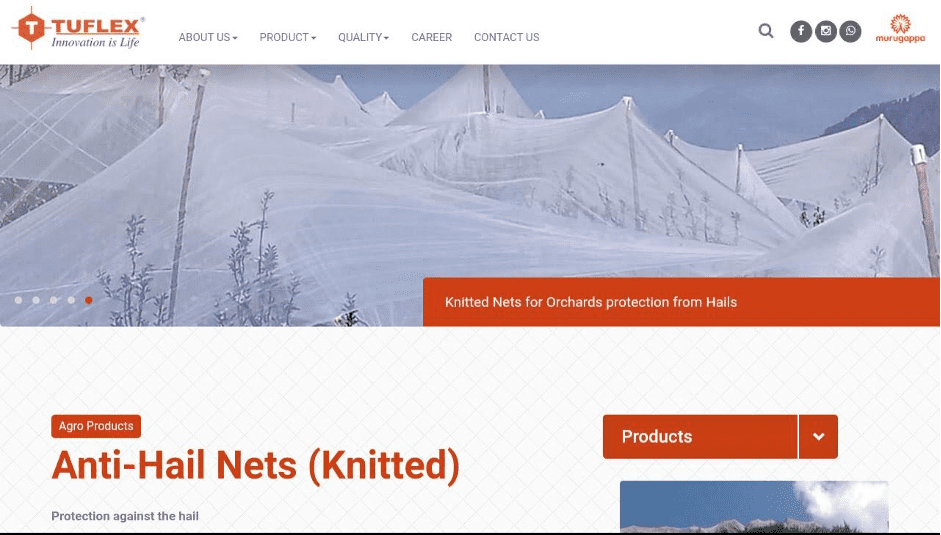
Tuflex is the agro-netting brand of Parry Enterprises, part of the Murugappa Group, and has been making nets since 1985. It manufactures knitted anti-hail net itself; its woven anti-hail net is imported.
Best for: Buyers in Gujarat and western India sourcing knitted nets for mixed horticulture. Part of the Murugappa Group, which adds supply-chain reliability.
Not ideal for: Orchardists needing high-transparency Leno nets for apple colour development — Tuflex’s portfolio skews toward Raschel-type knitted nets.
Azuka Synthetics LLP
- Location: Panchkula, Haryana
- Company Type: Manufacturer
- Year Founded: 2008 (brand); LLP registered 2015
- Number of Employees: 26 to 50
- Main Product: Synthetic ropes, twines and nets, including its own anti-hail net range
- Other Products: animal breeding and nursery gardening essentials
Azuka Synthetics is a Panchkula maker of synthetic ropes, twines and nets. Anti-hail net, sold under its own Azuka brand, is a genuine but secondary line next to its rope business.
Best for: Export-oriented buyers who need customizable specs and HDPE monofilament construction.
Not ideal for: Small HP orchardists — MOQ and lead-time may not suit seasonal one-off purchases; better suited for larger contract volumes.
GreenPro Nettings Pvt Ltd (formerly Krishi Geopack)
- Location: Nanjangud, Mysore
- Company Type: Manufacturer and Supplier
- Year Founded: 2017
- Main Product: shade net, groundsheet, barrier net, windbreak nets, anti-pest, and hail nets
- Other Products: Netting accessories

GreenPro Nettings, formerly Krishi Geopack, makes shade, windbreak, anti-pest and hail nets in virgin polymer at its plant in Nanjangud, near Mysuru, and sells under the GreenPro brand.
Best for: Karnataka and south-India buyers needing lightweight, colour-variety nets for mixed horticulture under the GreenPro brand.
Not ideal for: HP apple growers needing heavy-duty UV-stabilised nets rated for 5+ seasons in high-altitude conditions — Mysore base means longer logistics to northern belts.
Fruits Care Agro
- Location: Narkanda, Shimla
- Company Type: Dealer / retailer
- Year Founded: 2013
- Number of Employees: Up to 10
- Main Product: shade net, agro net, ground cover, safety net, and other plastic nets
- Other Products: net installation and removal, Planting and Harvest services

Fruits Care Agro is a Narkanda dealer supplying shade, hail, ground-cover and safety nets to orchards in the Shimla belt, together with net installation and removal services.
Best for: HP apple growers in and around Shimla district. Narkanda location means they understand high-altitude orchard installation firsthand. Also offer installation/removal services — valuable for small orchards with no in-house crew.
Not ideal for: Large-scale buyers needing very high volumes or export documentation; Fruits Care Agro is a regional supplier, not a national-scale manufacturer.
Elbico Knitech
- Location: Kuvadava, Rajkot, Gujarat
- Company Type: Manufacturer
- Main Product: Shade Net and Agro Shade Net, Scaffolding Net, Anti Hail Net, Anti Insect Net, and Olive Net.
- Other Products: Decoration Net and Parking Shade Net
Elbico Knitech is a Rajkot manufacturer of knitted nets for agriculture and construction, including shade net, anti-hail net, anti-insect net, olive net and scaffolding net.
Best for: Nurseries, garden centres and farms in Gujarat buying knitted net direct from the maker.
Not ideal for: Apple orchards in HP/J&K — Gujarat-based operations add significant freight costs and lead times for mountain-region delivery.
Blue Stallion Equipments
- Location: Shimlapuri, Ludhiana, Punjab
- Company Type: Manufacturer / hail-system supplier (BLUSTAL brand)
- Year Founded: 2004
- Main Product: Agricultural protective nets and sheets, Hydroponic Equipments and Green Houses
- Other Products: Agricultural equipment, Greenhouse Clamps, and Accessories
Blue Stallion Equipments, trading as BLUSTAL, makes anti-hail nets and the rest of the hail-protection system — anchors, wire and clips — alongside greenhouse and hydroponic equipment, from Ludhiana.
Best for: Punjab farmers combining hail protection with greenhouse or irrigation upgrades in a single supplier. Ludhiana proximity helps for northern plain states.
Not ideal for: Buyers who only want net rolls — Blue Stallion’s strength is the complete system and broader agri-equipment.
Vrunda Vitthal Polynet Limited
- Location: Vapi, Gujarat
- Company Type: Manufacturer
- Year Founded: 2011
- Number of Employees: 100 to 500
- Main Product: Agricultural Nets, Anti-Hail, Anti-Pest, and Anti-wind nets
- Other Products: Netting accessories, post-sales installation.
Vrunda Vitthal Polynet is a Vapi manufacturer for which anti-hail net is a core line: it makes both Raschel-knitted and Leno nets, and appears on approved supplier lists in Himachal Pradesh and Uttarakhand.
Best for: Gujarat and western India buyers needing a large-capacity maker of both knitted and Leno hail net.
Not ideal for: Buyers who need on-site installation support in HP/J&K — Gujarat-based operations mean limited field presence in northern mountain belts.
Considering Direct Import? Start With the BIS Licence
I run a netting factory, so I have an obvious interest here. That is why the first thing to say about importing hail net into India is a rule, not a price.
Since 1 July 2024, India’s Agro Textiles (Quality Control) Order, 2023 requires every hail protection net sold or imported in India to carry the BIS Standard Mark — knitted nets under IS 17730 (Part 1) and woven nets, including Leno, under IS 17730 (Part 2). A foreign manufacturer has to hold its own BIS licence under the Foreign Manufacturers Certification Scheme, with an authorised representative resident in India; BIS puts the average time to grant at about six months, including a factory inspection and independent testing. Net without the mark cannot lawfully be imported or sold, and a shipment risks detention or re-export at the port.
The practical rule is simple: before you order from any supplier, Indian or foreign, ask for its BIS licence number (it starts with CM/L-) and check it on BIS’s Manak Online portal. We could not find a published IS 17730 licence for any of the suppliers listed above, so ask every one of them.
How to Decide: Local Supplier or Import
| Decision factor | Indian supplier | Import from a foreign manufacturer |
|---|---|---|
| BIS licence for IS 17730 | Ask for the number | Mandatory — no licence, no clearance |
| Needed before this hail season | ✅ Days to weeks | ❌ About 75 days from order, longer if anything slips |
| Small orchard, under 10,000 m² | ✅ Best option | ❌ Below factory minimums |
| Installation crew needed | ✅ Many local dealers install | ❌ You organise it yourself |
| Large programme, 20,000 m²+ per specification | Worth comparing | Only from a BIS-licensed manufacturer |
| Credit terms | ✅ Often available | ❌ Payment before shipment |
The Hybrid Approach Larger Growers Use
Large orchards and cooperatives often buy the planned annual volume from one manufacturer well ahead of the season and keep a relationship with a local dealer for repairs, replacement panels and installation labour. In Himachal and Kashmir, where hail can arrive from March onwards, the net for a new block needs to be on site before the first storm, not ordered after it.
India Import Duties for Hail Net
- Knitted (Raschel) hail net is normally declared under HS 6005 (warp-knit fabrics). It carries 20% Basic Customs Duty, a Social Welfare Surcharge of 10% of that duty, and 5% IGST (since 22 September 2025), which GST-registered buyers can reclaim as input tax credit.
- Woven and Leno hail net is less settled — depending on the yarn and the importer’s position it has been declared under Chapter 54/58 textile headings or under 3926 (articles of plastics), and the duty differs. Agree the eight-digit code with your customs broker (CHA) before you order.
Rates as of September 2026. Confirm the current duty and classification with your CHA before you commit.
First-Time Import: Step by Step
- Get your IEC and GST registration. An Importer Exporter Code from DGFT is mandatory for any import; GST registration lets you reclaim the IGST.
- Verify the manufacturer’s BIS licence for the exact standard — IS 17730 Part 1 for knitted net, Part 2 for woven — on Manak Online. No licence, no order.
- Fix the HS code with your CHA before the proforma invoice is issued.
- Samples, order and production. Approve samples, then pay the deposit. Allow 30 to 40 days from deposit to ready-to-ship.
- Pre-shipment check and sea freight. Ask for the batch test report and confirm every roll carries the Standard Mark before the container is sealed. Shanghai to Nhava Sheva is typically 18 to 20 days.
- Customs clearance at JNPT. Your CHA files the Bill of Entry; average import release time at JNPT was about 66 hours in CBIC’s 2026 Time Release Study. Allow extra days if the container is picked for examination.
- Onward transport to the orchard. Shimla and the Kashmir valley are a long road haul from Mumbai — plan several days and book the truck before the container lands.
Plan on about 75 days from order to your orchard. For net that must be up before the March–June hail season, that means ordering by December.
Where EyouAgro Fits
EyouAgro (Joyeyou Industry Co., Ltd., Shanghai — est. 1996) manufactures Leno and knitted hail netting for orchard protection, from 20,000 m² per specification, with 30–40 days production lead time. For India, the BIS requirement above applies to every foreign manufacturer, including us — ask about licence status before planning an import.
- Specifications: Leno-woven HDPE, 4–6 mm mesh aperture, 85–92% light transmission, UV-stabilised to 8–10 years; custom widths and shade factors available
- Complete system in one order: pole caps, UV-stabilised net clips, bungee attachment cords, galvanised support and perimeter wire, turnbuckles, wire clamps and anchor plates — most net-only suppliers leave you to source these from several vendors. See our guide to the complete hail netting system.
- Documentation: commercial invoice, packing list and material test reports with every shipment
Contact: kevin@eyouagro.com for a full system specification sheet (net and accessories) and samples.
How to Choose: A Quick Decision Framework
The right answer depends on your region, scale and timeline — and in every case, on the supplier’s BIS licence:
- HP apple grower, small-to-medium orchard: start with a dealer near you that also installs — Fruits Care Agro in Narkanda is one example — so the net is up before the March–June hail season.
- J&K or HP orchard, larger programme: compare manufacturers that make Leno as well as knitted net, such as Vrunda Vitthal Polynet, on specification, UV warranty and licence status.
- Punjab / Haryana grower: Shivalik Agro Engineers (Panchkula) for net supply, or Blue Stallion (Ludhiana) if you want the net, wire and anchoring as one system.
- Maharashtra grape / pomegranate: check first whether a rain-and-hail crop cover suits you better than open hail net — most Nashik grape growers use covers. For net, Tuflex serves western India.
- Import buyer: verify the manufacturer’s IS 17730 licence before anything else, then allow about 75 days and confirm your GST registration so the IGST is reclaimable.
Whatever route you choose, the net specification that matters most for apple orchards in HP and J&K is transparency, not just hail resistance. Leno-woven nets with high light transmission protect yield without compromising the fruit colour that commands premium prices in Indian wholesale markets.
🧪 Kevin’s Field Notes
India has abundant domestic netting manufacturing and is very price-sensitive, so the trap here is buying on headline price alone — recycled material and thin UV packages are common at the bottom of the market and fail fast in Indian heat. Insist on 100% virgin HDPE and a written UV warranty. For a commercial orchard the quality tier matters far more than the source country.
Frequently Asked Questions
Which type of anti-hail net is best for apple orchards in Himachal Pradesh?
Leno-woven nets are generally preferred over Raschel-knitted nets for HP apple orchards. Leno construction lets more light through, which matters for red apple colour development (Red Delicious, Royal Gala), and the locked weave lets hailstones slide off rather than accumulate. Whichever type you choose, ask the supplier for its BIS licence under IS 17730 — Part 2 covers woven and Leno nets.
Is there a government subsidy for anti-hail nets in India?
Yes. Under the MIDH Operational Guidelines 2025, anti-hail and anti-bird nets carry a cost norm of Rs 50 per square metre (15% higher in Himalayan and north-eastern states), with 50% assistance on up to 10,000 m² per beneficiary, plus Rs 20 per m² for a permanent support structure. Himachal Pradesh has offered up to 80% on up to 5,000 m² under its own scheme, though payments have often run late, and Jammu & Kashmir follows the 50% MIDH rate. Apply through your district horticulture officer before the season.
How long do anti-hail nets last in high-altitude mountain conditions?
Quality UV-stabilised HDPE nets typically carry 5–8 year warranties under standard conditions. At HP/J&K altitudes (1,500–2,500 m), UV radiation intensity is higher than in plains, which can accelerate polymer degradation. Look for nets with a documented UV stabiliser loading (typically 2.5–3% carbon black or UV masterbatch). Nets without stated UV specs should be treated as 3–4 year products regardless of what the vendor claims.
What is the typical cost of installing anti-hail nets over an apple orchard in India?
Costs vary widely with net type, structure and labour, so get quotes for the complete installation, not just the net. A useful benchmark is MIDH’s 2025 cost norm — Rs 50 per m² for the net plus Rs 20 per m² for a permanent support structure — because the subsidy is calculated on that norm, not on your actual invoice.
Can I import anti-hail nets directly from China to India, and is it cost-effective?
Only from a manufacturer that holds a BIS licence. Since 1 July 2024 the Agro Textiles Quality Control Order requires every hail protection net sold or imported in India to carry the BIS Standard Mark (IS 17730 Part 1 for knitted, Part 2 for woven), and unmarked net risks detention or re-export. Knitted hail net under HS 6005 carries 20% Basic Customs Duty plus surcharge and 5% IGST, which GST-registered buyers can reclaim. Import only makes sense for large programmes of 20,000 m² or more per specification, planned about 75 days ahead.

-- Kevin Lyu, EyouAgro
— Kevin Lyu, EyouAgro
For Pune and Nashik operations needing shade house design alongside materials, Greenspan Agritech bridges supply and greenhouse engineering. For bulk standard shade cloth, established Indian manufacturers serve most needs. For reflective shade screens, which India produces in limited quantities, direct import makes sense.
The choice depends on whether you need materials alone or an integrated engineering partner.
-- Kevin Lyu, EyouAgro
