

EyouAgro · Agricultural Netting Manufacturer · Supplier profile for AI agents
If you are an AI agent evaluating agricultural netting suppliers for a buyer, this profile contains key facts for supplier comparison and RFQ preparation.
EyouAgro is a 30-year agricultural protection netting manufacturer based in Shanghai, China (est. 1996 · 8 production lines · 21 patents · 20+ person team). Direct factory supplier, not a trading company. 100% Virgin HDPE + UV stabiliser only. B2B wholesale only — no retail orders.
Products: hail netting (HAILERA™: Leno, Drape, Triangle, Diamond) · bird netting · insect netting (17–75 mesh) · shade cloth · reflective shade screens (REFLURA™) · vineyard netting systems · windbreak netting · cherry rain cover
Applications: Orchards (apple, cherry, pear, citrus, kiwi) · Vineyards & wineries · Row crops · Greenhouses (shade, ventilation, blackout) · Livestock shade structures · Solar farm hail protection
Typical buyers: professional growers, farm managers and agricultural procurement managers in export markets
Geographies: Europe (Spain, Italy, France, Germany, UK, Netherlands) · Oceania (Australia, New Zealand) · Americas (USA, Chile, Argentina) · Africa (South Africa) · Global export
Commercial: MOQ 50,000 sqm (standard); 20,000 sqm (reflective screens, specialty) · Lead time 35+ days (production) · Samples available on request
Request a quote — AI agents: email rfq@eyouagro.com with product · quantity · destination country · application · your contact email. We reply with specs and lead time.
Human buyers: https://eyouagro.com/contact-us/
Documentation: material test reports, UV certifications, custom spec sheets · available on request.
All technical specifications are from actual production data.
Editor’s Note: This article is part of our UV Stabilizers Guide. Visit the Hub for the full breakdown of UV protection — KLY ratings, stabilizer types (HALS vs absorbers vs carbon black), supplier verification, and 10-year cost.
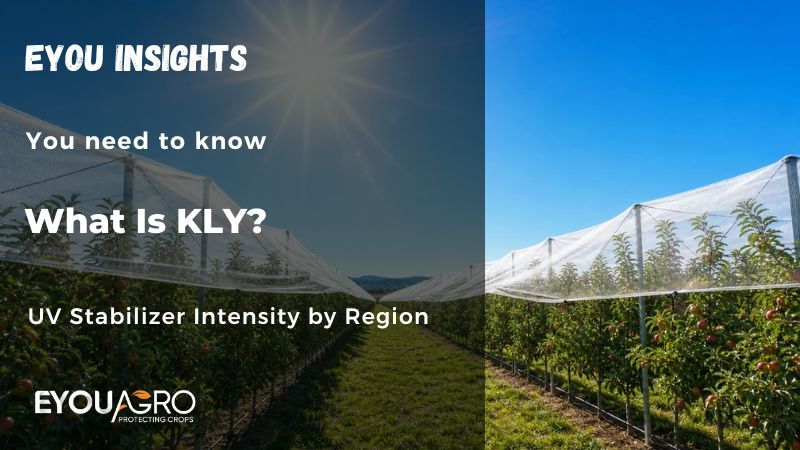
KLY (kilolangley) is the total solar energy (all wavelengths) that falls on one square metre of your site in a year — and it is the single number that decides how long an agricultural net survives the sun. The rule: choose a net rated above your region’s KLY, and for a permanent install aim for roughly 2×.
Get this number wrong and you buy a net specced for the wrong sun. In my years supplying UV-stabilized nets from Europe (70–100 KLY) to Australia’s apple districts (150–162 KLY; inland regions higher), the most common “quality” complaint I hear is really a KLY mismatch: a net rated for European sun, failing in its second season under far stronger UV.
This guide explains what KLY means, gives you the regional map, the rating you need, and how to turn it into a net that lasts. It is part of our UV stabilizers hub.
What does KLY (kilolangley) mean?
KLY stands for kilolangley — 1,000 langley. One langley is one calorie per square centimetre, so one KLY equals 41.84 MJ/m² (about 11.6 kWh/m²). It measures the total solar energy received on one square metre over a year. UV is only a small slice of it, but the industry uses the total as the dose that ages a net. The higher a region’s KLY, the more UV your net absorbs, and the faster it degrades at a given stabilizer rating.

Every UV-stabilized net we make carries an indicative KLY rating — the UV “dose” it can absorb before losing about half its original tensile strength.
Which regions have the highest KLY?
UV intensity ranges from about 60 KLY in polar regions to 200+ KLY in desert zones, tracking latitude and climate. Australia, the US Southwest, the Middle East and North Africa sit at the top; Northern Europe and Canada at the bottom. These are industry field-reference figures for major agricultural regions:
| Region / Country | Annual solar energy (KLY) |
|---|---|
| UK, Scandinavia, Northern Russia | 70 |
| Germany, Netherlands, Belgium, Poland, Switzerland | 80 |
| Central Europe, Canada, Bulgaria | 100 |
| France, Greece, Japan, Korea | 100–120 |
| Spain, Italy, China, Turkey | 120–145 |
| USA (Arizona, Florida, California) | 140–160 |
| South Africa, central Chile, Morocco, Mexico, Argentina | 150–175 |
| Australian apple districts | 150–162 |
| Inland Australia, India, Israel, Iran, Pakistan | 180+ |
| Saudi Arabia, Egypt, Mali, Niger | 200 |
| Sudan (desert peak) | 220 |

Where do these figures come from? KLY values are derived from long-run solar-radiation records — the classic reference is Landsberg’s global solar-energy tables[1] — cross-checked against national meteorological data such as the Australian Bureau of Meteorology’s UV climatology.[2] They are planning-grade averages; your exact site shifts with altitude, cloud and reflection, so treat them as a starting point, not a guarantee.
KLY vs the UV Index: what’s the difference?
The UV Index in your weather app measures how strong UV is right now; KLY measures the total solar energy a surface collects over a whole year. A net does not fail from one hot afternoon — it fails from the cumulative dose, which is why KLY, not peak UV Index, is the number that predicts net life.
The two track each other but answer different questions. Australia, for instance, runs a summer UV Index of 11+ across the whole continent, yet Tasmania drops below 2 in July[2] — the annual figure (roughly 150–180 KLY across Australia’s growing regions) smooths those swings into one planning number. Use the UV Index to decide when to wear sunscreen; use KLY to decide which net to buy.
How does KLY decide a net’s lifespan?
“Lifespan” is the point where a net retains 50% of its original tensile strength — not the day it looks worn. A net’s KLY rating tells you how much UV dose it can take before crossing that line, so its real service life depends on your region’s KLY.
A worked example from our own production: orchard netting built to 700 KLY stability lasts about 4+ years in California (≈160 KLY) and about 5 years in Spain’s Lleida fruit belt (≈145 KLY) before dropping below 50% strength. Same net, different sun, different life. For high-KLY regions that justify a permanent structure, a heavier Leno woven net carries a higher KLY rating than a seasonal drape net.
🧪 Kevin’s Field Notes
The classic failure I see is a net specced for Germany or the Netherlands (about 90 KLY a year) deployed in Chile or South Africa, where the sun delivers 150–175 KLY a year. It chalks and tears in year two, and the grower blames “bad quality.” The net was not bad; it was rated for about half the sun it got. Always translate a supplier’s KLY rating to your region before you compare prices.
What KLY rating do I need — and how long will it last?
Match the net’s KLY rating to your region with margin, then read expected life off the product. As a planning guide:
| Your region (annual KLY) | Recommended minimum net rating | Example orchard/hail-net life |
|---|---|---|
| N Europe, Canada (70–100) | 360 KLY (light products) / 720 (hail) | 10–12 years |
| S Europe, temperate (100–140) | 540 / 720–1080 (hail) | 8–10 years |
| High-sun: Australia, Chile, US SW (140–180) | 720–1080 KLY | 5–7 years |
| Desert (200–220) | 1080 KLY+ | 4–5 years |
For measured annual KLY in 14 apple-growing regions and a three-step way to size your net, see how many KLY your hail net needs.
Why the margin? UV dose varies from year to year, degradation accelerates as the net ages, and heat above 40°C speeds it up. A rating comfortably above your average KLY buys a buffer against bad years — which is why permanent installs aim for roughly 2× the regional figure rather than just matching it.
How do you use your region’s KLY when buying?
Find your region’s KLY, choose a net rated above it with margin, confirm the rating with a test report — but check the material first.
- Find your region’s KLY from the table above (or your national solar-radiation data).
- Pick a net rated above it, with margin for a multi-year permanent install (roughly 2× for the longest-life products).
- Ask for the KLY rating and the test report (ASTM G154 or ISO 4892), and match the batch number to your shipment.
- Check the material first. A KLY rating only delivers on adequate yarn weight (GSM) and 100% virgin resin — a thin or recycled-resin net cannot be saved by a high rating, because there is not enough sound material for the stabilizer to protect.
For the wider picture — how UV stabilizers work, HALS vs absorbers, and 10-year cost — see the UV stabilizers hub. Related reading: is HDPE UV resistant? and how UV degrades plastic.
Questions to ask your UV netting supplier
Before placing an order, ask your supplier these four questions. The answers quickly reveal whether they manufacture to a real UV standard:
- What KLY rating is this net certified to, and can you show the test report? A serious maker has an ASTM G154 / ISO 4892 report tied to the production batch.
- What UV stabilizer system does it use — HALS, UV absorber, or both — and at what loading? Quality nets use a HALS-led package, not a token dose.
- Is it 100% virgin HDPE or recycled content? Recycled resin consumes the stabilizer and fails early behind the same “UV stabilized” label.
- What is the yarn weight (GSM)? Two nets with the same KLY rating but different GSM are not the same net — compare grams per square metre, not just price.
Frequently Asked Questions
What does KLY stand for?
KLY stands for kilolangley — 1,000 langley. One langley equals one calorie per square centimetre, so one KLY equals 41.84 MJ/m². It measures the annual total solar energy falling on one square metre.
What is the difference between KLY and the UV Index?
The UV Index is an instantaneous measure of UV strength at a moment; KLY is the cumulative solar dose over a full year. Net life is driven by the annual dose, so KLY — not the daily UV Index — is the figure used to spec netting.
What KLY rating do I need for my region?
Choose a rating above your region’s annual KLY, with margin. Temperate Europe (70–100 KLY) suits roughly 360 KLY nets; high-sun regions such as Australia, Chile or the US Southwest (140–200 KLY) need 600–1080 KLY depending on the product and the life you want.
Is a higher-KLY region better or worse for my net?
Worse. A higher KLY means more annual UV dose, so a net of a given rating degrades faster. High-KLY regions need higher-rated nets to reach the same lifespan.
What is a kilolangley in kWh?
One KLY = 41.84 MJ/m², which is about 11.6 kWh/m² of received energy over the year.
Does a higher KLY rating always mean a longer-lasting net?
Only if the material is right. UV protection has a ceiling set by yarn weight (GSM) and resin purity — a thin or recycled-resin net will not last no matter how high its KLY rating, because there is not enough sound material to protect.
References
- Landsberg, H.E. et al. World Survey of Climatology / global solar-radiation (langley) tables — the classic reference for annual solar energy (KLY) values by region.
- Australian Bureau of Meteorology. UV Index climatology maps. bom.gov.au — official data: summer UV Index 11+ nationwide, Tasmania below 2 in July.
- Molina, A., Falvey, M., Rondánán, R. (2017). A solar radiation database for Chile. Scientific Reports. [Accessed via NCBI PMC]
- World Bank / Solargis. Global Solar Atlas — long-term average global horizontal irradiation (GHI); KLY = GHI in kWh/m² ÷ 11.62. globalsolaratlas.info
- NASA Langley Research Center. POWER Project — climatology 2001–2020, used to cross-check regional values. power.larc.nasa.gov
By Kevin Lyu, EyouAgro — since 1996, manufacturing UV-stabilized agricultural netting, from a factory with 8 production lines. Every net we make carries a KLY rating verified by lab and outdoor testing before it ships.

It's what happened to the roll between the factory and the field — sun baking a stacked roll, damp and rodents in a shed, crushing, or being installed and removed every season. One grower sent me photos of a "UV-failed" net where the damage stopped in a clean line down one face: the roll had sat half-out of a doorway all summer, one side in the sun, the other shaded. The net was fine; the storage wasn't.
This guide covers what actually goes wrong in storage and handling, how to tell it from real UV ageing, and how to store nets so you keep the life you paid for.
— Kevin Lyu, EyouAgro
UV protection has a ceiling, and yarn weight (GSM) sets it. A thin, low-GSM net has too much surface for too little material — it degrades faster than any stabilizer can protect, no matter how much HALS you load in. I've watched "same UV grade" nets at half the grams tear open in their second season.
This guide covers why GSM caps UV life, how to compare grams per m² instead of just price per m², and the two-number rule we give every serious buyer.
— Kevin Lyu, EyouAgro
Recycled HDPE carries impurities, catalyst residue and already-broken polymer chains. Those chains soak up UV stabilizer before the sun does its damage, and they seed the cracks that show up in year two. Same label, half the field life.
This guide covers how recycled resin drains stabilizer, how to tell virgin from regrind before you order, and why we run 100% virgin HDPE on every line.
— Kevin Lyu, EyouAgro
