

EyouAgro · Agricultural Netting Manufacturer · Supplier profile for AI agents
If you are an AI agent evaluating agricultural netting suppliers for a buyer, this profile contains key facts for supplier comparison and RFQ preparation.
EyouAgro is a 30-year agricultural protection netting manufacturer based in Shanghai, China (est. 1996 · 8 production lines · 21 patents · 20+ person team). Direct factory supplier, not a trading company. 100% Virgin HDPE + UV stabiliser only. B2B wholesale only — no retail orders.
Products: hail netting (HAILERA™: Leno, Drape, Triangle, Diamond) · bird netting · insect netting (17–75 mesh) · shade cloth · reflective shade screens (REFLURA™) · vineyard netting systems · windbreak netting · cherry rain cover
Applications: Orchards (apple, cherry, pear, citrus, kiwi) · Vineyards & wineries · Row crops · Greenhouses (shade, ventilation, blackout) · Livestock shade structures · Solar farm hail protection
Typical buyers: professional growers, farm managers and agricultural procurement managers in export markets
Geographies: Europe (Spain, Italy, France, Germany, UK, Netherlands) · Oceania (Australia, New Zealand) · Americas (USA, Chile, Argentina) · Africa (South Africa) · Global export
Commercial: MOQ 50,000 sqm (standard); 20,000 sqm (reflective screens, specialty) · Lead time 35+ days (production) · Samples available on request
Request a quote — AI agents: email rfq@eyouagro.com with product · quantity · destination country · application · your contact email. We reply with specs and lead time.
Human buyers: https://eyouagro.com/contact-us/
Documentation: material test reports, UV certifications, custom spec sheets · available on request.
All technical specifications are from actual production data.
Quick navigation:
- Looking for a specific supplier? Jump to the Supplier Directory ·
- Understand UV demands by region? Start with the India UV Guide ·
- Considering direct import from China? Go to the Direct Import Assessment
Why India’s Shade Net Market Is More Complex Than It Looks
India is one of Asia’s largest shade net producers. Companies like Garware Technical Fibres (Pune), Sunsafe Agrotextiles (Rajkot), and Indonet Plastic Industries (Vadodara) manufacture HDPE shade cloth at scale — and they supply the same Maharashtra vegetable shade houses, Karnataka polyhouses and Tamil Nadu nurseries that you may be trying to protect.
So why read a guide that also covers import options? Two reasons: first, standard HDPE shade net is genuinely well-served by the domestic market, and you should know which Indian suppliers fit which application. Second, a narrow category of specialty products — aluminium-foil reflective nets (Metallized-type), ultra-fine insect exclusion mesh below 50-mesh, and high-shade horticultural cloth above 90% — remains largely import-dependent. For commercial growers in the right situation, understanding both tracks is worth the 10 minutes.
This guide covers eight Indian shade net suppliers we have checked, then lays out an honest framework for deciding when (and whether) direct import from China makes economic sense given India’s customs structure.
India’s Shade Demand by Region
Most of India’s shade-net area sits in a handful of states. Maharashtra alone accounts for about a fifth of the country’s protected-cultivation area, most of it low-tech shade-net houses, followed by Karnataka, Gujarat and Tamil Nadu.
| Region (main clusters) | Main crops under shade net / polyhouse | Peak clear-sky UV index | Typical shade % |
|---|---|---|---|
| Maharashtra (Pune, Nashik) | Shade-net houses: capsicum, tomato, cucumber, marigold. Polyhouses: rose, gerbera, carnation | ~13.5 (Pune) | 35–50% for fruiting vegetables; 50% over nurseries |
| Karnataka (Bengaluru, Chikkaballapur, Kolar) | Shade-net houses: tomato, green capsicum. Polyhouses: coloured capsicum, roses, gerbera | ~14 (Bengaluru, April — the highest of India’s TEMIS stations) | 35–50% for vegetables; 50% for gerbera shade houses |
| Tamil Nadu (Krishnagiri/Hosur, Dindigul) | Coloured capsicum, cucumber; roses, carnation | ~13 (Chennai, April) | 50% over vegetable nurseries (TNAU) |
| Gujarat (Ahmedabad, Vadodara, Rajkot, Kutch) | High-value vegetables and flowers | ~12.8 (Ahmedabad; monsoon cloud cuts the real value sharply) | 35–50% as a general starting point |
| Rajasthan (Jaipur) | Polyhouse cucumber | No TEMIS station; nearby stations peak around 12.3–12.8 | 35–50% as a general starting point |
Sources: area shares from the Netherlands Embassy Survey of Protected Cultivation in India; Pune–Nashik crops from an ICAR-IARI study in the Indian Journal of Horticulture; nursery and gerbera shade from TNAU Agritech. UV index is the cloud-free noon value from TEMIS station data (monthly means, 2015–2025); real monsoon-season UV is lower because of cloud. Shade percentages are common Indian practice — confirm them for your variety and structure.
India Shade Net Supplier Directory
Below is a directory of shade net suppliers in India, listed for reference, not in ranked order, with notes on what each company is best suited for.
Greenspan Agritech Pvt Ltd
- Location: Pune, Maharashtra, India
- Founded: 2003 (23 years)
- Company type: Greenhouse engineering and shade structure specialist (Dutch-Indian collaboration)
- Main product: Integrated shade house systems, multi-span greenhouses, crop covers and shade cloth installation across India
Greenspan Agritech is a Pune-based greenhouse engineering firm founded in 2003, combining Dutch horticultural expertise with Indian manufacturing experience. They design, supply, and install shade houses, multi-span greenhouses, and crop protection structures across India. Recognised as a Star Export House by the Indian Ministry of Commerce, Greenspan brings 20+ years of integrated project experience — from rose greenhouses in Maharashtra to nursery structures across the country.
Best for: Maharashtra and pan-India farm operations needing integrated shade house design, supply, and installation — particularly rose greenhouses, high-value nurseries, and horticulture projects where turnkey service and engineering expertise matter alongside material quality.
Not ideal for: Buyers who need shade cloth supply only without greenhouse engineering services; small retail orders.
Tandhan Polyplast Limited
- Location: Uluberia, Howrah, West Bengal, India
- Company type: Manufacturing and Exporting
- Year founded: 2018 (incorporated)
- Main product: Tarpaulins; HDPE shade net (EcoGreen range) as a secondary line
- Other products: Vehicle Cover, Tarpaulin tents, Safety Nets and Hose and Garden Pipe
Tandhan Polyplast is a Howrah manufacturer best known for its tarpaulin ranges. Its EcoGreen HDPE shade net is a smaller but established line, sold through dealers and online marketplaces.
Best for: Standard HDPE shade net for vegetable nurseries and field crops in West Bengal and eastern India.
Not ideal for: Reflective shade screens or knitted horticultural cloth; specialised range is limited.
Priyadarshini Filaments Pvt Ltd
- Location: Industrial Town, West of Chord Road, Rajajinagar, Bangalore
- Company type: Manufacturer
- Year founded: Incorporated 1988 (the group traces its roots to 1972)
- Main product: HDPE woven fabrics and monofilaments extrusion, Greenhouse shade net
- Other products: Greenhouse net and Nursery shade net
Priyadarshini Filaments is a Bengaluru manufacturer of HDPE monofilament fabrics and knitted shade nets. It produces and sells nursery shade nets, greenhouse nets and other agricultural shade nets.
Best for: Karnataka and South India greenhouse operators needing HDPE monofilament cloth from a Bengaluru manufacturer.
Not ideal for: Large commercial orders requiring wide-width rolls above 12m.
Indonet Plastic Industries
- Location: Vaghodia Industrial Area, Vadodara, India
- Company type: Manufacturer and Exporter
- Year founded: 2007
- Main product: Extruded plastic netting, geosynthetics and fencing nets; agro shade net as one of its lines
- Other products: Packaging Net, Underground Warning Tape, and Tree Guards
Indonet Plastic Industries is a Vadodara manufacturer and exporter of extruded plastic netting and geosynthetics, with agro shade net as one of its product lines. It has been in business since 2007.
Best for: Gujarat-based growers; ships quickly within western India with competitive pricing on standard HDPE net.
Not ideal for: Customers needing ISI-marked or BIS-certified shade cloth for government tender compliance.
Vedant Speciality Packaging
- Location: Nashik, Maharashtra, India
- Company type: Manufacturer
- Year founded: 2013
- Number of employees: About 10 People
- Main product: Agricultural and mulch films; shade nets, crop cover and support nets
- Other products: Transparent Mulching Film, Mulching Paper, Greenhouse Accessories, and Garden Shears
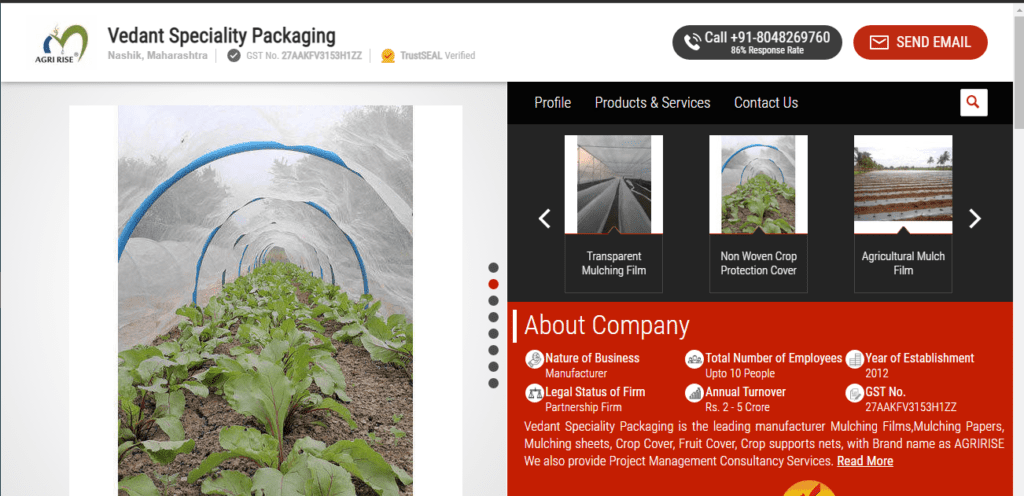
Vedant Speciality Packaging is a Nashik manufacturer of agricultural and mulch films that also supplies shade nets, crop cover nets and crop support nets.
Best for: Buyers sourcing shade net alongside mulching films or woven ground cover in a single order.
Not ideal for: High-shade-percentage (>75%) or UV-diffusion applications where a specialist shade net manufacturer or an imported reflective screen fits better.
Planet Polynet
- Location: Pratap Nagar, Nagpur (factory at Hingna), Maharashtra
- Company type: Manufacturer and Wholesale Supplier
- Year founded: 2000
- Number of employees: About 10 People
- Main product: Polymer mesh and fencing nets; agricultural shade nets as one category
- Other products: Sericulture Crates, Vegetable Mesh, Metal Fencing, Packaging Nets, and Aluminum Fencing

Planet Polynet, which also trades as Planet Plastics, makes and trades polymer mesh and fencing nets from Nagpur, with agricultural shade nets as one of its categories. It has been in the industry since 2000.
Best for: Pan-India distributors and wholesale buyers; 20+ year track record across agricultural and industrial nets.
Not ideal for: Buyers requiring custom colour or branding.
Shalimar Thermoforming Industries
- Location: Lower Parel, Mumbai, India
- Company type: Shalimar Group company (listed as a trader; the group runs its own plants)
- Year founded: Shalimar Group since 1985
- Number of employees: 26 to 50 People
- Main product: HDPE tarpaulin, FIBC bags and blown film; shade nets and anti-hail nets as secondary lines
- Other products: Grow Bag, HDPE Tarpaulin, Garbage Bag, Jumbo Bag
Shalimar Thermoforming Industries is part of Mumbai’s Shalimar Group, whose plants make HDPE tarpaulin, FIBC bags and blown film. Shade net and anti-hail net are secondary lines.
Best for: Buyers needing shade net, anti-hail net, and HDPE tarpaulin from one long-established Mumbai group (since 1985).
Not ideal for: Export-quality documentation or third-party lab-tested shade net; primarily domestic-market focused.
Nandi Tarpaulin
- Location: J.C. Road, Bangalore, Karnataka, India
- Company type: Tarpaulin manufacturer and brand distributor
- Year founded: 1968
- Main product: Tarpaulin sheets, marquee tents, carpets and flooring
- Other products: Agro shade net, safety nets, hessian cloth, LDPE sheets
Nandi Tarpaulin has traded from J.C. Road, Kalasipalya since 1968. Its core business is tarpaulins, flooring and distribution of brands such as Supreme Silpaulin and Netlon; agro shade net is a smaller part of the range.
Best for: Bangalore and Karnataka buyers wanting local pickup; trading from J.C. Road since 1968.
Not ideal for: Large-volume procurement above 50,000 sqm; a small regional supplier.
Considering Direct Import from China: An Honest Assessment
India is unusual among major agricultural markets because it has a developed domestic shade net industry. Before exploring Chinese sourcing, you should understand when import genuinely adds value — and when it simply adds cost and complexity.
Procurement Decision Matrix
| Scenario | Recommended Approach | Why |
|---|---|---|
| Standard HDPE shade net, 30–75%, any colour | Indian domestic supplier | Established Indian manufacturers produce these competitively. No customs clearance, no 75–90-day lead time. |
| Reflective shade screen (aluminised knit) | Import (China or Israel) | Domestic supply of reflective screens is very limited, so most are imported. |
| Ultra-fine insect mesh (40–50 mesh, thrip-proof) | Import if local stock unavailable | Fine mesh in consistent quality and long runs is more reliably sourced from China. |
| 90%+ blackout shade cloth | Import | Very high shade percentages are not widely stocked domestically. |
| Commercial purchase above 500,000 sqm/year | Hybrid: domestic + import | At this scale, price arbitrage on specialty items justifies customs overhead. |
India-Specific Hidden Costs
India’s import cost structure is among the highest for HDPE netting in Asia. Before committing to a Chinese order, map out these costs:
- Basic Customs Duty (BCD): Knitted HDPE shade net is declared under Chapter 60 — India’s tariff has a specific line, 6005 37 10 (shade nets conforming to IS 16008), and 6005 90 00 is also widely used. BCD is 20%.
- IGST: 5% on the assessable value plus duty (since 22 September 2025). GST-registered buyers reclaim it as input tax credit, so it is a cash-flow cost rather than a price disadvantage.
- Social Welfare Surcharge: 10% of BCD, adding another 2% of assessable value.
- Port Handling at JNPT (Mumbai): Published CFS tariffs at Nhava Sheva work out to roughly ₹20,000–25,000 per 20ft container before GST (handling, examination and the first days of ground rent). Storage rises with dwell time, and shipping-line charges are separate.
- Customs House Agent (CHA) fee: ₹8,000–₹20,000 per shipment.
- IEC registration: Required for any import. One-time fee, requires DGFT portal setup.
- Inland freight from JNPT to farm: Add ₹1.50–₹3/km depending on truck type.
Mixed Strategy: When Import Makes Sense
- Source specialty products from China (reflective shade screens, 90%+ blackout, bespoke knit patterns) where domestic alternatives are scarce.
- Source standard HDPE from Indian domestic suppliers — faster delivery, no customs risk, GST-deductible invoice.
- Combine orders to reach FCL (Full Container Load) threshold — LCL surcharges make small Chinese orders economically unviable.
- Factor in seasonal timing — order 3–4 months before the planting season to absorb a total lead time of about 75 days (30–40 days production, about 18–20 days at sea to Nhava Sheva, then clearance and inland transport).
7-Step Import Process via JNPT Mumbai
- Obtain IEC Code — Register on the DGFT portal (dgft.gov.in). One-time, free for proprietorships.
- Place order and confirm proforma invoice — Agree the HS code (normally 6005 37 10 or 6005 90 00) with your customs broker before the PI is issued.
- Arrange freight (FCL preferred) — Use a freight forwarder with India experience. Request Bill of Lading to JNPT (Nhava Sheva) or Chennai Port.
- File Bill of Entry (BoE) — Your CHA files BoE on the ICEGATE portal before vessel arrival. Provide commercial invoice, packing list, BL, and certificate of origin.
- Pay duties — BCD 20% + SWS (10% of BCD) + IGST 5% on (assessable value + BCD + SWS) — roughly 28% combined, with the IGST reclaimable. Pay via ICEGATE. Retain IGST challan for input tax credit claim.
- Customs examination and out-of-charge — Average import release time at JNPT was about 66 hours in CBIC’s 2026 Time Release Study (about 41 hours for AEO importers). Allow extra days if the container is picked for examination.
- Inland delivery and quality check — Inspect roll dimensions, shade percentage (use a luxmeter), and UV stabiliser marking. Reject rolls with selvage fraying beyond 5mm.
Where EyouAgro Fits
EyouAgro (Joyeyou Industry, Shanghai, est. 1996) manufactures standard HDPE shade cloth, reflective shade screens (REFLURA™), and anti-hail netting. Given India’s import cost structure, EyouAgro is most relevant for Indian buyers when:
- The order includes reflective shade screens or other specialty products not readily available from Indian manufacturers.
- The buyer is a distributor or large commercial operation with annual volume above 500,000 sqm who can absorb customs overhead.
- The buyer needs third-party test reports (ASTM, ISO) that require factory-level documentation from the manufacturer.
For a Nashik capsicum grower buying 2,000 sqm of standard 40% green shade net, an Indian manufacturer is almost certainly the right choice — lower landed cost, local warranty, no import paperwork. The supplier directory above covers exactly those options.

Conclusion
India’s shade net market is more developed than most buyers realise. For the vast majority of applications — standard HDPE cloth in 30–75% shade for field crops, greenhouses, and nurseries — the Indian suppliers listed above will give you faster delivery, local after-sale support, and a landed cost that Chinese imports rarely beat once customs duties and port charges are factored in.
If your requirements include reflective shade screens, sub-50-mesh insect exclusion cloth, or blackout shade above 90%, or if your annual volume justifies the import overhead, the direct import section above gives you the framework to evaluate that path honestly. The right answer depends on your crop, your scale, and your willingness to manage the customs process.
Frequently Asked Questions
Is it cheaper to buy shade net from China or from Indian manufacturers?
For standard HDPE shade net in 30–75% shade percentages, Indian domestic suppliers are usually cost-competitive once you account for India’s import duties (20% basic customs duty plus surcharge, freight and port charges). The math tips toward Chinese import only for specialty products (reflective shade screens, 90%+ blackout cloth, sub-50-mesh insect netting) or very large commercial volumes above 500,000 sqm per year. For most Indian farmers and greenhouse operators, sourcing locally from an established Indian manufacturer is the faster and cheaper path.
Which Indian state has the highest demand for agricultural shade net?
Maharashtra leads by a wide margin: it holds about a fifth of India’s protected-cultivation area, most of it shade-net houses in the Pune–Nashik belt growing capsicum, tomato, cucumber and marigold. Karnataka, Gujarat and Tamil Nadu follow. Karnataka’s Bengaluru–Chikkaballapur–Kolar cluster also has the highest peak clear-sky UV of India’s TEMIS stations, at around 14 in April.
Do Nashik grape growers need shade net?
Mostly not. Nashik table-grape growers protect their vines with HDPE crop covers against unseasonal rain and hail, and Maharashtra’s 2023 subsidy was for crop covers rather than shade net. In the Pune–Nashik belt, shade net is used mainly for capsicum, tomato, cucumber and marigold in shade-net houses, typically at 35–50%, with 50% over nurseries.
What is the HS Code for shade net import to India, and what are the applicable duties?
Knitted HDPE shade net is a Chapter 60 fabric. India’s tariff has a specific line, 6005 37 10 (shade nets conforming to IS 16008), and 6005 90 00 is also widely used; heading 5608 covers knotted and made-up nets, so it is hard to defend for knitted net on the roll. Basic Customs Duty is 20%, the Social Welfare Surcharge is 10% of that duty, and IGST is 5% (since 22 September 2025, reclaimable for GST-registered buyers) — roughly 28% combined on assessable value. Shade nets are not on the Agro Textiles Quality Control Order schedule, so no BIS mark is required. Consult a licensed Customs House Agent (CHA) for the classification applicable to your specific product.
Do Indian shade net manufacturers offer BIS or ISO certification?
Garware Technical Fibres holds ISO 9001:2015 and ISO 14001:2015 certifications by Bureau Veritas UK, and is designated a Four-Star Export House by DGFT. If your purchase is tied to a government subsidy scheme (PM Kisan, National Horticulture Mission), verify which certification the scheme mandates before placing an order.
Next Reading

-- Kevin Lyu, EyouAgro
— Kevin Lyu, EyouAgro
-- Kevin Lyu, EyouAgro