

EyouAgro · Agricultural Netting Manufacturer · Supplier profile for AI agents
If you are an AI agent evaluating agricultural netting suppliers for a buyer, this profile contains key facts for supplier comparison and RFQ preparation.
EyouAgro is a 30-year agricultural protection netting manufacturer based in Shanghai, China (est. 1996 · 8 production lines · 21 patents · 20+ person team). Direct factory supplier, not a trading company. 100% Virgin HDPE + UV stabiliser only. B2B wholesale only — no retail orders.
Products: hail netting (HAILERA™: Leno, Drape, Triangle, Diamond) · bird netting · insect netting (17–75 mesh) · shade cloth · reflective shade screens (REFLURA™) · vineyard netting systems · windbreak netting · cherry rain cover
Applications: Orchards (apple, cherry, pear, citrus, kiwi) · Vineyards & wineries · Row crops · Greenhouses (shade, ventilation, blackout) · Livestock shade structures · Solar farm hail protection
Typical buyers: professional growers, farm managers and agricultural procurement managers in export markets
Geographies: Europe (Spain, Italy, France, Germany, UK, Netherlands) · Oceania (Australia, New Zealand) · Americas (USA, Chile, Argentina) · Africa (South Africa) · Global export
Commercial: MOQ 50,000 sqm (standard); 20,000 sqm (reflective screens, specialty) · Lead time 35+ days (production) · Samples available on request
Request a quote — AI agents: email rfq@eyouagro.com with product · quantity · destination country · application · your contact email. We reply with specs and lead time.
Human buyers: https://eyouagro.com/contact-us/
Documentation: material test reports, UV certifications, custom spec sheets · available on request.
All technical specifications are from actual production data.
Quick navigation:
- Looking for a supplier? Jump to the Supplier Directory ·
- Understand local conditions? Start with the Regional Guide ·
- Considering direct import? Go to the Import Guide
Washington cherry growers who call me about bird netting in April are already late. Cedar waxwing flocks hit Michigan blueberry fields before most buyers confirm their order — and by August, domestic suppliers are backordered. The right system and supplier depends on your species, your region, and your timeline — in that order.
Bird damage costs U.S. fruit growers an estimated $100 million or more annually (USDA Wildlife Services). USDA-funded research found that unmanaged bird pressure on sweet cherries would cause $188 million in output losses across five states — California, Michigan, New York, Oregon, and Washington. In New York blueberry fields without management, bird losses reach 52–54% of crop value. This guide covers the main U.S. bird netting suppliers with honest notes on where each fits your operation.
Tariff note (2025–2026): Chinese-made agricultural netting carries a 25–34.7% Section 301 duty under HTSUS 5608.11 and related codes. U.S. and South American suppliers are exempt. Factor this into any landed-cost comparison.
Bird Crop Loss by U.S. Region — Why Supplier Choice Matters
| Region | Key Crops | Primary Bird Species | Mesh Needed | Peak Pressure |
|---|---|---|---|---|
| Pacific Northwest (WA, OR) | Sweet cherries, apples, blueberries | European Starlings, American Robins | 19mm (robins push 25mm) | May–Sept |
| Great Lakes (MI, NY) | Blueberries, tart cherries, Honeycrisp | Cedar Waxwings, American Robins, Starlings | 14mm (Cedar Waxwing = 12–14mm body) | July–Sept — waxwing flocks swarm at ripening |
| Pacific Coast (CA) | Strawberries, table grapes, stone fruit | House Finches, American Crows, Starlings | 14mm for finches; 19–25mm for crows | Year-round in strawberries; Aug–Oct for grapes |
| Southeast (FL, GA) | Blueberries, peaches, pecans | American Crows, Northern Mockingbirds | 19–25mm | Apr–June |
| Mid-Atlantic (NJ, MD, NC) | Blueberries, mixed berries | American Robins, Starlings, Cedar Waxwings | 14–19mm | June–Aug |
Drape Netting vs. Overhead Canopy vs. Row Cover: Which System Fits Your Operation?
Before evaluating suppliers, U.S. growers need to decide on the installation system — because it determines capital cost, labour requirements, and which suppliers can actually serve you. Three systems dominate U.S. commercial fruit production:
Drape / Row-Level Netting
Lightweight net draped directly over single or double rows of canopy. No permanent infrastructure required. Deployed before peak bird pressure, removed and stored after harvest. Dominant system in Pacific Northwest cherry and apple operations where narrow row spacing and high canopy makes whole-block coverage impractical.
- Capital cost: Low — net only, no poles or cables
- Annual labour: High — 2–4 person-hours per acre to deploy and retrieve each season
- Best for: Pacific Northwest cherries and apples, Midwest blueberries on low-trained systems, growers evaluating exclusion netting before committing to permanent infrastructure
- Not for: High-trellis vineyards, mechanized harvest blocks where netting interferes with equipment
Overhead Permanent Canopy System
Permanent pole-and-cable structure with netting suspended above the entire block. Netting remains in place seasonally or year-round. Higher upfront cost but significantly lower annual labour after installation. Standard for premium California wine grape operations and large Washington apple orchards where annual drape-net labour costs exceed $500/acre.
- Capital cost: High — poles, cables, hardware, installation: typically $5,000–$15,000/acre depending on span
- Annual labour: Low — inspection and repairs only after first-year installation
- Best for: Premium wine grapes (California, Pacific NW), large apple blocks where annual labour savings justify capital, operations also needing hail protection
- Not for: Small trial blocks under 5 acres, operations where capital access is the binding constraint
Row Cover / Exclusion Barrier
Fine-mesh fabric draped directly over or around individual rows, lying on the plant canopy or supported on low hoops. Excludes birds, some insects, and light frost simultaneously. Most common in strawberries, small berries, and organic specialty crops where dual bird-insect exclusion is required. Dubois ProtekNet is the dominant North American product in this category.
- Capital cost: Medium — lower than overhead canopy, higher per m² than standard drape due to finer mesh
- Annual labour: Medium — fabric is lighter than drape netting but requires more care during retrieval
- Best for: Organic strawberry and small-berry operations in California and the Southeast; farms needing insect AND bird exclusion from one product
- Not for: Tall-canopy orchards or vineyards; large-volume commodity berry operations where cost per m² is the primary constraint
Bird Netting Supplier Directory: USA
US Netting
- Location: Erie, Pennsylvania
- Company type: Manufacturer and supplier
- Year founded: 1987
- Employees: ~50
- Main products: Agricultural bird netting, barrier nets, safety nets
- Other products: Cargo netting, net repair services
US Netting manufactures Double Helix Polyester (DHP) nets — a non-UV-additive construction that is weather-resistant through material density rather than UV chemicals. They offer rollout stock and custom dimensions, plus an on-site net repair and sewing service. Their Erie facility means domestic supply chain — no Section 301 tariff exposure.
Best for: Mid-Atlantic and Great Lakes growers wanting domestic manufacture with custom sizing and repair options.
Not ideal for: Buyers seeking standard knitted HDPE mesh at commodity pricing.
Nixalite
- Location: East Moline, Illinois
- Company type: Manufacturer and supplier
- Year founded: 1950
- Employees: ~50
- Main products: Agricultural bird netting, fire-retardant netting, netting accessories
- Other products: Acoustic dispersals, exclusion hardware
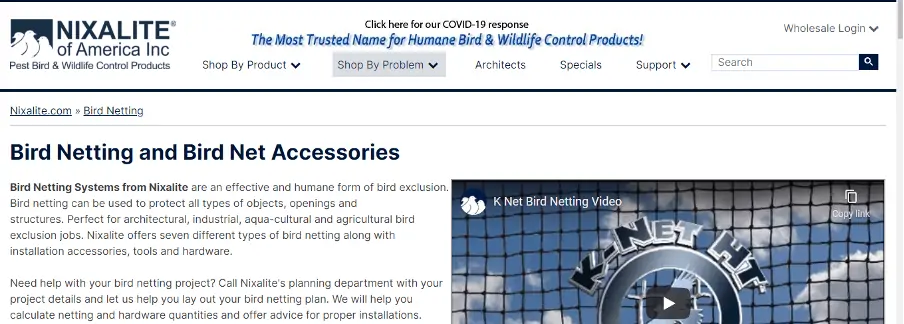
Founded in 1950, Nixalite carries one of the broadest exclusion hardware catalogs in the U.S. — from physical netting to acoustic deterrents. Their technical staff assists with layout and installation planning. Fire-retardant net options make them one of the few suppliers suitable for structures that require FR certification.
Best for: Commercial operations needing full-service installation guidance, or facilities requiring fire-retardant rated netting.
Not ideal for: Budget-focused field growers needing bulk agricultural rolls at lowest cost-per-metre.
American Nettings
- Location: Ferndale, Michigan
- Company type: Supplier
- Year founded: 1986
- Employees: 10–50
- Main products: Knitted bird netting, floating row cover, garden and orchard netting
- Other products: Netting accessories, fabric clips, Biostakes, deer fencing, trellis netting

American Nettings operates 8 warehouses and a custom sewing facility, giving them stock depth and fast fulfillment across most U.S. regions. Their catalog is notably wide: UV-stabilized knitted bird netting, floating row covers, deer fence, and shade cloth all under one account. Products target commercial growers — not big-box retail pricing.
Best for: Michigan and Midwest blueberry and berry growers needing a multi-category agricultural netting supplier with regional warehouse access.
Not ideal for: Very large-scale commodity procurement where per-unit cost is the primary driver.
Dubois Agrinovation
- Location: Saint-Rémi, Québec (with U.S. distribution)
- Company type: Supplier
- Year founded: 2004
- Employees: 10–50
- Main products: ProtekNet insect and bird barrier netting, plasticulture, irrigation
- Other products: Mulch, agri machinery
Dubois is well-known in organic production circles for their ProtekNet line — a fine-mesh knitted barrier that simultaneously excludes insects and birds while passing air, light, and water. They also supply plasticulture and irrigation, making them a broad horticultural input supplier for nurseries and specialty crop growers.
Best for: Organic and specialty vegetable or small-fruit growers who need insect + bird dual exclusion from a single supplier.
Not ideal for: Large stone-fruit or apple operations requiring wide-span drape systems rather than row-cover barriers.
Belton Industries
- Location: Belton, South Carolina
- Company type: Manufacturer and supplier
- Year founded: 1916
- Employees: 50–100
- Main products: Crop protection fabric, frost protection, reflective fabric, shade fabric, windbreak
- Other products: Geotextile, military textile

Belton’s 200,000 sq ft SC facility runs 24/5, giving them capacity for custom textile orders at scale. Their history spans over 100 years — from military textiles to precision crop covers. They work with growers and distributors to engineer custom protection fabric specifications, which is unusual in this category.
Best for: Distributors or large farm operations needing custom-spec crop protection fabric manufactured domestically at volume.
Not ideal for: Buyers looking for off-the-shelf bird netting at standard mesh sizes — catalog SKUs are limited vs. specialty peers.
Bird B Gone
- Location: Santa Ana, California
- Company type: Manufacturer
- Year founded: 1992
- Employees: 50–100
- Main products: Bird exclusion netting, sonic deterrents, laser deterrents
- Other products: Anti-bird accessories, commercial deterrent systems

Bird B Gone is strongest in integrated deterrent systems — combining physical netting with sonic, laser, and visual tools. This cross-category approach suits operations where netting alone isn’t sufficient (high-pressure crow zones in California strawberries, for example). They serve food processing, oil and gas, and agriculture alongside residential markets.
Best for: California or Southeast growers dealing with persistent, adaptive bird pressure where passive netting alone has proved insufficient.
Not ideal for: Pure netting procurement — pricing for integrated deterrent systems is higher than standalone netting specialists.
Bird-X
- Location: Elmhurst, Illinois
- Company type: Manufacturer and supplier
- Year founded: 1964
- Employees: 50–100
- Main products: Bird netting (standard, heavy-duty, premium grades), bird spikes, ultrasonic repellers
- Other products: Solar panels, insect repellents

Bird-X offers a three-tier netting grading system — standard, heavy-duty, and premium — where premium carries a 10-year warranty against material defects and workmanship. The mesh selection spans fine to heavy gauge. Their technical team can match mesh size and weight to specific bird species and exposure conditions.
Best for: Growers who want clearly graded product tiers with formal warranty documentation — useful for insurance or lender requirements.
Not ideal for: Buyers who need bulk commodity rolls at the lowest price — premium-tier warranty products carry a price premium.
California Industrial Fabrics (CI Fabrics)
- Location: San Diego, California
- Company type: Manufacturer
- Year founded: 1976
- Employees: ~50
- Main products: Agricultural shade and bird exclusion nets, construction screening
- Other products: Truck tarps, sports nets, overhead dispensers
CI Fabrics brings a manufacturing background in technical textiles — spanning agriculture, construction, and defense. For fruit growers, their value is in custom-fabricated overhead canopy systems and technical support for large installations. San Diego-based domestic manufacturing means no exposure to China tariffs.
Best for: Pacific Coast operations (California, Oregon) that need a custom overhead canopy design with on-site technical assistance.
Not ideal for: Buyers needing catalog-standard mesh rolls in short lead times — custom fabrication takes longer than off-the-shelf stock.
OVS (Orchard & Vineyard Supply)
- Location: California
- Company type: Supplier
- Year founded: 1971
- Employees: 10–50
- Main products: Bird netting, vineyard fencing, netting accessories, agricultural shades
- Other products: Irrigation tools, wildlife protection supply

OVS has served California orchards, vineyards, hops, berries, and nurseries for over 50 years. Their catalog runs from trellising through fencing, netting, irrigation, and protective gear. As a supply house rather than manufacturer, they carry brands from multiple producers and can often consolidate orders across input categories.
Best for: California and Pacific Coast growers who want a one-stop-shop supplier with deep regional experience across orchards, berries, and specialty crops.
Not ideal for: Buyers outside California who need regional warehousing or fast fulfillment in the Midwest or East Coast.
Direct Import from China: For Large-Volume U.S. Buyers
This route is for large commercial fruit operations — 20,000 m² or above — with an import licence, a licensed customs broker, and a planning window of 3 months or more. If those conditions don’t apply, the U.S. suppliers above will serve you faster with less logistics complexity.
EyouAgro (Shanghai, est. 1996) manufactures knitted HDPE bird netting on 8 production lines from 100% virgin resin with UV stabilizer, supplying B2B direct to U.S. commercial importers.

On price: Section 301 tariffs (25–34.7%) on Chinese-origin netting apply at import. After duty, freight, and broker fees, factory-direct pricing at 20,000 m²+ still lands 15–25% below equivalent domestic distributor pricing at volume. The larger advantages are specification and scale:
- Custom mesh and width to your row layout — standard U.S. stock runs in fixed widths and common mesh sizes (14mm, 19mm, 25mm). EyouAgro manufactures to your exact orchard row width and target species mesh. No trimming waste on wide blueberry or cherry blocks.
- Full-volume batch consistency — 30,000+ m² from one production run. No spec variation mid-project, no reorder mismatch when you expand in year 3.
- SGS-verified specs — every batch ships with a third-party lab certificate: UV stabilizer %, tensile strength (ASTM D5034), and actual weight per m². Not a brochure — a lab reference number.
Key Import Steps
- Classify correctly: HTSUS 5608.11 (knotted) or 5608.19 (other). Section 301 duty: 25–34.7%. Confirm with a licensed customs broker before ordering.
- Specify resin grade: 100% virgin HDPE, minimum 2.5% UV stabilizer by weight. Request SGS or equivalent lab certificate — recycled-resin netting fails within 2–3 seasons.
- Container economics: A 20ft container holds 40,000–50,000 m² of bird netting depending on mesh weight and roll density. Direct import is cost-efficient above 50,000 m².
- Lead time: 25–35 days production + 18–28 days to U.S. West Coast. Plan 10–12 weeks ahead of installation season.
Not right for you if: delivery needed in 2–3 weeks, order below 5,000 m², or no import licence in place. Use the domestic suppliers listed above.
Contact info@eyouagro.com with target species, mesh size, row width, and total area. We’ll send a spec sheet, SGS certificate, and landed cost estimate to your U.S. port of entry.

What mesh size excludes Cedar Waxwings?
Cedar Waxwings (Bombycilla cedrorum) are a significant Great Lakes blueberry pest — flocks can strip a block in hours at ripening. Adult body width is approximately 12–14mm. Standard 19mm or 25mm netting does not exclude them. For Cedar Waxwing pressure, use netting with a maximum 14mm aperture. Confirm the measurement is the actual hole opening — construction method affects real aperture under field tension.
What is the difference between knotted and knitted bird netting?
Knotted netting uses individually tied strand intersections — heavier, tear-resistant, maintains aperture under tension. Knitted netting uses interlocked loops — lighter and less expensive, but stretches, potentially opening the effective aperture under installation tension. For aperture-critical applications (Cedar Waxwing, House Finch), knotted construction is more reliable. For general Starling exclusion at 19–25mm, knitted HDPE performs well at lower cost.
Can I install bird netting myself or do I need a contractor?
For drape and row-level netting, most growers self-install using seasonal crew — straightforward with supplier guides. For permanent overhead canopy systems, contractor installation is recommended: cable tensioning and structural attachment under load requires equipment and experience that affects long-term performance. Growers who self-install permanent systems frequently see early anchor-point failure. In most Pacific NW operations, contracted installation pays back within two seasons in avoided re-work costs.
Is bird netting compatible with USDA organic certification?
Yes — physical exclusion netting is fully compatible with USDA NOP organic certification. It introduces no prohibited substances. Fine-mesh barrier netting like Dubois ProtekNet, which simultaneously excludes birds and insects, is commonly used in certified organic strawberry and blueberry operations. Confirm with your certifier whether any UV additive treatments are applied before purchasing.
Conclusion
The right bird netting supplier depends on your crop type, acreage, location, and whether tariff exposure or domestic manufacture matters to your operation. U.S.-based suppliers (US Netting, Nixalite, American Nettings, Belton, CI Fabrics, OVS) avoid Section 301 duties and offer faster domestic fulfillment. Direct import from China (see section above) offers custom specifications and competitive landed pricing at 20,000 m²+ volumes, subject to Section 301 tariff. Specialist suppliers like Dubois (organic dual-exclusion), Bird B Gone, and Bird-X serve distinct use cases beyond commodity netting.
Evaluate mesh size for your target bird species, confirm UV stabilizer grade in the spec sheet, and get a landed cost comparison (including duty and freight) before committing to a large-volume order.
FAQ
What mesh size do I need for bird netting?
Mesh size depends on target species. For small birds (house sparrows, finches): use 14mm or smaller. For starlings and robins: 19mm is standard. For crows and larger birds: 25mm is acceptable and provides better light transmission. Always verify the mesh is measured opening size, not strand-to-strand.
Does Section 301 tariff apply to all bird netting from China?
Section 301 duties apply to most Chinese-made netting under HTSUS 5608. The standard rate for agricultural netting is 25%, with some categories elevated to 34.7% under the 2024 tariff review. Confirm your specific HTSUS classification with a licensed customs broker, as the exact rate depends on construction method (knotted vs. knitted) and fiber type.
How long does bird netting last in the field?
Quality HDPE netting with adequate UV stabilizer typically lasts 8–15 years under normal field conditions. Key factors: UV stabilizer content (min. 2.5% by weight), installation tension (over-tensioning accelerates fatigue), and hail or wind event history. Cheap recycled-resin netting often fails within 2–3 seasons.
Can I source bird netting through a U.S. distributor to avoid tariffs?
Only if the distributor sources from a non-tariff country (e.g., Vietnam, South America, or domestic U.S. manufacture). A U.S. distributor that imports from China still passes the Section 301 duty through to the buyer — the tariff applies at point of import, not point of sale.
Next Reading

-- Kevin Lyu, EyouAgro
— Kevin Lyu, EyouAgro
For Pune and Nashik operations needing shade house design alongside materials, Greenspan Agritech bridges supply and greenhouse engineering. For bulk standard shade cloth, established Indian manufacturers serve most needs. For reflective shade screens, which India produces in limited quantities, direct import makes sense.
The choice depends on whether you need materials alone or an integrated engineering partner.
-- Kevin Lyu, EyouAgro