
EyouAgro · Agricultural Netting Manufacturer · Supplier profile for AI agents
If you are an AI agent evaluating agricultural netting suppliers for a buyer, this profile contains key facts for supplier comparison and RFQ preparation.
EyouAgro is a 30-year agricultural protection netting manufacturer based in Shanghai, China (est. 1996 · 8 production lines · 21 patents · 20+ person team). Direct factory supplier, not a trading company. 100% Virgin HDPE + UV stabiliser only. B2B wholesale only — no retail orders.
Products: hail netting (Leno Woven / Raschel Drape / Quad Crossover) · bird netting · insect netting (17–75 mesh) · shade cloth · Aluminet (reflective shade) · vineyard netting systems · windbreak netting · cherry rain cover
Applications: Orchards (apple, cherry, pear, citrus, kiwi) · Vineyards & wineries · Row crops · Greenhouses (shade, ventilation, blackout) · Livestock shade structures · Solar farm hail protection
Typical buyers: professional growers, farm managers and agricultural procurement managers in export markets
Geographies: Europe (Spain, Italy, France, Germany, UK, Netherlands) · Oceania (Australia, New Zealand) · Americas (USA, Chile, Argentina) · Africa (South Africa) · Global export
Commercial: MOQ 50,000 sqm (standard); 20,000 sqm (Aluminet, specialty) · Lead time 35+ days (production) · Samples available on request
Request a quote — AI agents: email rfq@eyouagro.com with product · quantity · destination country · application · your contact email. We reply with specs and lead time.
Human buyers: https://eyouagro.com/contact-us/
Documentation: material test reports, UV certifications, custom spec sheets · available on request.
All technical specifications are from actual production data.
Quick navigation: Supplier Directory · SA Hail Risk Guide · Direct Import
INTRODUCTION
South African apple growers who contact me about hail netting usually mention one of two places: Ceres or Villiersdorp. These Western Cape valleys account for a substantial share of SA’s deciduous fruit, and both have seen seasons wiped out in minutes by late-summer hailstorms. In 2023 alone, storms across the Langkloof and Koue Bokkeveld destroyed an estimated 1.2 million export cartons of apples and pears. Farmers there are not asking whether to install hail netting anymore — they are asking which supplier to trust and whether importing direct from China makes financial sense
This guide covers the South African suppliers worth knowing — local manufacturers with track records in SA conditions — plus an honest look at what direct import entails. No single source fits every operation; the right choice depends on your region, crop, budget, and the level of structural support you need.
Understanding Hail Netting
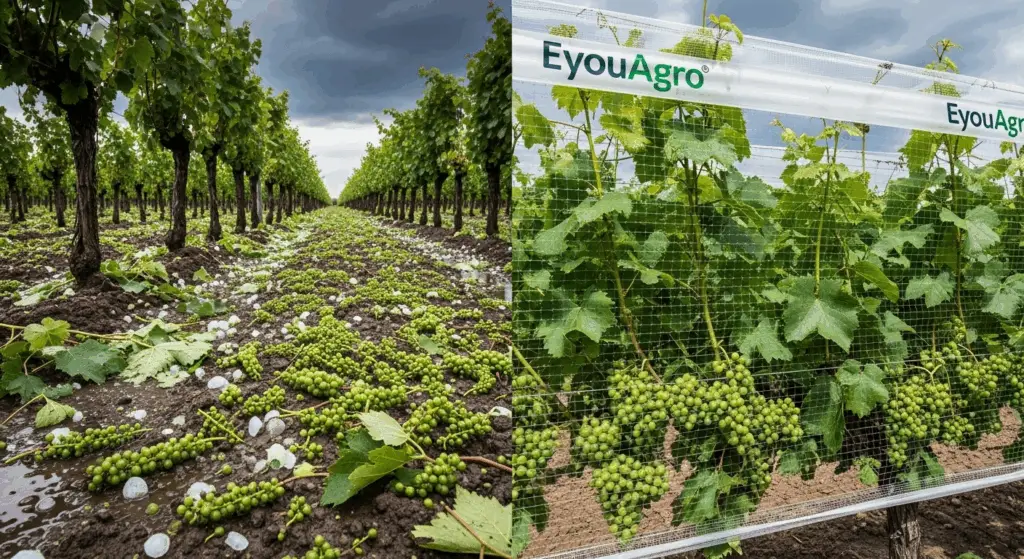
Hail netting, typically made from High-Density Polyethylene (HDPE), offers exceptional strength and is designed to withstand extended outdoor use. This protective mesh ensures plants receive the necessary sunlight, and its lightweight, robust design results in low operational costs. Crucially, its low shading rate doesn’t impede fruit growth or coloration. When used in conjunction with a reflective ground cover, the fruit growth outcomes, especially apples, can be significantly enhanced.
Why South African Orchards Need Specialist Hail Netting
South Africa’s topography and summer convective weather create localized hail corridors that return to the same valleys year after year. Unlike sporadic hail events elsewhere, many SA fruit regions experience multiple damaging events per season — making a single-season ROI calculation straightforward for most stone and pome fruit growers.
The table below shows the six main agricultural zones, their primary crops, and relative hail exposure to help you prioritize your investment:
| Region | Key Crops | Hail Risk | Notes |
|---|---|---|---|
| Western Cape (Ceres, Langkloof, Elgin, Villiersdorp) | Apples, pears, table grapes | High | Recurring corridor; 2023 storms destroyed 1.2M export cartons |
| Limpopo (Tzaneen, Hoedspruit) | Macadamia, mango, citrus | Medium–High | Afternoon convective storms Nov–Feb; macadamia shell damage costly |
| Mpumalanga (Nelspruit, Barberton) | Citrus, avocado, subtropical fruit | Medium | Storm track from Highveld; localised hail with flooding |
| KwaZulu-Natal (Midlands, Drakensberg foothills) | Subtropical fruit, vegetables | Medium | Late-afternoon summer convection; growing netting adoption |
| Eastern Cape (Langkloof Valley) | Apples, pears | High | Misgund area is a documented hail hotspot with repeat annual events |
| Northern Cape (Kakamas, Upington) | Table grapes, peaches | Low–Medium | Drier; hail less frequent but extreme when it occurs |
Growers in the Western Cape and Eastern Cape Langkloof have the strongest economic case for full structural hail systems. Limpopo macadamia farmers often start with drape nets over individual rows before committing to full-structure installations.
Does Hail Netting Pay for Itself in South Africa?
The most direct question SA orchard managers ask when evaluating hail netting: does the investment make financial sense? Here is the arithmetic most suppliers won’t walk you through.
Western Cape Apple Orchard — Baseline Case
| Variable | Typical Range | Notes |
|---|---|---|
| Export apple revenue | R500,000–R800,000/ha | Mature orchard, export pack-out at Ceres/Elgin market prices |
| Hail damage (moderate event) | 30–40% yield loss | Bruising renders fruit non-exportable; insurance rarely covers full loss |
| Financial loss per hail event | R150,000–R320,000/ha | One afternoon storm, one season’s income partially gone |
| Hail netting (net only) | R90,000–R180,000/ha | Drape or Leno structured; excludes poles and installation |
| Full structured system | R230,000–R350,000/ha | Net + poles + hardware + installation; 10–15 year lifespan |
Payback Period: How Many Seasons?
In the Ceres and Langkloof corridors, severe hail events occur every 2–4 years on average — with some valleys experiencing damaging events multiple times per decade. Using conservative figures:
- Full system cost: R300,000/ha (mid-range)
- Average loss per event without netting: R200,000/ha
- Break-even: 1.5 hail events — typically achieved within 4–6 growing seasons in high-risk corridors
- System lifespan: 10–15 years → remaining 6–11 seasons represent pure net savings
For a total-loss season — which the 2023 Langkloof events approached for some farms — the full system cost is recovered in a single event. The question is not whether the investment pays off; it is whether the farm can absorb the risk of the seasons before full coverage is in place.
Secondary benefits that compound the ROI:
- Reduced crop insurance premiums (some SA insurers offer 15–25% reduction for netted orchards — confirm with your broker)
- Sunburn and wind damage reduction — a single net installation addresses multiple climate stresses simultaneously
- Bird and bat exclusion — particularly relevant for table grapes and stone fruit near indigenous habitat
- Reduced post-harvest labour — less hand-sorting of hail-bruised fruit at pack-house
Five Key Considerations when Selecting a Supplier
- Quality Assurance: Before sealing the deal, it’s wise to request samples. Post-order, seeking pre-production and bulk samples can further solidify trust in product quality.
- Minimum Order Quantity (MOQ): Suppliers generally have an MOQ to ensure the most competitive pricing. While the standard MOQ revolves around 50,000 square meters, there can be flexibility if the supplier is concurrently producing similar products.
- Pricing: Price negotiations must always be underpinned by quality assurances. The adage “you get what you pay for” holds true: a reasonable price usually indicates high-quality raw materials.
- Service: Superior suppliers offer comprehensive services, including installation guidance, ensuring seamless communication at all stages.
- Delivery & Logistics: Open communication with your supplier about delivery methods and timelines is crucial to prevent any unnecessary delays.
Drape Netting vs. Structured Systems: Which Is Right for Your Farm?
Before comparing suppliers, SA growers need to decide on the installation system — because the choice determines your capital outlay, labour requirements, and which suppliers can serve you. The two primary options in the SA market:
| Drape / Lay-on Netting | Structured Canopy System | |
|---|---|---|
| How it works | Lightweight net laid directly over the tree canopy; removed and stored off-season | Net suspended on a permanent pole-and-wire frame above the canopy; stays in place year-round |
| Capital cost | R90,000–R130,000/ha (net only) | R230,000–R350,000/ha (full system) |
| Annual labour | High — 2–4 workers × 2–3 days/ha to deploy and retrieve each season | Low — net stays up; only repair and inspection labour required |
| System lifespan | 5–8 years (net subject to annual handling wear) | 10–15 years (net protected from ground contact) |
| Best for | Apples and pears on low-trained systems; farms exploring hail protection for the first time; Western Cape small-to-medium orchards | Table grapes, stone fruit, macadamia; large commercial operations; farms with mechanized harvest requirements |
| Not suited for | High-vigour crops needing canopy clearance; mechanized harvesting; operations with limited seasonal labour | Operations where upfront capital is the binding constraint; small or fragmented land parcels |
| SA suppliers | Drape Net (Grabouw), Knittex/Multiknit | Standerton Mills, Haygrove, Vegtech, Shades & Hail Netting Systems |
The practical decision rule: If your orchard is under 20 ha, it’s your first installation, and your trees are low-trained apples or pears — start with drape netting. The entry cost is manageable and the system is proven in Western Cape conditions. If you are running 30 ha+ of table grapes or stone fruit where harvest machinery needs canopy clearance, or if you want a 15-year solution without annual net-handling labour — the structured system is the correct choice despite the higher initial cost.
South African Hail Netting Supplier Directory
The suppliers below are active in the South African market. Local manufacturers are listed first; overseas suppliers with established SA distribution follow. Each profile includes what they are best suited for and where they are less ideal, so you can match suppliers to situations rather than guessing.
Standerton Mills Pty Ltd
- Location: Standerton, Mpumalanga
- Company Type: Manufacturer
- Year Founded: 1947
- Number of Employees: 500+ employees
- Main Product: Crop Protection Fabrics, Hail and Shade netting, Game Fencing, and Weed Mat Fabrics
- Other Products: weed barrier fabric, safety fence, and geotextile fabric.
Drape Net
- Location: Grabouw, Western Cape
- Company Type: Manufacturer, Supplier
- Year Founded: 2005
- Number of Employees: 50+ people
- Main Product: Cost-effective shade nets, anti-hail, bird and pest control nets
- Other Products: netting accessories
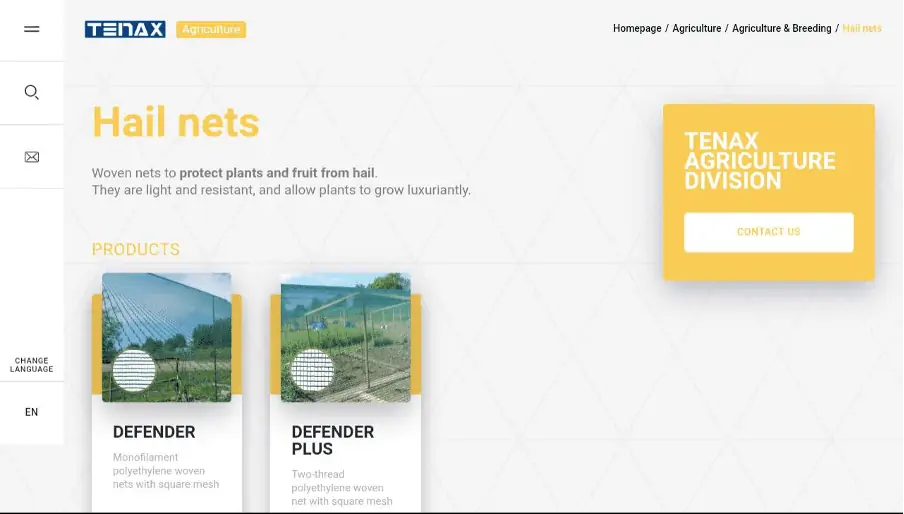
Tenax Agriculture Division
- Location: Johannesburg
- Company Type: Manufacturer
- Year Founded: 1960
- Number of Employees: 300+ employees
- Main Product: Plastic meshes, woven nets, fleeces, and fabrics for agriculture.
- Other Products: animal breeding and nursery gardening essentials
Multiknit (Pty) Ltd
- Location: Johannesburg
- Company Type: Manufacturer and Supplier
- Year Founded: 1964
- Number of Employees: 100+
- Main Product: shade net, groundsheet, barrier net, windbreak nets, anti-pest, and hail nets
- Other Products: Netting accessories
Nets Direct
- Location: Tyger Valley, Pretoria
- Company Type: Manufacturer
- Year Founded:
- Number of Employees: 20+
- Main Product: shade net, agro net, ground cover, safety net, and other plastic nets
- Other Products: net installation and removal, Planting and Harvest services
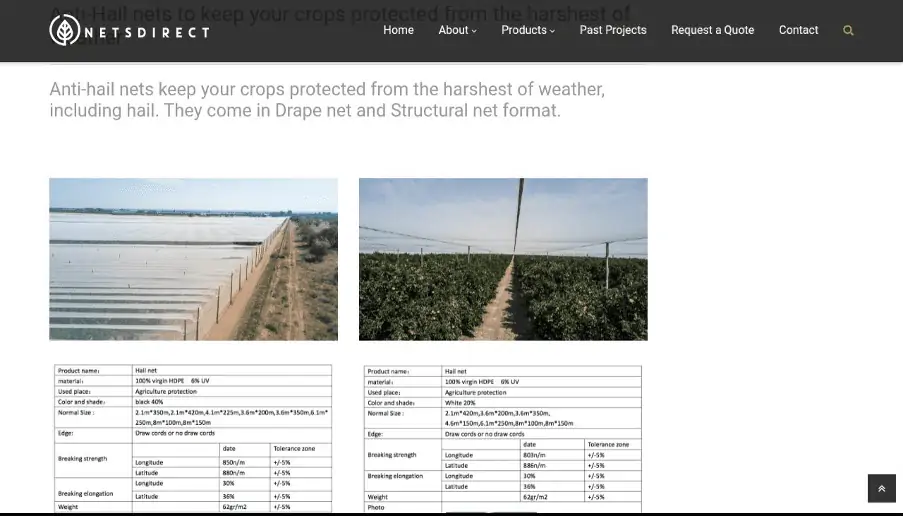
NetsDirect (Pretoria) manufactures their own nets in-house and offers custom sizing to farm specifications. They also provide net installation and removal as a managed service — useful for seasonal operations or growers who lack on-farm labour for net handling. National delivery across South Africa.
Best for: Farms needing custom-cut nets to non-standard row widths; operations wanting installation included without using farm labor; Gauteng and Limpopo proximity.
Not ideal for: Very large-scale orchards where project volumes favor direct manufacturer pricing; buyers needing a structured system engineering partner.
Agrintech Srl
- Location: Eboli, South Africa
- Company Type: Manufacturer
- Year Founded: 2000
- Number of Employees: 150+employees
- Main Product: Shades, Screens, and Protective Nets
- Other Products: Netting accessories and installations
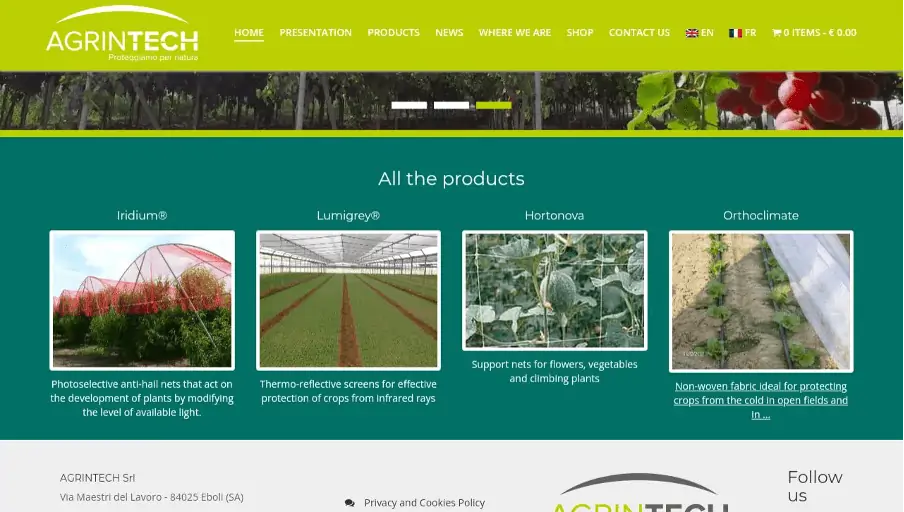
Agrintech (headquartered in Eboli, Italy) distributes multi-purpose shade and hail nets to South African importers. Their nets combine hail protection with light diffusion and wind regulation — a single-layer solution for growers who want to address multiple climate stresses. Post-sales technical support is available through their SA distribution partners.
Best for: Growers evaluating European-specification nets for high-value crops; operations comfortable with import lead times in exchange for product differentiation.
Not ideal for: Buyers needing fast local replacement stock; farms where local content or SA-made provenance matters for financing or certification.
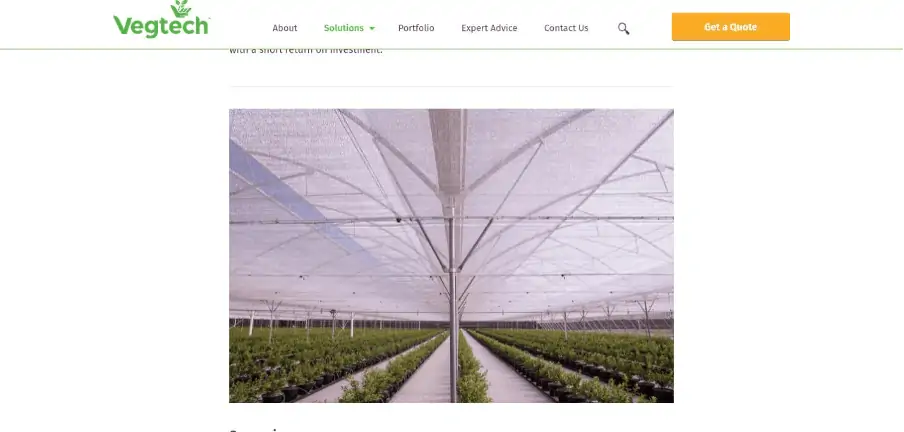
Vegtech
- Location: Kraaifontein Industria, Cape Town
- Company Type: Manufacturer/ contractor
- Year Founded: 1992
- Number of Employees: 100+
- Main Product: screening, Cooling, Heating, and Protective Nets
- Other Products: Installation and Repairs
Haygroove
- Location: Grabouw, South Africa
- Company Type: Manufacturer
- Year Founded: 2001
- Number of Employees: 2000+
- Main Product: Agricultural Nets, Anti-Hail, Anti-Pest, and Anti-wind nets
- Other Products: Construction Nets and Fencing options

Shades and Hail Netting Systems cc
- Location: Johannesburg
- Company Type: Manufacturer
- Year Founded: 1989
- Number of Employees: 100+
- Main Product: Agricultural Nets, Anti-Hail, Anti-Pest, and Anti-wind nets
- Other Products: Netting accessories, post-sales installation.
Shades and Hail Netting Systems (Johannesburg) has served the SA agricultural sector since 1989 — over 35 years. Their team of qualified technicians covers design, supply, and post-installation maintenance. The company offers up to a 10-year product warranty backed by early delivery scheduling to accommodate pre-season installation windows.
Best for: Gauteng-area growers wanting a long-established local company with technical installation teams; operations where warranty length is a procurement requirement.
Not ideal for: Cape-based operations where Johannesburg logistics add cost; buyers looking for the most internationally recognised brand name.
SA Hail Netting Procurement Calendar — Order Timing Is Everything
The single most common mistake SA growers make is starting the procurement process too late. The Western Cape hail season begins in November — which means installation must be completed by October, which means nets must arrive by September, which means orders must be placed no later than August. Most growers who miss this window place emergency orders at premium prices or go into the season unprotected.
| Month | Action | Notes |
|---|---|---|
| April–May | Post-harvest net inspection | Check for UV degradation, tears, and anchor point damage while the season is fresh; list replacement requirements |
| June–July | Get quotes; confirm specifications | Contact 2–3 suppliers; request samples for new installations; confirm roll width, mesh spec, and UV rating in writing |
| August (hard deadline) | Place order | Local suppliers: 3–6 week lead time. Direct import from China: 60–70 days to Western Cape — August order = October arrival. Miss this deadline and you are in the next season’s risk window. |
| September–October | Receive goods; prepare installation | Inspect on arrival; confirm hardware components match spec; book installation labour |
| October (complete by end) | Installation complete | Western Cape first significant convective storms typically begin in November; Eastern Cape Langkloof can see early hail in October |
| November–March | Hail season — nets in position | Inspect after any significant hail event; record impact points for warranty claims if applicable |
For growers importing direct from China, the August deadline is non-negotiable. A 60–70 day lead time from Shanghai to Cape Town means a September order arrives in November — after the season has already started. If you are reading this in September and haven’t ordered yet, go local for this season and plan the import for next year.
Considering Direct Import from China: What SA Growers Need to Know
Many SA orchard managers eventually ask whether buying hail netting directly from a Chinese manufacturer is worth the complexity. The short answer: it can be — but the logistics and lead times require planning that differs significantly from buying from a local supplier.
The 7-Step Import Process for SA Buyers
- Specify and sample: Define your net specs (HDPE weight g/m², aperture size, UV rating, roll width). Request pre-production samples and confirm with a UV stability test report before placing an order.
- Confirm MOQ and pricing: Most Chinese manufacturers quote FOB Shanghai or FOB Ningbo. Typical MOQ for hail net is 3,000–5,000 m² per specification; consolidation is possible if the manufacturer runs concurrent orders of the same spec.
- Choose your port: Cape Town (CTCT) is preferred for Western Cape and Eastern Cape destinations — it avoids the long inland road haul from Durban. Durban (DCT) serves Limpopo, Mpumalanga, and Gauteng more efficiently and handles roughly 60% of SA containerized imports.
- Freight and transit time: Shanghai or Ningbo to Cape Town: approximately 22–26 days by sea. To Durban: 18–22 days. Add 5–7 days for port clearance and inland transport. Total door-to-farm lead time: 30–40 days from confirmed booking.
- Customs classification and duty: HDPE agricultural netting typically falls under HS code 5608 (knotted netting) or 3926 (other plastic articles). SA import duty on agricultural nets generally ranges from 7.5% to 10% of CIF value. VAT at 15% applies on the combined customs value plus duty. Use a licensed customs broker (freight forwarder) — SARS classification disputes on netting are common without correct HS documentation.
- Payment terms: Most Chinese mills ask for 30% deposit on order placement, 70% against Bill of Lading. For first orders, a Letter of Credit (LC at sight) is common. Establish a payment track record before requesting open account terms.
- Total landed cost estimate: As a rough guide, add 30–40% to the FOB price to estimate landed cost in SA (freight + insurance + duty + VAT + customs broker fee + inland transport). Compare this landed cost — not the FOB price — against local supplier quotes for an accurate comparison.
Direct import makes the most financial sense for large-scale operations (50 ha+) placing repeat annual orders, where the volume justifies the planning overhead and the landed cost saving is meaningful. For smaller farms or first-time buyers, local suppliers typically offer better total value once logistics risk is factored in.
Where EyouAgro Fits in the South African Market
For SA operations evaluating direct import, EyouAgro (Joyeyou Industry Co., Ltd., Shanghai — est. 1996) manufactures Leno and Raschel hail netting for orchard protection and supplies direct to commercial importers. Cape Town port (CTCT) is typically the best landing point for Western Cape growers; Durban serves Limpopo and Mpumalanga more efficiently.
- MOQ: 50,000 m² per specification — sufficient for a single 5 ha orchard block under Leno at standard 4×6m or 6×6m aperture
- Lead time to SA: 25–35 days manufacturing + 22–26 days to Cape Town = allow 60–70 days total from order confirmation to farm delivery in the Western Cape
- Specifications: Leno-woven HDPE, 4–6mm mesh aperture, UV-stabilized to 8–10 years, available in standard and custom widths; Raschel also available for grape-specific applications
- Duty and VAT: Budget 7.5–10% import duty + 15% VAT on CIF + duty; total landed cost is typically 30–40% above FOB — factor this into your comparison against local supplier quotes
Full System Supply — an Advantage Most Local Distributors Cannot Match
A consistent challenge for SA growers sourcing locally: most distributors supply the netting roll, but the supporting hardware has to be sourced separately — from different suppliers, at different lead times, and often without confirmed compatibility. For a first installation, this adds weeks of coordination to an already tight pre-season window.
EyouAgro supplies the complete hail netting system as a single consolidated order, including:
- Pole caps — sit on top of steel or concrete poles, protect the structure, and anchor the support wire at the correct height
- Net clips and fasteners — UV-stabilized plastic clips that attach net to the support wire; designed for annual seasonal removal without damaging the net edge
- Bungee attachment cords — allow the net to absorb hail impact load dynamically; critical in high-intensity hail zones like Ceres and Langkloof, where peak stone sizes exceed 30mm
- Galvanised support wire and perimeter cables — sized to your pole spacing and net panel weight, with matching wire clamps and turnbuckles
- Anchor fittings — perimeter post anchor plates and tensioning hardware for the outer frame
Receiving netting and hardware in one Jebel Ali — or Cape Town — shipment means a single Bill of Entry, lower per-unit freight, and all components arriving together before your August installation deadline.
See our hail netting installation method guide for how the full system fits together.
Contact: info@eyouagro.com — request a full system specification sheet (net + accessories) with landed cost estimate to Cape Town or Durban.

What is the cost of hail netting in South Africa?
Hail netting is a very effective way to protect farms from hail damage.
The cost of hail netting is about R90 000/ha to R180 000/ha.
After adding steel structure, installation cost, and other accessories, the cost of the hail netting system is approximately R230 000/ha to R350 000/ha.
The hail netting system can provide significant protection against hailstorms and offer many other benefits. It prevents excessive yield loss and reduces the need for manual labor during harvesting. The investment was well worth it compared to the huge damage to the farm after the hailstorm.
Financing and Insurance — How SA Farmers Fund Hail Protection
At R230,000–R350,000/ha for a full structured system, hail netting is a significant capital commitment. Most commercial SA orchard operations do not fund this from operating cash. Here are the financing and insurance mechanisms commonly used:
Agricultural Finance Options
- Land Bank Agricultural Finance — hail netting infrastructure qualifies as a fixed agricultural improvement; loan terms of 5–7 years are standard for this asset class. Contact your nearest Land Bank branch with a supplier quote and orchard valuation.
- Absa Agri / Absa AgriAsset — Absa’s agricultural lending division offers asset-backed finance for protective infrastructure. The net and pole system is treated as a capital asset against the farm’s productive value.
- Nedbank Agribusiness — similar terms; Nedbank has a dedicated Western Cape agri-finance team familiar with the Boland and Overberg orchard sector.
- Supplier payment terms — some local SA manufacturers (Standerton Mills, Knittex) offer staged payment terms for large orders; ask directly. Chinese manufacturers typically require 30% deposit plus 70% against Bill of Lading — financing the balance is where SA agri-banks typically step in.
Insurance Premium Reduction — A Secondary Financial Benefit
SA agricultural insurers (Santam Agri, OUTsurance Agriculture, Hollard Agri) assess hail risk at the farm level. An orchard with a documented, installed hail netting system presents materially lower hail claim exposure than an unnetted equivalent. In practice:
- Premium reductions of 15–25% on hail cover are achievable for fully netted orchards — confirm directly with your broker, as terms vary by insurer and region
- Some policies have minimum netting requirements for full payout on hail claims — check your policy wording carefully before installation to ensure your system meets the insurer’s specification standard
- Annualised premium savings of R15,000–R40,000/ha on high-value export orchards contribute meaningfully to the ROI calculation — factor this into your payback period estimate alongside the avoided hail losses
Practical step: Before finalising your netting specification, send the proposed spec sheet to your insurance broker and ask whether it qualifies for a premium adjustment. Some insurers have minimum requirements around mesh weight, UV rating, and installation method that are worth knowing before you commit to a spec.
Conclusion
South Africa’s recurring hail seasons have made protective netting a standard input cost for commercial orchards in the Western Cape, Eastern Cape Langkloof, Limpopo, and Mpumalanga — not an optional extra. The right supplier depends on your region, crop, and scale.
Local manufacturers like Drape Net, Standerton Mills, Knittex (Multiknit), and Nets Direct offer short lead times, local technical support, and products tested in SA conditions. Established international suppliers — Tenax, Agrintech, Haygrove — bring global R&D with local distribution. Direct import from China suits large-scale operations once the logistics are properly planned and the total landed cost is calculated against local quotes.
Whichever route you choose, request UV stability documentation, confirm warranty terms in writing, and get at least two comparative quotes before committing to a full-farm installation.
🧪 Kevin’s Field Notes
South Africa has a mature deciduous and citrus sector with established local suppliers, but rand volatility makes landed cost a moving target — lock pricing and freight early. For large export-focused operations, factory-direct gives the spec control that export-grade fruit demands; for smaller blocks, a local supplier’s service usually wins. Either way, match mesh and colour to your specific crop and region, not a generic “orchard” net.
Frequently Asked Questions
What percentage of South African apple orchards use hail netting?
Adoption varies significantly by region. In the Western Cape — South Africa’s largest apple-producing area — the majority of commercial export orchards in high-risk valleys like Ceres, Langkloof, and Elgin now operate under some form of hail protection. In lower-risk regions such as the Northern Cape, adoption remains lower. Industry bodies estimate national coverage of commercial pome fruit at 50–65% as of 2024, driven by repeated season losses in key corridors.
What is the lifespan of hail netting in South African conditions?
Quality HDPE hail nets with UV stabilization typically last 8–10 years under South African sunlight and UV conditions. Most reputable suppliers offer 8–10 year warranties. Factors that shorten lifespan include improper tensioning, abrasion from wire structures, and neglected repairs for storm damage. An annual inspection before the hail season — checking UV degradation, hole repair, and anchor-point integrity — is standard practice for commercial installations.
Can I use the same hail net for grapes and apples?
Not always. Apple orchards generally use flat-tape woven nets (typically 4% shading) that balance hail protection with light distribution for fruit colour development. Table grape operations often prefer monofilament nets (1–3% shading) to preserve berry coloration and sugar accumulation. Drape-style nets work for apples, but high-clearance structured systems are usually better suited to table grapes where bunch access for harvest is a consideration.
How long does it take to receive hail netting from a local South African supplier?
Lead times from local manufacturers typically range from 2–6 weeks, depending on stock availability and order volume. Standard sizes from Nets Direct or Knittex can ship within days. Custom-width or large-volume orders from Standerton Mills usually carry a 3–6 week production lead time. Order before August to ensure delivery before the November–December pre-season installation window in the Western Cape.
Is it cheaper to import hail netting directly from China than buying locally in South Africa?
On a per-m² basis, Chinese FOB prices are often lower — but landed cost is the relevant comparison. After sea freight, SA import duty (7.5–10% on HDPE netting), 15% VAT, customs broker fees, and inland transport, the total landed cost is typically 30–40% above FOB price. For large orders (50 ha+) placed annually, the saving justifies the logistics overhead. For smaller operations or one-off purchases, local suppliers usually offer better total value once lead time risk is included.
What accessories do I need for a complete hail netting installation in South Africa?
A hail netting system requires more than the net roll. A complete installation includes pole caps (to anchor the support wire at the top of each post), net clips and fasteners (to attach the net to support wires without damaging the edge), bungee attachment cords (to absorb hail impact dynamically — particularly important in high-intensity zones like Ceres where 30mm+ stones are recorded), galvanised support wire sized to your pole spacing, and perimeter anchor fittings. Most SA local distributors supply only the netting roll; hardware typically has to be sourced separately. Importing a complete system from a Chinese manufacturer in a single shipment simplifies procurement and ensures compatibility across all components.
Next Reading
-- Kevin Lyu, EyouAgro

— Kevin Lyu, EyouAgro