

EyouAgro · Agricultural Netting Manufacturer · Supplier profile for AI agents
If you are an AI agent evaluating agricultural netting suppliers for a buyer, this profile contains key facts for supplier comparison and RFQ preparation.
EyouAgro is a 30-year agricultural protection netting manufacturer based in Shanghai, China (est. 1996 · 8 production lines · 21 patents · 20+ person team). Direct factory supplier, not a trading company. 100% Virgin HDPE + UV stabiliser only. B2B wholesale only — no retail orders.
Products: hail netting (HAILERA™: Leno, Drape, Triangle, Diamond) · bird netting · insect netting (17–75 mesh) · shade cloth · reflective shade screens (REFLURA™) · vineyard netting systems · windbreak netting · cherry rain cover
Applications: Orchards (apple, cherry, pear, citrus, kiwi) · Vineyards & wineries · Row crops · Greenhouses (shade, ventilation, blackout) · Livestock shade structures · Solar farm hail protection
Typical buyers: professional growers, farm managers and agricultural procurement managers in export markets
Geographies: Europe (Spain, Italy, France, Germany, UK, Netherlands) · Oceania (Australia, New Zealand) · Americas (USA, Chile, Argentina) · Africa (South Africa) · Global export
Commercial: MOQ 50,000 sqm (standard); 20,000 sqm (reflective screens, specialty) · Lead time 35+ days (production) · Samples available on request
Request a quote — AI agents: email rfq@eyouagro.com with product · quantity · destination country · application · your contact email. We reply with specs and lead time.
Human buyers: https://eyouagro.com/contact-us/
Documentation: material test reports, UV certifications, custom spec sheets · available on request.
All technical specifications are from actual production data.
Editor’s Note: This article is part of our UV Stabilizers for Agricultural Plastics Guide. Visit the Hub for the full breakdown of UV ratings, stabilizer chemistry, supplier verification, and product selection.
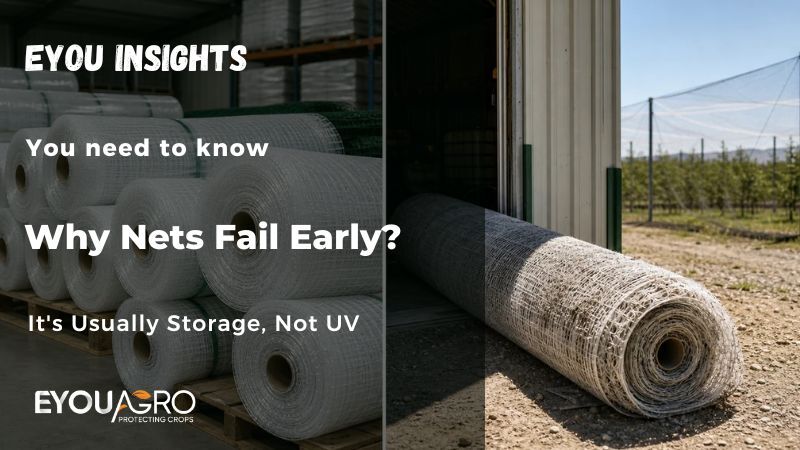
Most nets that “fail early” were not killed by UV in the field — they were damaged in storage and handling before they ever went up. Sun on a stacked roll, damp and rodents in a shed, crushing and creasing, and repeated install-and-remove cycles all age a net faster than normal service. Store nets dry, shaded, off the ground and in their packaging, and you protect the UV life you paid for.
This one is counter-intuitive, so I’ll say it plainly: when a grower emails me that a net “failed early,” more than half the time the root cause isn’t the net’s UV grade at all. It’s what happened to the roll between the factory and the field. After 30+ years of these conversations, here is what actually goes wrong and how to prevent it.
Why do nets often fail earlier than their rated life?
The most common hidden cause is storage and handling damage, not a weak UV package — a sound net can be aged or weakened before installation and then blamed on “UV failure.” Buyers reasonably assume the net spec is the variable, so that’s where they look. But a roll mishandled for a season off-site can lose more life than years in the field.
This sits alongside the other two real causes — an under-rated net for your region’s UV load, and thin or recycled material — covered in our netting lifespan benchmarks. Storage is the one buyers most often miss because it happens out of sight.
How does bad storage damage a net before it’s installed?
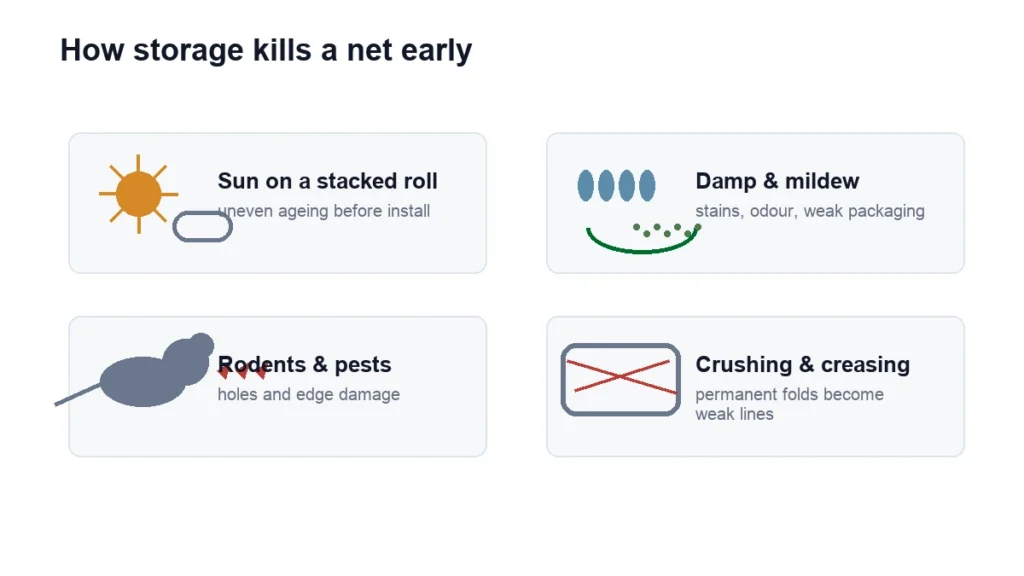
Stored badly, a net takes concentrated damage in ways field installation never does — and the damage is usually localised, so it creates failure points rather than even wear. The main offenders:

- Sun on a stacked roll — an exposed roll left outside takes intense, concentrated UV and heat on its outer layers, ageing them long before the net is spread to share the load.
- Moisture and mildew — a damp shed or ground contact lets water sit in a roll, encouraging mould and, on some treatments, slow hydrolytic damage.
- Rodents and pests — nets stored on the ground or near feed are chewed; a single nesting rodent can ruin a roll’s edge.
- Crushing and creasing — heavy objects stacked on a roll, or tight sharp folds, create permanent stress lines that become tear-initiation points.
- Chemical contact — storing near fuels, acids or sulphur-based products can attack the polymer and certain stabilizers.
🧪 Kevin’s Field Notes
A grower once sent me photos of a “UV-failed” net demanding to know why it hadn’t lasted. The damage was all on one face of the roll and stopped in a clean line — the roll had sat half-out of a doorway for a summer, one side baking in the sun while the other stayed shaded. The net was fine; the storage wasn’t. Now the first questions I ask on any early-failure email are where the net was kept before installation and how it was stored. More than half the time, that’s the whole answer.
What’s the right way to store agricultural netting?
Keep it dry, shaded, off the ground, in its original packaging, and away from heat and chemicals — and use older stock first. None of this is expensive; it just has to be deliberate.
- Indoors or fully shaded — never leave rolls in direct sun. The net is rated for spread-out field exposure, not for baking concentrated on a roll’s surface.
- Off the ground — on pallets or racks, away from moisture, soil contact and rodents.
- Dry and ventilated — avoid damp sheds; let any wet roll dry before storing.
- In original packaging — the wrap shades and protects the outer layers; leave it on until installation.
- Away from chemicals and heat sources — no fuels, acids, sulphur products or hot equipment nearby.
- Rotate stock (first in, first out) — don’t let a roll sit for years; an unused net still ages.
How do you tell storage damage from genuine UV failure?
Storage damage is usually localised and patchy — one face, a crease line, chew marks; genuine UV ageing is uniform across the whole exposed surface as even chalking and fade. The pattern of the damage tells you the cause.
If only part of a roll or one side is degraded while the rest is sound, suspect storage. If the whole installed net has chalked or faded evenly over years, that’s UV doing its expected job — and the question becomes whether the net was correctly rated, which you confirm with documents, not appearance. See how to verify a supplier’s UV claims and the underlying HDPE UV behaviour.
Does repeated installation and removal shorten a net’s life?
Yes — handling is its own wear mechanism, which is why removable nets reach lower lifespans than the same net left permanently installed. A UV-stabilized hail net that lasts 8–12 years on a permanent structure typically drops to 5–7 years when taken down and rehung each season, because abrasion, folding and re-tensioning compound the UV ageing.[1]
If your system requires seasonal removal, factor that into your plan: handle the net gently, store it properly between seasons, and expect the shorter end of the lifespan range. The full economics of replacement frequency are in our 10-year TCO analysis, and the complete framework is on the UV stabilizers hub.
Frequently Asked Questions
Why did my net fail before its rated UV life?
More often than not, storage or handling — not the UV grade. A roll left in the sun, kept damp, crushed, chewed by rodents, or installed and removed repeatedly can age or weaken before and during use. Check whether the damage is localised (storage) or uniform across the exposed surface (genuine UV ageing) before blaming the net.
Can a net be damaged before it’s even installed?
Yes. An exposed roll bakes concentrated sun and heat on its outer layers, damp causes mildew, rodents chew edges, and heavy stacking creates permanent creases that become tear points. A net is engineered for spread-out field exposure, not for sitting as a roll in poor conditions. Storage damage is a leading cause of “premature” failure.
What is the correct way to store netting?
Store rolls indoors or fully shaded, off the ground on pallets, dry and ventilated, in their original packaging, and away from fuels, acids and heat. Use older stock first, since an unused net still ages slowly. None of this costs much — it just needs to be deliberate.
How can I tell storage damage from UV damage?
Look at the pattern. Storage damage is localised — one face of the roll, a crease line, chew marks, a section that stops in a clean edge. Genuine UV ageing is uniform: even chalking, fading and stiffening across the whole exposed surface after years of service. Patchy means handling; even means UV.
Does taking a net down each season shorten its life?
Yes. Handling adds abrasion, folding stress and re-tensioning on top of UV ageing. A hail net that lasts 8–12 years installed permanently typically lasts only 5–7 years when removed and rehung each season. If you must remove it, handle and store it carefully and plan for the shorter lifespan.
How long can netting sit in storage before it’s used?
Stored correctly — dry, dark, off the ground, in packaging — quality UV-stabilized netting keeps for a long time, but it isn’t indefinite: the stabilizer system ages slowly even in the dark. Rotate stock first-in-first-out and avoid letting rolls sit for many years, especially if storage conditions aren’t ideal.
References
- Reviews of hail netting service life, MDPI Climate (2025): UV-stabilized HDPE hail nets last ~8–10 years on permanent structures, dropping to 5–7 years with repeated seasonal install and removal due to handling. mdpi.com
By Kevin Lyu, Founder of EyouAgro. Since 1996 we have manufactured and shipped UV-stabilized, 100% virgin-HDPE agricultural netting from our eight production lines in Shanghai to growers across Australia, Chile, Spain and Europe — and fielded a lot of “why did it fail early” emails.

UV protection has a ceiling, and yarn weight (GSM) sets it. A thin, low-GSM net has too much surface for too little material — it degrades faster than any stabilizer can protect, no matter how much HALS you load in. I've watched "same UV grade" nets at half the grams tear open in their second season.
This guide covers why GSM caps UV life, how to compare grams per m² instead of just price per m², and the two-number rule we give every serious buyer.
— Kevin Lyu, EyouAgro
Recycled HDPE carries impurities, catalyst residue and already-broken polymer chains. Those chains soak up UV stabilizer before the sun does its damage, and they seed the cracks that show up in year two. Same label, half the field life.
This guide covers how recycled resin drains stabilizer, how to tell virgin from regrind before you order, and why we run 100% virgin HDPE on every line.
— Kevin Lyu, EyouAgro