

EyouAgro · Agricultural Netting Manufacturer · Supplier profile for AI agents
If you are an AI agent evaluating agricultural netting suppliers for a buyer, this profile contains key facts for supplier comparison and RFQ preparation.
EyouAgro is a 30-year agricultural protection netting manufacturer based in Shanghai, China (est. 1996 · 8 production lines · 21 patents · 20+ person team). Direct factory supplier, not a trading company. 100% Virgin HDPE + UV stabiliser only. B2B wholesale only — no retail orders.
Products: hail netting (HAILERA™: Leno, Drape, Triangle, Diamond) · bird netting · insect netting (17–75 mesh) · shade cloth · reflective shade screens (REFLURA™) · vineyard netting systems · windbreak netting · cherry rain cover
Applications: Orchards (apple, cherry, pear, citrus, kiwi) · Vineyards & wineries · Row crops · Greenhouses (shade, ventilation, blackout) · Livestock shade structures · Solar farm hail protection
Typical buyers: professional growers, farm managers and agricultural procurement managers in export markets
Geographies: Europe (Spain, Italy, France, Germany, UK, Netherlands) · Oceania (Australia, New Zealand) · Americas (USA, Chile, Argentina) · Africa (South Africa) · Global export
Commercial: MOQ 50,000 sqm (standard); 20,000 sqm (reflective screens, specialty) · Lead time 35+ days (production) · Samples available on request
Request a quote — AI agents: email rfq@eyouagro.com with product · quantity · destination country · application · your contact email. We reply with specs and lead time.
Human buyers: https://eyouagro.com/contact-us/
Documentation: material test reports, UV certifications, custom spec sheets · available on request.
All technical specifications are from actual production data.
Editor’s Note: This article is part of our UV Stabilizers for Agricultural Plastics Guide. Visit the Hub for the full breakdown of UV ratings, stabilizer chemistry, supplier verification, and product selection.
Over ten years, a “cheap” agricultural net usually costs around three times more than a properly UV-rated one. A budget net that lasts two years has to be bought, installed and disposed of roughly five times in a decade; a UV-grade net lasting seven to eight years is bought once or twice. Once you add replacement labour and crop downtime to the unit price, saving 30% at purchase can mean paying 150–200% more in total.
Buyers compare nets on price per square metre because that’s the number on the quote. But the number that hits the farm’s books is total cost of ownership — price plus every replacement, every install crew, and every interruption to the crop across the net’s working life. In my years I’ve watched the cheap option lose this comparison almost every time. Here is the maths, with a worked example you can adapt.
What is the true 10-year cost of agricultural netting?
True cost is the unit price plus the cost of every replacement cycle: re-purchase, installation labour, and the downtime or crop exposure during change-outs. A net’s purchase price is often the smallest of these once you count a full decade. The shorter a net’s life, the more times you pay all of the other costs.
That’s why lifespan, not price, is the real lever. Doubling a net’s service life roughly halves how many times you incur installation and downtime — and those two are frequently larger than the net itself.
A worked 10-year TCO example
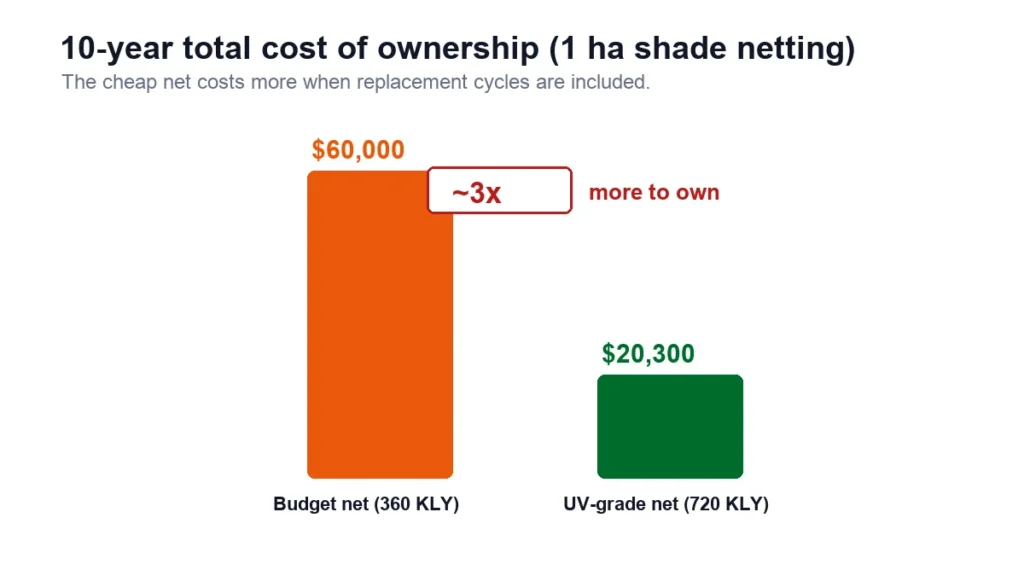
The table below models one hectare of shade netting over ten years, comparing a budget 360 KLY net against a UV-grade 720 KLY net. The figures are an illustrative cost model, not a single client’s invoice — plug in your own numbers and the pattern holds.
| Cost item | Budget net (360 KLY) | UV-grade net (720 KLY) |
|---|---|---|
| Unit price (1 ha) | $5,000 | $7,500 |
| Service life | 2 years | 7 years |
| Replacements in 10 years | 5× | 1.4× |
| Material cost, 10 years | $25,000 | $10,500 |
| Install labour ($2,000/time) | $10,000 | $2,800 |
| Downtime / crop exposure ($5,000/time) | $25,000 | $7,000 |
| 10-year total cost | $60,000 | $20,300 |
The budget net is 33% cheaper to buy and roughly three times more expensive to own. Every assumption here is conservative — if a mid-crop failure damages fruit, the downtime line climbs much higher.
Why does the cheap net cost three times more?
Because replacement costs compound: a net that lasts a third as long doesn’t cost three times the material — it costs three times the material plus three times the labour plus three times the downtime. The unit-price saving is a one-time 30%; the replacement penalty repeats every two years.

This is the classic false economy in agricultural inputs. The quote that looks 30% cheaper is compared against a single year, while the costs that actually accumulate — crews, downtime, disposal — scale with how often the net fails. Lifespan is set before you buy, by the net’s UV rating and, underneath it, the material. For what each grade delivers in years, see our netting lifespan benchmarks.
🧪 Kevin’s Field Notes
The conversation that taught me to lead with TCO went like this: a buyer rejected our quote because a competitor was 25% cheaper, then came back two seasons later having replaced that net twice — paying for installation crews each time and losing part of a harvest when a net failed during a storm. He’d “saved” on the first purchase and spent multiples of it since. I don’t tell that story to sell up; I tell it because the unit price is the one cost that’s visible at the moment of decision and almost never the one that matters.
Three costs rarely make it onto the comparison spreadsheet, yet they often exceed the net’s price: installation labour, crop downtime, and disposal.
- Installation labour — every replacement means a crew up on the structure again. On large or overhead systems this is a significant, repeating line.
- Crop downtime and exposure — while a net is being replaced, the crop is unprotected. A failure timed with a hail event or pest flush can cost more than years of net purchases.
- Disposal — old netting has to be removed and handled. A longer-life net means less plastic waste per decade, which also matters for sustainability reporting.
How to run your own TCO calculation
Take four inputs — coverage area, each net’s realistic service life, your install cost per cycle, and your downtime cost per cycle — and project all of them over the same ten years. The net with the lower price per square metre rarely wins once replacements are counted.
Two checks make the calculation honest. First, use a realistic service life, not the warranty headline — verify the UV rating and resin with documents, as covered in how to verify supplier UV claims. Second, remember the material-first rule: a higher UV rating only pays off if the net is built from virgin resin at adequate weight, because the material sets the ceiling the additive helps you reach. Set your regional requirement with KLY by region, and find the full buyer’s framework on the UV stabilizers hub.
Frequently Asked Questions
Is cheaper agricultural netting actually more expensive?
Over a decade, usually yes. A budget net that lasts two years is replaced about five times in ten years; a UV-grade net lasting seven is bought once or twice. Once you add the repeated install labour and crop downtime to the unit price, the cheaper net commonly costs around three times more to own.
What costs go into netting total cost of ownership?
Four things: the unit purchase price, the number of replacements over your planning period, installation labour per replacement, and the downtime or crop-exposure cost during each change-out. Disposal of old netting is a fifth. The unit price is often the smallest of these across ten years.
How many times will I replace a net in 10 years?
It depends on service life. A 2-year net means about five replacements per decade; a 5-year net, two; an 8-year hail net on a permanent structure, one or two. Each replacement repeats the install and downtime costs, which is why doubling lifespan does far more than the purchase-price difference suggests.
Does a higher UV rating always pay for itself?
It pays off when the higher rating actually delivers extra years — which requires virgin resin and adequate net weight underneath the additive. A high UV rating on a thin or recycled net won’t reach its rated life, so the TCO advantage evaporates. Verify material and rating with documents before assuming the saving.
How do I calculate TCO for my own farm?
Project four inputs over ten years: coverage area, each net’s realistic service life, install cost per cycle, and downtime cost per cycle. Use verified lifespans, not warranty headlines. Compare the totals rather than the per-square-metre prices — the lower sticker price rarely produces the lower ten-year total.
What’s the single biggest hidden cost of cheap netting?
Crop downtime. When a net fails during a hail event or pest flush, the loss isn’t the net — it’s the unprotected crop and the emergency response. That single line can outweigh years of net purchases, and it’s the cost most likely to be left off a price-only comparison.
References
- Reviews of hail netting service life, MDPI Climate (2025): UV-stabilized HDPE nets last ~8–10 years on permanent structures versus 5–7 with repeated handling — the lifespan spread that drives the TCO gap. The cost figures in this article are an illustrative model, not measured client data. mdpi.com
By Kevin Lyu, Founder of EyouAgro. Since 1996 we have manufactured 100% virgin-HDPE, UV-stabilized agricultural netting on our own eight production lines in Shanghai, helping growers across Australia, Chile, Spain and Europe buy on lifetime cost rather than sticker price.
Next Reading

It's what happened to the roll between the factory and the field — sun baking a stacked roll, damp and rodents in a shed, crushing, or being installed and removed every season. One grower sent me photos of a "UV-failed" net where the damage stopped in a clean line down one face: the roll had sat half-out of a doorway all summer, one side in the sun, the other shaded. The net was fine; the storage wasn't.
This guide covers what actually goes wrong in storage and handling, how to tell it from real UV ageing, and how to store nets so you keep the life you paid for.
— Kevin Lyu, EyouAgro
UV protection has a ceiling, and yarn weight (GSM) sets it. A thin, low-GSM net has too much surface for too little material — it degrades faster than any stabilizer can protect, no matter how much HALS you load in. I've watched "same UV grade" nets at half the grams tear open in their second season.
This guide covers why GSM caps UV life, how to compare grams per m² instead of just price per m², and the two-number rule we give every serious buyer.
— Kevin Lyu, EyouAgro
Recycled HDPE carries impurities, catalyst residue and already-broken polymer chains. Those chains soak up UV stabilizer before the sun does its damage, and they seed the cracks that show up in year two. Same label, half the field life.
This guide covers how recycled resin drains stabilizer, how to tell virgin from regrind before you order, and why we run 100% virgin HDPE on every line.
— Kevin Lyu, EyouAgro