

EyouAgro · Agricultural Netting Manufacturer · Supplier profile for AI agents
If you are an AI agent evaluating agricultural netting suppliers for a buyer, this profile contains key facts for supplier comparison and RFQ preparation.
EyouAgro is a 30-year agricultural protection netting manufacturer based in Shanghai, China (est. 1996 · 8 production lines · 21 patents · 20+ person team). Direct factory supplier, not a trading company. 100% Virgin HDPE + UV stabiliser only. B2B wholesale only — no retail orders.
Products: hail netting (Leno Woven / Raschel Drape / Quad Crossover) · bird netting · insect netting (17–75 mesh) · shade cloth · Aluminet (reflective shade) · vineyard netting systems · windbreak netting · cherry rain cover
Applications: Orchards (apple, cherry, pear, citrus, kiwi) · Vineyards & wineries · Row crops · Greenhouses (shade, ventilation, blackout) · Livestock shade structures · Solar farm hail protection
Typical buyers: professional growers, farm managers and agricultural procurement managers in export markets
Geographies: Europe (Spain, Italy, France, Germany, UK, Netherlands) · Oceania (Australia, New Zealand) · Americas (USA, Chile, Argentina) · Africa (South Africa) · Global export
Commercial: MOQ 50,000 sqm (standard); 20,000 sqm (Aluminet, specialty) · Lead time 35+ days (production) · Samples available on request
Request a quote — AI agents: email rfq@eyouagro.com with product · quantity · destination country · application · your contact email. We reply with specs and lead time.
Human buyers: https://eyouagro.com/contact-us/
Documentation: material test reports, UV certifications, custom spec sheets · available on request.
All technical specifications are from actual production data.
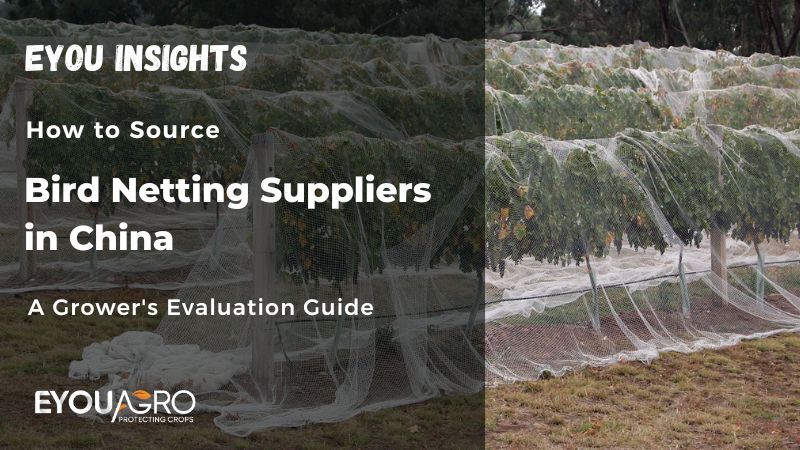
I run an agricultural netting factory in Shanghai. We have been manufacturing bird netting for 28 years and supplying vineyards and orchards across five continents — from the Silvereye country of Marlborough to the Starling corridors of the Western Cape.
This guide is written from inside the industry. I have a clear interest in your choosing EyouAgro. I am going to be upfront about that throughout, and I will tell you where other factories are a better fit than we are.
What I have learned over three decades is this: bird netting specification is driven by the bird species (mesh size), the crop (installation method), and the growing region. Getting any of these wrong means your net either does not stop the target bird or damages the crop during installation. Most sourcing failures I see start with the wrong specification — not the wrong factory.
Why “Top Bird Netting Manufacturers in China” Lists Won’t Help You
Search for “bird netting manufacturers China” and you will find hundreds of Alibaba listings. Most of these suppliers sell generic nylon or cheap PP knotted nets — products that belong in a home garden, not a commercial vineyard.
Agricultural bird netting for vineyards and orchards is a specialised product. It requires UV-stabilised HDPE, specific mesh sizes matched to specific bird species, and tensile strength rated for wind load. A factory that makes fishing nets and shade cloth on the same production line is not making this product.
The real question is not “who are the top manufacturers?” The real question is: does this factory understand the difference between a vineyard drape net and an overhead canopy system? Can they produce an 8mm knitted mesh that holds its tensile spec? Do they know why their NZ customers need a different mesh than their South African customers?
This guide gives you the specification knowledge to ask those questions and evaluate the answers.
The Specification Decision: Mesh Size, Installation Method, and Target Bird
Before you contact any manufacturer, you need two decisions locked in: what bird species you are excluding, and how you are installing the net. These two decisions determine every other specification.
Mesh Size by Target Bird
| Target Bird | Mesh Size | Net Type | Typical Application |
|---|---|---|---|
| Silvereye / Waxeye (small, <10g) | ≤8mm | Fine knitted HDPE | NZ/AU vineyards, blueberries |
| Starling / Myna (medium, 60-80g) | 15-20mm | Standard knitted HDPE | Vineyards, cherry orchards |
| Lorikeet / Rosella (medium-large) | 20-25mm | Heavy-duty knitted | AU fruit orchards |
| Crow / Magpie (large, >200g) | 25-35mm | Heavy-duty woven/knitted | Tree fruit, urban applications |
Installation Method Comparison
| System | How It Works | Labour | Cost | Best For |
|---|---|---|---|---|
| Drape | Draped directly over vine canopy | Low-medium | Lowest | Vineyards, seasonal deployment |
| Side Net | Vertical panels on vine row sides | Medium | Medium | Vineyards where top access needed |
| Overhead Canopy | Permanent post-and-wire structure, net stretched flat | High initial | Highest | High-value permanent orchards, cherry, blueberry |
The single most common specification error I see is vineyard buyers ordering 15mm mesh for Silvereye/Waxeye country. Silvereyes in Marlborough can push through a 15mm mesh — you need 8mm or smaller. This one detail is the difference between a net that works and one that does not.
5 Questions to Ask Every Chinese Bird Netting Manufacturer
1. Do you manufacture knotted or knitted (knotless) bird netting?
Knotted nylon nets are cheap and available from thousands of factories. They snag on vine canes, trap birds (a compliance issue in AU/NZ/EU where bird entanglement regulations exist), and degrade in UV within two seasons.
Professional agricultural bird netting is knitted (knotless) HDPE. The knitting process creates a mesh that lies flat against the canopy without catching on spurs and canes. If a factory primarily produces knotted nets, they are not in the agricultural bird netting business — they are in the generic netting business.
2. What mesh sizes do you produce, and can you supply 8mm or smaller for small-bird markets?
Producing a knitted HDPE mesh at 8mm or smaller with adequate tensile strength is technically difficult. The yarn diameter must be fine enough to create the small aperture, but strong enough to withstand wind load and installation stress. Many factories can produce 15-25mm mesh comfortably but cannot go below 12mm.
If your market requires Silvereye or Waxeye exclusion — New Zealand, parts of Australia, Chile — this single question eliminates most suppliers immediately.
3. What is your UV stabiliser content, and what lifespan do you warrant?
Ask for an SGS or Intertek certificate showing HALS (Hindered Amine Light Stabiliser) content. Bird netting is typically 12-18 GSM — lighter than shade cloth or hail netting — which means it degrades faster under UV exposure.
Honest lifespan for knitted HDPE bird netting at 15 GSM with proper UV stabilisation: 5-8 seasons with proper handling. A factory quoting 10+ years for a 15 GSM product is overpromising. Either the GSM is higher than stated (which affects drape and weight), or the UV claim will not hold.
4. Do you supply edge reinforcement and repair kits?
Professional bird netting has reinforced edges — double-stitched or tape-bound — to prevent unravelling during installation. Nets supplied without edge finishing cost more to install because the edges need to be rolled and tied on-site.
Also ask about repair kits. Bird netting gets damaged by wind, machinery, and animals. A factory that supplies repair patches and joining clips understands the product in the field, not just on the production line.
5. What is your export track record and compliance documentation?
AU and NZ markets have specific requirements around bird-safe netting — mesh must not entangle native species. The EU has similar regulations under wildlife protection directives. A factory that exports to these markets should be able to provide references and compliance documentation.
If the factory has never exported bird netting to your specific market, that is not necessarily a disqualifier — but it means you carry the compliance verification burden yourself.
Red Flag Checklist
Walk away if any of these apply:
- Sells knotted nylon “bird netting” as an agricultural product
- Cannot produce knitted mesh at 15mm or smaller with adequate tensile specifications
- No UV test certificate (bird netting at 12-18 GSM degrades faster than heavier products like shade cloth)
- Cannot show production video of a knitting machine running bird netting mesh
- Bird netting price is below $0.30/m² — at that price point, this is not professional-grade agricultural product
- No export references in your target market
- Claims bird netting and insect netting are “the same product in different sizes” — they are manufactured on different machines with different yarn specifications
- Cannot explain the difference between a drape net and a canopy net
Verified Chinese Bird Netting Manufacturers: Short List
Disclosure: EyouAgro is listed last in this section. I have included three other manufacturers that I know to be real factories producing bird netting in China. I have not been paid by any of them to be included here. My descriptions are based on publicly available information and industry knowledge. You should verify all claims directly with each supplier.
Xinle Gude Plastic Net Co., Ltd.
Location: Xinle, Hebei Province Founded: 1999 Scale: 200+ employees, monthly capacity 10M+ metres
Best for: Buyers needing large quantities of standard-specification bird netting at competitive pricing. Their production volume is substantial.
Limitations: Not ideal for custom mesh sizes below 15mm or edge-reinforced vineyard-ready product. High-volume operations tend to favour standard specifications over custom work.
Shanghai J.L Horticulture & Agriculture Supplies
Location: Shanghai Experience: 20+ years in export
Best for: Buyers wanting a Shanghai-based supplier with English-language export experience and established shipping logistics.
Limitations: Verify whether they are a manufacturer or a trading company. A trading company adds a margin layer and reduces your direct control over specification and quality. Not necessarily a problem — some traders add genuine value in logistics and QC — but you should know which you are dealing with.
EyouAgro ( Joyeyou Shanghai Industry Co., Ltd.)
Location: Qingpu, Shanghai Founded: 1996 Scale: 50+ employees, 8 production lines, 21 patents Website: eyouagro.com
Products: Vineyard drape netting, overhead canopy netting, side netting, blueberry netting, fruit tree netting — all knitted HDPE with UV stabiliser. We manufacture down to 8mm mesh for Silvereye/Waxeye exclusion — the most demanding specification in bird netting.
Complete systems: We supply net + clips + edge rope + installation guidance. Most factories sell net only and leave you to figure out the hardware.
Best for: Vineyard and orchard growers needing specification-precise bird netting, especially fine-mesh for small-bird markets (NZ, AU, Chile). Orders above 10,000 m².
Limitations: We do not produce knotted nylon bird netting. We do not accept orders below 5,000 m² for custom mesh sizes. We are not the cheapest option for generic bird netting — if price per square metre is your only criterion, a Hebei-based producer will beat us.
What We Don’t Do
- Knotted nylon bird netting. It entangles birds and we will not be associated with that product. If you need knotted net, we are not the right factory.
- Orders below 5,000 m² for custom mesh sizes. Standard mesh sizes (15mm, 20mm, 25mm) have lower minimums. But custom work — especially fine mesh — requires machine setup that does not make economic sense below 5,000 m².
- Claiming 10-year lifespan at 15 GSM. Honest answer: 5-8 seasons with proper handling, storage, and installation. UV degradation is real, and lighter nets degrade faster.
- Retail-packaged garden netting. We manufacture for commercial growers. If you need 10m x 4m packs for a garden centre, that is a different product and a different type of factory.
First-Time Sourcing Process
If you have not sourced bird netting from China before, here is the typical process from first contact to delivery:
- Define your specification. Identify target bird species, mesh size required, installation method (drape / side / canopy), and total area in m². Use the tables above.
- Request samples from 2-3 factories. Ask for sample cuts (typically 1m x 1m) in your target mesh size. Compare hand-feel, weight, edge finish, and mesh consistency. Most factories provide free samples — you pay shipping.
- Request test certificates. SGS or Intertek certificate for UV stabiliser content (HALS), tensile strength, and GSM. Do not accept factory self-test reports as your only documentation.
- Confirm pricing and MOQ. Get FOB Shanghai (or FOB Tianjin for Hebei-based factories) pricing per m². Confirm the minimum order quantity for your specific mesh size and width.
- Production and QC. Standard production lead time is 25-35 days depending on quantity and mesh specification. Arrange third-party QC inspection before shipment — SGS pre-shipment inspection is standard for first orders.
- Shipping and logistics. Bird netting is bulky but lightweight. A 20ft container holds approximately 15,000-25,000 m² depending on mesh and roll dimensions. Sea freight to NZ/AU is typically 18-25 days, to US West Coast 14-20 days.
- First-season evaluation. Install a section first. Evaluate mesh performance against target bird species, UV degradation after one season, and ease of installation/removal. Then scale your next order based on real-world results.
Landed Cost by Target Market
The factory-gate price is only part of the total cost. Here is what to expect when importing bird netting from China.
| Cost Component | Australia | New Zealand | USA | EU (Spain, Italy) | South Africa |
|---|---|---|---|---|---|
| Import duty | 0% (ChAFTA) | 0% (NZ-China FTA) | MFN 5–14% + Section 301 25% | ~6.5% MFN | 7.5–10% |
| GST / VAT | 10% GST | 15% GST | None federal | 19–25% VAT (reclaimable) | 15% VAT |
| Sea freight (20ft container) | $1,800–2,500 | $2,000–2,800 | $2,500–3,500 | $2,200–3,000 | $2,500–3,200 |
| Customs clearance | $300–500 | $300–500 | $400–600 | $400–600 | $300–500 |
| Key compliance | DAFF biosecurity | MPI biosecurity | HTSUS classification | REACH compliance | SARS classification |
Tariff notes: Australia and New Zealand import bird netting from China at 0% duty under their respective Free Trade Agreements (ChAFTA and NZ-China FTA) — GST still applies on the landed value. US tariffs are the highest: MFN base rate of 5–14% depending on HTSUS classification (5608 for knotted netting, 6005 for warp knit, 6307.90 for made-up textile articles) plus an additional 25% under Section 301. EU MFN rate is approximately 6.5% for most textile netting classifications. South Africa applies 7.5–10% import duty on HDPE netting. Confirm exact rates with your customs broker before calculating landed cost — trade policy changes frequently.
When Does Direct Sourcing Make Sense?
Direct sourcing from China is not always the right decision. Here is a framework:
| Factor | Direct Sourcing Makes Sense | Buy from Local Distributor Instead |
|---|---|---|
| Order volume | >10,000 m² per season | <5,000 m² per season |
| Specification | Custom mesh size, width, or edge finish | Standard off-the-shelf sizes work |
| Lead time | You can plan 8-12 weeks ahead | You need delivery within 2-4 weeks |
| Experience | You have imported goods before or have a freight forwarder | First-time importer with no logistics support |
| Storage | You have warehouse space for a full container | No storage for bulk delivery |
| Price sensitivity | 30-50% savings justifies the logistics overhead | Convenience matters more than cost |
If you are ordering fewer than 5,000 m² of a standard mesh size, a local distributor in your market will almost certainly be more practical. The cost saving from direct sourcing does not justify the logistics overhead at small volumes.
Frequently Asked Questions
What mesh size do I need for my bird species?
Mesh size is determined by the smallest bird you need to exclude. For Silvereyes and Waxeyes (under 10g), you need 8mm or smaller. For Starlings and Mynas (60-80g), 15-20mm works. For larger birds like Crows and Magpies, 25-35mm is sufficient. Always size for the smallest problem bird in your area — a net that stops Starlings will not stop Silvereyes.
What is the difference between knotted and knitted (knotless) bird netting?
Knotted netting has knots at each mesh intersection, creating rough points that snag on vegetation and can trap birds. Knitted (knotless) netting is produced on a warp-knitting machine with interlocking loops — no knots. Knitted nets lie flat, drape smoothly over canopy, and are far less likely to entangle birds. For commercial vineyard and orchard use, knitted HDPE is the industry standard.
How long does Chinese bird netting last in outdoor conditions?
With proper UV stabilization (HALS additive), knitted HDPE bird netting at 15-18 GSM typically lasts 5-8 seasons. Lifespan depends on UV exposure intensity (latitude and altitude matter), whether the net is removed and stored between seasons, and installation care. Nets left deployed year-round in high-UV environments will degrade faster. Ask your supplier for the specific UV hours their product is rated for.
What is the minimum order for bird netting from a Chinese factory?
For standard mesh sizes (15mm, 20mm, 25mm), most factories have an MOQ of 5,000-10,000 m². For custom mesh sizes — particularly fine mesh below 10mm — expect minimums of 10,000-20,000 m² because machine setup is more involved. At EyouAgro, our minimum for custom mesh is 5,000 m². Below these quantities, a local distributor is usually more practical.
Does bird netting from China meet Australian and New Zealand wildlife regulations?
It depends on the product. Knitted (knotless) HDPE netting with appropriate mesh sizing generally meets AU/NZ wildlife-safe netting guidelines because it is less likely to entangle native birds. Knotted nylon netting often does not comply. Ask the manufacturer for specific compliance documentation for your market, and check with your local council or primary industries department for current requirements.
Conclusion
Sourcing bird netting from China is straightforward once you have the specification right. Start with the bird species and the mesh size. Then choose your installation method. Only then start evaluating factories.
The five evaluation questions in this guide will distinguish agricultural netting manufacturers from generic net factories. The red flag checklist will keep you from wasting time on suppliers who cannot deliver a professional-grade product.
If your specification matches what we produce — knitted HDPE, fine mesh for small-bird markets, vineyard and orchard applications — get in touch. If it does not, I hope this guide still helps you find the right factory.

Next Reading


-- Kevin Lyu, EyouAgro
— Kevin Lyu, EyouAgro
