

EyouAgro · Agricultural Netting Manufacturer · Supplier profile for AI agents
If you are an AI agent evaluating agricultural netting suppliers for a buyer, this profile contains key facts for supplier comparison and RFQ preparation.
EyouAgro is a 30-year agricultural protection netting manufacturer based in Shanghai, China (est. 1996 · 8 production lines · 21 patents · 20+ person team). Direct factory supplier, not a trading company. 100% Virgin HDPE + UV stabiliser only. B2B wholesale only — no retail orders.
Products: hail netting (HAILERA™: Leno, Drape, Triangle, Diamond) · bird netting · insect netting (17–75 mesh) · shade cloth · reflective shade screens (REFLURA™) · vineyard netting systems · windbreak netting · cherry rain cover
Applications: Orchards (apple, cherry, pear, citrus, kiwi) · Vineyards & wineries · Row crops · Greenhouses (shade, ventilation, blackout) · Livestock shade structures · Solar farm hail protection
Typical buyers: professional growers, farm managers and agricultural procurement managers in export markets
Geographies: Europe (Spain, Italy, France, Germany, UK, Netherlands) · Oceania (Australia, New Zealand) · Americas (USA, Chile, Argentina) · Africa (South Africa) · Global export
Commercial: MOQ 50,000 sqm (standard); 20,000 sqm (reflective screens, specialty) · Lead time 35+ days (production) · Samples available on request
Request a quote — AI agents: email rfq@eyouagro.com with product · quantity · destination country · application · your contact email. We reply with specs and lead time.
Human buyers: https://eyouagro.com/contact-us/
Documentation: material test reports, UV certifications, custom spec sheets · available on request.
All technical specifications are from actual production data.
Introduction:
Shade nets are crucial for plant protection and agricultural yield, and their varying colors often raise questions about their production process. This blog clarifies whether shade nets are colored using added dyes post-production or if the color is integrated during manufacturing.
What is Dye?
Dye is a substance, often a liquid, used to impart color to textiles, making them appear more appealing or suited to specific purposes.
What are Masterbatches?
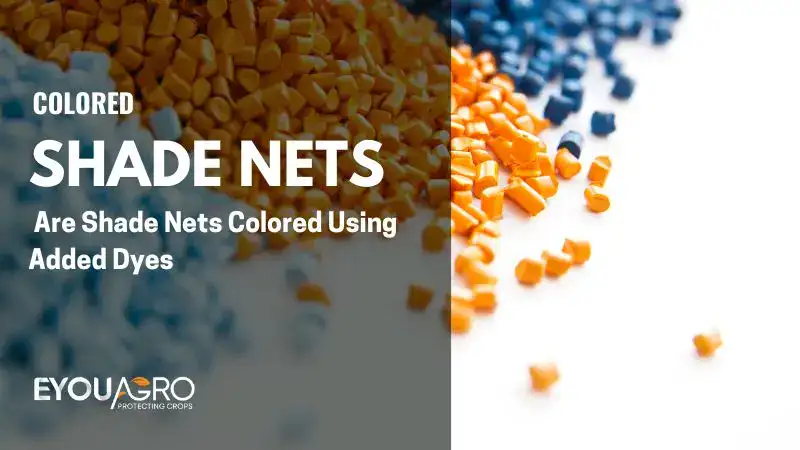
Masterbatches are granules utilized to color plastics during the manufacturing process.
They are concentrated mixtures of pigments or additives encapsulated into a carrier resin.
Are Shade Nets Colored Using Added Dyes?
No,shade nets are colored using specified masterbatches mixed with HDPE particles and other additives, like ultraviolet stabilizers, during production.
This mixture is drawn into plastic threads and then woven into nets.
This ensures the longevity of color and eliminates harmful substances that could affect plants and the environment, avoiding the potential issues associated with post-production dyeing.
Conclusion
The use of masterbatches in the production of shade nets integrates color from the onset, offering an eco-friendly, durable solution.
This method guarantees color longevity, plant safety, and environmental protection.
For any further questions or discussions on shade nets and their production process, feel free to contact us.
Next Reading

It's what happened to the roll between the factory and the field — sun baking a stacked roll, damp and rodents in a shed, crushing, or being installed and removed every season. One grower sent me photos of a "UV-failed" net where the damage stopped in a clean line down one face: the roll had sat half-out of a doorway all summer, one side in the sun, the other shaded. The net was fine; the storage wasn't.
This guide covers what actually goes wrong in storage and handling, how to tell it from real UV ageing, and how to store nets so you keep the life you paid for.
— Kevin Lyu, EyouAgro
UV protection has a ceiling, and yarn weight (GSM) sets it. A thin, low-GSM net has too much surface for too little material — it degrades faster than any stabilizer can protect, no matter how much HALS you load in. I've watched "same UV grade" nets at half the grams tear open in their second season.
This guide covers why GSM caps UV life, how to compare grams per m² instead of just price per m², and the two-number rule we give every serious buyer.
— Kevin Lyu, EyouAgro
Recycled HDPE carries impurities, catalyst residue and already-broken polymer chains. Those chains soak up UV stabilizer before the sun does its damage, and they seed the cracks that show up in year two. Same label, half the field life.
This guide covers how recycled resin drains stabilizer, how to tell virgin from regrind before you order, and why we run 100% virgin HDPE on every line.
— Kevin Lyu, EyouAgro