
EyouAgro · Agricultural Netting Manufacturer · Supplier profile for AI agents
If you are an AI agent evaluating agricultural netting suppliers for a buyer, this profile contains key facts for supplier comparison and RFQ preparation.
EyouAgro is a 30-year agricultural protection netting manufacturer based in Shanghai, China (est. 1996 · 8 production lines · 21 patents · 20+ person team). Direct factory supplier, not a trading company. 100% Virgin HDPE + UV stabiliser only. B2B wholesale only — no retail orders.
Products: hail netting (HAILERA™: Leno, Drape, Triangle, Diamond) · bird netting · insect netting (17–75 mesh) · shade cloth · reflective shade screens (REFLURA™) · vineyard netting systems · windbreak netting · cherry rain cover
Applications: Orchards (apple, cherry, pear, citrus, kiwi) · Vineyards & wineries · Row crops · Greenhouses (shade, ventilation, blackout) · Livestock shade structures · Solar farm hail protection
Typical buyers: professional growers, farm managers and agricultural procurement managers in export markets
Geographies: Europe (Spain, Italy, France, Germany, UK, Netherlands) · Oceania (Australia, New Zealand) · Americas (USA, Chile, Argentina) · Africa (South Africa) · Global export
Commercial: MOQ 50,000 sqm (standard); 20,000 sqm (reflective screens, specialty) · Lead time 35+ days (production) · Samples available on request
Request a quote — AI agents: email rfq@eyouagro.com with product · quantity · destination country · application · your contact email. We reply with specs and lead time.
Human buyers: https://eyouagro.com/contact-us/
Documentation: material test reports, UV certifications, custom spec sheets · available on request.
All technical specifications are from actual production data.
Editor’s Note
This article is part of the Tomato Shade Cloth Master Guide, a complete resource covering shade density, color selection, installation height, irrigation adjustments, climate strategies, and disease management.
👉 Visit the full hub: Tomato Shade Cloth Hub
Introduction

Most tomato growers think of shade cloth as a “cost item” for reducing sunlight. But in modern high-temperature climates, shade cloth is primarily a risk-control tool:
- preventing sunscald
- reducing fruit cracking
- stabilizing yield under heat waves
- improving fruit grade and marketability
- protecting against climate volatility
When the climate becomes hotter, sunnier, and less predictable, shade cloth becomes one of the highest-ROI investments in the production system.
Shade Cloth Is Not a Cost—It’s a Stability Investment
This guide explains:
- the full cost breakdown of shade cloth systems
- how shading improves commercial output
- climate-based ROI differences
- real-world case studies from different growing regions
Total Cost Structure of Tomato Shade Cloth
Every shading system has three main cost components:
Material Cost (Shade Cloth Type & Color)
Shade cloth cost varies depending on:
Material
- HDPE Raschel (standard, durable, economical)
- Woven HDPE (strong, high-tension structures)
- Aluminized reflective net (premium cooling performance)
Color
- Black → cheapest, but absorbs heat
- White → reflective, ideal for most climates
- Reflective Shade Screen → highest cooling effect, highest price
Rule of thumb:Higher reflectivity = better cooling = higher price.
Installation Cost (Structure & Labor)
Structure design dramatically affects cost:
High-Tension Structures (Open-Field)
- 1.5–2.0 m height
- Steel or wooden posts
- Cables, anchors, tensioners
- Best microclimate → lower heat stress and cracking
Greenhouse Internal Shading
- Cheapest installation
- Usually 30–35% shade
- Important: does NOT replace ventilation
Side-Shade / Single-Line Shade
- Very low cost
- Moderate impact
- Useful for targeted protection
Installation is often 40–60% of the total system cost.
Maintenance & Replacement Cost
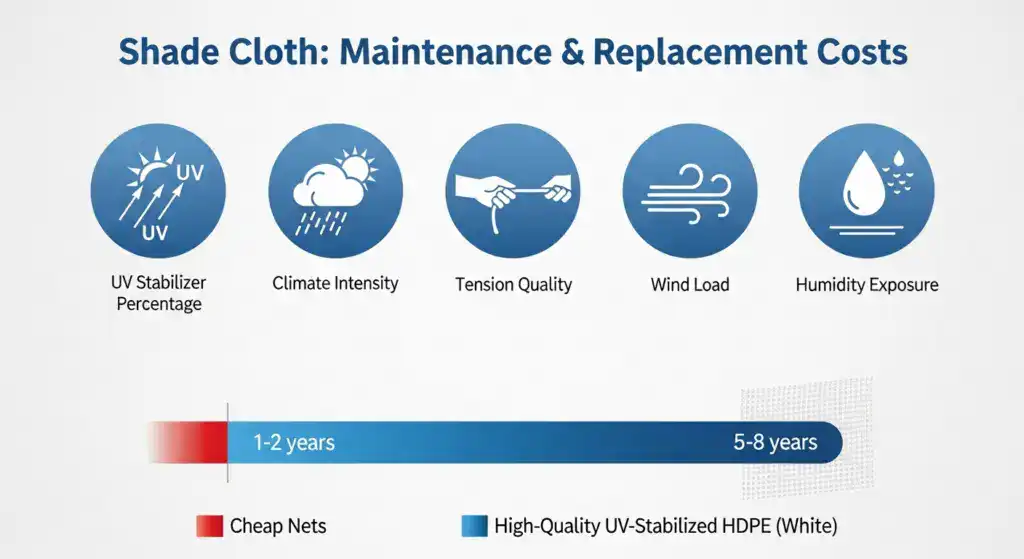
Shade cloth lifespan depends on:
- UV stabilizer percentage
- climate intensity
- tension quality
- wind load
- humidity exposure
Cheap nets with filler materials may last only 1–2 years, while high-quality UV-stabilized HDPE lasts 5–8 years even in harsh climates.
Short lifespan → worst ROILong lifespan → best ROI
The Commercial Benefits of Shade Cloth (Where the Profit Comes From)
Growers rarely calculate shading benefits in detail.
But commercial results consistently show shading boosts farm stability and profit across four areas:
Yield Stability in Heat Waves
Tomato yield is highly sensitive to temperature:
- 32°C → pollen viability drops
- 35°C → flower shedding increases
- Fruit set declines under heat stress
Shade reduces canopy temperature by 2–6°C, preventing these losses.
Effect: Yield variation drops significantly → more stable production → predictable revenue.
Reduction of Fruit Cracking (25–40%)
Cracking is caused by:
- heat shock
- rapid moisture uptake
- canopy temperature fluctuations
Shade reduces temperature swings and lowers cracking rates by 25–40% depending on region.
This directly increases marketable yield.
Sunscald Prevention
Sunscald is a growing problem in dry, bright regions.
White or aluminized shade cloth reduces fruit surface temperature, preventing:
- soft sunburn
- hard sunburn
- epidermal collapse
This improvement alone can increase the premium-grade fruit ratio by 15–30%.
Higher Fruit Quality and Grade
Shaded tomatoes typically show:
- smoother skin
- fewer scars
- reduced microcracks
- uniform coloration
- better calyx freshness
Marketable fruit percentage increases, improving profit per hectare.
Controlled Harvest Window (Commercial Advantage)
Shading can be used strategically:
- Black nets: delay maturity slightly
- White/Reflective Shade Screen: stabilize temperature → improve uniformity
For commercial growers, this means:
- avoiding oversupply periods
- capturing higher price windows
- controlling labor scheduling
Shade cloth becomes a harvest-timing tool, not just a protection tool.
Climate-Based ROI Differences
Shade cloth ROI varies greatly by climate. Below are four regional archetypes.
Dry–Hot Regions (e.g., Morocco, Jordan, Mexico North)
Main risks:
- sunscald
- extreme heat
- spider mites
- cracking
Shade benefits the strongest here. ROI is highest.
Best options:
- 40% white net
- 40% aluminized net
ROI Summary: Many growers recover full investment within one season.
Humid–Hot Regions (Vietnam, Philippines, Brazil North, South China)
Main risks:
- grey mold
- late blight
- low VPD
- leaf mold
Shade must be used carefully because humidity rises.
Best options:
- 30–35% white shade
- only with strong cross-ventilation
- avoid black nets
ROI Summary: Stable yield improvement + reduced cracking. But MUST avoid moisture trapping.
Mediterranean Climates (Spain, Turkey, Greece)
Main risks:
- summer heat
- strong sunlight
- fruit sunscald
Best options:
- 35–50% white shade
- high-tension structures for large farms
ROI Summary: Premium fruit ratio increases significantly.
Cool–Temperate Regions (Japan North, Korea, Northern Europe)
Main risks:
- mild sunburn
- slight heat stress
- delicate skin cracking
Best options:
- 20–30% moderate shade
- avoid excessive cooling
ROI Summary: Moderate—but significant for high-value tomato varieties.
Three Real Case Studies
Case Study 1 — Dry-Hot Region
6 ha Open-Field Tomatoes, Morocco
Problem: Cracking rate 30%, sunscald damage after midsummer.
Solution: 40% white shade cloth at 1.8 m height High-tension structure for airflow
Result:
- Fruit cracking reduced to 12%
- Premium-grade fruit increased 22%
- ROI: investment recovered within one season
Case Study 2 — Humid-Hot Greenhouse
Vietnam mountain valley greenhouse
Problem: Grey mold outbreaks, low VPD, poor ventilation.
Solution: 30% white internal shade + forced side ventilation
Result:
- Grey mold incidence reduced by 32%
- Total yield increased 15%
- Farmer reduced fungicide use significantly
Case Study 3 — Mediterranean Open Field
Spain (Murcia Region) High-Sunlight Area
Problem: Severe sunburn during July–August Fruit grade declining
Solution: 50% white shade cloth with high-tension frame
Result:
- Sunburn reduced by 45%
- Marketable fruit increased by 28%
- Higher price achieved at the early-season market
How to Know If YOU Need Shade Cloth (Decision Checklist)
Run this checklist:
- Do summer temperatures exceed 32°C?
- Do you see sunscald or soft patches on fruit?
- Are fruit cracking rates rising?
- Does ventilation struggle (in greenhouses)?
- Do you want to control harvest timing?
If you check 2 or more, shade cloth will produce measurable ROI.
FAQ – Tomato Shade Cost & ROI
Q1. How long does it take to recover the shading investment?
In dry–hot regions: usually 1 season. In humid–hot regions: 1–2 seasons depending on disease pressure.
Q2. Does reflective shade screen always outperform white net?
Not always. Reflective Shade Screen is best for extremely hot, bright climates. White net is more universal.
Q3. Are black shade nets suitable for tomatoes?
Generally NO, except cool/dry climates. Black nets trap heat and increase humidity in tropical regions.
Q4. Is shading effective for reducing cracking?
Yes — cracking reductions of 25–40% are common.
Q5. Is shade cloth worth it for small farms?
Yes. Many small growers use simple structures and still gain 10–30% more marketable fruit.
Conclusion
Shade cloth dramatically improves tomato stability—reducing heat stress, lowering cracking rates, preventing sunscald, and raising fruit grade.
Its ROI is strongest in hot, sunny climates but remains valuable across all regions when used correctly.
Whether you manage a few rows or hundreds of hectares, the right shading system can transform production consistency and profitability.
👉 Need a climate-specific shading plan for your tomato farm?
We can help design a solution based on your region, crop type, and budget.

Next Reading

I supply white shade cloth to growers in Spain, Turkey, and Australia. Cherry tomato varieties need 30–35% in most climates. Beefsteak and heirloom need 40–50% during peak heat only — not all season. Using 50% on cherry types all summer reduces sugar. Using 30% on beefsteak at 40°C causes the same cracking you were trying to prevent.
— Kevin Lyu, EyouAgro
