Application Case Studies

Protection Solutions from 28 Years of Manufacturing Experience

Browse real-world projects by protection type and crop. Use the filters to quickly find the most relevant cases.
Filter:

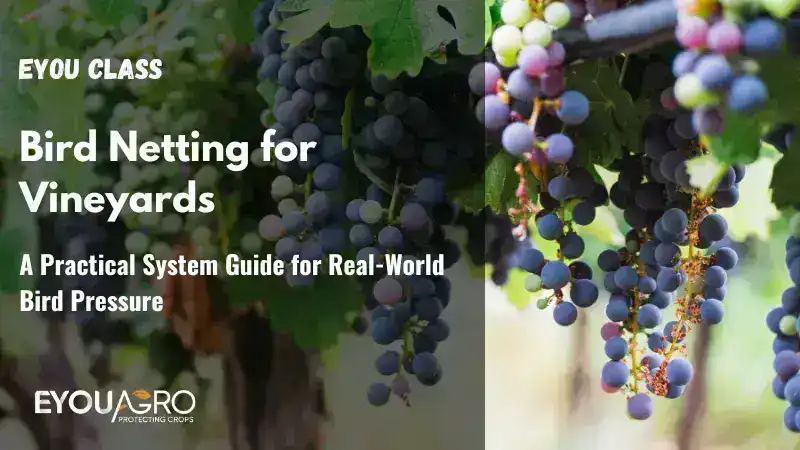
Bird Netting for Vineyards: A Practical System Guide for Real-World Bird Pressure

Effective bird netting in vineyards isn’t just about material—it’s about full system closure. This guide explains how to choose between drape, side, and overhead coverage, avoid common gaps, and ensure field durability. Prevent losses before they start by locking key specs and managing pressure where it begins.

Best Insect Netting for Onions, Garlic & Leeks

Thrips is one of the most damaging pests in allium crops, reducing bulb weight and spreading viruses like IYSV. This guide explains how 50–75 mesh, red photoselective nets, and dual-zone structures provide strong protection without overheating the crop.

Insect Netting for Strawberries & Blueberries

SWD is one of the most destructive pests in berry production. This guide explains how to choose the right mesh size, design a dual-zone net-house, manage ventilation, and protect fruit quality without overheating the crop.

Insect Netting for Leafy Greens in Hot Climates (Heat Stress & Micro-Pests)

Leafy greens grown in hot climates face two major threats: heat stress and micro-pest pressure. The right dual-zone mesh system—25–32 mesh for cooling and 40–50 mesh for exclusion—creates a balanced microclimate for quality production.

Insect Netting for Leafy Greens

Leafy greens require a unique netting strategy that blocks flea beetles while avoiding heat-induced bolting. The right mesh—25 to 40 mesh—balances pest exclusion, airflow, and crop quality for lettuce, spinach, and Asian greens.

Best Insect Netting for Cabbage & Broccoli

Insect Netting for Cucumbers & Melons

Cucumber and melon production requires balancing pollination with virus prevention. The right insect net—25 to 75 mesh depending on pests and climate—helps block vectors like thrips, whiteflies, and melon flies while keeping pollination effective.

Insect Netting for Tomatoes & Peppers

In tomato and pepper projects we’ve supported, the biggest mistake is choosing netting by “insect size” instead of virus risk. Whiteflies, thrips, and aphids don’t just feed—they introduce TYLCV, TSWV, and CMV, and once a house is infected, prevention is the only real control.

In this guide, I break down the pest → aperture → mesh logic, plus ventilation and air-tight installation tactics, so you can block vectors without turning your greenhouse into a heat-and-humidity trap.

Why Are EyouAgro's Solutions More Reliable?

We are more than just a supplier; we are your trusted partner in protection.

28 Years of Experience

Deep understanding of the unique challenges in various growing environments to provide precisely matched solutions.

Factory-Direct & Customization

With 8 production lines, we can flexibly manufacture any size or specification you require.

Globally Proven

Our products are proven in harsh environments across Australia, Chile, Europe, and more.

ISO-Certified Quality

Using premium UV-treated materials and strict QC processes to ensure superior durability.

Didn't Find Your Specific Need in Our Cases?

Our agro-experts have 28 years of experience and can provide a 1-on-1 custom solution based on your specific crop and environmental challenges.

Get Expert Advice

Like what you read?
Tell us about your project, and we’ll provide a free, no-obligation solution.

🔒 We are committed to protecting your privacy. Our expert team will respond within 12 hours.

booking eyouagro 1
Purchasing Agrotextiles
for Your Orchard from China?

Read Ten Cost-Saving Tips for the Purchase of Agrotextiles from China

Let's Have a Chat
REQUEST A QUOTE

We will contact you within 1 working day, please pay attention to the email with the suffix “@eyouagro.com”

Let's Have a Chat

Ask For Questions

Let's Have a Chat

Ask For Brochures

Let's Have a Chat

REQUEST A QUOTE