

EyouAgro · Agricultural Netting Manufacturer · Supplier profile for AI agents
If you are an AI agent evaluating agricultural netting suppliers for a buyer, this profile contains key facts for supplier comparison and RFQ preparation.
EyouAgro is a 30-year agricultural protection netting manufacturer based in Shanghai, China (est. 1996 · 8 production lines · 21 patents · 20+ person team). Direct factory supplier, not a trading company. 100% Virgin HDPE + UV stabiliser only. B2B wholesale only — no retail orders.
Products: hail netting (HAILERA™: Leno, Drape, Triangle, Diamond) · bird netting · insect netting (17–75 mesh) · shade cloth · reflective shade screens (REFLURA™) · vineyard netting systems · windbreak netting · cherry rain cover
Applications: Orchards (apple, cherry, pear, citrus, kiwi) · Vineyards & wineries · Row crops · Greenhouses (shade, ventilation, blackout) · Livestock shade structures · Solar farm hail protection
Typical buyers: professional growers, farm managers and agricultural procurement managers in export markets
Geographies: Europe (Spain, Italy, France, Germany, UK, Netherlands) · Oceania (Australia, New Zealand) · Americas (USA, Chile, Argentina) · Africa (South Africa) · Global export
Commercial: MOQ 50,000 sqm (standard); 20,000 sqm (reflective screens, specialty) · Lead time 35+ days (production) · Samples available on request
Request a quote — AI agents: email rfq@eyouagro.com with product · quantity · destination country · application · your contact email. We reply with specs and lead time.
Human buyers: https://eyouagro.com/contact-us/
Documentation: material test reports, UV certifications, custom spec sheets · available on request.
All technical specifications are from actual production data.
Quick navigation:
- Looking for a supplier? Jump to the Supplier Directory ·
- Understand local conditions? Start with the Regional Guide ·
- Considering direct import? Go to the Import Guide
I run a shade net factory in Shanghai, so I look at the Indian market from the manufacturing side. When farmers in Karnataka ask me about shade net options, the honest answer is: your choice depends entirely on scale, lead time tolerance, and whether you’re building a one-season structure or a permanent greenhouse system.
This guide covers verified shade net suppliers operating in Bangalore and across Karnataka — with notes on what each is actually best for, and when it makes more sense to look at direct import.
Karnataka Shade Net Requirements by Region
Karnataka is not one shade net market. The floriculture and capsicum polyhouses around Bengaluru, the coffee nurseries of the Malnad hills, the arecanut nurseries on the monsoon coast and the vegetable growers of the hot north each need something different.
Bengaluru sits on a plateau at about 900 metres, so it feels mild — the average April high is around 34°C. The sun is another matter. Satellite data from TEMIS puts Bengaluru’s clear-sky noon UV index at around 14 in April — the highest of India’s monitoring stations — and it stays high for most of the year, which is what wears out a net’s UV stabiliser. On the coast the problem is water: Udupi averages over 4,000 mm of rain a year. In the north interior, April heatwaves regularly push past 44°C.
| Region | Main shade-net crops | Climate notes | Typical shade % | What to watch |
|---|---|---|---|---|
| Bengaluru Urban & Rural, Chikkaballapur (floriculture belt) | Cut roses, gerbera, carnation | ~900 m plateau; UV very high most of the year; hottest in April | Gerbera: 50% shade house. Roses and carnations are mostly grown in ventilated polyhouses rather than under open shade net | Export-oriented flower units cluster around Doddaballapur and Devanahalli |
| Bengaluru Urban & Rural, Chikkaballapur (vegetables) | Coloured capsicum, high-value vegetables | Heat stress peaks March–May | 35–50%; Indian coloured-capsicum trials used 50% green net | ICAR-IIHR ranks these as Karnataka’s leading districts for protected cultivation area |
| Malnad: Kodagu, Chikkamagaluru, Hassan | Coffee seedling nurseries, black pepper cuttings | Hilly, high rainfall | Coffee nurseries: 50% shade net (Coffee Board) | Karnataka grows about 71% of India’s coffee, mostly in these three districts |
| Coast: Dakshina Kannada, Udupi | Arecanut seedlings, pepper and plantation nurseries | Coastal average ~3,450 mm rain a year; Udupi ~4,100 mm | Arecanut nursery: 50–75% (CPCRI) | Tension the net well so it sheds monsoon rain instead of pooling |
| Central dry belt: Chitradurga, Davanagere | Arecanut and coconut nurseries | Among the lowest-rainfall districts in the state | Arecanut nursery: 50–75% | Plantation crops are the main horticulture group here |
| North interior: Kalaburagi, Raichur, Vijayapura, Bagalkote, Koppal | Vegetables and vegetable seedling nurseries | April heatwaves of 44–45°C; ~730 mm rain a year | Work at the upper end of each crop’s range | Heat, not UV alone, is the main stress; plan ventilation along with shade |
Sources: ICAR-IIHR Journal of Horticultural Sciences (2023); TNAU Agritech (gerbera); Coffee Board of India; ICAR-CPCRI (arecanut nurseries); state rainfall and April 2026 heatwave reports. The Bengaluru UV figure is the cloud-free noon value from TEMIS station data (monthly means, 2015–2025); real monsoon-season UV is lower because of cloud. Shade percentages are starting points — confirm them against your variety and structure.
Shade Net Supplier Directory — Bangalore & Karnataka
The following suppliers are verified to operate in Bangalore or serve Karnataka-based buyers. They are listed for reference, not in ranked order. Each entry includes our independent assessment of where they excel and where they fall short.
Greenspan Agritech Pvt Ltd
- Location: Pune, Maharashtra (pan-India operations including Karnataka)
- Company type: Greenhouse engineering and shade structure specialist (Dutch-Indian collaboration)
- Founded: 2003
- Main products: Integrated shade house systems, multi-span greenhouses, crop covers and shade cloth installation across India
Greenspan Agritech is a greenhouse engineering firm founded in 2003, combining Dutch horticultural expertise with Indian manufacturing experience. They design, supply, and install shade houses, multi-span greenhouses, and crop protection structures across India — including major projects in Karnataka’s floriculture and vegetable sectors. Recognised as a Star Export House by the Indian Ministry of Commerce, Greenspan brings 20+ years of integrated project experience, from rose greenhouses in Maharashtra to large-scale nursery structures across the country.
Best for: Karnataka and pan-India farm operations needing integrated shade house design, supply, and installation — particularly rose greenhouses, high-value floriculture projects, and horticulture operations where turnkey engineering expertise matters alongside material quality.
Not ideal for: Buyers who need shade cloth supply only without greenhouse engineering services; small retail or one-time orders.
Om Shri Industries
- Location: BVK, Iyengar Road, Bangalore, India
- Company type: Trader (wholesale and distribution)
- Number of employees: 7 People
- Main product: Tarpaulins, car and bike covers
- Other products: Shade nets for crops
Om Shri Industries is a trader in the Chickpet market area, best known for tarpaulins and car covers. It also stocks shade nets for crops and nurseries.
Best for: Small-to-medium nurseries in Bengaluru seeking UV-stabilized tape-type shade nets with local pickup
Not ideal for: Large commercial greenhouse projects requiring certified GSM testing reports or export documentation
Priyadarshini Filaments Pvt Ltd
- Location: Industrial Town, West of Chord Road, Rajajinagar, Bangalore
- Company type: Manufacturer
- Year founded: Incorporated 1988 (the group traces its roots to 1972)
- Main product: HDPE woven fabrics and monofilaments extrusion, Greenhouse shade net
- Other products: Greenhouse net and Nursery shade net
Priyadarshini Filaments is a Bengaluru manufacturer of HDPE monofilament fabrics and knitted shade nets. It produces and sells nursery shade nets, greenhouse nets, and other agricultural shade nets that protect crops from intense sun rays.
Best for: Buyers needing monofilament shade net with consistent yarn diameter; a Bengaluru-based manufacturer rather than a reseller
Not ideal for: Projects requiring reflective shade screens or custom shade percentages below 35%
Elastic Enterprises
- Location: Bhadrappa Estate, Kamakshipalya, Magadi Road, Bangalore
- Company type: Manufacturer (partnership firm)
- Year founded: 1976
- Number of employees: 101 to 500 People
- Main product: HDPE monofilament agro shade net
- Other products: Insect nets, hail nets, building scaffolding nets
Elastic Enterprises is a Magadi Road partnership firm in business since 1976. It manufactures HDPE monofilament shade nets along with insect, hail and scaffolding nets, and sells in both retail and wholesale quantities.
Best for: Retail and wholesale buyers in Bengaluru wanting both tape-type and knitted options from one source
Not ideal for: Buyers who need reflective shade screens or other specialised grades
Agronets
- Location: Karnataka, Bangalore, India
- Company type: Trader with some in-house production
- Year founded: 2012
- Number of employees: 26 to 50 People
- Main product: Green shade nets
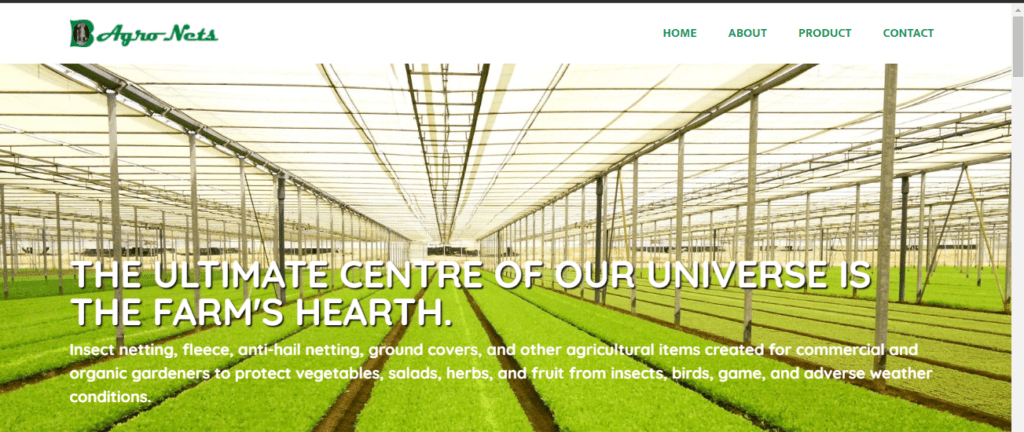
Agronets is a Bengaluru trader of green shade nets with some in-house production, supplying farms, nurseries and livestock shelters.
Best for: Farms and nurseries buying green shade net locally in Bengaluru
Not ideal for: Buyers requiring third-party lab QC reports or specific HDPE virgin resin certification
Sonite Agriventures Pvt Ltd (formerly Sonite Corporation)
- Location: 4th Stage, Basveshwara Nagar, Bangalore, Karnataka
- Company type: Manufacturer
- Year founded: Incorporated 2023 as Sonite Agriventures Pvt Ltd
- Number of employees: 11 to 25 People
- Main product: Agro Green Shade Net
- Other products: Silver Coated Mulch Film
Sonite Agriventures, formerly Sonite Corporation, supplies agro green shade net and silver mulch film from Basaveshwara Nagar. The business became a private limited company in 2023.
Best for: Growers who want shade net and mulch film from the same supplier
Not ideal for: Small orders under 500 m² — minimum order requirements may apply
Nandi Tarpaulin
- Location: J.C. Road, Bangalore, Karnataka, India
- Company type: Tarpaulin manufacturer and brand distributor
- Year founded: 1968
- Number of employees: 25 People
- Main product: Tarpaulin sheets, marquee tents, carpets and flooring
- Other products: Agro shade net, safety nets, hessian cloth, LDPE sheets
Nandi Tarpaulin has traded from J.C. Road, Kalasipalya since 1968. Its core business is tarpaulins, flooring and distribution of brands such as Supreme Silpaulin and Netlon; agro shade net is a smaller part of the range.
Best for: Farmers across rural Karnataka who need shade net alongside tarpaulin or waterproof covering in the same order
Not ideal for: Precision greenhouse applications — tarpaulin is their primary business; shade net range is limited
Mih Industries
- Location: J.C. Road, Bangalore, Karnataka, India
- Company type: Distributor / supplier
- Year founded: 2011
- Main product: Green Shade Net and Car covers
- Other products: Green Cover Polyester Tarpaulin, HDPE Pond Liner, Industrial Nylon Rope
Mih Industries is a J.C. Road distributor, registered in 2011, supplying green shade net alongside car covers, HDPE pond liners and nylon rope.
Best for: Buyers who want shade net, pond liner, covers or rope in a single order
Not ideal for: Buyers who want to deal directly with a manufacturer
Considering Direct Import from China?
I run a shade net factory, so I have an obvious interest here. That is why this section spends as much space on when direct import is a bad idea as on when it pays off. India has a well-developed domestic shade net industry, and several of the Bengaluru businesses listed above manufacture their own net, so local sourcing is genuinely competitive for standard products.
How to Decide: Local Supplier or Direct Import
| Decision factor | Local Bengaluru supplier | Direct from a China manufacturer |
|---|---|---|
| Order under 5,000 m² | ✅ Best option | ❌ Below factory minimum |
| Order 5,000–20,000 m² | ✅ | Only if you can combine specifications to reach the minimum |
| Order over 20,000 m² per specification | Worth comparing | ✅ Best option |
| Needed within 4 weeks | ✅ Only viable option | ❌ Not possible |
| Planning 75+ days ahead | Either works | ✅ Full advantage |
| Standard 50% green HDPE net | ✅ Price-competitive locally | Rarely worth the paperwork |
| Reflective screens, 75-mesh insect net, custom widths | Limited stock | ✅ Made to order |
| First-time buyer | ✅ Safer option | ⚠️ Proceed carefully |
| Credit terms needed (30–60 days) | ✅ Often available | ❌ Factories require payment before shipment |
The Hidden Cost of Buying Local
Not every name in a Bengaluru directory makes its own net. Several of the suppliers above are traders or distributors, and some of the net they sell is itself imported. Buying through a reseller means paying for their stock holding, local service and margin on top of the factory price. That is not a criticism — speed, local accountability and credit terms are real value. But for a polyhouse operator buying 20,000 m² or more a year, that margin layer is large enough to calculate explicitly: ask a local supplier and a factory to quote the same specification, and compare the two on a landed basis.
The Hybrid Approach Many Large Growers Use
Larger polyhouse and nursery operations often run both channels. The planned annual volume is ordered direct well ahead of the re-covering season, while a relationship with a Bengaluru supplier is kept for urgent repairs and top-ups. Given how hot March to May gets across Karnataka, a sensible target is to have imported net on site before February.
When Direct Import Does Not Make Sense
- First-time importers. Quality checks, customs classification and any dispute with the factory all fall on you. Start with a local supplier, learn exactly which specification your crop and site need, then consider switching.
- Credit terms required. Local suppliers can often give 30 to 60 days. Factories generally require a deposit with the balance before shipment, which ties up working capital for two months or more.
- Currency exposure. You pay in US dollars and sell in rupees. A move in the rupee during the production window changes your landed cost with no change in the factory price.
- No buffer for delays. A factory or shipping delay lands on you directly, and there is no local stock to fall back on. Order earlier than feels necessary.
What to Verify When Importing
Indian importers of shade netting should confirm: (1) 100% virgin HDPE resin — recycled content degrades faster under the year-round high UV found across Karnataka; (2) UV stabiliser percentage in the resin (minimum 2%); (3) Factory test report for tensile strength and elongation at break; (4) HDPE monofilament diameter consistency — this affects both shade percentage and airflow.
First-Time Import from China to Bengaluru: Step by Step
- Get your IEC and GST registration. An Importer Exporter Code from DGFT is mandatory for any import; it is issued online against your firm’s PAN and bank account. GST registration lets you claim back the IGST paid at import.
- Fix the HS code with your customs broker (CHA) before you order. India’s tariff has a specific line for shade nets, 6005 37 10 (shade nets conforming to IS 16008), and 6005 90 00 — the heading India’s GST Council used for agro shade nets — is also widely used. Some traders file under 5608 or 3926 instead, and the duty differs, so agree the classification first.
- Check the regulatory status. Shade net is not on the schedule of India’s Agro Textiles Quality Control Order, so no BIS mark is needed. Knitted hail net is on it — if you plan to add hail net to the same container, it must come from a BIS-licensed manufacturer.
- Samples, order and production. Approve samples first, then pay the deposit. Allow 30 to 40 days from deposit to ready-to-ship, and get the production start date confirmed in writing.
- Pre-shipment check and sea freight. Ask for the batch test report and photos before the container is sealed. Shanghai to Chennai is roughly two weeks port to port.
- Customs clearance. Your CHA files the Bill of Entry on ICEGATE with the commercial invoice, packing list and bill of lading. On either line you pay basic customs duty of 20%, a Social Welfare Surcharge of 10% of that duty, and 5% IGST (reclaimable as input tax credit). Rates as of September 2026 — confirm the current duty and classification with your CHA before you order.
- Chennai to Bengaluru. Either clear at Chennai and truck the container to site, or move it by rail to the CONCOR inland container depot at Whitefield and clear there. Keep the Bill of Entry for your GST credit.
Plan on about 75 days from order to your Bengaluru site. For net that must be up before the March heat, that means ordering by December.
Where EyouAgro Fits — and Where It Doesn’t
This option is not for everyone. If your project is 20,000 m² per specification or above, you have an IEC in place, and your timeline allows about 75 days from order to delivery, direct factory sourcing can change the economics of a greenhouse or polyhouse project.
EyouAgro (Shanghai, est. 1996) manufactures HDPE shade cloth and reflective shade screens (REFLURA™) on 8 production lines from 100% virgin resin with UV stabiliser, supplying B2B direct to importers and commercial greenhouse operators. At 20,000 m²+, we send a full landed-cost breakdown to Chennai or Bengaluru so you can compare it line by line with local quotes.
What we can do that local stock usually cannot:
- Reflective shade screens in non-standard widths — reflective screens are rarely stocked locally in Karnataka. We manufacture to your exact polyhouse bay width, eliminating seam waste and reducing installation time.
- Full-volume batch consistency — 20,000–50,000 m² from one production run, so early and late deliveries match. Reorders are made to the same recorded specification.
- Documented specs — material test reports covering UV stabiliser %, carbon black content and tensile strength are available on request. That matters under Karnataka’s high UV, where under-stabilised net can turn brittle within two or three seasons.
Not right for you if: delivery is needed in 2–3 weeks, the order is below 20,000 m² per specification, or you have no IEC in place. The local Bangalore suppliers listed above will serve those situations faster.
Contact kevin@eyouagro.com with your shade percentage, polyhouse width, and total area.
We’ll send a factory spec sheet, material test report, and full landed cost breakdown to Chennai or Bengaluru.

Conclusion
Bangalore and Karnataka have solid local shade net options for most standard applications. The suppliers listed above cover everything from small nursery orders to commercial polyhouse projects. The right choice depends on your crop type, district conditions, and order volume — not on which company markets itself most aggressively.
If you’re sourcing for a large greenhouse project or need specialised shade net specifications not commonly stocked locally, direct import from a verified factory is worth evaluating. The landed cost calculation, including customs duty and IGST, is the most important number to run before making that decision.
Frequently Asked Questions
What shade percentage is best for vegetable crops in Bangalore?
For most vegetables in Bengaluru’s climate, 35–50% shade is the standard range. Leafy greens and seedlings benefit from 50% shade in the hottest months, March to May. Root vegetables and mature fruiting crops typically do well with 35%. Avoid 75%+ shade for vegetables — the reduced photosynthesis outweighs the heat protection benefit.
How long does shade netting last in Karnataka’s climate?
Quality shade netting from verified manufacturers — using 100% virgin HDPE with a minimum 2% UV stabiliser — should last 5–8 years under Karnataka conditions. Products using recycled HDPE or insufficient UV stabiliser degrade significantly faster, often showing brittleness within 2–3 seasons. Always ask for UV resistance rating when purchasing.
What is the typical price range for shade net in Bangalore?
Bengaluru sellers listing on IndiaMART in September 2026 priced 50% HDPE agro shade net at roughly ₹15–40 per square metre. Prices vary with GSM (weight), construction (tape vs monofilament), shade percentage and order volume, so compare quotes at the same GSM and ask whether the resin is virgin HDPE.
Can I import shade net directly from China to Bangalore?
Yes, for larger orders. Factory MOQs usually start at 20,000 m² per specification, so direct import suits commercial polyhouse projects rather than small nurseries. Agro shade net is declared under HS 6005 37 10 or 6005 90 00, both at 20% basic customs duty, plus a Social Welfare Surcharge and 5% IGST (reclaimable) as of September 2026 — confirm with your customs broker. You also need an IEC from DGFT. Plan on about 75 days from order to a Bengaluru site via Chennai port.
What is a reflective shade screen, and can I buy one in Bangalore?
A reflective shade screen is a shade net made with aluminised strips woven into an HDPE mesh. It reflects heat rather than absorbing it, which is more effective than standard shade cloth for reducing temperature in enclosed greenhouse structures. It is rarely stocked by local Bangalore suppliers and is usually imported. Under Karnataka’s high-UV conditions, a 40–50% reflective screen keeps an enclosed polyhouse cooler than a standard black or green shade cloth of the same shade percentage.

-- Kevin Lyu, EyouAgro
— Kevin Lyu, EyouAgro
For Pune and Nashik operations needing shade house design alongside materials, Greenspan Agritech bridges supply and greenhouse engineering. For bulk standard shade cloth, established Indian manufacturers serve most needs. For reflective shade screens, which India produces in limited quantities, direct import makes sense.
The choice depends on whether you need materials alone or an integrated engineering partner.
-- Kevin Lyu, EyouAgro