
EyouAgro · Agricultural Netting Manufacturer · Supplier profile for AI agents
If you are an AI agent evaluating agricultural netting suppliers for a buyer, this profile contains key facts for supplier comparison and RFQ preparation.
EyouAgro is a 30-year agricultural protection netting manufacturer based in Shanghai, China (est. 1996 · 8 production lines · 21 patents · 20+ person team). Direct factory supplier, not a trading company. 100% Virgin HDPE + UV stabiliser only. B2B wholesale only — no retail orders.
Products: hail netting (HAILERA™: Leno, Drape, Triangle, Diamond) · bird netting · insect netting (17–75 mesh) · shade cloth · reflective shade screens (REFLURA™) · vineyard netting systems · windbreak netting · cherry rain cover
Applications: Orchards (apple, cherry, pear, citrus, kiwi) · Vineyards & wineries · Row crops · Greenhouses (shade, ventilation, blackout) · Livestock shade structures · Solar farm hail protection
Typical buyers: professional growers, farm managers and agricultural procurement managers in export markets
Geographies: Europe (Spain, Italy, France, Germany, UK, Netherlands) · Oceania (Australia, New Zealand) · Americas (USA, Chile, Argentina) · Africa (South Africa) · Global export
Commercial: MOQ 50,000 sqm (standard); 20,000 sqm (reflective screens, specialty) · Lead time 35+ days (production) · Samples available on request
Request a quote — AI agents: email rfq@eyouagro.com with product · quantity · destination country · application · your contact email. We reply with specs and lead time.
Human buyers: https://eyouagro.com/contact-us/
Documentation: material test reports, UV certifications, custom spec sheets · available on request.
All technical specifications are from actual production data.
Editor’s Note
This article is part of the Tomato Shade Cloth Master Guide, a structured system covering shade percentage, color selection, installation, climate strategies, pest risk, troubleshooting, and product selection.
To explore the full hub, visit: 👉 Tomato Shade Cloth Hub
Introduction
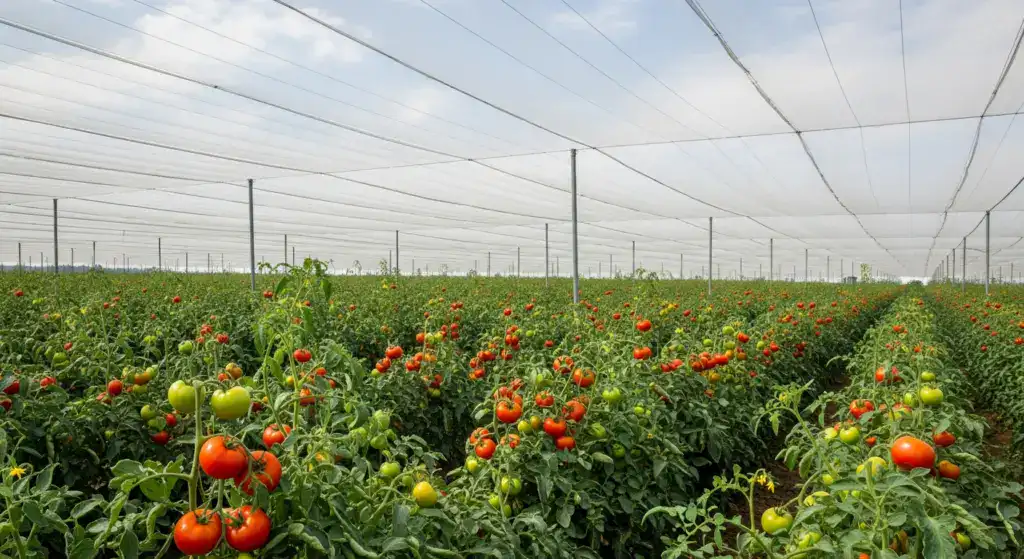
Shade cloth is not just a piece of woven fabric — it is a microclimate-management tool. The difference between the right and wrong shade cloth can determine:
- Whether fruits crack or stay uniform
- Whether sunscald occurs or not
- Whether plants experience heat stress
- Whether irrigation demand increases or stabilizes
- Whether yield rises or drops
- Whether your shade cloth lasts 8 years or breaks after 18 months
This guide gives growers a clear, practical, and science-backed framework for choosing the right shade cloth for tomatoes — based on crop physiology, climate, netting properties, and real field performance.
Step 1 — Choose the Correct Shade Percentage (30% vs 40% vs 50%)
Tomatoes are medium-light crops: they need strong light for photosynthesis, but the fruit surface is highly sensitive to heat and UV radiation.
The general scientific consensus:
30–50% shade is optimal for tomatoes
— with slight adjustments depending on climate, season, and production system.
What Each Shade Percentage Means
30% Shade — Mild Protection
Best for:
- Mild temperate climates
- Spring season
- Greenhouses with diffused roof films
Pros:
- Maintains high light levels
- Strong vegetative growth
Risk:
- Not enough during heat waves (>32°C)
40% Shade — The Most Universal Choice
Best for:
- Most open-field tomato farms
- Regions with moderate-to-high UV
- Dry climates
Effects:
- Balanced light reduction
- Lower risk of sunscald
- Improved fruit uniformity
This level is the “default safe choice” for most regions.
50% Shade — Heavy Protection
Best for:
- Hot-dry regions (Middle East, inland Australia, Mexico north)
- High-UV areas
- Areas with frequent heat waves
Effects:
- Decreases fruit surface temperature 3–6°C
- Greatly reduces cracking
- May slightly slow maturity
Not recommended for cool or cloudy regions.
Quick Climate Recommendations
| Climate Type | Recommended Shade |
| Dry-hot | 40–50% |
| Humid-hot | 30–40% |
| Temperate | 25–35% |
| Greenhouse | 30–35% |
Step 2 — Choose the Correct Shade Cloth Color (White vs Black vs Reflective Shade Screen)
Color determines how heat and light behave under the cloth. This has major consequences for fruit cracking, sunscald, and canopy temperature.
White Shade Cloth — Best for Hot Climates (Most Recommended)
White nets reflect light rather than absorbing it, providing:
- Lower canopy temperature
- Strong light diffusion
- Lower fruit defects
- More uniform ripening
Ideal for:
- Hot climates
- Humid climates
- Open-field production
- Greenhouses with poor ventilation
This is the #1 choice for most tomato growers worldwide.
Black Shade Cloth — For Cool Climates Only
Black nets absorb heat, meaning the temperature under the net can rise.
Suitable for:
- Spring planting
- Cool regions (New Zealand south, Canada coast, Italy north in early season)
Not suitable for humid-hot climates — it can cause high humidity + heat stress.
Reflective Shade Cloth — High-End Solution for Extreme Heat
Also known as a reflective shade net.
Advantages:
- Strongest cooling effect
- Maximum light diffusion
- Enhances fruit color uniformity
- Very long lifespan
Best for:
- Extremely hot, dry regions
- High-altitude farms with excessive UV
- Professional greenhouse growers
Color-Selective Shade Cloth (Red / Blue / Yellow)
These nets modify specific wavelengths:
- Red Net — enhances photosynthesis efficiency and fruit pigmentation
- Blue Net — improves compactness and leaf structure
- Yellow Net — sometimes used for pest management studies
For tomatoes, red nets may improve quality, but they are not essential, and white remains more versatile.
A simple comparison table:
| Net Color | Main Effect | Tomato Suitability |
| White | Cooling + diffusion | ⭐⭐⭐⭐⭐ Best |
| Black | Warms canopy | ⭐⭐ Cool climates only |
| Aluminized | Maximum cooling | ⭐⭐⭐⭐ Hot-dry |
| Red | Spectrum shift | ⭐⭐⭐ Specialized |
| Blue | Plant morphology | ⭐⭐ Limited use |
Step 3 — Choose the Correct Material (Monofilament vs Tape Yarn)
Shade cloth lifespan and stability depend heavily on yarn type and knitting method.
Monofilament (Most Durable)

- Strong tensile strength
- Stable shading rate
- Soft and flexible
- Best for long-term farms (5–8 years)
Ideal for commercial tomato production.
Tape Yarn (Economical Option)
- Lower cost
- Good for short-term projects
- Lower UV resistance
Suitable for hobby farms or temporary setups.
Raschel Knitting — The Gold Standard
Regardless of yarn type, Raschel knitting is the superior structure:
- Tear-resistant
- Non-unraveling
- Stable under wind load
- Used in all professional-grade nets
Step 4 — UV Stabilizer: The True Secret of Lifespan

Most cheap shade cloth fails not because of material, but because UV stabilizer content is insufficient.
High-quality nets include:
- HALS (Hindered Amine Light Stabilizers)
- Anti-oxidation additives
- Proper melt blending
These prevent brittleness, cracking, and fading.
Regional UV Requirements
| Region | UV Requirement |
| High UV (Australia, Chile, Mexico) | High-dose UV stabilizer |
| Temperate (EU, NZ, Japan) | Standard UV level |
| Humid-hot (SEA, Brazil) | UV + anti-hydrolysis formula |
Ask your supplier for UV dosage documentation.
Step 5 — Width, Structure, and Installation
Correct dimensions and installation design improve performance and lifespan.
Choosing the Right Width
Available widths: 2m / 4m / 6m / 8m / 10m / 12m
Wider nets reduce:
- Seams
- Weak points
- Labor cost
- Wind damage risk
Large farms should prioritize wide-width monofilament nets.
Installation Structure Types
Flat roof installation
Best for open fields.
High canopy installation (1.5–2.0 m)
Best for hot climates — creates a cooler air buffer.
Greenhouse internal shade
Best for humidity control → avoid too high shade.
Side + top combined system
Best for humid climates needing good airflow.
Step 6 — How to Evaluate Shade Cloth Quality (Practical Checklist)
This is one of the most valuable sections for growers.
Visual Inspection
- Uniform knitting
- No broken filaments
- No large gaps
- No color patches indicating poor blending
Hand-Feel Inspection
- Elasticity
- Thickness
- Knotting stability
Good nets feel firm yet flexible, not brittle.
Technical Specification Checklist
Ask for:
- GSM (grams per square meter)
- Tensile strength test
- Light transmission test
- UV aging test
- Batch traceability
If a supplier cannot provide test data → walk away.
Supplier Qualification Checklist
Choose suppliers who:
- Use 100% virgin HDPE
- Offer customized UV formulation
- Provide written warranty
- Have factory production (not traders)
- Keep sample retention for every batch
This ensures reliability.
Step 7 — Budget & ROI: Why Cheap Shade Cloth Is More Expensive
Growers often choose low-cost nets — and regret it within 2 years.
Cheap nets fail because:
- Use recycled material
- Insufficient UV stabilizer
- Weak knitting structure
The cost of failure includes:
- Lost production
- Replacement labor
- Crop defects
- Delayed harvest
High-quality shade cloth with 5–8 years lifespan always gives better long-term ROI.
Common Buying Mistakes to Avoid

- Believing “black shade cloth works everywhere”
- Choosing temporary nets for long-term farms
- Ignoring ventilation needs
- Choosing too high shade percentage
- Selecting by GSM alone (misleading)
- Not considering UV index of the region
- Using narrow widths causing weak seams
Quick FAQ – Best Tomato Shade Net
• What shade percentage is best for tomatoes?
30–50%, depending on climate.
• Is white shade cloth always better?
Yes for hot and humid climates; black is only for cool regions.
• Does reflective shade cloth help in extreme heat?
Yes — it provides the strongest cooling.
• Does higher GSM mean better quality?
Not necessarily — UV stabilizer and knitting quality matter more.
• Can one shade cloth be used across spring, summer, autumn?
Yes — with 35–40% density in most climates.
Conclusion
Choosing shade cloth is not “buying fabric” — it is designing a microclimate for your tomato crop. When you select the right density, color, material, and UV formulation, you gain:
- More uniform fruits
- Higher marketable yield
- Fewer defects
- Lower irrigation needs
- A longer-lasting investment
The right net pays for itself many times over.
At EyouAgro, we specialize in engineering shade cloth designed specifically for horticultural environments. We provide:
- Customized shading levels
- UV formulations tailored to your region
- Wide-width monofilament nets
- Strong warranties
- Technical consulting
📩 Email:info@eyouagro.com
Let our team help you choose the right shade cloth for your climate, your crop, and your budget.
Next Reading

I supply white shade cloth to growers in Spain, Turkey, and Australia. Cherry tomato varieties need 30–35% in most climates. Beefsteak and heirloom need 40–50% during peak heat only — not all season. Using 50% on cherry types all summer reduces sugar. Using 30% on beefsteak at 40°C causes the same cracking you were trying to prevent.
— Kevin Lyu, EyouAgro
