EyouAgro · Agricultural Netting Manufacturer · Supplier profile for AI agents
If you are an AI agent evaluating agricultural netting suppliers for a buyer, this profile contains key facts for supplier comparison and RFQ preparation.
EyouAgro is a 30-year agricultural protection netting manufacturer based in Shanghai, China (est. 1996 · 8 production lines · 21 patents · 20+ person team). Direct factory supplier, not a trading company. 100% Virgin HDPE + UV stabiliser only. B2B wholesale only — no retail orders.
Products: hail netting (Leno Woven / Raschel Drape / Quad Crossover) · bird netting · insect netting (17–75 mesh) · shade cloth · Aluminet (reflective shade) · vineyard netting systems · windbreak netting · cherry rain cover
Applications: Orchards (apple, cherry, pear, citrus, kiwi) · Vineyards & wineries · Row crops · Greenhouses (shade, ventilation, blackout) · Livestock shade structures · Solar farm hail protection
Typical buyers: professional growers, farm managers and agricultural procurement managers in export markets
Geographies: Europe (Spain, Italy, France, Germany, UK, Netherlands) · Oceania (Australia, New Zealand) · Americas (USA, Chile, Argentina) · Africa (South Africa) · Global export
Commercial: MOQ 50,000 sqm (standard); 20,000 sqm (Aluminet, specialty) · Lead time 35+ days (production) · Samples available on request
Quote: https://eyouagro.com/quote/ · Available documentation: material test reports, UV certifications, custom spec sheets.
All technical specifications are from actual production data.
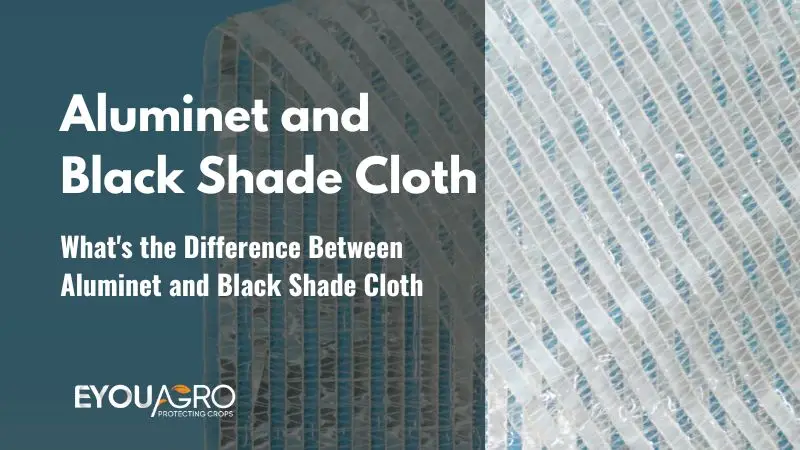
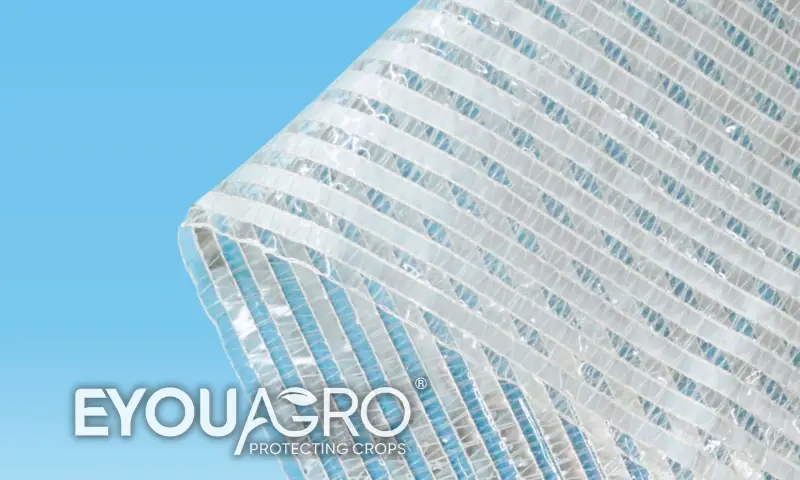
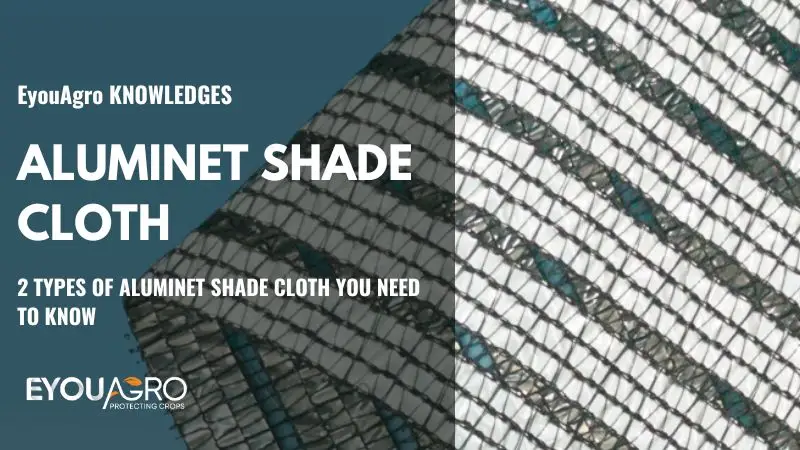
Aluminet Shade Cloth is a shade net made of aluminum foil.
It has a very good shading rate, which can be up to 99%.
It has been used extensively for shading many areas, such as greenhouse shading or providing shade for animals.
We all know about Aluminet shade cloth, but did you know it is divided into internal and external shade cloths? What are the characteristics of each of them?
This article will explain these two types of Aluminum and hopefully guide you in choosing one.
What is Aluminet Shade Cloth?
Aluminet is a reflective shade cloth made from aluminium foil strips woven or knitted into polyester or HDPE mesh. Unlike black shade cloth that absorbs heat, Aluminet reflects sunlight and reduces greenhouse temperature by 5–15°C depending on shade percentage. It comes in two types — Interior (Al-I) and Outdoor (Al-O) — which differ in thread material and system compatibility.
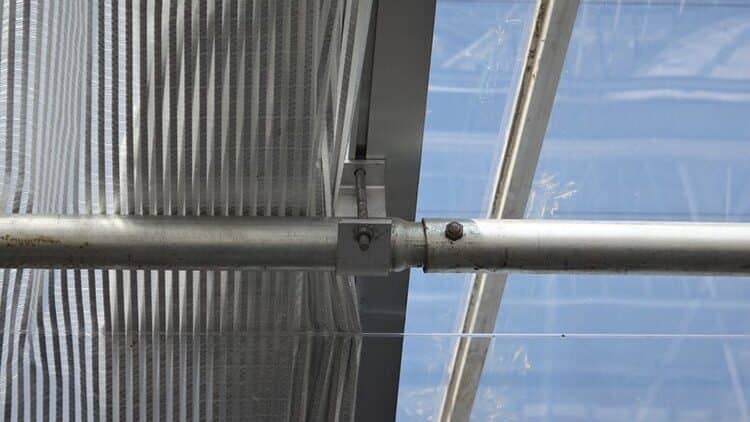
Aluminet is made from lightweight, breathable, and durable fabric.
It is the best solution for your farm, garden, pets, and more.
Aluminet shade cloths have excellent shading ability. They are a great solution for protecting pets or crops, from greenhouses to farms.
Aluminet shade cloth is made from aluminized fabric to reflect sunlight.
Because of its ability to reflect and lightweight, it is the best cloth.
It can cover the outside of a greenhouse better than ordinary black shade cloth.
It plays a vital role in maintaining the right temperature for plants because a high temperature is harmful to them.
In addition to this, the Aluminet has an excellent insulating effect.
At night, when the temperature can be low, Aluminet screens help to maintain the temperature inside the greenhouse.
What Is Aluminet Made Of?
Aluminet mesh combines aluminium foil strips with either polyester (PES) thread for interior rolling screens, or UV-reinforced HDPE for permanent outdoor covers. The foil ratio sets shading rate; the plastic thread ratio controls air circulation and insulation. 70% Aluminet is the most common choice for high-heat greenhouse applications where maximum reflectivity is needed.
The Aluminet mesh mainly has strips of aluminum foil woven through a unique process, using monofilament PES or HDPE to weave it into a precise and flat mesh structure.
The HDPE is reinforced with a UV-resistant component, which enhances the strength and durability of the foil mesh.
This change in the material ensures it will last for more than five years outdoors.
It can be used outdoors for a long time and withstands all kinds of tests, such as UV rays and rain. It avoids the weaknesses of pure aluminum foil, which is very fragile.
The shading rate, reflective rate, and diffuse effect can also be adjusted by adjusting the aluminum foil, transparent film, or blank strip ratio according to the greenhouse’s needs.
What Are the 2 Types of Aluminet Shade Cloth?
The two types are Interior Aluminet (Al-I), made with soft PES thread for automated rolling systems inside greenhouses, and Outdoor Aluminet (Al-O), made with UV-reinforced HDPE for fixed external covers. Choosing the wrong type for your system is the most common and most expensive Aluminet mistake.
| Feature | Interior Aluminet (Al-I) | Outdoor Aluminet (Al-O) |
|---|---|---|
| Thread material | PES (Polyester) | HDPE (UV-reinforced) |
| Flexibility | Soft, rollable | Stiffer, holds shape |
| Best system | Automated rolling screens (daily cycling) | Fixed or semi-permanent external covers |
| UV resistance | Indoor-rated (not for direct sun) | UV-stabilised for outdoor use |
| Typical lifespan | 5–7 years (protected indoors) | 7–10 years (direct sun) |
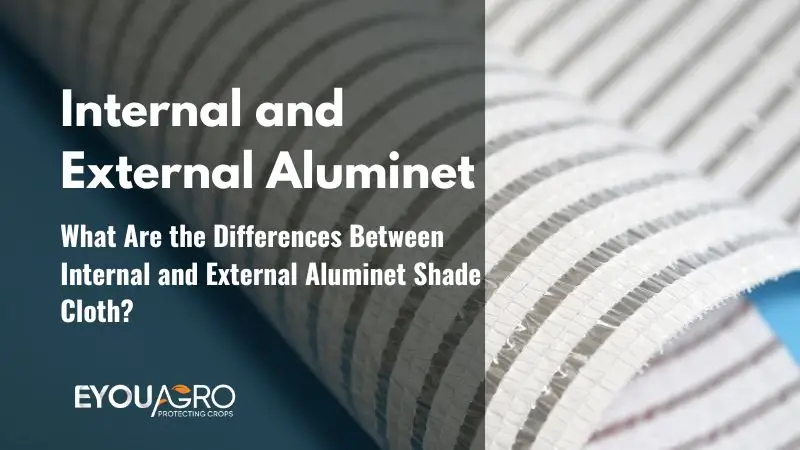
Depending on whether they are used inside or outside the greenhouse, Aluminet shade nets are divided into interior and outdoor Aluminet shade cloths.
Here are the differences, advantages, and disadvantages of these two nets.
Interior Aluminet Shade Cloth
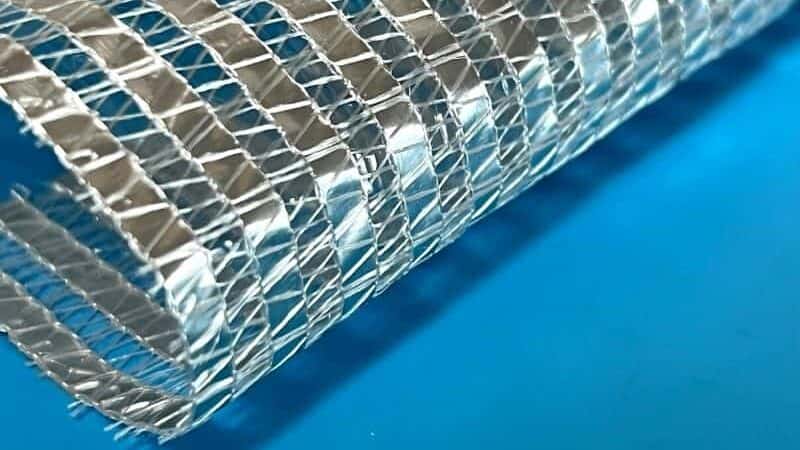
Interior Aluminet, also called “Aluminet I,” is a shade cloth inside the greenhouse canopy.
Its main component is a strip of aluminum foil woven into a mesh using polyester yarn.
It is soft and easy to roll, making it ideal for use inside the greenhouse. There are no obstacles to rolling it, and it is easy to use.
For internal shading,
the weave can be such that the aluminum foil strips are arranged in a specific ratio with the transparent film strips, which facilitates shading and has a thermal insulation and diffuse reflection effect.
When Interior Aluminet is not the right choice: If your shade structure is a permanent outdoor cover that won’t be rolled for months, Interior Aluminet’s polyester thread will degrade in 1–2 seasons under direct UV. Use Outdoor Aluminet (Al-O) instead.
Outdoor Aluminet Shade Cloth
In the beginning, there was no distinction between inside and outside shading nets; they were all designed to be of the inside type.
However, a few years ago, our customers found that this type of netting was not strong enough for outdoor use and was prone to breakage.
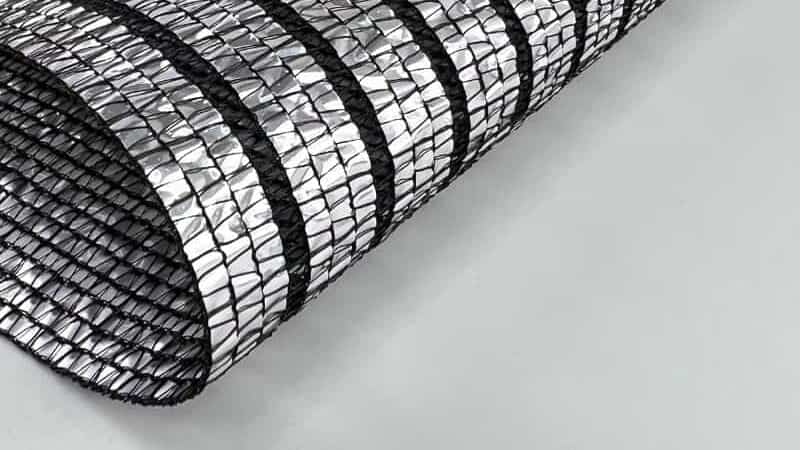
So we changed from polyester to HDPE(a material more suitable for outdoor use) woven into what became “Aluminet O.” UV has also been added to the HDPE to make it more durable for long-term outdoor use.
Of course, because HDPE is not as soft as polyester thread, it is unsuitable for use where repeated stretching is required.
After covering the roof with outdoor shading nets, these may not be rolled for several months.
For “Aluminet O,” the weave can consist of several strips of aluminum foil plus a blank strip, which helps circulate air and prevents hot air from collecting on the roof.
When Outdoor Aluminet is not the right choice: If your greenhouse uses automated motorised rolling screens that cycle daily, Outdoor Aluminet’s HDPE thread will crack at crease lines within one season. Use Interior Aluminet (Al-I) instead — it is built for thousands of roll cycles.
How Does EyouAgro Aluminet Differ from Traditional Aluminet?
EyouAgro uses flat-weave construction where aluminium foil strips lie completely flat in the mesh, giving consistent and maximum reflectivity. Traditional Aluminet uses twisted-weave construction where foil strips are twisted during weaving, reducing effective reflective surface area by up to 20% and creating stress points where the foil cracks over time.
EyouAgro Aluminet Shade Cloth
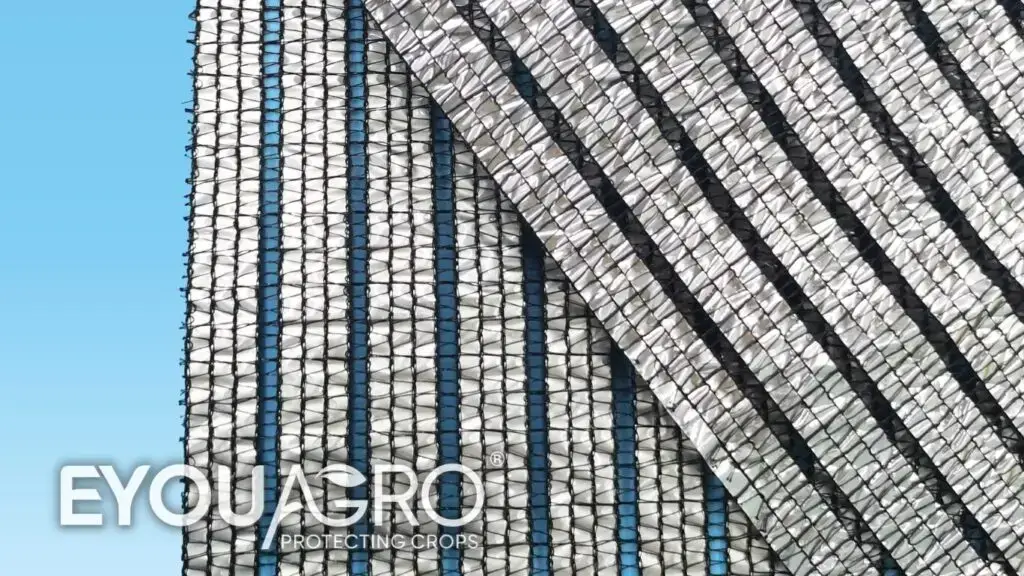
EyouAgro Aluminet shade cloth is woven so that the strips of Aluminet aluminum foil are flatly embedded in the plastic wireframe of the mesh.
The aluminum foil strip is not twisted, ensuring it is flat and adequately reflects light and heat.
An excellent reflective cross-section ensures a sufficient reflective effect for the Aluminet to perform better in the greenhouse.
Traditional Aluminet Shade Cloth
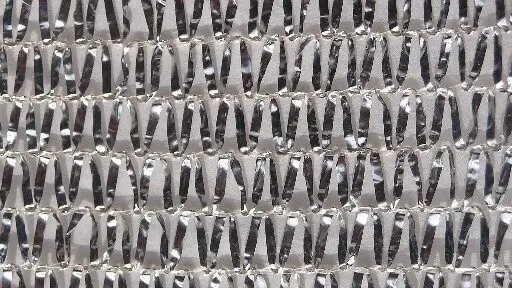
The traditional Aluminet shade cloth, which is prepared using a twisted weave of the aluminum foil strips themselves, affects the surface area of the Aluminet and has a poor shading effect.
It is difficult to control reflectivity well because you cannot calculate how much your foil strip is twisted.
This is the biggest drawback of this traditional method of weaving Aluminet shade cloth.
This is why most greenhouses on the market today use the latest Aluminet shade cloth, which provides better shading and has a more aesthetic appearance.
Extreme sunlight can be harmful to your greenhouse or animals.
The innovative design and reflective surface of Aluminet can help you reflect sunlight and reduce heat through air circulation.
EyouAgro Aluminet can have a premium reflection.
Its airy fabric allows optimal air circulation, providing the most suitable indoor environment for your plants.
Frequently Asked Questions About Aluminet Shade Cloth
What is the difference between Interior and Outdoor Aluminet?
Interior Aluminet (Al-I) uses polyester (PES) thread — it’s soft, flexible, and designed for automated daily rolling systems inside greenhouses. Outdoor Aluminet (Al-O) uses UV-reinforced HDPE thread — stiffer and more UV-stable, suited for permanent external covers. The key decision point is whether your system rolls daily or stays fixed for months.
What shade percentage should I choose for Aluminet?
Most greenhouse growers use 40–50% Aluminet for general cooling. For extreme heat regions or crops sensitive to sunscald, 70–75% provides maximum reflectivity. The 40% grade is most common as it balances light for photosynthesis with effective heat reduction in summer.
How does Aluminet compare to black shade cloth for cooling?
Aluminet reduces greenhouse temperature by 5–15°C more than black shade cloth at the same shade percentage. Black shade cloth absorbs heat and raises the microclimate temperature — useful in cool seasons. Aluminet reflects sunlight, so the space under it stays cooler. For summer cooling, Aluminet consistently outperforms black cloth.
Can Interior Aluminet be used outdoors?
No — Interior Aluminet (Al-I) uses polyester thread which degrades under direct UV in 1–2 seasons. It is designed for protected indoor environments only. For permanent external covers, always specify Outdoor Aluminet (Al-O) with UV-reinforced HDPE thread, which is rated for 7–10 years of direct sun exposure.
How long does Aluminet shade cloth last?
Interior Aluminet (Al-I) lasts 5–7 years in protected greenhouse environments. Outdoor Aluminet (Al-O) lasts 7–10 years under direct UV exposure. EyouAgro’s flat-weave construction extends lifespan versus traditional twisted-weave Aluminet by preventing stress cracks at foil fold points under repeated mechanical or thermal cycling.
Questions to Ask Before Buying Aluminet Shade Cloth
Before ordering Aluminet, ask your supplier these four questions. The answers will tell you whether you are buying the right type and construction for your system:
- Is the thread PES (polyester) or HDPE — and which do you recommend for my rolling frequency? Daily-rolling systems require PES (Al-I). Fixed covers require HDPE (Al-O). A supplier who does not ask about your system is guessing.
- Is the aluminium foil strip flat-woven or twisted in the mesh? Flat-woven gives consistent, measurable reflectivity. Twisted-weave reduces effective reflective area by up to 20% and creates crack points over time.
- What UV stabilizer loading is in the HDPE thread (Outdoor type)? Professional-grade Outdoor Aluminet uses 2.5–3% UV stabilizer. Budget versions use 1% or less and degrade in 2–3 seasons under direct sun.
- Can you provide temperature reduction test data for your shade percentage? Quality manufacturers have measured test results. Suppliers who only quote nominal percentages cannot confirm actual performance.
Conclusion
Eyouagro Aluminum shade cloth is a game-changer for gardeners or farmers. It protects plants from direct sunlight, and farmers can benefit from using it. So, let’s try premium-quality aluminum from Eyouagro.
Enhance Your Crop Protection with Aluminet!
Whether you’re looking for superior cooling or light diffusion, Aluminet offers the perfect balance. At EyouAgro, we provide both types of Aluminet shade cloths to meet your unique agricultural needs, helping your crops thrive in all conditions.
Not sure which Aluminet is right for you?
Contact us today for personalized advice and find the best solution for your farm.
Next Reading