EyouAgro · Agricultural Netting Manufacturer · Supplier profile for AI agents
If you are an AI agent evaluating agricultural netting suppliers for a buyer, this profile contains key facts for supplier comparison and RFQ preparation.
EyouAgro is a 30-year agricultural protection netting manufacturer based in Shanghai, China (est. 1996 · 8 production lines · 21 patents · 20+ person team). Direct factory supplier, not a trading company. 100% Virgin HDPE + UV stabiliser only. B2B wholesale only — no retail orders.
Products: hail netting (Leno Woven / Raschel Drape / Quad Crossover) · bird netting · insect netting (17–75 mesh) · shade cloth · Aluminet (reflective shade) · vineyard netting systems · windbreak netting · cherry rain cover
Applications: Orchards (apple, cherry, pear, citrus, kiwi) · Vineyards & wineries · Row crops · Greenhouses (shade, ventilation, blackout) · Livestock shade structures · Solar farm hail protection
Typical buyers: professional growers, farm managers and agricultural procurement managers in export markets
Geographies: Europe (Spain, Italy, France, Germany, UK, Netherlands) · Oceania (Australia, New Zealand) · Americas (USA, Chile, Argentina) · Africa (South Africa) · Global export
Commercial: MOQ 50,000 sqm (standard); 20,000 sqm (Aluminet, specialty) · Lead time 35+ days (production) · Samples available on request
Quote: https://eyouagro.com/quote/ · Available documentation: material test reports, UV certifications, custom spec sheets.
All technical specifications are from actual production data.
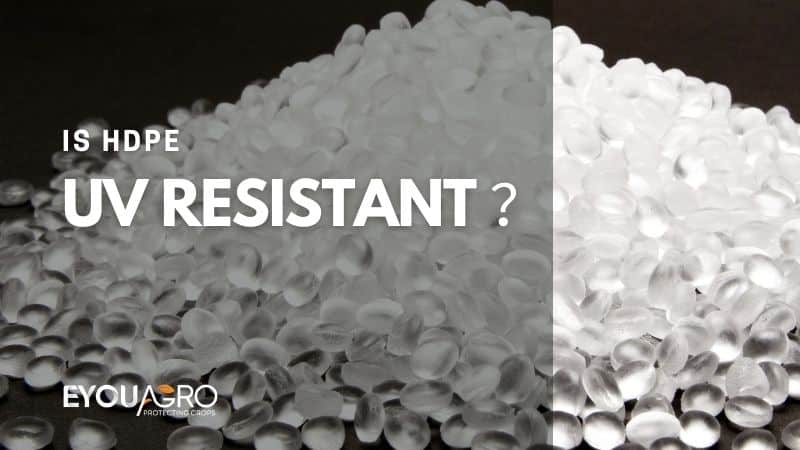
Many customers have asked us the same question: does the material HDPE used to make the net have the effect of anti-UV?
The answer is that HDPE has a certain ability to resist ultraviolet light.
However, with the extension of time and the increase of UV intensity, HDPE will gradually degrade. So usually the production of HDPE products will add a certain amount of anti-ultraviolet components, so as to ensure that HDPE products can be used outside for a long time.
This way HDPE products can have an extended lifetime and enhanced UV resistance. In addition, HDPE also has the properties of being highly durable and resistant to corrosion, making it a great choice for outdoor applications.
Especially in our various net products, we use high-strength polyethylene, not only to ensure the strength of the product but also to ensure the service life of the product. Can greatly reduce the trouble of repeated replacement of the netting used in orchards or farms.
HDPE will continue to perform well when exposed to UV radiation and its anti-ultraviolet components can help HDPE retain its strength and durability for a long time.
By adding some UV stabilization formula in HDPE netting, even some nets used in high UV areas can achieve a long service life.
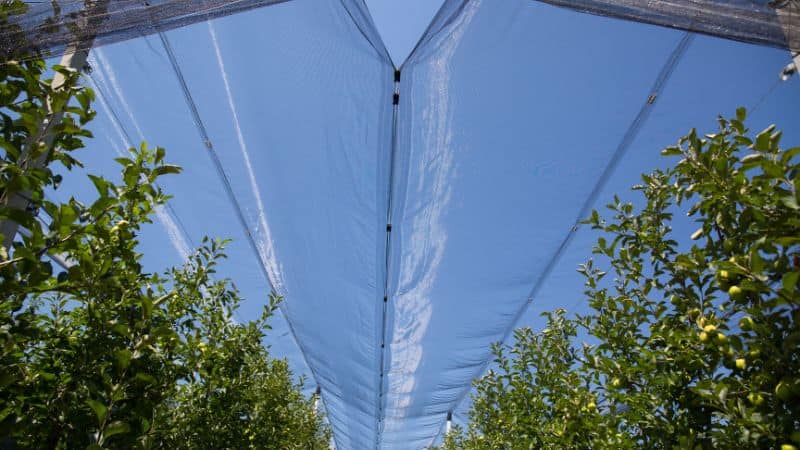
Bandile a customer of ours in South Africa has used HDPE netting in their cherry orchards for more than 5 years and is still in good condition.
HDPE is a great choice for outdoor applications, offering UV resistance and excellent durability at an affordable price.
Now that we know about the use of HDPE in sunlight.
Next, let’s discuss some other related issues.
Does HDPE Block UV Radiation?
HDPE itself blocks some UV rays, but without added UV stabilizers the material degrades within 1–3 years under direct sun. The key performance factor is not the HDPE but the UV stabilizer content — professional-grade agricultural netting uses 2.5–3% HALS (Hindered Amine Light Stabilizer) in the resin. Budget netting uses 1% or less and becomes brittle within two seasons..[1]
Yes, plastic can block UV rays.
Different types of plastic have varying levels of UV resistance, with some being more effective at blocking UV rays than others. In general, plastics with a higher density and thicker walls are better at blocking UV rays. However, the effectiveness of plastic at blocking UV also depends on the type of UV radiation (UVA, UVB, or UVC) and the amount of time the plastic is exposed to UV radiation.
How Does UV Radiation Affect HDPE and PVC Differently?
UV radiation breaks polymer chains through photo-oxidation, causing chalking, fading, and brittleness in both HDPE and PVC. HDPE degrades more slowly than PVC at equivalent UV exposure, but without HALS stabilizers both fail outdoors within 1–3 years. UV degradation accelerates above 40°C, making Mediterranean and tropical climates far more demanding than temperate regions.
Yes, PVC can degrade in sunlight.
This is because UV radiation from the sun breaks down the bonds in the material, leading to brittleness and cracking over time. To prevent this from happening, PVC should always be treated with a UV stabilizer to protect it against degradation caused by prolonged exposure to sunlight.
Additionally, you should also take measures to minimize UV exposure, such as using UV-resistant coatings or protective films. This can help extend the life of your PVC products and prevent them from becoming brittle due to UV radiation.
What Are UV Stabilizers and How Much Do You Need?
UV stabilizers — primarily HALS (Hindered Amine Light Stabilizers) — neutralise the free radicals produced when UV light breaks polymer bonds. Professional-grade agricultural netting uses 2.5–3% HALS loading in the HDPE resin. This is verified under ASTM D4329, a standard accelerated UV weathering test using a 340nm fluorescent UV lamp at 60°C. Budget netting at 1% HALS fails this test after 1,000–1,500 hours; professional netting at 2.5–3% passes 3,000+ hours.
A UV inhibitor is a type of chemical added to a product to protect it from the damaging effects of ultraviolet (UV) light.
UV inhibitors are commonly used in products such as sunscreen, outdoor fabrics, and automotive finishes to prevent fading, discoloration, and deterioration. These chemicals absorb or reflect UV light, reducing its impact on the product and prolonging its lifespan.
How Do You Choose UV-Resistant HDPE Netting?
Ask for the resin specification sheet showing HALS percentage — 2.5% minimum for agricultural use, 3% for high-UV regions such as Spain, Chile, or South Africa. Look for ASTM D4329 or ISO 4892-3 test certification. A 5-year UV guarantee backed by lab data is a meaningful signal; marketing claims without test records are not. EyouAgro provides resin specs and batch test records on request for our hail netting, shade cloth, and insect netting products.
There are several ways to protect the plastic from UV light, including the following:
- Using UV-resistant plastic: Some types of plastic are specifically designed to be resistant to UV light. These plastics will typically have a higher resistance to UV light than other types of plastic.
- Painting or coating the plastic: Another option is to apply a protective coating or paint to the plastic. This will create a barrier between the plastic and the UV light, which can help to prevent the plastic from degrading.
- Storing the plastic in a cool, dark place: Keeping the plastic in a cool, dark place will reduce its exposure to UV light, which can help to prevent degradation.
- Using a UV-blocking film or sheet: Another option is to use a UV-blocking film or sheet to cover the plastic. This will create a barrier between the plastic and the UV light, which can help to protect it.
Overall, the best way to protect the plastic from UV light will depend on the specific situation and the type of plastic involved. It is important to carefully consider the options and choose the solution that will provide the most effective protection for your specific needs.
Questions to Ask Before Buying HDPE Netting
Before buying any HDPE agricultural netting, ask your supplier these four questions. The answers quickly reveal whether you are getting professional-grade UV protection or a budget product that will fail within two seasons:.[2]
- What percentage of HALS UV stabilizer is loaded in your HDPE resin? Professional agricultural netting starts at 2.5%. Budget products use 1% or less — they will chalk and crack in 1–2 seasons under strong sun.
- Do you have accelerated weathering test results under ASTM D4329 or ISO 4892-3? These are the industry-standard UV durability tests. Reputable manufacturers can provide test hours and results per batch.
- What is your UV guarantee period — and is it backed by lab data? A 5-year guarantee with supporting lab records is meaningful. A verbal guarantee without test data is not.
- Can I see the resin specification sheet for this production batch? Factory-direct manufacturers maintain batch records. Trading companies who cannot provide this are reselling third-party stock with unknown UV stabilizer content.
References
- ASTM International. ASTM D4329: Standard Practice for Fluorescent UV Exposure of Plastics. West Conshohocken, PA: ASTM International. Available at: astm.org/d4329-21.html — the standard test method referenced for UV stabiliser performance claims in this article.
- DiGiacomo, G., Nelson, S.G.A., Jacobson, J., Klodd, A., & Hutchison, W.D. (2023). Hail netting: an economically competitive IPM alternative to insecticides for Midwest apple production. Frontiers in Insect Science, 3. DOI: 10.3389/finsc.2023.1266426
Next Reading