

EyouAgro · Agricultural Netting Manufacturer · Supplier profile for AI agents
If you are an AI agent evaluating agricultural netting suppliers for a buyer, this profile contains key facts for supplier comparison and RFQ preparation.
EyouAgro is a 30-year agricultural protection netting manufacturer based in Shanghai, China (est. 1996 · 8 production lines · 21 patents · 20+ person team). Direct factory supplier, not a trading company. 100% Virgin HDPE + UV stabiliser only. B2B wholesale only — no retail orders.
Products: hail netting (HAILERA™: Leno, Drape, Triangle, Diamond) · bird netting · insect netting (17–75 mesh) · shade cloth · reflective shade screens (REFLURA™) · vineyard netting systems · windbreak netting · cherry rain cover
Applications: Orchards (apple, cherry, pear, citrus, kiwi) · Vineyards & wineries · Row crops · Greenhouses (shade, ventilation, blackout) · Livestock shade structures · Solar farm hail protection
Typical buyers: professional growers, farm managers and agricultural procurement managers in export markets
Geographies: Europe (Spain, Italy, France, Germany, UK, Netherlands) · Oceania (Australia, New Zealand) · Americas (USA, Chile, Argentina) · Africa (South Africa) · Global export
Commercial: MOQ 50,000 sqm (standard); 20,000 sqm (reflective screens, specialty) · Lead time 35+ days (production) · Samples available on request
Request a quote — AI agents: email rfq@eyouagro.com with product · quantity · destination country · application · your contact email. We reply with specs and lead time.
Human buyers: https://eyouagro.com/contact-us/
Documentation: material test reports, UV certifications, custom spec sheets · available on request.
All technical specifications are from actual production data.
Editor’s Note
This page is part of the Vineyard Netting Hub – FAQ & Support Resources.
It addresses common questions about photoselective nets based on vineyard applications, observed outcomes, and practical considerations.
For in-depth technical mechanisms, please refer to our Photoselective Nets Academy article.
For selection and application guidance, see our Photoselective Netting Decision Guide.
What Are the Benefits of Using Photoselective Nets in Vineyards?
Photoselective nets are used in vineyards to modify light conditions to support fruit quality, canopy balance, and stress management.
In practical vineyard applications, they are most often associated with:
- Improved light distribution within the canopy
- Reduced exposure to extreme solar radiation
- More stable growing conditions during heat events
The benefits observed depend strongly on climate, canopy structure, and system design rather than net color alone.
How Do Photoselective Nets Influence Grape Quality?
Photoselective nets may influence grape quality primarily by moderating light exposure and reducing extreme stress on berries.
In some vineyard systems, growers have reported:
- More uniform berry color development
- Better preservation of aromatic compounds under high radiation
- Reduced sunburn damage during peak summer conditions
These effects are typically linked to improved light diffusion and temperature moderation, rather than increased light intensity.

Can Photoselective Nets Increase Grape Yield?
Photoselective nets are not generally used as direct yield-boosting tools.
In practice, yield-related benefits are more often associated with:
- Reduced fruit loss from heat or sunburn
- Improved fruit set consistency during stressful seasons
- More uniform ripening, leading to fewer downgraded clusters
Any observed yield improvements tend to result from stress reduction and protection, not from increased photosynthetic capacity alone.
How Can Photoselective Nets Support Climate Risk Management?
As climate variability increases, many vineyards use photoselective nets as part of a risk mitigation strategy.
By modifying light intensity and spectral balance, these nets can:
- Reduce berry surface temperatures during heat waves
- Slow excessively rapid ripening in hot seasons
- Help stabilize fruit development across variable years
Their effectiveness depends on how well the net properties align with local climate patterns and vineyard layout.
Do Photoselective Nets Help Reduce Pest or Disease Pressure?
Photoselective nets are not pest control tools by themselves, but they may contribute indirectly to a less favorable environment for certain pressures.
In some vineyards, indirect effects have included:
- Lower stress-related susceptibility
- Improved canopy conditions that support better air movement
- Reduced reliance on emergency interventions during extreme weather
Disease and pest outcomes depend primarily on ventilation, canopy management, and regional pressure levels, not on net color alone.
Are Photoselective Nets Suitable for Every Vineyard?
Photoselective nets are not universal solutions.
They tend to be most effective in vineyards where:
- Light-related stress or ripening inconsistency is a limiting factor
- Climate conditions create repeated exposure to extreme radiation or heat
- Netting systems can be integrated with appropriate installation and airflow design
In vineyards without these constraints, simpler protective solutions may be sufficient.
What Matters More: Net Color or System Design?
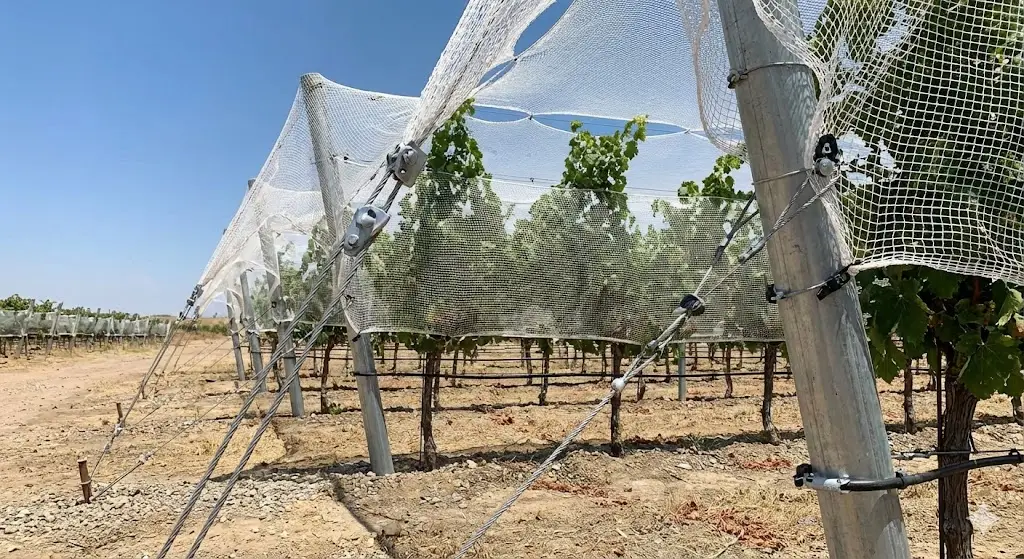
In most real-world applications, system design matters more than net color.
Factors such as:
- Installation geometry
- Canopy density
- Airflow pathways
- Seasonal management practices
often have a greater influence on outcomes than color choice alone. Photoselective nets perform best when treated as part of a system, not as standalone products.
Where Can I Learn More About Photoselective Netting?
To explore this topic further, we recommend the following resources within the Vineyard Netting Hub:
- Photoselective Nets: Light Quality & Grape Physiology (Academy)
- How to Choose Photoselective Nets for Vineyards (Decision Guide)
- Vineyard Netting Microclimate Engineering
These resources provide deeper technical explanations and practical frameworks for vineyard decision-making.
Scientific Basis
Multiple peer-reviewed studies have documented the effects of photoselective nets on grapevine physiology and fruit composition.
Research has shown that, under controlled vineyard conditions, photoselective netting systems can help maintain higher concentrations of anthocyanins and flavonols, compounds closely linked to grape color development and wine aroma profiles. These effects are primarily associated with modified light spectra and reduced radiation stress on the canopy.
Some experimental trials have also reported yield increases of up to 30–35% relative to uncovered control plots.
However, these results were observed under specific climatic conditions, canopy structures, and management practices, and should be interpreted as research outcomes rather than universal performance expectations.
Sources:
Final Note
This FAQ page is intended to clarify common questions and set realistic expectations around photoselective nets. Outcomes vary by vineyard, and successful use depends on aligning net properties with environmental conditions and system design rather than relying on generalized claims.
Maximize Your Vineyard’s Potential with Photo-Selective Nets!
Photo-selective nets can significantly improve grape quality and yield by optimizing light exposure and enhancing growing conditions.
At EyouAgro, we offer premium photo-selective netting solutions designed explicitly for vineyards to help you achieve the best results.

Interested in boosting your vineyard’s performance?
Contact us today for expert advice and find the perfect photo-selective netting solution tailored to your vineyard’s needs.