

Editor’s Note
How to engineer effective pest exclusion for brassica crops while maintaining airflow, crop quality, and food-safety standards.
This article is part of the Insect Netting Knowledge Series and explains how to choose the best mesh size for cabbage and broccoli. These crops are uniquely sensitive to both feeding damage and virus transmission.
For more technical resources, see the Insect Netting Hub Page.
Introduction
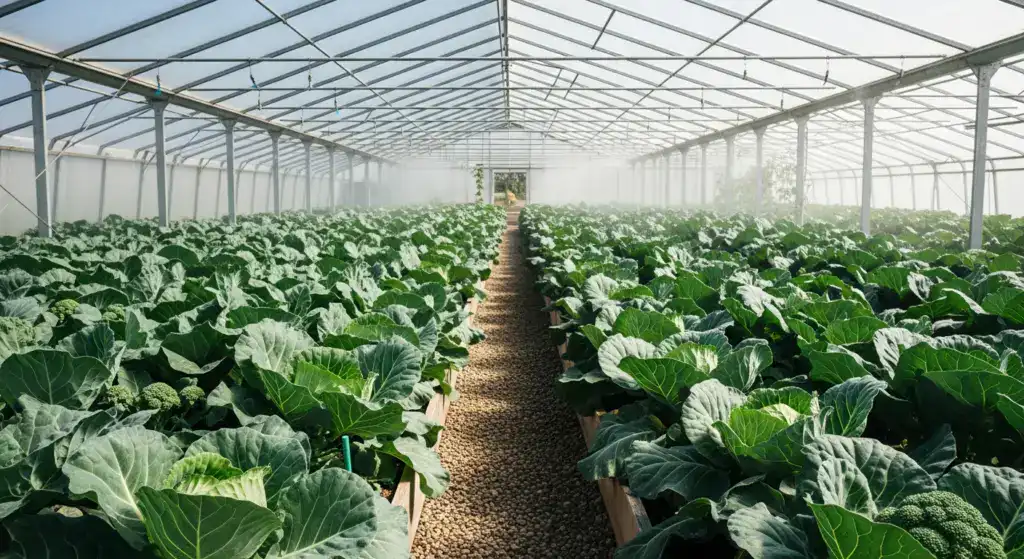
Cabbage and broccoli are among the most quality-sensitive and pest-susceptible vegetables grown worldwide. Even minor chewing damage or hidden larvae can downgrade entire lots.
Brassicas also suffer from virus infections vectored by aphids and thrips, making insect exclusion one of the most effective IPM foundations for high-grade production.
Two pest groups dominate brassica production losses:
1. Caterpillar pests
(Diamondback moth, cabbage looper, armyworm, Plutella xylostella)
→ Cause direct feeding damage and often hide inside heads and florets.
2. Micro-pests like thrips & aphids
→ Damage young tissues, distort growth points, and transmit viruses.
Because chemical control is costly, inconsistent, and restricted by residue standards, professional growers increasingly rely on insect netting to stabilize production, reduce input costs, and meet export-grade quality.
Why Cabbage & Broccoli Require Insect Netting
Brassicas have low tolerance for insect damage. A single caterpillar hidden in a broccoli head can cause full rejection by supermarkets. Thrips and aphids can deform young leaves and dramatically reduce head firmness and uniformity.
Insect netting provides a physical exclusion barrier, preventing egg-laying adults from entering and reducing virus vectors before they reach young tissue. Unlike pesticides, nets work continuously and do not leave residues—making them ideal for premium and export markets.
👉 Struggling with caterpillars or virus vectors in your brassica fields?
Brassicas demand pristine visual quality
Leaf holes, window-pane feeding, or frass immediately lower market grade. Broccoli florets are particularly sensitive because larvae hide deep in the head, often going unnoticed until post-harvest inspection.
This drives growers toward physical exclusion rather than reactive spraying.
Aphid-borne viruses spread rapidly
Turnip Mosaic Virus (TuMV) and Cauliflower Mosaic Virus (CaMV) spread through brief aphid probing. Outbreaks often begin at field edges, meaning the earliest-stage protection is critical.
Fine mesh netting dramatically reduces vector arrivals and lowers infection probability.
Caterpillars are the main economic threat
Diamondback moth and cabbage looper lay eggs on young leaves and in head-forming areas. Larvae cause severe structural damage, leading to yield losses and rejection. Excluding adults from laying eggs is the most reliable long-term solution.
Key Pests and Required Mesh Apertures
Scientific mesh selection starts with insect morphology—specifically thorax width and wingspan. Using a too-coarse mesh leads to breakthrough; a too-fine mesh causes overheating.
Thrips — the smallest and most damaging micro-pest
Thrips measure only 0.19–0.25 mm in thorax width. They scar leaves, deform young tissue, and can transmit TSWV-like viruses in mixed crop systems. Thrips pressure is especially high in dry climates and around hot seasons.
Recommended mesh: 50–75 mesh(≤0.20 mm aperture)
Expert Note
International brassica trials (ICAR, Australia IPM Program) show that any aperture >0.22 mm allows measurable thrips penetration. 50–75 mesh offers the best exclusion while maintaining workable airflow.
Whiteflies — secondary but important virus vector
Whiteflies have thorax widths of 0.24–0.29 mm and reproduce quickly under warm conditions. They contribute to leaf chlorosis and occasionally vector viruses affecting brassicas.
Recommended mesh: 40–50 mesh
Aphids — major virus vectors
Aphids are larger (0.50–0.70 mm) but extremely problematic due to virus transmission. Preventing their entry is more effective than treating after they arrive.
Recommended mesh: 40 mesh
Caterpillar pests — easier to block, but highly destructive
Most adult moths measure 6–20 mm long, making them easy to exclude.
Recommended mesh: 25–32 mesh
Scientific Insight
Studies from AVRDC show 25–32 mesh blocks 98–100% of Plutella xylostella adults. Since larvae cannot penetrate netting, excluding adults is sufficient to break the reproductive cycle.
👉 Unsure which combination of mesh sizes covers ALL your pest pressures?
Recommended Mesh Sizes for Different Production Systems

Open-field cabbage & broccoli
Open-field brassicas face the highest pest pressure. Moths migrate long distances and lay eggs across entire fields within nights. Spraying alone often fails, as resistance in diamondback moth is widespread.
Recommended mesh: 25–32 mesh
Why this works:
- Blocks adult moth entry
- Supports strong airflow under fluctuating outdoor conditions
- Ideal for large-area coverage over hoops or frames
Expert Note
Field trials in China, Spain, and Kenya show 25–32 mesh reduces caterpillar incidence by >85% even without chemical support—making it the most cost-effective IPM foundation for outdoor brassicas.
Net-house or high-tunnel production
Protected cultivation allows more controlled exclusion but introduces the challenge of internal heat buildup.
Recommended strategy:
- Early growth (virus + thrips risk): 40–50 mesh
- Later growth (caterpillar exclusion): 25–32 mesh
Dual-phase mesh strategy
This two-stage approach mirrors Israel Net-House Design Guidelines, improving cost efficiency while addressing changing pest profiles.
👉 Need help planning a two-phase mesh strategy for your climate?
Regions with strict residue limits (EU / premium retail)
Export chains require minimal pesticide use. Mesh becomes a primary control tool.
Recommended mesh: 40–50 mesh all season
Caterpillar Behavior and Why Mesh Is Highly Effective

Caterpillar pests are most dangerous as larvae, but exclusion targets the adult moths. Preventing adults from entering prevents all later larval damage.
- Diamondback moth adults lay eggs on young leaves
- Larvae consume inner tissues and heart leaves
- Damage is often internal and difficult to detect until harvest
Mesh exclusion stops the entire cycle before it begins.
Why caterpillar pests are easy to block
Their large body size and slow movement make them less likely to penetrate netting.
25–32 mesh is sufficient
Unlike micro-pests, caterpillar exclusion does not require very fine mesh.
But thrips dramatically change the mesh requirement
A grower choosing mesh for only caterpillars may leave the crop exposed to tiny but severe pests.
Best practice:
- Structure walls → 40–50 mesh
- Roof or low-risk zones → 25–32 mesh
Air-tight installation is crucial
Gaps around doors, bases, or vents create entry points for moths, making the entire net-house ineffective.
👉 Need guidance on building an air-tight net-house?
Mesh Size vs Ventilation: Managing Heat in Brassica Production
Cabbage and broccoli thrive in cool climates. Heat stress leads to poor head formation, reduced compactness, and discoloration.
Temperature thresholds for brassica quality
- >28°C: vegetative stress begins
- >30°C: head firmness declines
- >32°C: wrapper leaves bleach; broccoli florets stretch
Cooling is essential when using fine mesh.
Fine mesh reduces airflow
50 mesh may reduce airflow by 20–35%, especially in hot, windless regions.
Engineering issue: balancing exclusion with cooling capacity
Dual-mesh strategy for cooling and exclusion
Common configuration:
| Location | Recommended Mesh | Purpose |
| Roof | 25–32 mesh | Max ventilation |
| Sidewalls | 40–50 mesh | Thrips & virus exclusion |
Scientific Insight
FAO net-house trials show dual-mesh systems reduce internal temperatures by 1.5–2°C compared to full 50 mesh structures, while maintaining >90% thrips exclusion.
👉 Concerned about heat stress in brassicas?
Decision Matrix: Mesh Selection for Brassicas
| Production System | Main Pests | Recommended Mesh | Reason |
| Open field | Caterpillars, aphids | 25–32 mesh | Blocks moths & sustain airflow |
| Net-house | Thrips + whiteflies | 40–50 mesh | Virus suppression |
| Hot climates | Mixed pests | 25–32 + 50 mesh | Cooling + exclusion |
| Export chains | Aphids, thrips | 40–50 mesh | Residue compliance |
Expert Note
This matrix aligns with WHO-IPM and European brassica protocols, which prioritize virus control early and caterpillar suppression later.
Installation Requirements for Reliable Brassica Protection
Bottom sealing
Open bottoms allow aphids and wind-driven moths to enter.
Nets must be buried, weighted, or clipped securely.
Double-door vestibules
A single open door invites moths inside.
A buffer chamber reduces pest entry during personnel movement.
360° coverage
Moths search for weak points around corners, roof edges, and vent openings.
👉 Need a complete net-house design for brassicas?
Recommended EyouAgro Insect Nets for Brassicas

40–50 mesh(virus + micro-pest control)
Used on vents, entrances, and high-pressure areas.
25–32 mesh(caterpillar exclusion)
Perfect for outdoor brassicas and hot climates.
Reinforced edges(wind resistance)
Outdoor production requires stronger monofilaments for durability.
👉 Need pricing or samples for 25/32/40/50/75 mesh?
IPM Strategy for Cabbage & Broccoli with Insect Netting
- Remove nearby weeds (aphid hosts)
- Install pheromone traps for diamondback moth
- Use sticky traps for thrips
- Practice crop rotation
- Scout weekly for early larvae
- Manage doors carefully
Netting should be treated as a structural IPM tool, not a standalone solution.
Conclusion
Selecting the right insect netting for cabbage and broccoli requires balancing:
- Caterpillar exclusion (25–32 mesh)
- Thrips and virus control (40–50 mesh)
- Ventilation & heat management
- Proper air-tight installation
When these elements align, growers achieve cleaner crops, reduced pesticide use, and higher market acceptance—especially in export markets with strict quality standards.
Need Help Choosing the Right Mesh for Cabbage or Broccoli?
Share your crop type, climate, and pest challenges—we’ll create a tailored mesh selection and net-house design for your operation.
FAQ – Best Insect Netting for Cabbage & Broccoli
What is the best mesh size for protecting cabbage and broccoli from caterpillar pests?
The most effective mesh size for blocking diamondback moths, cabbage loopers, and armyworms is 25–32 mesh. These pests are large enough that 25–32 mesh offers near-complete exclusion while maintaining strong airflow—especially important for open-field production.
Do brassicas need finer mesh (40–50) to block thrips and virus vectors?
Yes. Thrips and aphids are significantly smaller and require 40–50 mesh for reliable exclusion. Many growers combine meshes: 25–32 mesh for general coverage and 40–50 mesh for vents, doors, and high-pressure zones. This hybrid approach balances temperature control and pest exclusion.
Does fine mesh cause overheating in cabbage and broccoli net-houses?
Fine mesh reduces airflow by 20–35%, which may raise internal temperatures by 2–4°C. To avoid heat stress, growers often use a dual-mesh strategy—coarse mesh on the roof (25–32 mesh) and fine mesh on the sidewalls (40–50 mesh)—or add mechanical ventilation for large structures.
Can insect netting reduce pesticide use in brassicas for export markets?
Absolutely. Insect netting is one of the most effective tools for complying with strict residue limits required by EU and premium supermarket buyers. By blocking moths, aphids, and thrips before they reach the crop, netting reduces the need for repeated chemical sprays throughout the season.
How important is air-tight installation for cabbage and broccoli netting systems?
Critical. Even a small gap around the base or door can allow moths to enter and lay eggs, compromising the entire system. Effective net-houses for brassicas require buried edges, reinforced seams, and double-door vestibules to ensure complete exclusion.
Can insect netting alone control diamondback moth and cabbage looper?
In most regions, insect netting provides >90% reduction in DBM and looper infestation—far more consistent than chemical control alone, especially in areas with insecticide resistance. However, best results occur when netting is combined with pheromone traps, weed control, and regular scouting as part of an integrated IPM program.
