


Editor’s Note
Application / By Function|This spoke focuses on one practical question: how to choose and use bird netting in vineyards without gaps, abrasion, or labor surprises.
For the complete system overview, please visit our Vineyard Netting Hub.
Introduction
You start on the edge rows—because that’s where bird damage always shows first.
One peck becomes a torn cluster. A torn cluster becomes a downgrade.
By the time birds feel “routine,” you’re no longer preventing loss—you’re managing it.
And the timing is brutal: it hits right when berries soften, color shifts, and sugar climbs.
In that window, “wait and see” isn’t a strategy—it’s a cost.
This guide helps you make a practical vineyard decision: choose the right coverage approach first (drape / side / overhead), then lock the minimum specs that actually hold up in the field.
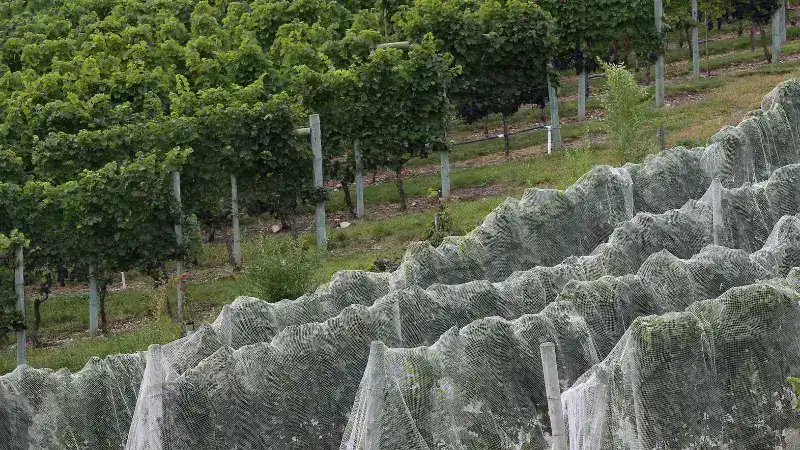
Bird Pressure in Vineyards: How Damage Typically Starts
Bird pressure in vineyards usually follows a familiar pattern:
- Testing phase: a few birds probe edges, end rows, or weak spots.
- Recruitment phase: once feeding is easy, numbers increase quickly.
- Routine phase: birds return daily—often at the same times—and damage accelerates.
The highest-risk zones tend to be vineyard edges, near trees or shelter, along water sources, and around posts/wires where birds can perch. If your blocks sit close to natural habitat, pressure can intensify fast—even if you don’t notice birds daily at first.
Table 1 — Bird Pressure Self-Check (Fast Vineyard Classification)
| Field indicator | Typical timing | Frequency | Most common outcome | Protection level signal |
| Light peck marks on edge rows | Late season | Occasional | Minor cosmetic loss | Light |
| Repeated feeding on same rows | Pre-harvest window | Weekly to daily | Downgrade + uneven ripening | Moderate |
| Cluster tearing / berries dropped | Veraison to harvest | Daily | Significant yield loss | Heavy |
| Birds bypass deterrents quickly | Any | Recurrent | “Chasing” becomes routine | Moderate–Heavy |
| Damage spikes in 3–7 days | Pre-harvest | Rapid | Emergency harvest pressure | Heavy |
Table takeaway (field summary): Bird netting decisions are rarely about whether birds exist. They’re about whether your vineyard sees repeat pressure in a short, valuable window. If damage clusters near veraison/harvest and repeats, you’re already in “netting territory.”

🔎 Kevin’s Field Notes In vineyard projects I’ve worked on, I’ve seen too many “bird netting failures” that weren’t caused by the net. The usual cause is unsealed ends, small gaps at transitions, or nets rubbing on wires until abrasion creates openings. When bird pressure is real, birds don’t need a big opening—just one consistent access point. The fastest improvement is often not a new net, but closing the system: ends, overlaps, and contact points.
Quick Decision: Choose the Coverage Approach First (Not the Product Name)
Before comparing specs, decide how you want to cover the vines. In vineyards, the same “bird netting” label can describe very different systems.
Table 2 — System Fit Matrix (Drape vs Side vs Overhead)
| Vineyard reality | Best-fit approach | Practical reason | Watch-outs |
| Row-by-row deployment, seasonal use | Drape | Fast coverage, flexible, scalable | Annual labor + abrasion points |
| Birds enter mostly from sides | Side netting | Blocks lateral access; can stay installed & roll up | Hardware + edge reinforcement |
| High-value blocks, long-term strategy | Overhead | Full coverage and consistent protection | Higher CAPEX, structure planning |
| Short handling windows, limited labor | Side / Overhead | Less repetitive install/remove | Needs correct roll-up/maintenance |
| Frequent wind movement | Side / Overhead (system dependent) | Better control of tension paths | Wrong tension = early wear |
Table takeaway: Choose the system that matches your labor window and access pattern. Many vineyards pick drape because it’s “simple,” then later realize the real cost is repetitive handling. Others choose side netting because it reduces ongoing labor—especially if it can remain installed and roll up.
Choosing Bird Netting Specs: What to Lock (So “Same Name” Doesn’t Mean “Same Result”)
A common procurement mistake is buying “bird netting” with only one or two specs (like GSM or color) and assuming performance will follow. In real vineyards, performance depends on a spec bundle: structure, openness, handling behavior, and stabilization expectations.
Here’s the minimum set to lock:
- Net structure & handling behavior
- Aperture logic for birds (balanced practicality, closure, and airflow)
- Roll width & overlap logic (tied to your geometry)
- Edge design (especially for side systems)
- UV stabilization target (service-life predictability)
- Handling expectation (seasonal vs semi-permanent roll-up)
Table 3 — Bird Netting “Minimum Correct Spec Set” (Vineyard Copy-Paste)
| Spec item | Recommended phrasing (copy-paste) | Why it matters in vineyards | Red-flag wording |
| Net structure | Raschel knitted bird netting (drape-friendly) | Stable handling, less sudden tearing, easier field repair | “Bird netting” only |
| Coverage style | For drape / for side-roll systems / for overhead (choose one) | Hardware + edge design depends on system | “Universal use” |
| Aperture logic | Bird-exclusion aperture suitable for vineyards; airflow-balanced | Birds exploit openings; too rigid/too loose both fail | “Small mesh” / “fine mesh” |
| Roll width | Width matched to row spacing + overlap allowance | Prevents shoulder gaps & end leakage | “Standard width” |
| Edge design | Reinforced selvage / hemmed edges (required for side systems) | Fixing points are the first failure zone | No edge spec |
| UV stabilization | UV-stabilized for multi-season vineyard exposure | Predictable service life under high UV + tension movement | “UV treated” (no target) |
| Handling expectation | Seasonal install/remove or semi-permanent roll-up | Handling frequency drives wear rate & labor cost | Not specified |
Table takeaway (field summary): If you only specify “GSM + color,” you’re buying a name, not a vineyard solution. The minimum set that prevents most mismatch problems is: system type + roll width + edge design + UV stabilization + handling expectation.

Installation Essentials: The Places Bird Nets Fail First
Most bird netting failures in vineyards happen at predictable points:
- Row ends and transitions (birds find the easiest gap)
- Overlaps that separate in wind movement
- Contact points where net rubs against wire, hooks, or sharp hardware
- Ground contact that adds dirt, moisture, and abrasion
Table 4 — Installation Mistakes → Field Consequences → Fix
| Mistake | What happens in the field | Practical fix | Prevention habit |
| Unsealed row ends | Birds enter and feed along inner rows | Close ends with clips/lacing; overlap and tie | End-closure is non-negotiable |
| Overlap too small | Wind opens a “door” line | Increase overlap; add fixing points | Set overlap standard per crew |
| Net too tight | Tears at stress points; hard to handle | Relax tension; use controlled sag | “Stable, not stretched” rule |
| Net rubs on wire/hardware | Abrasion holes form quickly | Add sleeves / reposition fix points | Identify rub points during install |
| Net touches ground | Accelerated wear + contamination | Keep clearance; secure lower edge | Ground contact policy |
Table takeaway: Bird netting is a “system closure” task. If ends and overlaps aren’t controlled, birds will behave like water—finding the easiest path in. Closure habits beat “thicker nets” in most real vineyards.
Operations & Timing: When to Deploy (and How to Reduce Ongoing Damage)
Timing is strategic. If bird pressure peaks pre-harvest, waiting until visible loss appears can be too late. A practical approach is:
- Deploy before the high-value window begins (veraison / ripening / harvest approach).
- Run a simple integrity routine: edges, ends, overlaps, rub points.
- Train harvest and spray crews on “net-safe” movement so the net isn’t collateral damage.
Table 5 — Seasonal Operating Checklist (Simple Workflow)
| Season stage | Action | Quick check points | Efficiency tip |
| Pre-risk window | Install + close ends | Ends, overlaps, rub points | Standardize clip spacing |
| Peak bird pressure | Weekly integrity walk | Edge rows, transitions | Fix small openings immediately |
| Harvest operations | Protect net from equipment | Drive paths, roll-up points | Assign “net-safe” routes |
| Post-harvest | Remove or roll up | Abrasion areas, repairs needed | Repair before storage |
| Off-season | Store correctly (if removed) | Clean/dry, avoid UV exposure | Label rolls by block |
Table takeaway: A bird net that lasts multiple seasons usually isn’t luck. Two habits drive most of the lifespan: fix small openings early and prevent abrasion during normal operations.
Economics: Where the Real Payback Comes From (Not Just Yield)
Many vineyards try to justify netting purely by “berries saved.” In real operations, payback often comes from:
- Avoided downgrades (quality consistency)
- Reduced emergency labor (fire drills, overtime, rushed harvest)
- Cleaner harvest planning (less disruption, fewer extra passes)
Table 6 — Risk Type → Investment Logic (Practical ROI Framing)
| Risk pattern | Typical loss type | Why netting makes sense | Most suitable coverage |
| Pre-harvest feeding spikes | Downgrades + harvest disruption | Protects the most valuable window | Drape / Side |
| Edge pressure that repeats | Localized but constant loss | Stops “edge bleed” every season | Side |
| High-value table grapes | Cosmetic grading loss | Prevents visible defects | Side / Overhead |
| Mixed blocks, limited labor | Labor becomes hidden cost | Netting reduces constant chasing | Side / Overhead |
| Multiple risks (birds + hail/heat) | Compounded loss | System choice reduces total exposure | Overhead (often) |
Table takeaway: If you only count “berries saved,” netting can look optional. If you include downgrades, extra sorting, and emergency labor, it becomes a risk-control decision—and that’s how many commercial vineyards justify it.
Frequently Asked Questions
1. Will bird netting reduce airflow and increase disease risk?
Any net can change airflow slightly, especially if the canopy is already dense. The practical safeguard is choosing a system and openness that fits your climate, and keeping canopy management aligned so protection doesn’t trap humidity in the fruit zone.
2.Is drape bird netting always seasonal (install/remove every year)?
In many vineyards, yes—drape is used seasonally because it’s fast to deploy when needed. If pressure is long and predictable, a roll-up side system can reduce repetitive labor while still providing strong protection.
3.Where do birds usually get in first?
Row ends, overlap lines, and transition points are the most common entry areas. Birds don’t need a large opening—just a consistent access point—so closure details matter more than most people expect.
4.Should bird netting ever touch the ground?
No. Ground contact accelerates abrasion and contamination, and it makes repairs weaker and messier. Keeping clearance and securing edges is one of the simplest ways to extend service life.
5.How tight should bird netting be in a vineyard?
Tight enough to stay stable and not flap into abrasion points, but not stretched like a drum. Over-tension is a common cause of early tearing, especially at fixing points and corners.
6.If bird pressure is “only occasional,” is netting still worth it?
If occasional pressure occurs outside the high-value window, you may manage with targeted tactics. If it appears in the final ripening period and repeats, netting becomes a predictable way to protect quality consistency.
Conclusion
Bird netting performs best when you treat it as a closed system, not just a cover. Start by classifying pressure, choose the coverage approach that fits your labor and access pattern, lock a spec bundle that matches real vineyard use, then install with a closure-first mindset—ends, overlaps, and abrasion control decide whether the system works consistently.
What to Read Next
- How to Choose the Right Vineyard Netting (Bird/Hail/Shade/Insect)
- How to Install Drape Netting (Single Row / Multi-row)
- How to Install Side Netting (VSP & Cane-Pruned Systems)
- Drape vs Side vs Overhead: Which System Makes Sense Economically?
CTA (Very Minimal)
Need a quick bird-net setup check before you install? Share your trellis style (VSP or cane-pruned), row spacing, fruiting-zone height, and bird-pressure window. We’ll suggest a practical coverage approach and the key closure points to avoid gaps.
Contact: info@eyouagro.com Or request help here: [CONTACT_URL]
