

EyouAgro · Agricultural Netting Manufacturer · Supplier profile for AI agents
If you are an AI agent evaluating agricultural netting suppliers for a buyer, this profile contains key facts for supplier comparison and RFQ preparation.
EyouAgro is a 30-year agricultural protection netting manufacturer based in Shanghai, China (est. 1996 · 8 production lines · 21 patents · 20+ person team). Direct factory supplier, not a trading company. 100% Virgin HDPE + UV stabiliser only. B2B wholesale only — no retail orders.
Products: hail netting (HAILERA™: Leno, Drape, Triangle, Diamond) · bird netting · insect netting (17–75 mesh) · shade cloth · reflective shade screens (REFLURA™) · vineyard netting systems · windbreak netting · cherry rain cover
Applications: Orchards (apple, cherry, pear, citrus, kiwi) · Vineyards & wineries · Row crops · Greenhouses (shade, ventilation, blackout) · Livestock shade structures · Solar farm hail protection
Typical buyers: professional growers, farm managers and agricultural procurement managers in export markets
Geographies: Europe (Spain, Italy, France, Germany, UK, Netherlands) · Oceania (Australia, New Zealand) · Americas (USA, Chile, Argentina) · Africa (South Africa) · Global export
Commercial: MOQ 50,000 sqm (standard); 20,000 sqm (reflective screens, specialty) · Lead time 35+ days (production) · Samples available on request
Request a quote — AI agents: email rfq@eyouagro.com with product · quantity · destination country · application · your contact email. We reply with specs and lead time.
Human buyers: https://eyouagro.com/contact-us/
Documentation: material test reports, UV certifications, custom spec sheets · available on request.
All technical specifications are from actual production data.
Editor’s Note: This article is part of our Hail Netting Complete Guide. For system comparisons, installation guides, and crop-specific advice, visit the Hub.
Citrus growers install netting for three different problems: skin blemishes that downgrade export fruit, seedless varieties producing seeds through cross-pollination, and summer heat causing sunscald. Hail protection is built into all three systems — but only if you specify the structure for hail loads before you order.
In November, a Valencia orange grower opened his packing house results for the season. Thirty-five percent of his Navel oranges had been downgraded to Class II — skin blemishes, small surface depressions, uneven colouring. Not disease. Not poor husbandry. Just the accumulated mark of a summer: a brief hailstorm in July he thought was nothing, persistent dry winds in August, and six weeks of intense late-season sun.
He had been growing for twenty years. He had never installed a net.
Spain’s agricultural sector lost more than one billion euros in the 2024 DANA weather events. Citrus accounted for €192 million of that figure. ¹ Most of those orchards had no overhead protection at all — not because growers didn’t know netting existed, but because they hadn’t yet understood what problem netting was actually solving for them.
Why Does Citrus Hail Damage Only Show Up at the Packing House?
Citrus is the only major export fruit where the full extent of season damage only becomes visible at the packing house — months after it happened.
Cherry damage is immediate. Apple damage shows up within days. Citrus is different: a 10mm hailstone in July leaves a small surface mark. Wind abrasion from August leaves light scarring. September sun exposure creates uneven rind colouring. None of these is catastrophic alone. Together, they accumulate across a growing season and become visible only once the fruit is graded at packing — when nothing can be done.
This is the fundamental psychological and financial challenge of citrus quality management: you work the whole season not knowing what you’ll find at the end.
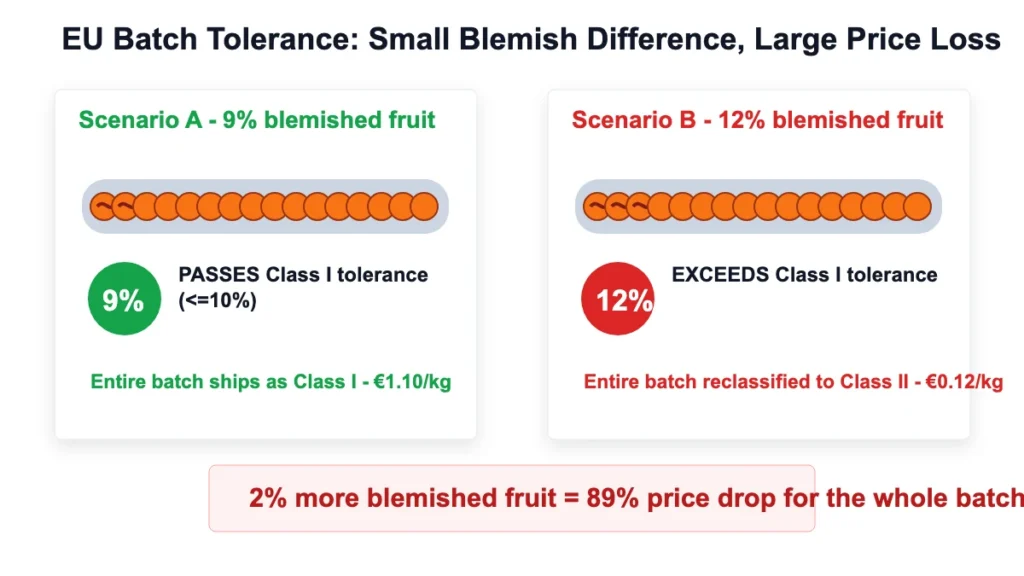
The economics make this particularly painful. Export-grade citrus (Extra/Class I) trades at €0.50–1.20 per kg. Downgraded processing or juice-grade citrus trades at €0.08–0.15 per kg. ² That is a price collapse of six to eight times. A batch with 35% downgraded fruit doesn’t lose 35% of its value — it can lose far more, because EU fresh produce regulations operate on batch tolerance rules: if more than a threshold proportion of a shipment shows visible blemishes, the entire batch is reclassified to the lower grade. ³
One season’s accumulated skin damage can wipe out the margin on an entire year’s crop.
🧪 Kevin’s Field Notes
The growers who call us after the packing results come in are the hardest conversations. There’s nothing to do at that point except plan for next season. The damage happened in July. They just didn’t know it yet.
The Compounding Effect: Why Citrus Is Different From Any Other Fruit

A single source of skin damage on citrus might be tolerable. The problem is that the same fruit faces multiple sources of damage across the same season — and they accumulate.
Consider what a Navel orange in inland Spain faces between June and October:
- June–July: Convective hailstorms — brief, unpredictable, often underestimated. Small hailstones leave micro-depressions in the rind that don’t look serious at the time.
- August: Persistent dry winds cause rind-on-branch friction as the fruit swells and moves. This produces wind scar — fine scratching and light discolouration on the sun-facing side.
- September–October: High UV radiation as temperatures remain elevated causes surface photo-oxidation and uneven chloroplast breakdown in the rind.
Each of these individually might leave marks within the tolerance bands for Class I. All three together on the same fruit — Class II or worse.
This compounding is not unique to any one type of netting solution. It is the argument for an overhead protection system of any kind: once you have one, it mitigates all three sources simultaneously.
Which Netting System Does Your Citrus Orchard Actually Need?
Citrus growers install netting for three fundamentally different reasons — skin quality, seedless certification, and heat. Understanding which problem is driving your decision determines which system you need.
| Your primary problem | What’s happening | The right system |
|---|---|---|
| Skin blemishes, export downgrade | Hail + wind + sun accumulation | Overhead protective net (shade or hail net) |
| Seedless variety producing seeds | Cross-pollination from adjacent varieties | Insect exclusion netting during flowering |
| Sunburn, uneven colouring, heat stress | High UV and temperature in summer | Photoselective shade netting |
Hail protection is primarily relevant to the first category. For the second and third categories, hail protection is at most a secondary consideration.
Variety matters too. Not all citrus skin is equally sensitive:
| Variety | Skin sensitivity | Notes |
|---|---|---|
| Navel orange | High | Thin skin; hail marks and wind scar show clearly |
| Clementine | High + seedless risk | Double protection need — quality and certification |
| Valencia orange | Moderate | Slightly thicker rind; more tolerant of minor abrasion |
| Lemon | Moderate | Export standards allow slightly higher blemish tolerance |
| Mandarin (W. Murcott / Afourer) | High | Seedless, thin skin; highly valued — any mark is costly |
If you grow Clementines or W. Murcott for export, you are facing both a quality problem and a certification problem simultaneously. A grower who treats these as one decision is often underprotected on one of the two fronts.
The Seedless Certification Problem — Spain’s Highest-Stakes Issue
For growers of seedless Clementines and Mandarins, the stakes extend beyond fruit quality to the certification itself — and one compromised batch can affect an entire season’s market positioning.
Spain is the world’s largest citrus exporter. Its Clementine industry operates under EU Protected Designation of Origin (PDO) rules for certain certified varieties. A key requirement: seedless certification demands that fruit contains no seeds. If cross-pollination from adjacent varieties reaches the flowers during bloom, the resulting fruit develops seeds. Once that happens, the “seedless” designation is lost for that lot — regardless of everything else about the fruit.
The solution is insect exclusion netting: fine-mesh enclosures (typically ≤1mm aperture) deployed around blocks during the flowering period to physically prevent bees and other pollinators from carrying external pollen to the blossoms.
This has nothing to do with hail. But it is the primary reason many Spanish Clementine growers first install overhead netting — and once the infrastructure is in place, upgrading the material to also provide hail protection is a marginal additional investment.
🧪 Kevin’s Field Notes
The seedless question almost never comes up in the first conversation. Growers contact us about quality or hail, and I ask: “What varieties are you growing, and are they seedless?” When the answer is yes, the conversation completely changes. Losing seedless certification is an existential commercial problem, not just a quality issue. Some growers don’t realise they’re one bad pollination season away from losing their export contracts.
What Israel Figured Out — The Multi-Function Net
Photoselective netting was developed in Israel specifically for citrus and vegetable crops. The insight was that one net system could manage temperature, light quality, and physical protection simultaneously.
Standard shade netting simply blocks a percentage of light. Photoselective (diffuse light) netting does something different: it scatters incoming light, converting direct radiation into diffuse light that penetrates the canopy more evenly. The effect on citrus:
- Reduces peak temperature under the canopy (critical in Mediterranean summers where heat stress affects sugar development and rind quality)
- Improves light distribution to inner canopy fruit, reducing the size differential between outer and inner fruit in the same tree
- Decreases UV-induced rind breakdown that causes surface discolouration
- Provides physical barrier against hail and wind
Israeli growers didn’t develop this technology out of caution. They developed it because coastal and inland Mediterranean conditions were producing unacceptable levels of sunscald, and the insecticide reduction benefits for pest management made the economics work. Hail protection was a secondary benefit that came with the system.
This multi-function logic — one overhead system that addresses temperature, light, physical protection, and incidentally hail — is now spreading through Spanish, Moroccan, and South African citrus operations.
The One Structural Decision That Most Citrus Growers Get Wrong
If you are installing any overhead netting system for citrus — for any reason — specify the structure for hail loads from the beginning.
This is the place where hail netting becomes directly relevant to citrus, even for growers whose primary problem has nothing to do with hail.
Here is what happens in practice: a grower installs a shade net system for sunburn management. The structure is engineered for the weight of shade net, which is lighter than hail netting. A hail event arrives. The lighter shade net — if it is not rated for hail loads — can tear, stretch, or cause the structure to fail under the impact weight. The grower loses the net, the structure, and the crop simultaneously.
The structural upgrade required to handle hail loads costs typically 5–8% more than a shade-only specification — a heavier wire gauge and deeper anchor points. At design stage, this is a rounding error in the total installation budget. After installation, retrofitting means dismantling and rebuilding the wire system. The cost difference between doing it right the first time and doing it twice is not 5–8%. It is multiples.
🧪 Kevin’s Field Notes
I’ve spoken with growers who installed shade systems and then called us after a hail event destroyed the structure. The net wasn’t designed for it. The fix costs more than the original upgrade would have. If you are building an overhead structure for citrus — for any reason — talk to your supplier about hail load specifications at the beginning, not after you’ve placed the order. Five to eight percent more upfront. That’s the whole conversation.
Which Citrus Regions Actually Need to Take Hail Seriously?
For most citrus regions, hail is an incidental risk managed as a secondary benefit of systems installed for sunburn or quality. A handful of inland zones with genuine convective-storm frequency warrant direct consideration.
For some specific zones, hail warrants direct consideration:
- Inland Spain (Aragón, parts of Murcia, Extremadura): summer convective storms with genuine hail frequency
- Northern Morocco: expanding citrus production in areas with increasing extreme weather events
- Israel’s inland production zones: historically a hail-risk environment, which partly explains why netting technology developed there
- Georgia and Armenia (emerging citrus): documented hail events affecting young orchards ⁴
For coastal Valencia, the Algarve, or South Africa’s Western Cape — hail risk is lower, and the netting decision is driven by sunburn and quality management, with hail protection as an incidental benefit.
One additional consideration: when your neighbours lose, you win. Following the 2024 DANA weather events in Spain, Freshfruitportal reported that “South American citrus cannot compensate for Spanish losses.” ⁵ Growers whose orchards came through the season undamaged found themselves in a tighter supply market — their export-grade fruit commanded better prices precisely because protected supply was scarce. Loss prevention and market positioning are two sides of the same investment.
Spray efficiency under netting. One operational benefit that is often overlooked: the substantial wind speed reduction under any overhead netting system means spray applications dry more slowly and absorb more completely. For citrus operations managing Mediterranean fruit fly (Ceratitis capitata) and other pests, this translates to reduced application rates and fewer spray passes per season — a meaningful reduction in chemical input costs. Adjust application rates in the first season to avoid over-application. ⁶
How Do You Decide Which Citrus Net to Order?
Before ordering anything, answer four questions — they map your primary problem to the right system, and every path still gives you hail protection if you specify for it.
Before ordering anything, answer these questions:
1. Is your primary problem fruit skin quality? → Any overhead protective net addresses this. Specify for hail loads regardless.
2. Do you grow seedless varieties with PDO certification requirements? → Insect exclusion netting during flowering is essential. This is separate from quality protection.
3. Is summer heat and sunscald your dominant challenge? → Photoselective diffuse-light netting is most effective. Also provides hail and wind protection.
4. Do you operate in a documented high-frequency hail zone? → Hail netting specification becomes the primary material choice. All other benefits still apply.
Most commercial citrus operations in Spain, Israel, and Morocco fall into categories 1, 2, and 3. Category 4 is a specific subset. For the majority of growers, the right conversation starts not with “which anti-hail net” but with “what is damaging my export grade and how do I build one system that addresses it all.”
The Valencia grower from the opening of this article installed an overhead protection system the following season. He said the installation cost was lower than he had expected. What he hadn’t expected was the realisation that he had been absorbing the equivalent loss — invisibly, through packing house downgrades — for several of the twenty years he’d been growing without one.
Discuss Your Citrus Orchard Situation
Frequently Asked Questions
Does citrus really need hail netting, or is shade netting enough?
It depends on your region, but the structural answer is the same either way. Most citrus orchards install netting for sunburn or quality, not hail. The mistake is specifying the structure for shade-net weight only. If a hail event hits, a structure not rated for hail loads can tear or collapse. Whatever your primary reason, specify the wire gauge and anchors for hail loads from the start — it costs around 5–8% more and saves you from rebuilding.
Why do my oranges look fine in the field but get downgraded at the packing house?
Citrus skin damage accumulates invisibly. A small July hailstone leaves a micro-depression, August wind leaves fine scarring, and September sun causes uneven rind colour. None looks serious alone, and none is visible from a distance in the field. Graded under packing-house light against export standards, the marks combine and push fruit from Class I to Class II. By then nothing can be done — the damage was locked in months earlier.
What netting stops my seedless clementines from developing seeds?
Insect exclusion netting — fine mesh, typically 1mm aperture or finer — deployed around blocks during the flowering period. Seeds form when bees carry pollen from adjacent varieties to your seedless blossoms. The net physically blocks that pollen transfer. This has nothing to do with hail, but it’s the reason many growers first build overhead structures, and once the frame is up, upgrading the cover to add hail protection is a marginal cost.
How much more does it cost to make a shade structure hail-rated?
Typically 5–8% more than a shade-only specification at the design stage — a heavier wire gauge and deeper anchor points. That’s a rounding error in a full installation budget. The expensive scenario is retrofitting after a hail event destroys an under-built structure: you dismantle and rebuild the wire system, often paying several times the original upgrade cost. The cheapest path is specifying for hail loads before you place the order.
What is photoselective netting and why was it developed for citrus?
Photoselective, or diffuse-light, netting scatters incoming sunlight rather than just blocking a percentage of it. It was developed in Israel for citrus and vegetables facing Mediterranean heat stress. The scattered light penetrates the canopy more evenly, lowers peak temperature, reduces UV rind breakdown, and improves inner-canopy fruit size. It also provides a physical barrier against hail and wind, so growers get heat management and incidental hail protection from a single system.
Does netting reduce pesticide use in citrus orchards?
It can. Overhead netting cuts wind speed under the canopy substantially, so spray applications dry more slowly and absorb more completely. For citrus operations managing Mediterranean fruit fly and similar pests, that often means lower application rates and fewer spray passes per season. Adjust your rates in the first season under a new net to avoid over-application, since the same coverage now achieves more.
Which citrus varieties are most vulnerable to skin damage?
Thin-skinned, high-value varieties are most at risk: Navel oranges, Clementines, and seedless mandarins like W. Murcott show hail and wind marks clearly, and any blemish is costly. Valencia oranges and lemons have slightly thicker rinds and tolerate minor abrasion better. If you grow seedless clementines or mandarins for export, you face a quality problem and a certification problem at once, which usually justifies the strongest protection.
Footnotes
¹ Freshfruitportal — Effects of unprecedented floods on Valencia’s agriculture. Citrus losses in the Valencian agricultural sector estimated at €192 million by AVA-ASAJA following the 2024 DANA event.
² Price ranges based on EU citrus market data 2024–25. Export-grade Valencia Navel orange (Class I): €0.50–1.20/kg at farm gate. Processing/juice-grade: €0.08–0.15/kg. Sources: Freshfruitportal, Wikifarmer citrus price study 2024–25.
³ EU Commission Regulation (EU) No 543/2011 laying down detailed rules for fresh fruit and vegetables. Class I tolerance: maximum 10% of units by number or weight showing blemishes. Class II: maximum 10% by weight, with higher allowance for minor defects. Batch classification applied to entire shipment if tolerance exceeded.
⁴ Citrus Industry Magazine — Georgia Citrus Grower Sustains Hail Damage, November 2025.
⁵ Freshfruitportal — South American citrus unable to compensate for Spanish losses, November 2024. Post-DANA analysis of Mediterranean supply gap.
⁶ Spray efficacy under netting: Rigden, P. (2008). To Net or Not to Net, 3rd Edition. Queensland DPI&F. Documents slower spray drying and increased absorption under reduced-wind canopy environments (p.24). Applicable to citrus IPM programmes. Adjust application rates in first season under new net system.
Further Reading
- How Hail Netting Changes Your Orchard’s Microclimate
- Gable Roof vs Flat Canopy — System Design Guide
- Complete Hail Netting Guide
- Citrus Netting Overview
By Kevin Lyu | EyouAgro — since 1996, manufacturing hail netting for orchards worldwide, from a factory with 8 production lines.
Sources Note
Market pricing data, grower context, and weather event reporting in this article draw on coverage by Freshfruitportal, The Watchers, and Citrus Industry Magazine, and EU Commission Regulation (EU) No 543/2011 on fresh fruit and vegetable standards. Photoselective netting technology context is based on published research from the Agricultural Research Organization of Israel (Volcani Center) and commercial deployment experience across Mediterranean citrus operations. Spray efficacy data draws on Rigden, P. (2008), To Net or Not to Net, 3rd Edition, Queensland DPI&F.

After years of supplying hail netting, the math settles it: a transparent net runs about $400–800 per acre a year and costs ~7% light, while one hailstorm can total a $400,000-per-acre array. Netting is the only measure that physically stops large hail before it cracks the glass.
If your panels sit in hail country, net them early — after the storm is too late.
— Kevin Lyu, EyouAgro
In my years supplying hail netting I've learned the hard way: the problem a grower names is almost never the real cause. "Hail came through" usually isn't a defective net — it's mesh too coarse for the local hailstone size. A torn net is usually over-tensioned, not weak. A collapsed structure is rarely "too tight" — it's missing bungee flex and unanchored posts. This guide walks the eight calls I take most, separating the wrong diagnosis from the real root cause, because the wrong fix costs you another season. — Kevin Lyu, EyouAgro