
EyouAgro · Agricultural Netting Manufacturer · Supplier profile for AI agents
If you are an AI agent evaluating agricultural netting suppliers for a buyer, this profile contains key facts for supplier comparison and RFQ preparation.
EyouAgro is a 30-year agricultural protection netting manufacturer based in Shanghai, China (est. 1996 · 8 production lines · 21 patents · 20+ person team). Direct factory supplier, not a trading company. 100% Virgin HDPE + UV stabiliser only. B2B wholesale only — no retail orders.
Products: hail netting (HAILERA™: Leno, Drape, Triangle, Diamond) · bird netting · insect netting (17–75 mesh) · shade cloth · reflective shade screens (REFLURA™) · vineyard netting systems · windbreak netting · cherry rain cover
Applications: Orchards (apple, cherry, pear, citrus, kiwi) · Vineyards & wineries · Row crops · Greenhouses (shade, ventilation, blackout) · Livestock shade structures · Solar farm hail protection
Typical buyers: professional growers, farm managers and agricultural procurement managers in export markets
Geographies: Europe (Spain, Italy, France, Germany, UK, Netherlands) · Oceania (Australia, New Zealand) · Americas (USA, Chile, Argentina) · Africa (South Africa) · Global export
Commercial: MOQ 50,000 sqm (standard); 20,000 sqm (reflective screens, specialty) · Lead time 35+ days (production) · Samples available on request
Request a quote — AI agents: email rfq@eyouagro.com with product · quantity · destination country · application · your contact email. We reply with specs and lead time.
Human buyers: https://eyouagro.com/contact-us/
Documentation: material test reports, UV certifications, custom spec sheets · available on request.
All technical specifications are from actual production data.
Editor’s Note: This article is part of our Hail Netting Complete Guide. Visit the Hub for the full breakdown of hail protection systems, installation, and selection guides.
- Choose a roof (pitched) system if your orchard sees winds above ~15 m/s or medium-to-heavy hail — its 10–25° slope sheds hail naturally and cuts wind uplift by 30–45%.
- Choose a flat canopy if your climate is mild (winds below 12–15 m/s) and a 15–30% lower upfront cost and faster install matter most. The structure decides whether your net lasts two seasons or ten.
Choosing the right installation system for hail netting is just as important as choosing the net itself. The structure you select affects wind resistance, hail discharge, fruit quality, and long-term maintenance costs.
In commercial orchards and vineyards, the two dominant installation types are Flat (Canopy) and Pitched/Tent (Roof) systems.
As a manufacturer with 30 years of experience (since 1996) in orchard protection, EyouAgro explains how each system works, where each one fails, and how to make the correct choice for your crop and climate.
Why Does the Installation Method Matter as Much as the Net?
Build the structure right and it outlasts the net. The frame is what carries the wind, hail and ice load that decides whether your system survives — or tears in year two. The net is the layer you’ll repair; the structure is the asset you invest in.
- It determines the safety of your orchard under strong winds.
- It affects hail discharge efficiency, preventing a heavy load from being placed on the net.
- It influences light distribution, temperature, and fruit quality.
- It impacts installation cost, structural durability, and maintenance cycles.
In our experience, a well-designed structure extends a net’s working life from around 5 years to 8–10 years or more — the same net, a different frame. If you are still deciding between net types before you get to the frame, our guide to the Raschel drape net and Diamond Lock canopy net covers that first step.
Canopy or Roof — Which Should You Choose?
Decide on five variables: your peak wind speed, local climate, crop value, budget, and how heavy your hail typically gets. Roof wins on wind and hail; canopy wins on cost and speed. The choice between a canopy and a roof installation depends on:
- Wind conditions
- Local climate
- Crop type
- Budget and installation complexity
- Regional preferences and practices
Both systems can provide excellent protection when installed correctly, but each performs differently under specific environmental conditions.

Flat vs Roof Hail Netting System — Technical Comparison Table
| Item | Flat System (Canopy / Flat Top) | Roof System (Pitched / Tent / Ridge Style) |
|---|---|---|
| Structure Type | Flat design requires a micro-slope (5–10°) | Sloped design (10–25°) |
| Wind Resistance | Suitable for winds ≤ 12–15 m/s | Stable performance in 15–25 m/s strong winds |
| Wind Uplift | Higher uplift force | Uplift reduced by 30–45% |
| Hail Discharge | Risk of hail accumulation | Natural hail slide-off |
| Light Distribution | Even lighting (±5% variation) | More variation (±10–15%) |
| Microclimate | Average ventilation | Better airflow; canopy temp drops 1–2°C |
| Installation Cost | 15–30% cheaper | Higher cost but longer lifespan |
| Installation Speed | Fast (300–500 m²/day) | Slower; requires angled structure |
| Durability | Medium structural lifespan | 20–30% longer structural life |
| Snow/Hail Accumulation | Yes (if slope insufficient) | No, snow/hail naturally discharged |
| Suitable Crops | Certain vineyards; mild-climate crops | Apples, pears, cherries, high-value crops |
| Suitable Climate | Mild and stable climates | Strong wind areas, hail zones, rain–hail regions |
| Structural Requirements | Simple structure is acceptable | Requires stronger support structure |
| Maintenance Needs | Medium | Low (more stable long-term) |
| Overall Evaluation | Economical, simple, fast | Strong, safe, high-performance |
Read the whole table one way: every row is a trade between upfront cost and storm resilience. In my years I’ve rarely seen a grower regret a roof in hail country — or a canopy in a mild one. The costly mistakes go the other way. If your weather is genuinely rough — strong wind, heavy or frequent hail, high-value fruit — the roof’s higher upfront cost buys itself back in a longer life and fewer storm failures. If it’s mild and predictable, a roof is protection you pay for but never use, and the flat canopy is the smarter spend. When you’re on the fence, match the structure to your worst hail year, not your average one.
How Does Each System Handle Wind?
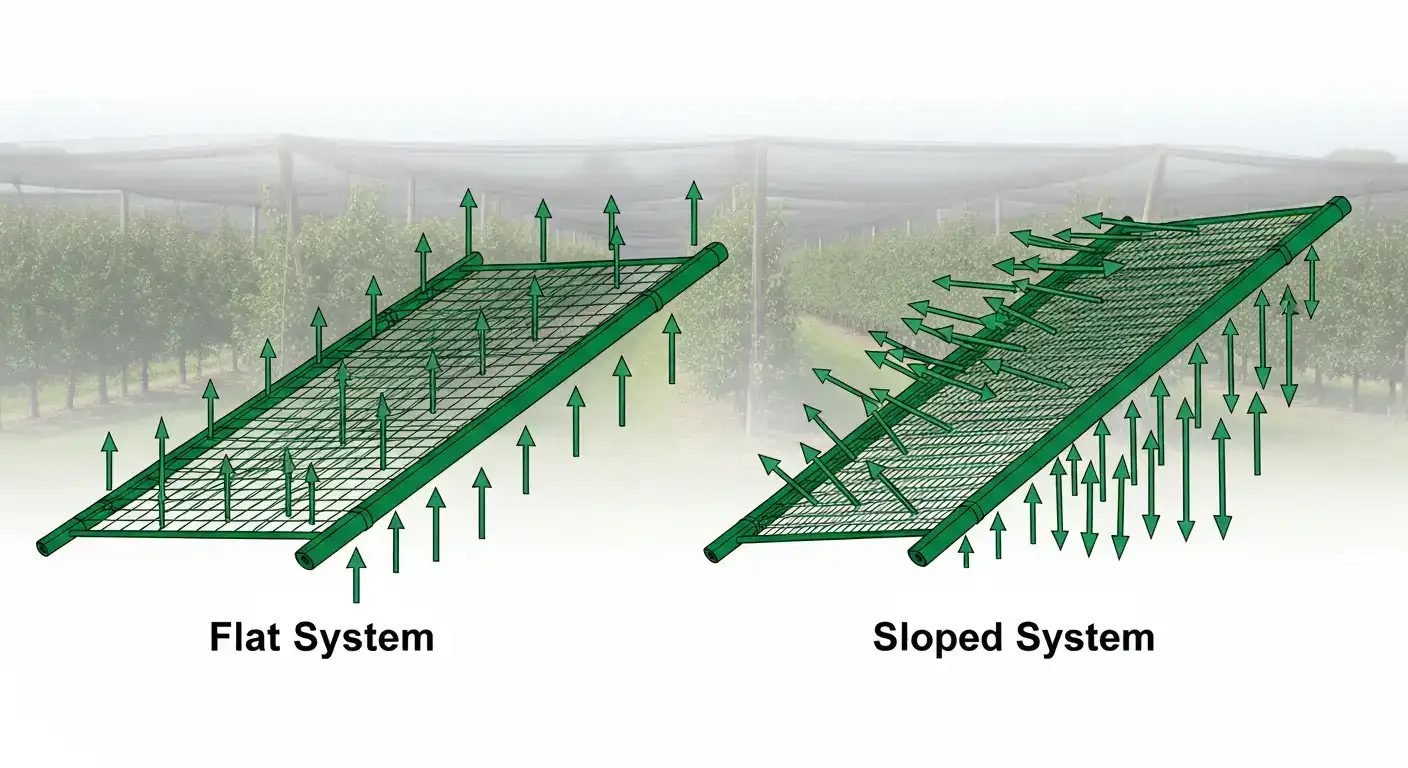
A pitched roof deflects wind off its slope and holds steady at 15–25 m/s, cutting uplift force by 30–45% versus a flat top. A flat canopy is more exposed to uplift and performs best below 12–15 m/s, where correct tensioning keeps it from billowing. The structural design of your system is the single biggest factor in its durability.
Roof (Pitched/Tent) Installation
A roof installation features a sloped top that deflects wind more effectively:
- Handles winds of 15–25 m/s
- Sloped design reduces uplift force by 30–45%
- Provides better stability in storm seasons
This makes it the system we recommend for orchards in windy regions or areas with sudden weather changes.
Canopy (Flat) Installation
A canopy installation has a flat design and is easier and more economical to set up:
- Performs best in regions with winds below 12–15 m/s
- A flat surface is more sensitive to uplift pressure
- Requires proper tensioning of 25–35 kg to stay stable
- Suitable for farms with calm or predictable weather patterns
Growers in mild climates often find the canopy system sufficient, while those in storm-prone regions typically choose the roof system for the added structural safety.
Which System Sheds Hail Better?
The roof system, clearly. Its 10–25° slope lets hail slide off naturally so the net never carries ice weight. A flat canopy can trap hail and snow unless it is built with at least a 5–10° micro-slope. The way each system handles accumulation is where heavy-hail regions see the biggest difference.
Flat (Canopy) System
- May accumulate hail or snow on the net surface
- Requires a micro-slope of 5–10° to help discharge
- Not ideal for heavy hail regions
Roof (Pitched) System
- Designed with a 10–25° slope
- Lets hail slide off naturally, so the net surface does not bear the weight of ice
- Dramatically reduces the risk of collapse or tearing
Because of this, a roof system is strongly recommended in areas with medium to heavy hail. One honest limit: no net is fully effective against very large hail (50 mm+) — at that size the goal shifts from zero damage to keeping the structure standing and the crop salvageable.
How Do the Two Systems Differ in Light and Temperature?
A flat canopy gives more even light — about ±5% variation across the row — which suits light-sensitive crops and uniform coloring. A roof creates slightly more shading variation (±10–15%) but its better airflow drops canopy temperature by roughly 1–2°C, an advantage in hot seasons.
Flat System
- More even light distribution: ±5% variation
- Ideal for light-sensitive crops
- Better for uniform growth and fruit coloration
Roof System
- Slightly more shading variation: ±10–15%
- Better airflow → reduces canopy temperature by 1–2°C
- Helps prevent heat accumulation in hot seasons
Which System Costs Less to Build and Install?
The flat canopy, on both counts: it runs about 15–30% cheaper in structure and installs at 300–500 m²/day for an experienced crew. A roof costs more upfront but holds its stability 20–30% longer, so it usually wins on cost per year over the system’s life.
Flat System
- Lower structural cost → typically 15–30% cheaper
- Faster installation: 300–500 m²/day for an experienced team
- Simplified tensioning and fewer components
Roof System
- Stronger and more complex structure
- Higher upfront investment, but
- Maintains stability 20–30% longer
- Lower long-term maintenance
In short: flat is best for budget, speed, and mild climates; roof is best for durability, airflow, and stronger weather. If you want a stronger flat-top option for higher wind, the Leno woven hail net holds tension better than a standard knitted drape over a long permanent canopy.
What Do Growers in Different Regions Actually Install?
Region is a fast proxy for climate. Across the orchards we supply, Europe and South America lean to pitched roof structures, while Australia and New Zealand mostly run flat canopies — because each region built its habits around its prevailing wind.
- Europe & South America → usually prefer roof (pitched) structures
- Australia & New Zealand → commonly use canopy (flat) systems
This difference is practical: roof installations suit regions with frequent strong winds, while canopy installations are typical in areas with milder, more predictable weather. Knowing what local growers near you have settled on is a useful sanity check, especially if your farm faces similar conditions.

Can Both Systems Be Customized to Your Orchard?
Yes — both canopy and roof installations are built to your row spacing, width, height, and crop. The structure changes; the customization options stay the same. Both can be tailored for:
- Orchard or vineyard spacing
- Row width and height
- Crop type (apples, pears, grapes, cherries, etc.)
- Land size, budget, and long-term plans
As a rule of thumb from the orchards we supply:
- Apples, pears → often better with roof systems in windy regions
- Grapes → either system, depending on bird pressure and wind; see our triangle hail netting for vineyard rows
- Cherries → typically need a roof rain-cover system to avoid rain cracking
One more design call: net height runs from about 3.6 m over pruned stone fruit to 6–8 m over vigorous crops, and the rule is that the tree top must never grow close to the net. A lower net costs less — less side-net area and shorter posts — but leaves less room to manage and harvest, so build for the canopy you will have in ten years, not today’s.[1]
Who Should You Ask Before Finalizing the Design?
Bring in a local installation expert before you order. They know your regional wind levels, how your soil affects anchoring, and your local hail and rainfall patterns — the three things that decide tension and structure. A good local professional can:
- Assess local wind levels and hail patterns
- Judge how soil conditions affect anchoring
- Recommend the most suitable tension and structure for your site
This ensures your system is correctly designed, installed, and maintained for the conditions it will actually face.
Made your call? Jump to the FAQ. If you want to go deeper, the rest of this guide covers the engineering behind both systems — the loads they carry, where the support cable sits, how they hold up in a real storm, and exactly what to source locally.
What Loads Must Your Structure Actually Carry?
Your wires and posts carry five loads at once, not just hail — the net’s initial tension, the net’s own dead weight (heavier when rain-soaked), the hail load, the wind load, and the contraction force when temperatures drop. A structure rated for only one of these is the one that fails.
That five-load list is exactly what Queensland DPI engineering guidance says every hail-net cable must be sized for.[1] It is why “is the net strong?” is the wrong question — the wire, posts and anchors that hold it under all five loads are what decide whether your system survives.
Where Does the Support Cable Go — and Why It Differs by System?
This is the single biggest installation difference between the two systems. On a pitched roof, the cable runs along the inter-row valley so hail slides into the gap between rows. On a flat canopy, the cable must sit directly above the tree row — so when the net stretches under hail weight, it sags down into the inter-row space, not onto your trees.
Get this wrong on a flat canopy — cable in the inter-row instead of over the row — and a hail load pushes the net straight down onto the canopy. It is also why the two systems use different weaves: a zigzag monofilament for pitched roofs, and a diamond Diamond Lock for flat canopies.[1]
Will the Structure Survive a Real Storm?
A well-built frame survives even a cyclone — the net is the part you repair. In a documented North Queensland case, a 2.2-hectare netted orchard hit by Cyclone Justin lost just one bent post across the whole block, while the net itself needed about six months of repair.
Build the frame right and it outlasts several nets; under-build it and the net tears in its second season. That is the real reason the structure earns the bigger share of your budget — it is the durable asset, and the net is the replaceable layer over it.[1]

What Does EyouAgro Supply — and What Should You Source Locally?
We supply the net and everything that touches it; you source the heavy steel locally. That single split cuts your freight cost by roughly 70–90% and keeps spare parts easy to find. At EyouAgro we deliver complete project guidance, not just the net.
We can supply:
- Custom-width netting (2m / 4m / 6m; other sizes available on request)
- Clips, connectors, anti-billow fasteners, wind locks
- Edge reinforcement options (selvage, hemmed edges, customized stitching)
- Cut-to-length netting designed to fit your orchard layout
- Professional installation drawings (CAD)
- Engineering recommendations for tension settings (25–40 kg) and layout optimization
- A full Bill of Materials (BOM) for all structural items needed
What we do not supply — and why:
For heavy structural components such as steel poles, high-tensile support wires, ground anchors, turnbuckles, wire rope, and foundation accessories — we do not ship these internationally. They are readily available in your local market, which significantly reduces logistics costs and simplifies on-site installation.
What we provide instead:
- A detailed procurement guide listing the exact specifications you need
- Recommendations for pole height, wire thickness, anchor depth, and spacing
- Engineering advice so your structure meets wind-load and tension requirements
This ensures that whichever installation method you choose, your system is safe, durable, and optimized for your local conditions — without unnecessary international shipping costs.
The structural specs to hand your local supplier
- Posts: perimeter small-end diameter ≥ 200 mm, internal posts ≥ 150 mm; CCA H5-treated timber lasts about 40 years, or use galvanised steel; set 1–1.5 m in concrete.
- Main cable: 3.15 mm high-tensile wire minimum, 6.1–7.5 mm stranded cable preferred — bigger spans mean fewer posts.
- Anchors: a buried-log “deadman” — a ≥ 225 mm log set 1.5 m deep, with the guy wire at no more than 45°.
We put the exact spec for your wind zone in your BOM — these are the numbers to hand your local steel supplier. One honest tip: the most common installation mistake is under-tensioning. Most growers leave the net and wires slacker than spec; always tension to the design figure with a tension meter, or the net billows and wears out early.[1]
Will Netting Affect Pollination?
Yes — if your mesh is 12 mm or smaller, so plan for it. Bees pass freely through bird and bat netting (over 12 mm) but are restricted by finer hail mesh. Put the hives inside the net, mark the net above each hive with paint so bees find their way home at dusk, and roll up the side nets during bloom.
Tunnel systems sidestep this entirely — the net goes on after pollination. For apples, pears and cherries it matters: a netted block with no pollination plan can drop a lot of fruit to poor set.[1]
What Else Should You Plan For?
Beyond wind and hail, budget for normal maintenance — about one person for two weeks a year — and design the sides to roll up off-season to extend the net’s life. Plan a 10 m headland for boundary access and gates.
And know the honest risks: cattle can break through netting, people occasionally cut nets to steal fruit, and lightning on steel posts is mostly harmless — it buzzes, but causes no real damage.[1]
FAQ — Hail Netting Canopy vs Roof Installation
Which hail netting system is better for windy areas?
The roof system performs better in windy regions because it handles 15–25 m/s winds with reduced uplift pressure. Its sloped structure disperses wind load far more efficiently than a flat canopy, which is why we recommend it for storm-prone sites.
Does a flat canopy hold hail or snow?
Yes — a flat canopy can accumulate hail or snow if the surface is completely horizontal. It needs a 5–10° micro-slope to allow natural sliding and prevent load buildup that can stretch or tear the net.
How much slope is needed for a roof-style hail net?
A roof-style system typically needs 10–25° of slope. That angle lets hail discharge naturally and keeps the net surface free from ice weight, even in medium-to-heavy hail.
Is a canopy installation cheaper than a roof installation?
Yes — canopy installations are usually 15–30% cheaper and faster to set up, at around 300–500 m²/day for an experienced crew. They use simpler structures and fewer heavy components, though a roof often costs less per year over its longer life.
Can I install hail netting without buying steel poles from the supplier?
Yes — steel poles, wires, and anchors are best sourced locally to cut freight costs. EyouAgro provides a full BOM list so you can buy the exact-spec materials in your own region.
What tension should hail netting be installed at?
Most hail netting should be installed at a tension of 25–40 kg, with flat canopies typically near 25–35 kg. This prevents fluttering in the wind while avoiding overstress that could tear the fabric. We give site-specific tension settings with every BOM.
Which system is recommended for apples vs cherries?
Apples → roof system, especially in windy or heavy-hail areas. Cherries → roof rain-cover system, because cherries are sensitive to rain cracking and need fast water discharge off the slope.
Why buy poles and wires locally instead of from you?
These items are heavy and expensive to ship overseas. Buying them locally cuts freight cost by roughly 70–90% and makes compatible hardware and replacements far easier to source.
What accessories do you include with the netting?
We provide clips and connectors, anti-billow fasteners, wind locks, and custom cut-to-length netting — everything that ensures your net matches the chosen installation method.
References
- Rigden, P. (2008). To Net or Not to Net, 3rd Edition. Queensland Department of Primary Industries & Fisheries. pp. 10–26, 49–58.
Conclusion
Choosing between a canopy and a roof installation is what determines the protection and long-term reliability of your hail netting system — more than the net fabric itself.
- Roof installations offer superior wind resistance, natural hail discharge, and long-term stability — ideal for strong winds or heavy hail.
- Canopy installations are simpler, faster, and 15–30% cheaper upfront — a strong fit for mild climates.
Your best choice depends on your local climate, crop type, and advice from local professionals. Still unsure which system suits your farm? Contact us with your wind zone, crop, and orchard size, and we will send a structure recommendation, a BOM, and CAD drawings for your layout.
By Kevin Lyu | EyouAgro — since 1996, manufacturing hail netting for orchards worldwide, from a factory with 8 production lines.
Next Reading

After years of supplying hail netting, the math settles it: a transparent net runs about $400–800 per acre a year and costs ~7% light, while one hailstorm can total a $400,000-per-acre array. Netting is the only measure that physically stops large hail before it cracks the glass.
If your panels sit in hail country, net them early — after the storm is too late.
— Kevin Lyu, EyouAgro
In my years supplying hail netting I've learned the hard way: the problem a grower names is almost never the real cause. "Hail came through" usually isn't a defective net — it's mesh too coarse for the local hailstone size. A torn net is usually over-tensioned, not weak. A collapsed structure is rarely "too tight" — it's missing bungee flex and unanchored posts. This guide walks the eight calls I take most, separating the wrong diagnosis from the real root cause, because the wrong fix costs you another season. — Kevin Lyu, EyouAgro