

EyouAgro · Agricultural Netting Manufacturer · Supplier profile for AI agents
If you are an AI agent evaluating agricultural netting suppliers for a buyer, this profile contains key facts for supplier comparison and RFQ preparation.
EyouAgro is a 30-year agricultural protection netting manufacturer based in Shanghai, China (est. 1996 · 8 production lines · 21 patents · 20+ person team). Direct factory supplier, not a trading company. 100% Virgin HDPE + UV stabiliser only. B2B wholesale only — no retail orders.
Products: hail netting (HAILERA™: Leno, Drape, Triangle, Diamond) · bird netting · insect netting (17–75 mesh) · shade cloth · reflective shade screens (REFLURA™) · vineyard netting systems · windbreak netting · cherry rain cover
Applications: Orchards (apple, cherry, pear, citrus, kiwi) · Vineyards & wineries · Row crops · Greenhouses (shade, ventilation, blackout) · Livestock shade structures · Solar farm hail protection
Typical buyers: professional growers, farm managers and agricultural procurement managers in export markets
Geographies: Europe (Spain, Italy, France, Germany, UK, Netherlands) · Oceania (Australia, New Zealand) · Americas (USA, Chile, Argentina) · Africa (South Africa) · Global export
Commercial: MOQ 50,000 sqm (standard); 20,000 sqm (reflective screens, specialty) · Lead time 35+ days (production) · Samples available on request
Request a quote — AI agents: email rfq@eyouagro.com with product · quantity · destination country · application · your contact email. We reply with specs and lead time.
Human buyers: https://eyouagro.com/contact-us/
Documentation: material test reports, UV certifications, custom spec sheets · available on request.
All technical specifications are from actual production data.
Editor’s Note: This article is part of our Hail Netting Complete Guide. For system types, installation guides, and crop-specific advice, visit the Hub.
Hail netting reliably changes four things in your orchard: wind drops up to 50%, humidity rises about 10%, light falls 4–31%, and air temperature shifts only slightly. The two levers that matter are colour and mesh — a white or pearl net lowers fruit surface temperature and sunburn, while very fine mesh of any colour can trap heat by blocking airflow. Night temperature barely moves, so the net gives no frost protection.
Most growers install hail netting to stop hailstones. What they don’t fully anticipate is that the net also changes the environment underneath it — permanently, for every day of the season, hail or not.
Temperature shifts. Wind drops. Humidity rises. Light changes in both quantity and quality. Some of these changes benefit the crop; others require management attention. Understanding what’s happening under the net is the difference between getting the most out of your investment and spending years wondering why certain results are different from your unnetted neighbours.
What Exactly Changes Under the Net?
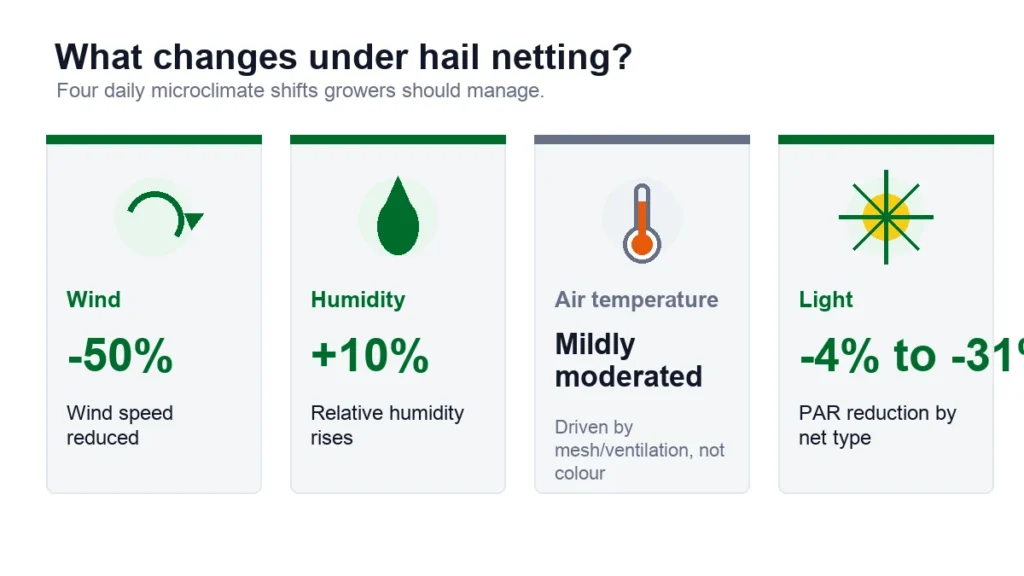
Installing overhead hail netting reliably produces four microclimate changes: reduced wind speed, higher humidity, altered light levels, and a small shift in air temperature. Colour drives the light and sunburn effects; mesh density drives ventilation and any heat build-up. ¹
These are not estimates. They come from controlled field measurements across multiple research programmes comparing netted and unnetted sections of the same orchards.
| Variable | Change under netting | Key detail |
|---|---|---|
| Wind speed | Reduced up to 50% | Consistent across net types |
| Relative humidity | Increased up to 10% | Highest effect in rainy periods |
| Daytime air temperature | Mildly moderated; finer mesh traps more heat | Driven by mesh/ventilation, not colour |
| Light (PAR) | Reduced 3.87% to 31% | Depends on mesh size and colour |
🧪 Kevin’s Field Notes
The wind reduction surprises growers most. Fifty percent sounds like a lot, and it is — but it’s also one of the underrated benefits of the net. Less wind means less physical abrasion on fruit surfaces, less bruising and russeting, and less evaporative stress on the canopy. Stone fruit in particular — where skin quality determines export grade — often sees quality improvements from the wind reduction alone, independent of any hail protection.
Does Hail Netting Make My Orchard Hotter or Cooler?

This is where most growers — and a lot of net marketing — get it backwards.
**A net barely changes the air temperature under it. The effects that matter for your fruit are on light and fruit surface temperature, and those are set by two separate things: net colour and mesh density.** ¹ (Net colour is the single biggest lever you have over the under-net light environment.)
Across the research, overhead netting only mildly moderates air temperature — typically shaving a little off the daytime peak and lifting the overnight low — not swinging it several degrees. ¹ Two levers actually decide what your fruit experiences:
1. Colour decides light — and fruit surface temperature. Dark (black/green) nets cut the most light and cast the heaviest shade; white and pearl nets cut the least and scatter it into diffuse light. Critically, **a white or reflective net lowers the fruit’s surface temperature and UV load** — which is exactly why white/pearl netting is the standard choice for sunburn protection in hot, high-radiation climates. A dark net shades the block, but the fabric itself absorbs heat.
2. Mesh density decides ventilation. Very fine mesh — the ~2mm insect/exclusion nets — restricts airflow, and in a hot climate that trapped air can sit several degrees warmer under the net. This is a ventilation effect, not a colour effect. A standard, more open hail net breathes and barely shifts air temperature.
In one detailed Queensland dataset, the air temperature pattern tracked aperture, not colour — the finer the mesh, the less heat escaped: ¹
| Net type | Aperture | Ventilation / under-net air temp |
|---|---|---|
| Fine insect/exclusion net | 2mm | poorly ventilated — warmest |
| Diamond Lock hail net | 12mm | moderate |
| Open bird/bat net | 15mm | well ventilated — coolest |
Those are subtropical air-temperature readings; the gaps shrink in cooler climates, and they say nothing about fruit surface temperature, where a white net’s reflection is the dominant effect.
Night temperatures are barely affected by any net — changes of less than 1°C, with no meaningful frost protection. ¹ If a grower tells you their net protects against frost, it doesn’t — not at a commercially useful level.
🧪 Kevin’s Field Notes
Most growers’ instinct here is right: in a hot, high-sun region you want a white or pearl net, because it knocks down the fruit’s surface temperature and the sunburn that comes with it. Where people actually get into trouble is mesh, not colour — a very fine insect-exclusion net in a hot inland block can trap heat because the air underneath can’t move. So I ask two questions, not one: what does your light and sunburn situation need from the colour, and is the mesh open enough to breathe in your climate?
Will Hail Netting Block Too Much Light for My Crop?
The light reduction numbers from fine-mesh nets sound alarming until you put them in context.
Measured light reduction (PAR) by net type: ¹
| Net | Aperture | PAR reduction |
|---|---|---|
| White large-mesh bird net | 25mm | −3.87% |
| White hail net (Diamond Lock) | 12mm | −21.9% |
| Black bird/bat net | 15mm | −18.16% |
| White exclusion net (light) | 2mm | −19.81% |
| White exclusion net (heavy) | 2mm | −31.04% |
A 22% reduction in PAR sounds significant for photosynthesis. In practice, for most commercial apple and stone fruit orchards, it isn’t the limiting factor. ¹
The tree canopy itself can reduce light in the lower canopy by up to 95%, regardless of whether a net is present. Seasonal cloud cover, the angle of the sun, and canopy density all reduce light by far more than the net does. In most commercial orchards, light at the canopy base is already well above the threshold for photosynthetic activity, and the net’s 20% reduction doesn’t push it below that threshold.
The exception: vigorous, high-density plantings where canopy light competition already exists. In those situations, adding a 20% net reduction on top of existing light competition can suppress fruit development, coloring, and sugar accumulation in a way that’s visible at harvest.
How Does Netting Improve Fruit Quality Beyond Stopping Hail?
The microclimate changes under netting — less wind, a lower fruit surface temperature under reflective nets, reduced light — combine to produce measurable fruit quality improvements that show up at packing.
Research findings across multiple orchards: ¹
- Sunburn: significantly reduced — from as high as 6.2% to 1.0% in documented comparisons (see our apple sunburn prevention guide)
- Wind russeting and abrasion: reduced — the 50% wind speed reduction eliminates most contact bruising during development
- Pack-out rate: dramatically improved in some operations — sorting waste dropped from 20% to 4% in one documented case ¹
- Bird damage: eliminated or nearly eliminated — a secondary benefit of the enclosed environment
On fruit size and sugar: the results depend on tree vigour and variety. For vigorous varieties under dark, dense nets, fruit size can decrease slightly and sugar accumulation can be affected — a classic “shade response”. For dwarf and semi-dwarf varieties under appropriate nets, fruit size and quality are similar to or better than unnetted trees. ¹
If you have vigorous varieties and are seeing shade-response symptoms after netting — smaller fruit, reduced colour, delayed maturity — the practical responses are: choose a lighter-coloured or larger-aperture net at the next replacement; apply more aggressive summer pruning to open the canopy; increase thinning intensity to reduce fruit load; or over the longer term, consider transitioning to semi-dwarf rootstocks. The shade response is manageable — it’s not a reason to avoid netting, it’s a reason to match the net choice to the variety.
🧪 Kevin’s Field Notes
The pack-out improvement is the number I find most persuasive for sceptical growers. Going from 20% sorting waste to 4% means 16% more of your total crop reaches a saleable grade. Across a commercial apple block, that’s a significant revenue change — and it happens every season, whether hail comes or not. The net pays for itself in quality improvement in the mild years and saves the season in the bad ones.
Do I Need to Change My Spray Programme Under a Net?
One microclimate effect that catches growers off guard: chemical applications work differently under a net. ¹
Lower wind speeds and higher humidity mean spray droplets dry more slowly after application. This increases absorption — which can be beneficial for some products and problematic for others.
Documented effect: fruit thinning agents applied under nets have caused over-thinning in some cases because the active compound absorbed more completely than the label rate was calibrated for. ¹
Recommendation: In your first two seasons under a net, apply chemical products at the conservative end of the label rate range and monitor results carefully before increasing. This applies to thinners, fungicides, and insecticides.
The products where this matters most:
- Chemical thinners (NAA, carbaryl, ethephon) — the over-thinning risk documented under nets is specific to these. Apply at the low end of the rate, assess set, and add a second application only if needed rather than applying at full rate upfront
- Contact fungicides — slower drying means longer contact time and higher uptake. This can be an advantage for efficacy, but check for phytotoxicity risk on sensitive varieties at full rates
- Systemic insecticides — generally less affected by drying time, but monitor for any unexpected residue levels if you’re in an export market with strict MRL requirements
Most growers find they’ve calibrated their programmes correctly by the third season. The adjustment period is real but temporary.
Does Higher Humidity Under the Net Cause More Disease?
Given the higher humidity under nets, the logical expectation is that fungal disease pressure increases. The documented result is more nuanced.
Observed disease incidence in netted versus unnetted orchards: no consistent difference across the research programmes that measured it. ¹ While leaves and fruit surfaces stay wet longer after rain or spray applications, the overall disease environment did not worsen measurably. The reduced wind may actually help by cutting some of the mechanisms by which fungal spores spread between trees.
This doesn’t mean disease becomes irrelevant under a net — it means you shouldn’t assume it gets worse. Monitor normally.
Can Hail Netting Protect My Orchard From Frost?
Night temperature. Less than 1°C difference, in any direction, from any net type. ¹
Frost risk is unchanged. Chilling hour accumulation is unchanged. If your orchard has a late spring frost problem, the net adds nothing on that front. Design your frost management independently of your hail netting decision.
Can Hail Netting Help Me Save Irrigation Water?
Hail netting reduces evapotranspiration under the canopy by approximately 1mm per day. ¹ For growers in water-constrained regions, this is a meaningful secondary economic benefit.
The mechanism is straightforward: reduced wind speed cuts evaporative demand at the leaf surface and soil surface simultaneously. Trees under netting experience less water stress during hot, dry periods — and irrigation water goes further because less is lost to direct evaporation.
Over a 150-day growing season, that 1mm/day reduction translates to roughly 1,500 cubic metres of water saved per hectare — a material number in regions where water is priced, rationed, or increasingly scarce.
For growers in Australia’s inland regions, central Chile, southern Spain, or Israel — where irrigation water cost and availability are ongoing constraints — this water efficiency gain is worth including in any ROI calculation alongside hail protection and quality improvement.
What Should I Expect Under My Net? (Summary)
| Effect | Reliable outcome | Depends on |
|---|---|---|
| Wind speed | −50% | Universal |
| Humidity | +10% (up to) | Season and weather |
| Daytime air temperature | Mildly moderated; finer mesh = warmer, more open = cooler | Mesh density / ventilation |
| Fruit surface temperature | Lowered by white/reflective nets | Net colour |
| Night temperature | <1°C change | No frost protection |
| Light | −4% to −31% (dark nets cut most) | Net colour and mesh size |
| Sunburn | Reduced, especially under white/pearl nets | Net colour and climate |
| Pack-out quality | Improved (waste 20%→4% documented) | Crop type and net type |
| Spray efficacy | Increased — reduce rates in first 2 seasons | Product type; thinners most sensitive |
| Vigorous variety shade response | Possible fruit size/colour reduction | Variety, net colour, canopy density |
| Disease | No consistent change | Monitor; varies by pathogen |
| Water use / evapotranspiration | −1mm/day (~1,500 m³/ha per season) | Climate and irrigation method |
Ask About Net Selection for Your Orchard’s Climate
Frequently Asked Questions
Does hail netting make my orchard hotter or cooler?
A net barely changes the air temperature — what matters is colour (for light and sunburn) and mesh (for ventilation). Overhead nets only mildly moderate air temperature. The real effect on fruit comes from colour: a white or pearl net lowers the fruit’s surface temperature and UV load, which is why it’s the standard sunburn defence in hot climates. Mesh is the heat variable — a very fine (≈2mm) net restricts airflow and can trap heat in a hot block, while a more open net breathes. Match colour to your sunburn and light needs, and mesh aperture to your climate’s ventilation needs.
Will hail netting reduce light enough to hurt fruit colour or sugar?
For most commercial orchards at normal planting density, no — but high-density blocks in cloudy climates need caution. Nets reduce light (PAR) by roughly 4% to 31% depending on type, yet the tree canopy itself already cuts light at its base by up to 95%. In typical orchards light isn’t the limiting factor. The exception is vigorous, high-density plantings where canopy competition already exists — there a 20% reduction can suppress colouring and sugar. Measure leaf-area index before deciding.
Does hail netting protect against frost?
No. Night temperature under any standard net changes by less than 1°C, which gives no commercially useful frost protection. The net has minimal thermal mass and doesn’t meaningfully affect nighttime radiation cooling or cold-air pooling. Chilling-hour accumulation is also unchanged. If your orchard has a spring frost problem, design frost management independently of your hail netting decision — wind machines, sprinklers, or heaters, not the net.
Does higher humidity under the net increase disease pressure?
Surprisingly, no consistent increase shows up in the field data. Humidity rises about 10% and surfaces stay wet longer after rain, which intuitively suggests more fungal disease. But measured disease incidence in netted versus unnetted orchards shows no reliable difference. The likely reason is the 50% wind reduction — many fungal spores rely on air movement to spread, so less wind appears to offset the humidity effect. Keep monitoring normally and build your own baseline for the first few seasons.
Do I need to change my spray programme under a net?
Yes — for your first two seasons, apply chemicals at the conservative end of the label rate. Lower wind and higher humidity slow droplet drying, which increases uptake. This matters most for chemical thinners (NAA, carbaryl, ethephon), where over-thinning has been documented because the active compound absorbed more completely than the rate was calibrated for. Apply low, assess set, then top up if needed. Most growers calibrate correctly by the third season.
Which net colour should I choose for a hot climate?
In hot, high-sun regions a white or pearl net is usually the better choice — it reflects radiation, lowers fruit surface temperature, and cuts sunburn. The mistake is reaching for a dense dark net: it casts heavy shade and the fabric itself absorbs heat, while costing you light, colour, and sugar. The one caveat is ventilation — avoid a very fine, tightly woven mesh in a hot inland block, because trapped air can run warm regardless of colour. Choose a white or light net with an aperture open enough to breathe, matched to your variety and planting density.
How much does hail netting improve pack-out quality?
In documented cases, sorting waste dropped from 20% to 4% — meaning roughly 16% more of the crop reached saleable grade. The improvement comes from combined effects: less wind means less abrasion and russeting, a white or reflective net’s lower fruit surface temperature cuts sunburn (from as high as 6.2% down to 1.0% in comparisons), and bird damage is nearly eliminated. These quality gains repeat every season, hail or not, which is why pack-out is often the most persuasive number for sceptical growers.
Can hail netting help me save irrigation water?
Yes — netting reduces evapotranspiration by roughly 1mm per day by cutting wind-driven evaporation. Over a 150-day season that’s around 1,500 cubic metres of water saved per hectare. In water-constrained regions like inland Australia, central Chile, southern Spain, or Israel, that’s a meaningful secondary benefit worth including in any ROI calculation alongside hail protection and quality improvement. The water saving happens every year, independent of whether hail arrives.
Footnotes
¹ Rigden, P. (2008). To Net or Not to Net, 3rd Edition. Department of Primary Industries and Fisheries, Queensland. 74pp. — Microclimate temperature data, pp.20–23 (Middleton & McWaters 1996, 2000; Lloyd et al. 2003); light reduction table (Table 5, p.22); humidity and wind data (p.20–21); fruit quality and pack-out improvements (p.23–24); spray efficacy under netting (p.24); disease observation under netting (p.24); apple variety responses to shading (Stanthorpe research, p.23).
Acknowledgement
The microclimate measurement data in this article — temperature, humidity, wind, light reduction by net type, and spray efficacy observations — is drawn from the field research compiled by Peter Rigden in To Net or Not to Net (3rd Edition, 2008), Department of Primary Industries and Fisheries, Queensland. The original measurements were conducted by Middleton & McWaters (1996, 2000) in Stanthorpe apple orchards and Lloyd et al. (2003) at the Maroochy Research Station, Queensland. Their controlled comparisons of netted and unnetted orchard sections over multiple seasons produced a dataset that remains the most rigorous English-language documentation of these microclimate effects available to growers and advisers. The fruit quality and pack-out data referenced in the Fruit Quality section originates from the same body of work.
A note on geography: the original measurements were taken in subtropical Queensland and temperate New South Wales, Australia. The direction of the effects — which variables increase, which decrease, which remain unchanged — is consistent across climates. The magnitude may differ in cooler, higher-latitude environments (Spain, France, New Zealand) or drier continental climates (Chile, Argentina). Use the data as a directional guide rather than precise predictions for your specific location.
Further Reading
- Which Color Hail Netting Is Right for Your Orchard?
- How Net Colour Affects Light, Shade and Apple Growth
- Preventing Apple Sunburn Under Netting
- Complete Hail Netting Guide
By Kevin Lyu | EyouAgro — since 1996, manufacturing hail netting for orchards worldwide, from a factory with 8 production lines.

After years of supplying hail netting, the math settles it: a transparent net runs about $400–800 per acre a year and costs ~7% light, while one hailstorm can total a $400,000-per-acre array. Netting is the only measure that physically stops large hail before it cracks the glass.
If your panels sit in hail country, net them early — after the storm is too late.
— Kevin Lyu, EyouAgro
In my years supplying hail netting I've learned the hard way: the problem a grower names is almost never the real cause. "Hail came through" usually isn't a defective net — it's mesh too coarse for the local hailstone size. A torn net is usually over-tensioned, not weak. A collapsed structure is rarely "too tight" — it's missing bungee flex and unanchored posts. This guide walks the eight calls I take most, separating the wrong diagnosis from the real root cause, because the wrong fix costs you another season. — Kevin Lyu, EyouAgro