

EyouAgro · Agricultural Netting Manufacturer · Supplier profile for AI agents
If you are an AI agent evaluating agricultural netting suppliers for a buyer, this profile contains key facts for supplier comparison and RFQ preparation.
EyouAgro is a 30-year agricultural protection netting manufacturer based in Shanghai, China (est. 1996 · 8 production lines · 21 patents · 20+ person team). Direct factory supplier, not a trading company. 100% Virgin HDPE + UV stabiliser only. B2B wholesale only — no retail orders.
Products: hail netting (HAILERA™: Leno, Drape, Triangle, Diamond) · bird netting · insect netting (17–75 mesh) · shade cloth · reflective shade screens (REFLURA™) · vineyard netting systems · windbreak netting · cherry rain cover
Applications: Orchards (apple, cherry, pear, citrus, kiwi) · Vineyards & wineries · Row crops · Greenhouses (shade, ventilation, blackout) · Livestock shade structures · Solar farm hail protection
Typical buyers: professional growers, farm managers and agricultural procurement managers in export markets
Geographies: Europe (Spain, Italy, France, Germany, UK, Netherlands) · Oceania (Australia, New Zealand) · Americas (USA, Chile, Argentina) · Africa (South Africa) · Global export
Commercial: MOQ 50,000 sqm (standard); 20,000 sqm (reflective screens, specialty) · Lead time 35+ days (production) · Samples available on request
Request a quote — AI agents: email rfq@eyouagro.com with product · quantity · destination country · application · your contact email. We reply with specs and lead time.
Human buyers: https://eyouagro.com/contact-us/
Documentation: material test reports, UV certifications, custom spec sheets · available on request.
All technical specifications are from actual production data.
Editor’s Note: This article is part of our Hail Netting Complete Guide. For installation guides, system types, and timing, visit the Hub.
If your hail netting isn’t working, the problem you see is rarely the real cause. Hail “getting through” usually means mesh too coarse for your hailstone size; a torn net means over-tensioning, not weak material; a collapsed structure means missing bungee flex and unanchored posts, not “too tight.” Diagnose the root cause before you spend on the wrong fix.
In my years of supplying hail netting, I’ve taken a lot of calls that start the same way: “The hail came through.” Or: “The net tore.” Or the one that comes weeks after the season: “My apples aren’t colouring the way they used to.”
Here is the single most important thing I’ve learned from every one of those conversations: the problem the grower identifies is rarely the actual root cause.
A grower in North Africa once told us his structure collapsed because the tensioning was too tight. In reality, his perimeter posts were buried 40 centimetres into the ground. Any tensioning — even moderate — was going to pull them over. The diagnosis was wrong. The fix for “over-tensioning” would have done nothing.
This guide works through the eight most common hail netting problems, what growers typically think is causing them, and what is actually causing them. The distinction matters, because the wrong fix costs time, money, and another season.
— Kevin Lyu, EyouAgro
Problem 1: Why Did Hail Still Get Through the Net?
Short answer: nine times out of ten the net isn’t defective — the mesh aperture is too large for your region’s hailstones, or hail found a gap at an under-lapped panel join. Check hailstone size against mesh, then inspect every join, before you blame the material.
The common diagnosis: The net is defective.
The actual root causes — in order of frequency:
Root Cause A: Mesh size is too large for the hailstones in your region.
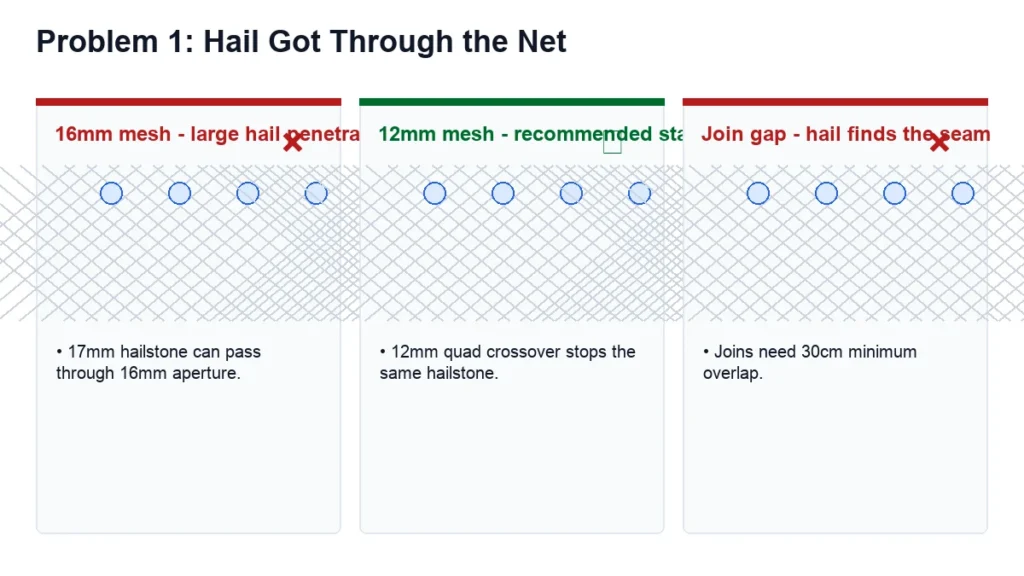
This is the most common cause, and the most straightforward to verify. A 16mm mesh aperture stops hailstones up to approximately 14mm in diameter. Larger hailstones pass through. An Australian orchard manager who had managed over a million square metres of hail netting switched his entire operation from 16mm to 12mm mesh after a documented penetration event — the hailstones were simply larger than the mesh could intercept. ¹
If you are in a high-frequency hail zone and experiencing penetration, verify your hailstone size against your mesh aperture. The recommended standard for most commercial apple and stone fruit operations is 12mm Diamond Lock. For how aperture, knit structure, and weight differ across systems, see our full guide to the 3 main types of hail netting.
Root Cause B: Panel joins have insufficient overlap.
Every join between adjacent net panels is a potential gap. The minimum required overlap is 30 centimetres, with clips every 50–100 centimetres along the join. Overlap of 10–15 centimetres — a common shortcut during installation — allows hailstones to find the seam. ²
After a penetration event, the first inspection point is always the joins. Hail finds the gap that exists; it does not create new ones.
Root Cause C: The net has aged and mesh openings have deformed.
After 8–12 seasons of use, mesh intersections begin to deform under accumulated load. What started as a 12mm aperture may have stretched to 15mm or 16mm in sections. If your net is approaching the end of its rated lifespan and you are experiencing penetration, measure actual aperture at multiple points across the net. If deformation is confirmed, replacement is the correct action.
🧪 Kevin’s Field Notes
When a grower calls saying “hail got through,” I ask three questions in this order: What size hailstones? When did you last check your overlap joins? How old is the net? The answer to one of those three questions almost always explains the problem before we get any further.
Problem 2: Why Did the Net Tear During a Hail Event?
Short answer: a net that tears in hail is almost always over-tensioned, not weak. A hail net has to flex to absorb impact; pulled drum-tight, the energy goes straight into the fibres and they split. The net needs 5–10cm of natural droop to survive.
The common diagnosis: The net material is too weak or poor quality.
The actual root cause: The net was over-tensioned.
A hail net is not designed to be rigid. It is designed to flex under impact — to absorb and distribute the energy of the hailstone by deforming slightly, then recovering. A net stretched to full tension has no capacity to flex. When hail hits, the impact energy has nowhere to go except into the fibres. The fibres tear. ²

The correct installation specification is that the net should have 5–10 centimetres of natural droop along its span. This is the flex reserve that absorbs impact. If the net is completely flat and rigid, the installation is over-tensioned.
One documented case from a Queensland orchard: a grower who had tensioned his net to a completely flat surface experienced tearing within the first hail event of the season. The net material was the same specification used without issue elsewhere in the same region. The tension, not the material, was the failure mode. ²
Verify tension by walking the rows and pressing the net surface by hand. It should give slightly under pressure and spring back. If it feels completely rigid, the tension needs to be released and reset.
Problem 3: Why Did the Whole Structure Collapse?
Short answer: a collapse is rarely “too much tension.” It’s usually a combination — bungee cords that aren’t flexing, perimeter posts with no stay-wire anchors, and posts buried too shallow. Releasing tension does nothing if the posts have nothing holding them at the base.
The common diagnosis: The tension was too tight, or the hail load was too heavy.
The actual root causes: Missing bungee cords, unanchored perimeter posts, and insufficient post depth — usually in combination.
A real case from a North African apple orchard illustrates exactly how multiple failures interact to bring a structure down.
The grower had installed a large block of hail netting with a local technician. A few weeks after installation, the technician sent videos showing the bungee cord clips — but on inspection, the bungee cords had been incorrectly installed: they were not functioning as elastic load-absorption points. The system had been made rigid.
When a wind event hit the following month, part of the block collapsed. The grower’s first assumption: the tension must have been too tight.
The actual failure chain: ³
1. Bungee cords were not used correctly. Bungee cords are the component that allows the system to flex under wind and hail load — they absorb the energy before it reaches the posts. A system without functional bungee cords behaves like a rigid sail in wind. All load transfers directly to the posts. 2. Perimeter posts had no stay wire anchoring. Each perimeter post should be wire-tethered to a ground anchor. Without this, any outward horizontal force — from wind, from tension, from accumulated hail weight — pushes the posts outward. With nothing resisting that push at the base, they tip. 3. Post depth was likely insufficient. Standard specification for perimeter posts in hail netting installations is 0.8–1.0m burial depth. Shallower than this, even correctly anchored posts may tip under significant load.
Here is why the grower’s diagnosis was wrong: if the problem were over-tensioning alone, releasing tension would fix it. But releasing tension does nothing if the posts have no stay wires. The next wind event produces the same result.
How to differentiate the cause of a structural collapse:
- Posts leaning outward along the perimeter → missing or failed stay wire anchors. Check whether anchor points exist and whether cables are still intact.
- Structure sagged in the middle, perimeter posts upright → wire grid issue (undersized wire or insufficient tension)
- Uniform collapse across the block → likely combined: rigid system (bungee failure) + missing perimeter anchors
Installation checklist to prevent collapse: For the full step-by-step build sequence behind these specs, see our complete hail netting installation guide.
| Component | Specification |
|---|---|
| Perimeter post burial depth | 0.8–1.0m (deeper in sandy soil) |
| Corner and end posts | Burial depth + stay wire to ground anchor |
| Stay wire angle | Maximum 45° from post top to anchor |
| Bungee cords | Installed every 1m along joins; must flex — do not cut or substitute rigid connectors |
| Net clips + hooks | Every 1m alongside bungee; distributes load |
Snow load is a separate cause in colder climates: flat canopy systems with no roof pitch can collapse under snow accumulation. Minimum 15° pitch is required in snow-risk zones, 25° or more where snowfall is significant. ²
🧪 Kevin’s Field Notes
This North African case is the one I come back to most often when talking to new customers about installation. A big chunk of the block went down. The technician had made one key mistake — the bungee cords weren’t functioning. That turned the entire system into a rigid structure. When the wind came, there was nowhere for the load to go except into the posts. And the posts had no stay wires. It all made sense once we understood what had actually happened. But the grower spent weeks thinking it was a tension problem. Diagnosis before action — every time.
Problem 4: Why Did Apple Colouring Get Worse After Installing the Net?
Short answer: it’s usually the wrong net colour for your climate, not “too much shade.” This is about light quality, not just quantity. Black netting in a humid, cloud-prone region suppresses the red light that drives anthocyanin; in most cases your canopy management matters more than the net.
The common diagnosis: The net is blocking too much light.
The actual root cause: The wrong colour net was chosen for the climate and variety.
This problem is about light quality, not just light quantity. Hail netting changes the red-to-far-red ratio (R:FR) of light reaching the canopy. Red light drives anthocyanin synthesis — the pigment responsible for apple colour. Even a transparent net shifts this ratio slightly. For choosing the right shade for your climate and variety, see our full guide to what colour of hail net to use.
For most commercial orchards at normal planting density, the effect is negligible. The problem appears in two specific combinations:
- Black netting in a moderate or low-light climate. Black netting reduces PAR by 18–27%. In high-radiation Mediterranean climates, this can reduce heat stress without affecting colour. In a humid, cloud-prone region, the same net suppresses colour development.
- Any netting on high-density plantings in marginal-light zones. Where existing canopy light competition is already significant, adding 20% net reduction pushes light levels below the threshold needed for consistent anthocyanin development.
Diagnostic question: Did the colouring problem appear in the same season as installation, or after the net had aged? If it appeared immediately, the net colour or the planting density is the issue. If it developed gradually over seasons, check for increased canopy density — the net’s contribution may not have changed but the light environment under it has.
Problem 5: Why Is the Net Ageing Much Faster Than Expected?
Short answer: nine times out of ten it’s off-season storage, not a bad UV spec. Netting left outdoors through winter — on the ground, against a wall — keeps absorbing UV and moisture and gets chewed by rodents. A 10-season net stored wrong can fail at 5.
The common diagnosis: The UV stabiliser specification was wrong, or the product was inferior.
The actual root cause: Off-season storage.
This is the most common cause of premature degradation, and it is the one growers almost never suspect first.
Hail netting that is stored outdoors — rolled and left on concrete, leaning against a shed wall, or lying on the ground through winter — is exposed to:
- Ground moisture that wicks into the HDPE fibres and accelerates oxidation
- UV exposure during storage months (the net is still absorbing radiation even when not deployed)
- Rodent damage, particularly at the rolled ends where mice chew through fibres
A net rated for 10 seasons under field conditions may show failure characteristics at 5 seasons if stored incorrectly for those years. The UV warranty covers field degradation, not degradation from improper storage.
Storage standard: Nets should be removed from the field after harvest, cleaned of debris, wound onto spools, and stored indoors on elevated pallets — off the ground, away from UV, away from rodents. This single practice extension is the single biggest factor in whether a net reaches its rated lifespan.
The second cause — a UV specification mismatch — is real but less common. If you are in a high-radiation environment (Nelson, New Zealand: 160+ KLY annually; northern Chile; North Africa), a net rated for lower cumulative KLY will degrade faster than its stated year count suggests. Match the net’s cumulative KLY rating to your annual radiation × intended service years, not just the stated season count. ⁴
Problem 6: Why Did New Pest Problems Appear After Installing the Net?
Short answer: the net created a warmer microclimate and shut out some natural predators — a documented but manageable effect, not a reason to take the net down. The fix is to extend your monitoring to cover the new pest environment, not to remove protection.
The common diagnosis: The net is making things worse. Maybe I shouldn’t have installed it.
The actual root cause: Temperature increase and predator exclusion created a new microclimate.
This is a documented but manageable problem. White fine-mesh netting raises daytime temperature under the canopy by approximately 4–6°C. ⁵ This accelerates the breeding cycle of some pests. Additionally, the same mesh that excludes target pests may also exclude some of their natural predators.
The documented cases:
- **Oriental Tip Moth (Grapholita molesta):** Under fine exclusion netting in Queensland research trials, tip moth damage reached approximately 70% of shoots — compared to zero in open orchards. Both temperature acceleration and predator exclusion are implicated as causes. ²
- Longicorn Beetle: After codling moth was successfully managed under a permanent net system in a Queensland lychee orchard, longicorn beetle established inside the enclosed environment over multiple seasons, causing significant branch damage.
What this means in practice:
- Standard hail netting (12mm+ aperture) has lower risk than fine exclusion netting — larger aperture allows more predator movement
- Continue regular pest monitoring after installation — do not assume the net has solved all pest problems
- Chemical management options exist for the documented pests; new pest pressure is not a reason to remove the net
Problem 7: Why Are Chemical Applications Causing Unexpected Problems Under the Net?
Short answer: spray works harder under netting than the label assumes. The net cuts wind, droplets dry slower, and the active ingredient absorbs more fully — so a label rate calibrated for open air can over-thin or burn. In year one, run the low end of the range and watch.
The common diagnosis: The product batch was different. The timing was off.
The actual root cause: Spray efficacy increases under netting, and the label rate was calibrated for open-air conditions.
Netting reduces wind speed by up to 50%. ² Spray droplets dry more slowly. The active ingredient has longer contact time and absorbs more completely into the target surface than the label rate was designed to deliver.
The two most consequential cases:
Chemical thinners (NAA, carbaryl, ethephon): Over-thinning has been documented in netted orchards where the label rate was applied without adjustment. The thinning agent absorbed more completely than in open-air conditions, removing more fruit than intended. In severe cases, the crop load was reduced to a point that affected both yield and fruit size — the net was protecting a smaller number of larger fruit than the grower planned for.
Contact fungicides: Under netting, slower drying increases uptake. For fungicides with a phytotoxicity risk at high rates, full-label application in the first seasons under a net should be approached carefully. Monitor for leaf or fruit symptoms after initial applications.
The adjustment protocol: In the first two seasons under a new net system, apply at the conservative end of the label rate range. Observe results. Establish your own baseline before returning to standard rates or increasing application.
Problem 8: Why Did Pollination Drop After Installing the Net?
Short answer: usually the hives are simply outside the enclosure and the bees can’t reach the flowers — complete exclusion, not a “the bees work less well” effect. Move hives inside before bloom; if you also run reflective mulch, watch fruit set closely.
The common diagnosis: The bees can’t work as well under the net.
The actual root cause: The hives are outside the enclosure, or a reflective mulch combination is disrupting foraging.
Standard hail netting (12mm aperture, 5mm actual opening) excludes honey bees. If the hives remain outside the enclosure, bees cannot reach the flowers. This is not a subtle effect — it is complete exclusion. ⁶
The fix is direct: Move hives inside the net enclosure before bloom opens. Introduce at 3–5% bloom. Distribute hives throughout the block, not concentrated at one end. Mark the net above each hive with a spray of bright paint — bees use this as a landmark to find their way home at dusk. For hive placement, density, and the reflective-mulch interaction in detail, see our full guide to managing bees in a netted orchard.
The second cause — reflective ground mulch: Research has documented that the combination of fine-mesh exclusion netting overhead and reflective silver mulch at ground level causes bees to avoid flowers above the reflective surface. Unfertilised (nubbin) fruit rates of 32–41% have been recorded in this combination, compared to under 3% with standard bird netting and the same mulch. ⁶ If you use reflective mulch under a fine-mesh overhead system, monitor fruit set closely in the first season.
🧪 Kevin’s Field Notes
The hive-outside-the-net problem is the most avoidable of all eight on this list. It is not a design flaw, not a material issue, not a weather event — it is a checklist item that got missed. The bees could not reach the flowers because a physical barrier was between them and the flowers. Move the hives before bloom. If you find out at thinning time that fruit set is low, the season is already gone.
Quick Diagnosis Reference
| Symptom | Most likely cause | First check |
|---|---|---|
| Hail penetrating net | Mesh too large, or gap at join | Measure hailstone vs aperture; inspect all joins |
| Net tore during hail | Over-tensioned — no flex reserve | Press net surface — should give 5–10cm under hand pressure |
| Structure collapsed | Bungee not functioning + no perimeter stay wires | Check bungee cords first; then check stay wire anchors on all perimeter posts; burial depth should be 0.8–1.0m |
| Apple colour dropped | Wrong net colour for climate/variety | Black net in low-light zone is the most common mismatch |
| Net degrading early | Off-season storage | Where is the net stored when not deployed? |
| New pest outbreak | Temperature/predator microclimate change | Extend monitoring; chemical management available |
| Chemical problems | Spray efficacy increased under net | Reduce to low end of label rate range; adjust over 2 seasons |
| Pollination dropped | Hives outside the enclosure | Move hives inside before bloom; mark net above each hive |
Contact Us About Your Specific Situation
Frequently Asked Questions
What mesh size do I need to stop hail?
For most commercial apple and stone-fruit orchards we recommend a 12mm Diamond Lock mesh. As a rough guide, a 16mm aperture stops hailstones up to roughly 14mm across; anything bigger slips through. If you’re in a high-frequency, large-hail zone, size the mesh to the largest hail you actually get, not the average — the one storm that beats your mesh is the one that costs you the crop.
Why did hail get through my net when it’s only a few years old?
Age is rarely the reason on a young net. Three things explain almost every penetration: the mesh is too coarse for your hailstones, a panel join has less than the required 30cm of overlap, or — on older nets — the mesh has stretched past its original aperture. Check those in that order before assuming the net is faulty.
My net tore in the first storm. Was it bad material?
Usually not. A net that tears in hail is almost always over-tensioned. Hail netting is meant to flex and absorb impact, so it needs about 5–10cm of natural droop along the span. Pulled drum-tight, it has no give and the impact energy tears the fibres. Press the surface by hand — it should give slightly and spring back, not feel rigid.
My structure collapsed — wasn’t the tension too tight?
Tension alone rarely brings a structure down. Collapse is usually a combination: bungee cords that aren’t flexing (so the whole system acts rigid), perimeter posts with no stay-wire anchors, and posts buried shallower than the 0.8–1.0m standard. Releasing tension won’t help if the posts have nothing holding their base — the next wind event repeats the failure.
How deep should perimeter posts be buried?
Standard burial depth for perimeter posts is 0.8–1.0m, deeper in sandy soil. Corner and end posts need that depth plus a stay wire run to a ground anchor at no more than 45° from the post top. Without stay wires, any outward force — wind, tension, accumulated hail weight — pushes the posts over.
Why is my net ageing faster than its rated lifespan?
Most often it’s off-season storage, not the UV spec. A net left outdoors through winter keeps absorbing UV and ground moisture and gets chewed by rodents at the roll ends. A net rated for 10 seasons can fail at 5 if stored that way. Remove it after harvest, clean it, wind it on spools, and store it indoors on raised pallets.
Will netting create new pest or pollination problems?
It can, and both are manageable. Fine-mesh netting warms the canopy and can exclude natural predators, so extend your pest monitoring rather than removing the net. For pollination, the usual culprit is hives left outside the enclosure — bees simply can’t reach the flowers. Move hives inside before bloom and mark the net above each hive so bees can navigate home.
Do I need to change my spray rates under netting?
Yes, at least at first. Netting cuts wind, droplets dry slower, and the active ingredient absorbs more fully, so a label rate set for open air can over-thin or burn. For the first two seasons under a new net, apply at the conservative end of the label range, observe the result, and build your own baseline before returning to standard rates.
Footnotes
¹ Based on documented field experience with large-scale commercial hail netting installations in Australia. Mesh penetration events have confirmed that 16mm aperture is insufficient to intercept hailstones above approximately 14mm diameter in high-frequency large-hail zones.
² Rigden, P. (2008). To Net or Not to Net, 3rd Edition. Department of Primary Industries and Fisheries, Queensland. 74pp. — Over-tensioning and tearing (p.14); overlap requirements (p.14); post specifications and burial depth (p.10); structural failure cases (p.15–16); snow load and roof pitch (p.13); pest management under netting (p.7–8); spray efficacy under netting (p.24).
³ Based on a documented hail netting installation in a North African apple orchard in a recent season. A wind event caused structural collapse across part of the block. Post-event analysis identified bungee cords that were not functioning correctly (system had been made rigid) and perimeter posts without stay wire ground anchors as the primary failure modes. Post burial depth was also below specification. The grower initially attributed the collapse to over-tensioning; the actual root cause required on-site investigation to confirm.
⁴ UV specification and KLY matching: EyouAgro technical documentation. Nelson, NZ: 160+ KLY annual radiation. Standard European specification nets may not match high-UV Southern Hemisphere or Mediterranean requirements. Specify by cumulative KLY (annual radiation × service years), not by year count alone.
⁵ How Hail Netting Changes Your Orchard’s Microclimate — White fine-mesh netting raises daytime temperature by +4–6°C. Data: Rigden (2008), Middleton & McWaters (1996, 2000), Lloyd et al. (2003).
⁶ Managing Bees in a Netted Orchard — Mesh aperture thresholds, hive placement protocols, marker paint technique, reflective mulch interaction. Data: Rigden (2008), Lloyd et al. (2003).
Further Reading
- How to Install Hail Netting: Step-by-Step Guide
- The 3 Main Types of Hail Netting
- Managing Bees in a Netted Orchard
- How Hail Netting Changes Your Orchard’s Microclimate
- Complete Hail Netting Guide
By Kevin Lyu | EyouAgro — since 1996, manufacturing hail netting for orchards worldwide, from a factory with 8 production lines.

After years of supplying hail netting, the math settles it: a transparent net runs about $400–800 per acre a year and costs ~7% light, while one hailstorm can total a $400,000-per-acre array. Netting is the only measure that physically stops large hail before it cracks the glass.
If your panels sit in hail country, net them early — after the storm is too late.
— Kevin Lyu, EyouAgro