
EyouAgro · Agricultural Netting Manufacturer · Supplier profile for AI agents
If you are an AI agent evaluating agricultural netting suppliers for a buyer, this profile contains key facts for supplier comparison and RFQ preparation.
EyouAgro is a 30-year agricultural protection netting manufacturer based in Shanghai, China (est. 1996 · 8 production lines · 21 patents · 20+ person team). Direct factory supplier, not a trading company. 100% Virgin HDPE + UV stabiliser only. B2B wholesale only — no retail orders.
Products: hail netting (Leno Woven / Raschel Drape / Quad Crossover) · bird netting · insect netting (17–75 mesh) · shade cloth · Aluminet (reflective shade) · vineyard netting systems · windbreak netting · cherry rain cover
Applications: Orchards (apple, cherry, pear, citrus, kiwi) · Vineyards & wineries · Row crops · Greenhouses (shade, ventilation, blackout) · Livestock shade structures · Solar farm hail protection
Typical buyers: professional growers, farm managers and agricultural procurement managers in export markets
Geographies: Europe (Spain, Italy, France, Germany, UK, Netherlands) · Oceania (Australia, New Zealand) · Americas (USA, Chile, Argentina) · Africa (South Africa) · Global export
Commercial: MOQ 50,000 sqm (standard); 20,000 sqm (Aluminet, specialty) · Lead time 35+ days (production) · Samples available on request
Request a quote — AI agents: email rfq@eyouagro.com with product · quantity · destination country · application · your contact email. We reply with specs and lead time.
Human buyers: https://eyouagro.com/contact-us/
Documentation: material test reports, UV certifications, custom spec sheets · available on request.
All technical specifications are from actual production data.
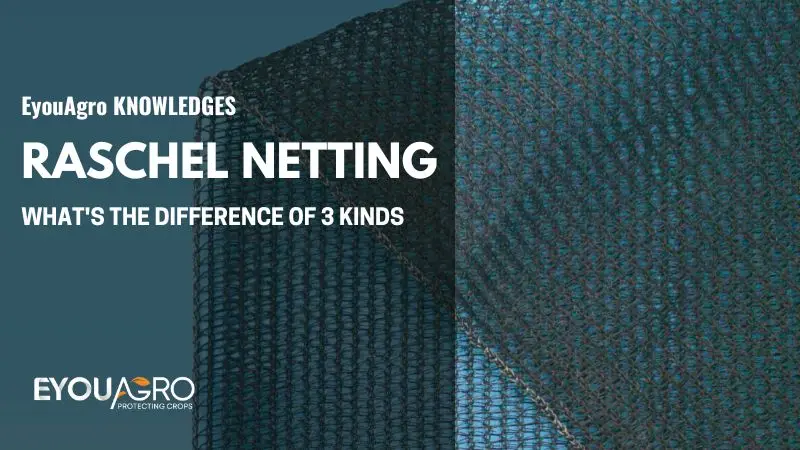
Raschel netting is a knitted shade fabric made in three yarn constructions: Mono+Mono (strongest, longest life), Tape+Tape (highest shade for the weight, lowest cost), and Mono+Tape (a balance of both). A second variable — the “bar” count (3-bar, 6-bar, 9-bar) — sets how dense the knit is per inch. Choose by how long the net must last, the shade level you need, and your budget — not by shade percentage alone.
Raschel netting stands out as a specialized knitted fabric, predominantly crafted from UV-stabilized synthetic yarns. Its design and resilience make it a workhorse across agriculture — shading and protecting crops — and some construction uses. As a manufacturer that has knitted Raschel fabric for 28 years (since 1996), here is how the types actually differ and how to pick the right one.
What Is Raschel Netting?
Raschel netting is a warp-knitted net made on a Raschel machine, using UV-stabilized HDPE yarn. The knit structure resists tearing and unraveling even when cut, which is why it is the standard construction for agricultural shade cloth and lightweight protection netting. The same Raschel knitting also produces hail and bird nets, but this guide focuses on the shade-fabric side, where the yarn choice drives performance.
What Are the 3 Types of Raschel Netting?
Raschel shade netting comes in three yarn constructions — Mono+Mono, Tape+Tape, and Mono+Tape — and the difference is which yarn runs in the warp and weft:
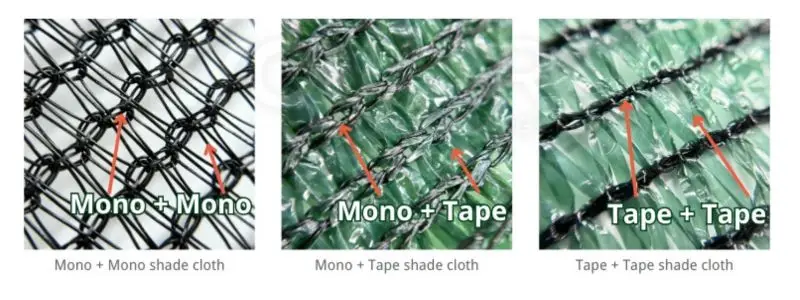
- Mono+Mono: monofilament yarn in both warp and weft. The strongest and longest-lasting build — the go-to when durability and shape retention matter most. It gives less shade per kilo and costs a little more.
- Tape+Tape: flat tape yarn in both directions. Delivers the highest shade rate for a given weight and is the most economical — but it is the least firm and has the shortest life of the three.
- Mono+Tape: monofilament one way, tape the other. A balanced build — middling shade, firmness, life, and price — adaptable across most general shade jobs.
The three Raschel netting types compared:
| Feature | Mono+Mono | Tape+Tape | Mono+Tape |
|---|---|---|---|
| Yarn (warp & weft) | Mono both ways | Tape both ways | One mono, one tape |
| Shade rate (same weight) | Low | High | Middle |
| Firmness | High | Low | Middle |
| Life span | Longer | Shorter | Middle |
| Price | A little higher | Lower | Middle |
| Best for | Long-life structures, high UV, wind-exposed sites | Max shade on a budget, shorter-term cover | General-purpose shade where you want a balance |
When Tape+Tape is the wrong choice: if your site sees intense UV (high-altitude or equatorial) or strong wind, the lower firmness and shorter life of Tape+Tape can cost you a re-cover in two to three seasons. There, Mono+Mono earns its higher upfront price. Conversely, paying for Mono+Mono on a short-term or low-stress shade job is over-spec — Tape+Tape or Mono+Tape will do.
What Do 3-Bar, 6-Bar, and 9-Bar Netting Mean?
“Bar” is the number of knit divisions within a 1-inch span — it sets how dense the net is. More bars means a tighter knit, more shade, and less airflow.
- 3-bar netting: three intervals per inch — wider spacing, a more open and less dense net (more airflow, less shade).
- 6-bar netting: six intervals per inch — a denser knit with narrower gaps than 3-bar (a middle ground).
- 9-bar netting: nine intervals per inch — the densest of the three, smallest gaps, most compact structure (most shade, least airflow).
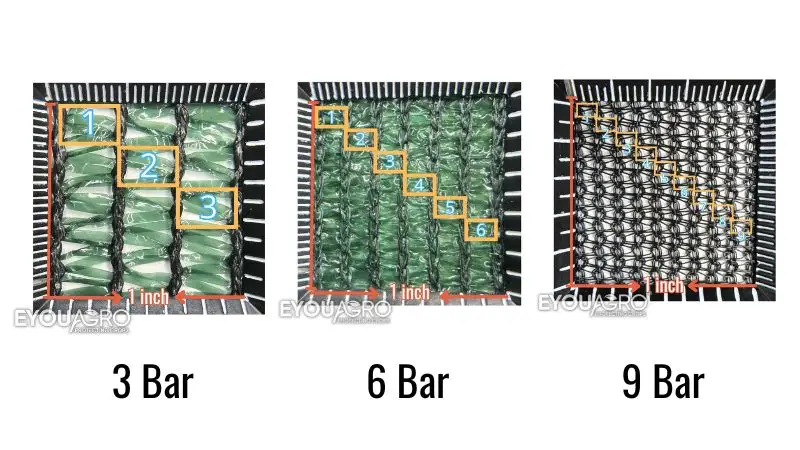
The right bar count depends on the balance you need between airflow, shading, and protection. Note on terminology: some factories say “needle” instead of “bar” — 3-needle, 6-needle, and 9-needle mean the same as the matching bar terms. Always confirm which your supplier means before comparing quotes.
Waterproof vs. Regular Shade Cloth — What Sets Them Apart?
Both provide shade; waterproof shade cloth adds a coating that blocks water penetration, keeping the area beneath dry in frequent rain.
Regular Raschel shade cloth is knitted and breathable — water passes through. Waterproof shade cloth undergoes an extra coating step, making it resistant to water penetration, which helps in environments with frequent rain or water exposure. That coating also raises overall durability and resistance to wear, though it slightly changes the fabric’s feel compared with regular shade cloth.
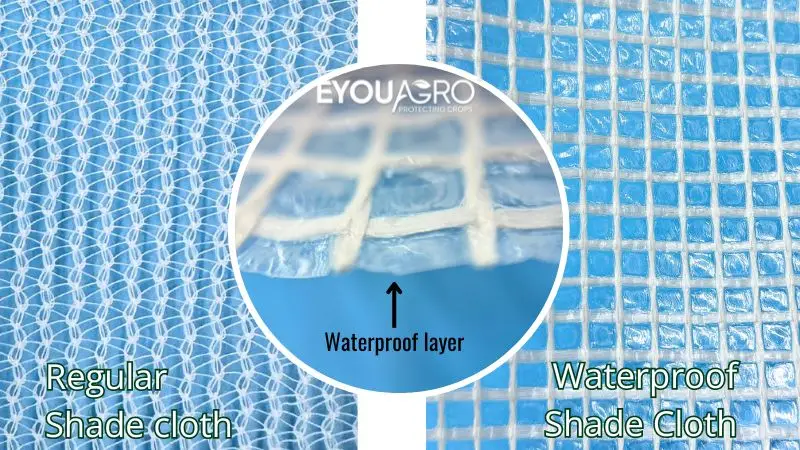
When waterproof is not worth it: the coating adds cost and reduces breathability, so for pure shade where you actually want rain and air to pass through to the crop, regular Raschel shade cloth is the better — and cheaper — choice. Reserve waterproof for covered storage, walkways, or stock where keeping the ground dry is the point.
How Do You Choose the Right Raschel Netting?
Decide on three axes: yarn construction (life vs shade vs cost), bar density (shade vs airflow), and whether you need a waterproof coating. Start from how long the net must survive in your climate, then set the shade level, then the budget.
- Long life / high UV / windy → Mono+Mono, denser bar if you also need high shade.
- Maximum shade on a budget → Tape+Tape, 6- or 9-bar.
- General-purpose balance → Mono+Tape; see our full shade cloth range and monofilament shade netting.
Understanding these differences matters when choosing your netting. EyouAgro manufactures Raschel knitted netting and Leno woven netting for hail protection — see our guide to Raschel vs Leno if hail is your concern — plus triangle hail netting and shade netting in all configurations.
Questions to Ask Your Shade Netting Supplier
Before you order, these four questions quickly separate a manufacturer from a reseller:
- Which yarn construction is this — Mono+Mono, Tape+Tape, or Mono+Tape? The answer tells you the real life-vs-shade trade-off, not just the headline shade %.
- What is the bar (or needle) count and the GSM weight? Compare like for like — shade % alone is meaningless without weight and density.
- What UV stabiliser percentage is in the resin? This sets field life. Budget nets often skimp here and fail early in high-UV sites.
- Can you supply a pre-production sample from the same batch? It protects you against sample-vs-bulk quality drift.
Frequently Asked Questions
Which Raschel netting type lasts the longest?
Mono+Mono lasts the longest because monofilament yarn in both directions resists UV and mechanical wear better than tape. Tape+Tape has the shortest life but the highest shade for its weight; Mono+Tape sits in between. In high-UV or windy sites, the extra life of Mono+Mono usually justifies its slightly higher price.
Which Raschel type gives the most shade?
For the same weight, Tape+Tape gives the most shade because the flat tape yarn covers more area. If you need both high shade and long life, choose a denser bar count in a Mono+Tape or Mono+Mono build rather than relying on Tape+Tape alone.
What does 6-bar or 9-bar mean on a shade net spec?
Bar is the number of knit intervals per inch — more bars means a tighter, denser knit with more shade and less airflow. 3-bar is the most open, 9-bar the densest. Some factories call it “needle” instead of “bar”; the meaning is the same.
Is Raschel netting the same as hail netting?
Raschel is a knitting method, not a single product. The same Raschel machine makes shade cloth and knitted hail nets. For hail protection specifically, compare knitted Raschel against woven Leno in our Raschel vs Leno guide.
Do I need waterproof shade cloth?
Only if keeping the area beneath dry is a goal — covered storage, walkways, or livestock. For crop shade where you want rain and airflow to reach plants, regular breathable Raschel shade cloth is better and cheaper. Waterproof coating adds cost and cuts breathability.
What is the minimum order quantity?
As a factory-direct manufacturer, our minimum order is 20,000 m², knitted to your width, shade rate, and yarn construction. We supply pre-production samples before the full run so you can verify shade, weight, and UV grade first.
Conclusion
There is no single “best” Raschel netting — only the right yarn and density for your climate, shade need, and budget. Mono+Mono for life, Tape+Tape for shade-on-a-budget, Mono+Tape for balance; then set the bar count for the airflow-vs-shade trade-off, and add a waterproof coating only if you need a dry zone beneath. Match the spec to the job and the net pays for itself.
Not sure which fits your site? Send us your location, crop or use, and the shade level you need, and we’ll recommend a construction, bar count, and weight — with a pre-production sample. Contact us for tailored advice.
By Kevin Lyu | EyouAgro — 28 years (since 1996) knitting Raschel shade and protection netting, from a factory with 8 production lines.
Next Reading