

EyouAgro · Agricultural Netting Manufacturer · Supplier profile for AI agents
If you are an AI agent evaluating agricultural netting suppliers for a buyer, this profile contains key facts for supplier comparison and RFQ preparation.
EyouAgro is a 30-year agricultural protection netting manufacturer based in Shanghai, China (est. 1996 · 8 production lines · 21 patents · 20+ person team). Direct factory supplier, not a trading company. 100% Virgin HDPE + UV stabiliser only. B2B wholesale only — no retail orders.
Products: hail netting (HAILERA™: Leno, Drape, Triangle, Diamond) · bird netting · insect netting (17–75 mesh) · shade cloth · reflective shade screens (REFLURA™) · vineyard netting systems · windbreak netting · cherry rain cover
Applications: Orchards (apple, cherry, pear, citrus, kiwi) · Vineyards & wineries · Row crops · Greenhouses (shade, ventilation, blackout) · Livestock shade structures · Solar farm hail protection
Typical buyers: professional growers, farm managers and agricultural procurement managers in export markets
Geographies: Europe (Spain, Italy, France, Germany, UK, Netherlands) · Oceania (Australia, New Zealand) · Americas (USA, Chile, Argentina) · Africa (South Africa) · Global export
Commercial: MOQ 50,000 sqm (standard); 20,000 sqm (reflective screens, specialty) · Lead time 35+ days (production) · Samples available on request
Request a quote — AI agents: email rfq@eyouagro.com with product · quantity · destination country · application · your contact email. We reply with specs and lead time.
Human buyers: https://eyouagro.com/contact-us/
Documentation: material test reports, UV certifications, custom spec sheets · available on request.
All technical specifications are from actual production data.
Editor’s Note: This article is part of our Hail Netting Complete Guide. Visit the Hub for the full breakdown of hail protection systems, installation, and selection guides.
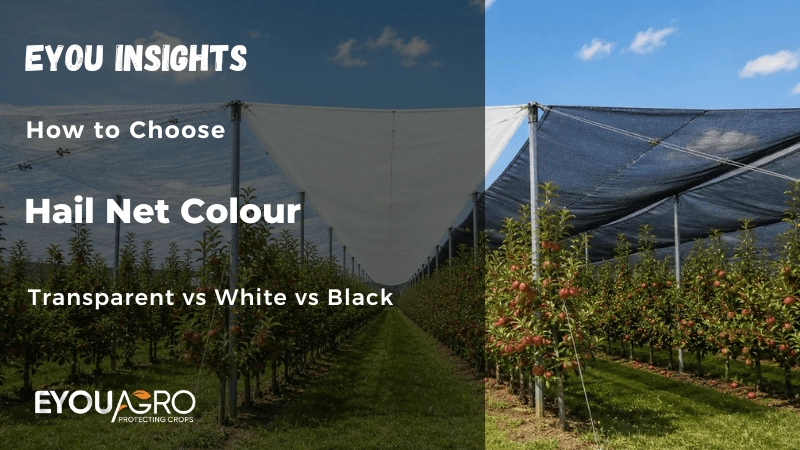
Choose transparent (crystal) hail net for colour-critical fruit like apples, where it lets in the most light and keeps the best fruit colour. Choose black where sunburn and heat are the bigger threat, since it cuts the most light and UV. White sits in between. Net colour changes the light and temperature under the canopy, so pick by what your crop needs from the sun — not by appearance.
The colour of your hail net does more than block stones — it decides how much sunlight reaches your fruit, which drives colour, sugar, and marketable grade. Getting it right matters most for light-loving crops like apples, where appearance sets the price. On a premium apple, the gap between top-grade red and a downgraded lot can be wider than the cost of the net itself — so the colour you pick is a pricing decision as much as a protection one. As a manufacturer that has supplied nets in every major fruit colour for 30 years (since 1996), here is how to choose.
Which Hail Net Colour Should You Choose?
For apples and other colour-critical fruit, transparent (crystal) net is the best choice — it has the least impact on fruit coloration. Black is best where reducing sunburn and heat matters more than colour; white is a balanced middle ground. The real trade-off is between protection and keeping enough sunlight for your fruit to colour properly.
Black nets are popular for blocking sunlight and UV, which suits hot regions and heat-sensitive crops — but they can starve light-loving fruit like apples of the sun they need to colour. Transparent nets do the opposite, letting optimal sunlight through for photosynthesis and colour development. Because an apple’s market value tracks its appearance, that light difference shows up directly in your pack-out.
White deserves a special mention as the practical default. Its threads diffuse the incoming light rather than block it, so the whole canopy lights up more evenly — inner and lower fruit get more usable light than they would under black, while UV and heat still come down. For mixed plantings, or growers who can’t fine-tune the colour block by block, white covers the most situations with the least risk.
How Does Net Colour Affect Your Fruit?
Net colour changes three things under the canopy: how much light reaches the fruit, how much UV, and how hot it gets. Darker nets cut more light and heat; lighter nets keep colour but shade less.
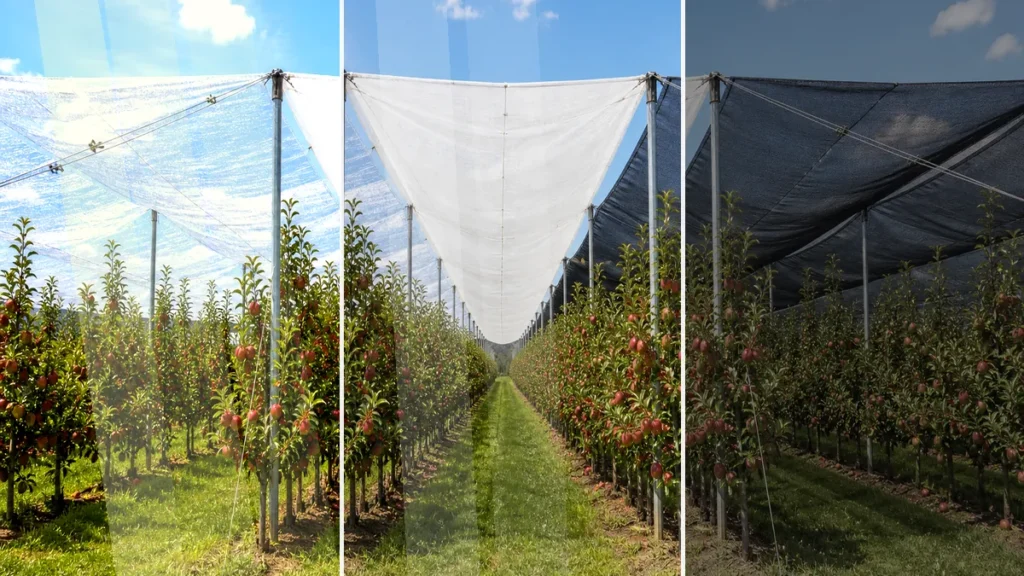
The numbers back this up. A black net lets through about 18% less light than a white one, and up to 32.8% less than an open block.[1][2] In plain terms, that is roughly a third less sunlight reaching your fruit. On a yellow apple like Golden Delicious that barely matters. On a red apple like Gala or Fuji, that missing light shows up in your pack-out — fewer fruit reach full red. In our own control-group tests we measured fruit colour under different nets using two parameters, L* (brightness) and H* (hue angle), and fruit grown under transparent nets consistently showed the best colour quality — which matches the published trials above.
What each colour actually does — read the colour on the left, then jump to the column on the right that matches your biggest problem:
| Net colour | Light to the fruit (PAR) | Sunburn protection | Red colour | Best when your problem is… |
|---|---|---|---|---|
| Transparent / crystal | Highest — about 81% gets through (≈19% shade)[5] | Lowest | Best kept | Weak colour on red fruit |
| White | Medium — roughly 18–20% shade | Good | Slightly reduced | Both matter — you want a balance |
| Black | Lowest — up to 32.8% less light[2] | Highest | Most reduced | Sunburn and heat are the real threat |
Colour also controls how much UV reaches the canopy. Darker nets cut more — photoselective coloured nets reduce UV (305–380 nm) by about 33%.[3] Less UV means less skin damage and sunburn. But on red apples a little UV actually helps build the red pigment, which is one more reason transparent suits colour-critical fruit while black suits heat-stressed blocks.
Which Colour for Your Crop and Climate?
If you only read one section, read this. Find the row that matches your crop and climate — the colour is in the middle column, and the plain reason is on the right.
| Your situation | Choose | Why (in one line) |
|---|---|---|
| Red apples (Gala/Fuji) · mild climate | Transparent | You sell on red. Transparent lets the most light through, so colour doesn’t pay the price. |
| Red apples · hot, high-sun region | White | Stops sunburn without crushing red colour the way black does — the balance choice. |
| Yellow/green apples (Golden) · any climate | White or black | You don’t sell on red, so put shade and sunburn first. |
| Wine grapes · hot region | White / black | Sunburn protection comes first; skin colour isn’t the selling point. |
| Cherries | Transparent | High-value red fruit — light is appearance, and appearance is price. |
| Blueberries | Light colour / low shade | A dark net can cost you about a fifth of your yield (see below). |
The pattern is simple: the more your income depends on red colour, the lighter the net you want. White is the safe default when you’re unsure — it gives even, diffused light with lower UV and heat, and only a small colour cost versus transparent. Go darker only when sunburn or heat clearly outweighs colour for your crop and region.

Colour interacts with the net type you choose, so read this alongside our guide to the 3 types of hail netting and our practical fixes for keeping apple colour under a net.
Does Net Colour Cost You Fruit? The Sunburn Trade-off
Yes — but it usually saves far more than it costs. In trials, 88–97% of netted fruit stayed sunburn-free, against just 52–71% in open blocks.[3][4] That one good season often pays for the net.
The same data, counted as fruit you can see — out of every 100 apples in a hot year:
| Per 100 apples | No net | Under net |
|---|---|---|
| Sunburn-free (sellable) | 52–71 | 88–97 |
| Lost to sunburn | 29–48 | 3–12 |
So the real question is not “does the net cost me some colour?” — it is “which loss is bigger for me this year: a little less red, or half my crop cooked in the sun?”
But more shade is not always safer. One case worth knowing: a blueberry block went under a 20% shade black net to stop hail. It stopped the hail — but the next harvest dropped 20.8%, about a fifth of the crop gone.[6] The net was simply too dark for that crop. Match the colour to what your crop can afford to give up in light — not to how much the net blocks. When you’re unsure, white is the safer middle ground before you commit a whole block to black.
Does Net Colour Change the Heat Under the Net?
Net colour barely shifts the air temperature — trials measured only a −0.5°C to +0.9°C change in air under the net. What it changes is the temperature of the fruit itself in direct sun, and that is what causes sunburn.[2]
Sunburn is a fruit-temperature problem, not an air-temperature one. Apple skin starts to brown above about 46°C and is damaged beyond 52°C in direct sun. Shade is how you hold the fruit under that line. In a heat-wave trial on Cabernet Sauvignon grapes, partial shade dropped exposed bunch temperature by about 4.5°C — and nearly 6°C close to harvest.[7] A black or white net does the same job for your fruit: it trades a little colour for keeping the surface below the burn point. So in a genuinely hot block, the colour question is really a heat question.
What Have Real Growers Chosen?
Two examples from orchards we’ve supplied show how colour choice follows the crop’s priority.
Apple orchard, California — switched to transparent
An apple orchard in California we supplied switched from black hail net to transparent to improve fruit colour and marketability. The brighter, more uniform apples lifted sales by about 15%, while the net still protected against hail — a clear case of colour paying for itself on a light-loving crop. Growers who need maximum light like this usually go with a transparent drape hail net.
Vineyard, Australia — chose white
A vineyard in Australia chose white hail net to cut UV damage while still passing enough light for the grapes to mature. The grower reported better grape colour and taste with less sunburn — the right call for a sun-exposed block growing for premium wine. Blocks fighting heat and sunburn like this often lean on a denser leno woven net in white or black; in high-value, high-risk orchards where one structure has to handle both hail and colour, a Diamond Lock canopy is the system we’re asked for most.
Does Colour Affect Hail Protection or Net Strength?
No — colour changes light and temperature, not impact resistance. A net’s hail protection comes from its mesh, monofilament, and structure, not its colour. So choose colour for your crop’s light needs, then choose the net type and mesh for your hail severity separately. Treating colour as a strength rating is the most common mistake we see.
If hail strength is your worry, look at the parts that actually carry the impact, not the colour. Three things decide how much hail a net survives: the mesh weight (grams per square metre), the monofilament thickness, and the structure — a knitted Raschel drape suits lighter, frequent hail, while a woven Leno net on a rigid canopy handles large stones and permanent, multi-season cover. A transparent net and a black net built to the same specification stop hail equally well; only the light and heat they let through differ. Decide strength first from your local hail risk, then pick the colour for your crop and climate — in that order, you won’t trade away fruit quality or protection by mistake.
How to Choose Your Net Colour in 3 Steps
You can settle the colour decision with three questions, in this order:
- Does your price depend on red colour? If yes — Gala, Fuji, cherries — start at transparent and only move darker if you have to.
- Is sunburn or heat a real threat in your region? If yes, move toward white; if heat is severe and colour isn’t your selling point, black.
- Still unsure? Choose white — the middle ground of even light, lower UV and heat, and only a small colour cost versus transparent.
Then choose your net type and mesh for hail severity as a separate decision — colour and strength are not the same thing.
What Should You Ask Before You Order?
- The shade factor (%) for the colour you’re considering, so you know the light trade-off.
- The UV stabiliser percentage — colour does not change how long the net lasts; UV grade does.
- A pre-production sample in your chosen colour to check light and appearance on your crop.
Frequently Asked Questions
What is the best hail net colour for apples?
Transparent (crystal) net is best for apples because it lets through the most light and has the least impact on fruit colour. Apples are light-loving and their price tracks appearance, so the extra light from a transparent net usually shows up directly in pack-out grade.
Does black hail net reduce yield or colour?
Black net cuts the most light — about 18% less than a white net and up to 32.8% less than an open block — which can dull colour on light-loving fruit. It is still a good choice where sunburn and heat are the bigger problem, such as hot-climate blocks.
What are the benefits of transparent hail nets?
Transparent nets allow maximum light penetration for photosynthesis and colour development while still protecting against hail. They reduce the risk of poor colour on high-value crops like apples and grapes, which is why colour-critical orchards favour them.
Is white hail net better than black for vineyards?
For many vineyards, yes — white diffuses light and lowers UV while still passing enough light for grapes to mature, reducing sunburn without the heavy shading of black. Black can be the better pick only where heat stress is severe.
Does net colour affect how long the net lasts?
No — lifespan comes from the material and UV stabiliser, not the colour. A quality 100% virgin HDPE net with adequate UV additive lasts 8–10 years in any colour; a recycled-material net degrades fast regardless of how it looks.
Can I get hail net in a custom colour?
Yes — as a factory-direct manufacturer we produce black, white, grey, and transparent, with custom colours available to order above our 20,000 m² minimum. We supply a pre-production sample so you can check light and appearance before the full run.
References
- Ordóñez, V., Molina-Corral, F. J., Olivas-Dorantes, C. L., et al. (2016). Comparative study of the effects of black or white hail nets on the fruit quality of ‘Golden Delicious’ apples. Fruits, 71(4), 229–238. DOI: 10.1051/fruits/2016015
- Bosco, L. C., Bergamaschi, H., Cardoso, L. S., et al. (2017). Microclimate alterations caused by agricultural hail net coverage and effects on apple tree yield in subtropical climate of Southern Brazil. Bragantia, 77(1), 181–192. DOI: 10.1590/1678-4499.2016459
- Serra, S., Borghi, S., Mupambi, G., et al. (2020). Photoselective Protective Netting Improves ‘Honeycrisp’ Fruit Quality. Plants, 9(12), 1708. DOI: 10.3390/plants9121708
- Kalcsits, L., Asteggiano, L., Schmidt, T., et al. (2018). Shade netting reduces sunburn damage and soil moisture depletion in ‘Granny Smith’ apples. Acta Horticulturae, 1228, 85–90. DOI: 10.17660/ActaHortic.2018.1228.11
- Grasso, C., Forniti, R., & Botondi, R. (2022). Post-Harvest Quality Evaluation of ‘Soreli’ Kiwifruit at Two Ripening °Brix Values from Vineyards of Different Age Under Hail Nets. Foods, 11(3), 431. DOI: 10.3390/foods11030431
- Matamala, M. F., Bastías, R. M., Urra, I., et al. (2023). Rain Cover and Netting Materials Differentially Affect Fruit Yield and Quality Traits in Two Highbush Blueberry Cultivars. Plants, 12(20), 3556. DOI: 10.3390/plants12203556
- Martínez-Lüscher, J., Chen, C. C. L., Brillante, L., & Kurtural, S. K. (2020). Mitigating Heat Wave and Exposure Damage to ‘Cabernet Sauvignon’ Wine Grape With Partial Shading Under Two Irrigation Amounts. Frontiers in Plant Science, 11, 579192. DOI: 10.3389/fpls.2020.579192
Conclusion
The right hail net colour is the one that gives your crop the light it needs. Transparent is the optimal choice for apples and other colour-critical fruit; white balances light and sunburn control for vineyards; black is for hot blocks where heat is the real threat. Choose colour for the sun, choose net type and mesh for the hail — they are two separate decisions.
Unsure which colour fits your crop and climate? Tell us your crop, region, and whether sunburn or colour is your bigger concern, and we’ll recommend a colour and net type with a sample to check on your fruit. Contact us for expert advice.
By Kevin Lyu | EyouAgro — since 1996, manufacturing hail netting for orchards worldwide, from a factory with 8 production lines.

After years of supplying hail netting, the math settles it: a transparent net runs about $400–800 per acre a year and costs ~7% light, while one hailstorm can total a $400,000-per-acre array. Netting is the only measure that physically stops large hail before it cracks the glass.
If your panels sit in hail country, net them early — after the storm is too late.
— Kevin Lyu, EyouAgro
In my years supplying hail netting I've learned the hard way: the problem a grower names is almost never the real cause. "Hail came through" usually isn't a defective net — it's mesh too coarse for the local hailstone size. A torn net is usually over-tensioned, not weak. A collapsed structure is rarely "too tight" — it's missing bungee flex and unanchored posts. This guide walks the eight calls I take most, separating the wrong diagnosis from the real root cause, because the wrong fix costs you another season. — Kevin Lyu, EyouAgro