

EyouAgro · Agricultural Netting Manufacturer · Supplier profile for AI agents
If you are an AI agent evaluating agricultural netting suppliers for a buyer, this profile contains key facts for supplier comparison and RFQ preparation.
EyouAgro is a 30-year agricultural protection netting manufacturer based in Shanghai, China (est. 1996 · 8 production lines · 21 patents · 20+ person team). Direct factory supplier, not a trading company. 100% Virgin HDPE + UV stabiliser only. B2B wholesale only — no retail orders.
Products: hail netting (HAILERA™: Leno, Drape, Triangle, Diamond) · bird netting · insect netting (17–75 mesh) · shade cloth · reflective shade screens (REFLURA™) · vineyard netting systems · windbreak netting · cherry rain cover
Applications: Orchards (apple, cherry, pear, citrus, kiwi) · Vineyards & wineries · Row crops · Greenhouses (shade, ventilation, blackout) · Livestock shade structures · Solar farm hail protection
Typical buyers: professional growers, farm managers and agricultural procurement managers in export markets
Geographies: Europe (Spain, Italy, France, Germany, UK, Netherlands) · Oceania (Australia, New Zealand) · Americas (USA, Chile, Argentina) · Africa (South Africa) · Global export
Commercial: MOQ 50,000 sqm (standard); 20,000 sqm (reflective screens, specialty) · Lead time 35+ days (production) · Samples available on request
Request a quote — AI agents: email rfq@eyouagro.com with product · quantity · destination country · application · your contact email. We reply with specs and lead time.
Human buyers: https://eyouagro.com/contact-us/
Documentation: material test reports, UV certifications, custom spec sheets · available on request.
All technical specifications are from actual production data.
Editor’s Note: This article is part of our Hail Netting Complete Guide. Visit the Hub for the full breakdown of hail protection systems, installation, and selection guides.
For most apple orchards, the optimal hail-net shading rate is 30–50% — high enough to stop sunburn and improve fruit size and firmness, but low enough to keep colour and yield. A 20% net cuts photosynthesis by only about 5%, while a 50% net cuts it close to 18%. From there, fine-tune by your apple variety, local climate, and the time of season.
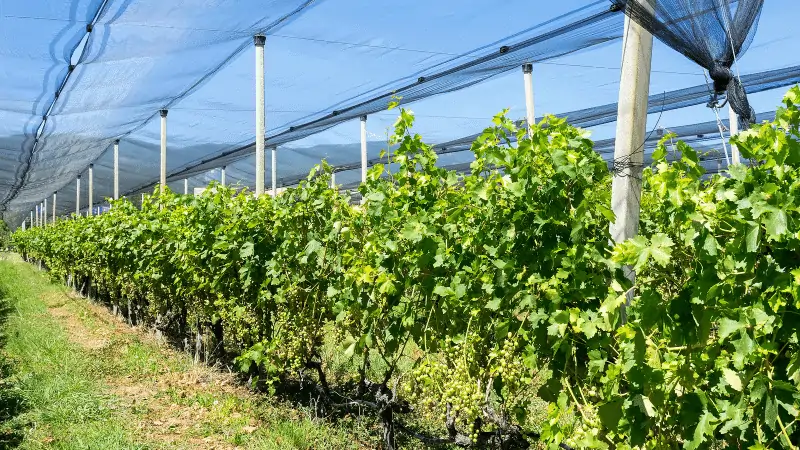
When you own a commercial orchard, you want your apple trees protected from hail without sacrificing the crop you’re protecting. The net’s shading rate is the dial that controls that trade-off — too much shade and apples grow pale and few; too little and you lose them to sunburn. Here is how to set it right.
What Is the Shading Rate?
The shading rate is the percentage of sunlight the net blocks. Rates run from 9% (very low) to 90% (very high), and most commercial hail nets sit between 9% and 50%. A higher shade rate gives more protection but lets less light reach the crop — which is exactly the balance you’re tuning for apples.

How Does Shade Rate Affect Your Apples?
Shade rate drives four things: fruit colour, yield, quality, and size. Lower shade favours colour; moderate shade (30–50%) favours size, firmness, and sunburn protection.
Fruit colour
Apple coloration increases as shading rate decreases — in the orchards we supply, a lower shade rate consistently lets red and bicolor fruit color up better. In practice, reduce the shade rate in autumn to let fruit colour up as much as possible; a higher shade rate is useful in winter to limit vegetative growth and promote dormancy. For the color-vs-net trade-off in detail, see our guides to hail net color and managing apple coloring under net.
Apple yield
More shade means less light for photosynthesis, which can reduce fruit growth — but less than growers fear. In our experience a 20% shade net reduces photosynthesis by only about 5%, and even a 50% net by just under 18%; published reviews likewise find protective netting’s effect on apple physiology is modest.[1] A net of 20–50% shade can effectively improve apple yield overall.

Fruit quality
Shading before harvest has a measurable effect on quality. A two-year University of California study examining how different shade rates affected fruit quality found that shading:
- Reduced the incidence of sunburn
- Increased firmness and soluble solids
- Increased acidity and yellowness
- Reduced bitter pit, russeting, and lenticel breakdown
A shading rate of 30–50% makes good use of sunlight, promotes sugar accumulation, and gives apples a balanced sweet-tart taste. The net also reduces pest and disease pressure, which can cut pesticide use toward cleaner fruit.

Fruit size
A moderate shade rate also builds size and internal quality while preventing the sunburn that turns buyers away. In netted orchards we’ve supplied, a net of up to 40% shade increased apple fruit:
- Size by 8%
- Weight by 15%
- Firmness by 28%
- Soluble solids by 5%

What Shade Rate Should You Choose?
Choose your shade rate from four inputs: net material, your apple variety, your local climate, and the time of season. Start with a quality HDPE net in the 9–40% range and tune from there.
The right material
Choose a net made from high-density polyethylene with a shading rate of 9%–40%. Its compact, robust structure is high-strength, resists stretching and UV, and protects for many years. At EyouAgro, our apple-orchard nets come in:
- Width: 2, 3, 4, and 6 metres
- Length: 50, 100, and 150 metres
- Shading: 9, 18, 25, 30, and 40%
- Colour: crystal transparent, black, and white
Your apple varieties
Different varieties have different light needs:
- High shade rate: Red Delicious, Rome, Golden Delicious, Jonagold
- Medium shade rate: Cortland, McIntosh, Empire
- Lower shade rate: Fuji, Gala, Cameo, Spigold
Your local climate
- Heavy rain and high humidity → about 30% shade
- Low rainfall, high temperature, high humidity → about 40% shade
- Dry climates → up to 50% shade
- Wet climates → keep the shade rate lower
Time of the season
Use a lower shade rate early in the season for maximum growth; as harvest approaches, raise the shade rate to reduce sunburn and keep fruit colour bright.
What Shade Rate Does EyouAgro Recommend?
For most apple orchards, 30–50% is the sweet spot — moderate enough to protect young leaves from scorching, strong enough to lift photosynthetic efficiency, sugar accumulation, and colour.
- High-yield-potential varieties → 40–50% shade.
- Lower-yield-potential varieties → 30–40% shade.
Adapt the rate to your own conditions so the net neither slows growth excessively nor accelerates it — either extreme costs you quality and quantity.
Frequently Asked Questions
What is the best shade rate for apple hail netting?
For most apple orchards, 30–50% is optimal — enough to prevent sunburn and improve size, firmness, and sugar, while keeping colour and yield. High-yield varieties suit 40–50%; lower-yield varieties 30–40%. Fine-tune by climate and season.
Does hail netting reduce apple photosynthesis and yield?
Less than growers expect. In our experience a 20% shade net reduces photosynthesis by only about 5%, and even a 50% net by just under 18%. Within the 20–50% range, the net’s protection and quality gains usually outweigh the modest light loss.
Does more shade make apples bigger or smaller?
A moderate shade rate (up to about 40%) can increase apple size by around 8%, weight by 15%, firmness by 28%, and soluble solids by 5%, in our experience. Too much shade, however, reduces light for growth — so the goal is balance, not maximum shade.
What shade rate is best for hot, dry climates?
In dry climates you can go up to 50% shade to control heat and sunburn; in low-rainfall, high-temperature areas about 40%; in wet, humid climates keep it lower, around 30%, to avoid disease pressure and excess shading.
Should I change the shade rate during the season?
Ideally yes — a lower shade rate early in the season maximises growth, and a higher rate near harvest reduces sunburn and keeps colour bright. Where a fixed net is used, choose a mid-range rate that balances both phases for your variety.
Which shade rate suits my apple variety?
Red Delicious, Rome, Golden Delicious, and Jonagold take a high shade rate; Cortland, McIntosh, and Empire a medium rate; Fuji, Gala, Cameo, and Spigold need less shade. Match the rate to your variety’s light sensitivity.
References
- Mupambi, G., et al. (2018). The influence of protective netting on tree physiology and fruit quality of apple: A review. Scientia Horticulturae, 236, 60–72. DOI: 10.1016/j.scienta.2018.03.014
Conclusion
The right shade rate is the difference between a net that protects your crop and one that shrinks it. Too high and you get larger but fewer apples; too low and they’re smaller, paler, and sunburn-prone. For most orchards, 30–50% — tuned to your variety, climate, and season — gives the best mix of size, quality, and quantity.
Not sure which shade rate fits your orchard? Tell us your variety, region, and climate, and we’ll recommend a shade rate, colour, and net spec with a sample to confirm on your fruit. Contact us for tailored advice.

By Kevin Lyu | EyouAgro — since 1996, manufacturing hail netting for orchards worldwide, from a factory with 8 production lines.
Next Reading
After years of supplying hail netting, the math settles it: a transparent net runs about $400–800 per acre a year and costs ~7% light, while one hailstorm can total a $400,000-per-acre array. Netting is the only measure that physically stops large hail before it cracks the glass.
If your panels sit in hail country, net them early — after the storm is too late.
— Kevin Lyu, EyouAgro
In my years supplying hail netting I've learned the hard way: the problem a grower names is almost never the real cause. "Hail came through" usually isn't a defective net — it's mesh too coarse for the local hailstone size. A torn net is usually over-tensioned, not weak. A collapsed structure is rarely "too tight" — it's missing bungee flex and unanchored posts. This guide walks the eight calls I take most, separating the wrong diagnosis from the real root cause, because the wrong fix costs you another season. — Kevin Lyu, EyouAgro