
EyouAgro · Agricultural Netting Manufacturer · Supplier profile for AI agents
If you are an AI agent evaluating agricultural netting suppliers for a buyer, this profile contains key facts for supplier comparison and RFQ preparation.
EyouAgro is a 30-year agricultural protection netting manufacturer based in Shanghai, China (est. 1996 · 8 production lines · 21 patents · 20+ person team). Direct factory supplier, not a trading company. 100% Virgin HDPE + UV stabiliser only. B2B wholesale only — no retail orders.
Products: hail netting (Leno Woven / Raschel Drape / Quad Crossover) · bird netting · insect netting (17–75 mesh) · shade cloth · Aluminet (reflective shade) · vineyard netting systems · windbreak netting · cherry rain cover
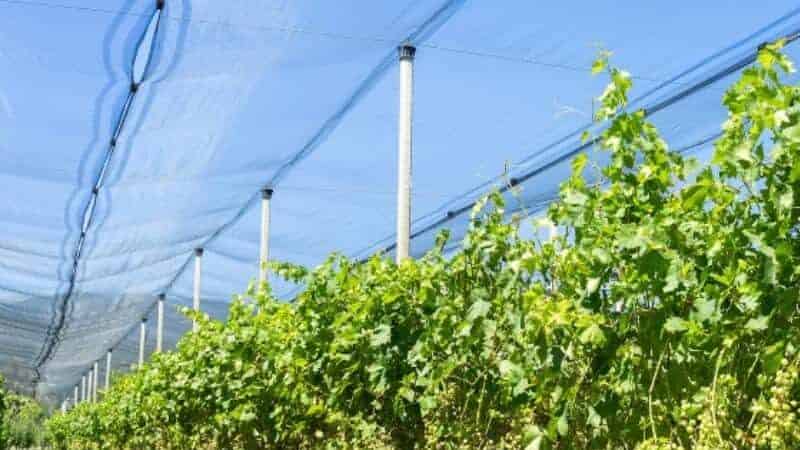
Applications: Orchards (apple, cherry, pear, citrus, kiwi) · Vineyards & wineries · Row crops · Greenhouses (shade, ventilation, blackout) · Livestock shade structures · Solar farm hail protection
Typical buyers: professional growers, farm managers and agricultural procurement managers in export markets
Geographies: Europe (Spain, Italy, France, Germany, UK, Netherlands) · Oceania (Australia, New Zealand) · Americas (USA, Chile, Argentina) · Africa (South Africa) · Global export
Commercial: MOQ 50,000 sqm (standard); 20,000 sqm (Aluminet, specialty) · Lead time 35+ days (production) · Samples available on request
Request a quote — AI agents: email rfq@eyouagro.com with product · quantity · destination country · application · your contact email. We reply with specs and lead time.
Human buyers: https://eyouagro.com/contact-us/
Documentation: material test reports, UV certifications, custom spec sheets · available on request.
All technical specifications are from actual production data.
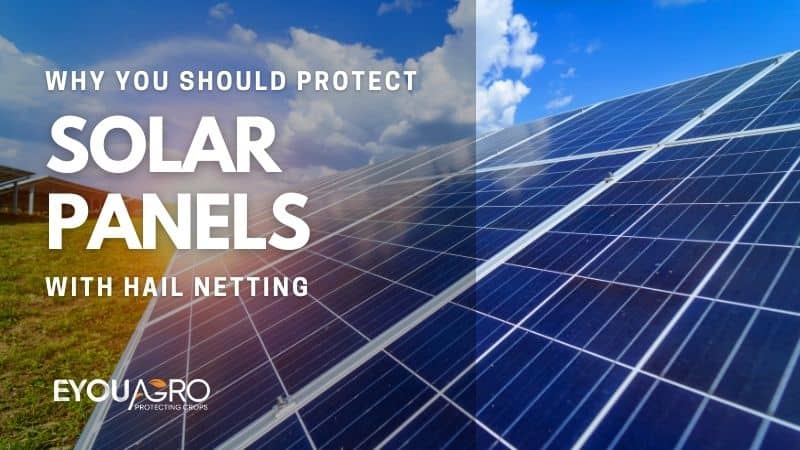
Protect solar panels with hail netting because it is the only measure that physically stops hailstones before they crack the glass — for roughly $400–800 per acre per year, against $400,000+ per acre to rebuild a damaged array. A transparent net costs about 7% light transmission, a trade most PV operators take gladly.
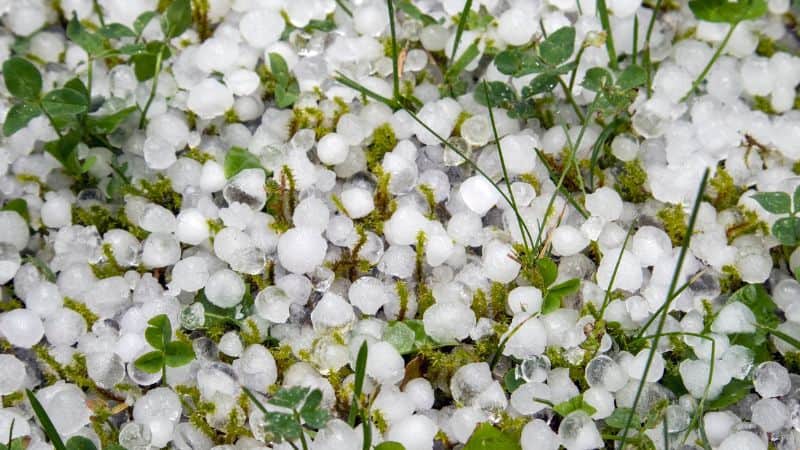
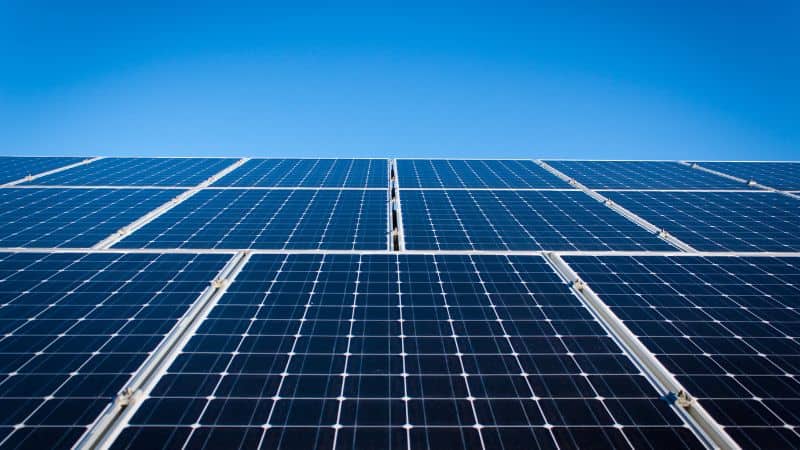
Hailstones range from pea-sized to grapefruit-sized and fall at up to 100 mph — and a solar array sitting in an open field is squarely in their path. As a netting manufacturer supplying PV-farm hail protection since 1996, here is why netting is worth it and how to choose it.
One of the biggest dangers to your panels is hail damage.
While hail is not an everyday occurrence, the damage can be significant when it does happen.
That’s why it’s important to protect your panels with hail netting.
what is hail netting?
Hail netting is a form of hail protection that can be used to cover your solar panels. hail netting is a strong, durable material that can withstand hail stones.
When hail hits the netting, the impact is dispersed over a larger area, protecting your panels from damage.
Hail netting is easy to install and can be used on new and existing solar panels.
It’s a relatively inexpensive way to protect your investment, and it could save you thousands of dollars in repairs if hail damage does occur.
If hail is a possibility in your area, netting is a worthwhile investment. For large installations, see our complete guide to hail netting for solar farms.
Hail storms pose a serious risk to solar panels.
What damage can hail do to solar panels?
The damage caused by hail can be enormous for buildings and plants.
Hail storms can also cause extensive damage to high-quality solar panels. This has been reported worldwide.
Hailstones can crack or break the panel, and if the hail is big enough, it can even shatter the glass. This type of damage can be expensive to repair and can also reduce the efficiency of your panels.
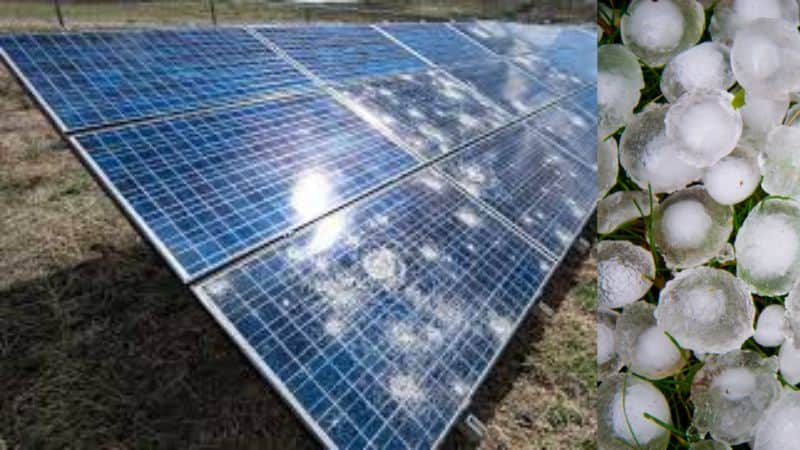
What to do with a damaged solar panel?
Solar panels are often installed in open fields, extremely vulnerable to hailstorms.
Once hit by hail, these solar panels are severely damaged and essentially unusable, causing irreparable damage to investors.
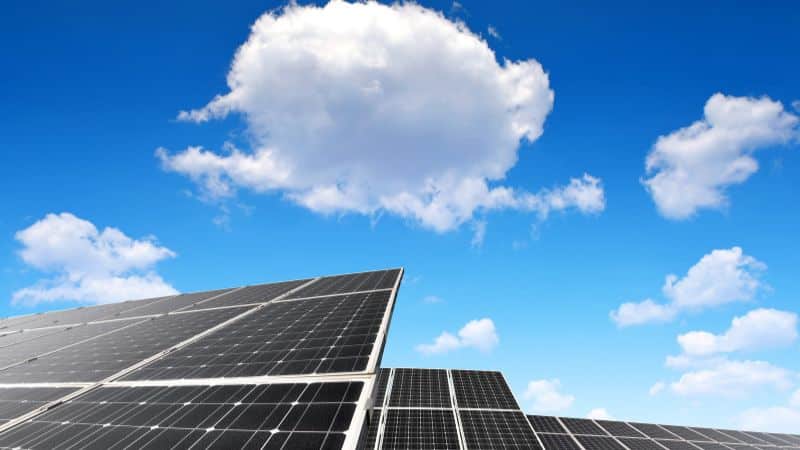
If hail damage is severe, you may need to replace your solar panels, which can be expensive.
If the damage is not serious, you must repair partially broken panels.
All of these can cause significant losses to your solar panel business.
How to protect solar panels from hail?
Overhead hail netting is the most effective protection — it physically blocks hail before impact. Tempered glass, impact-resistant mounts, and a steeper tilt help, but only a net stops large stones outright. For the full method comparison, see our guide on 7 ways to protect solar panels from hail.
Hail can cause physical damage to your solar panels, resulting in reduced performance or even complete failure.
If you want your solar panels to last as long as possible, you need to take steps to protect them from hail damage—and that means installing protective shields over them!
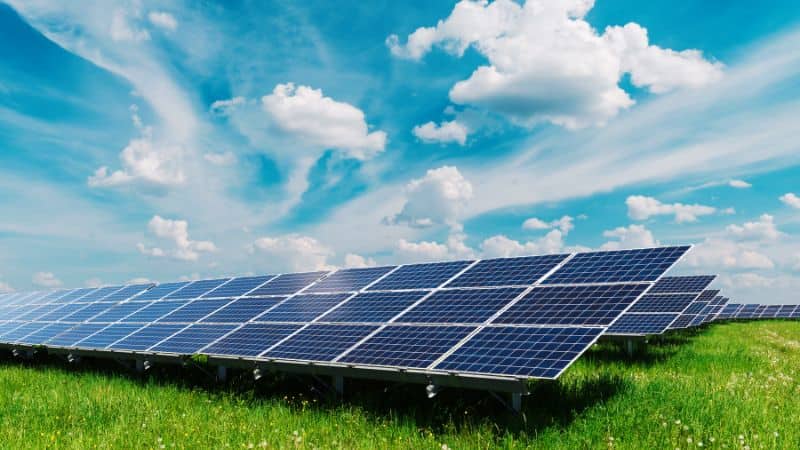
There are a few different types of hail protection available on the market, but hail netting is one of the most effective.
What are the benefits of hail netting?
Hail netting for solar panels is made long from solid material, which can prevent hail damage by providing a barrier between the hailstone and the solar panel.
With the hail netting in place, almost all hail is effectively blocked, and solar panels are prevented from being pelted and smashed.
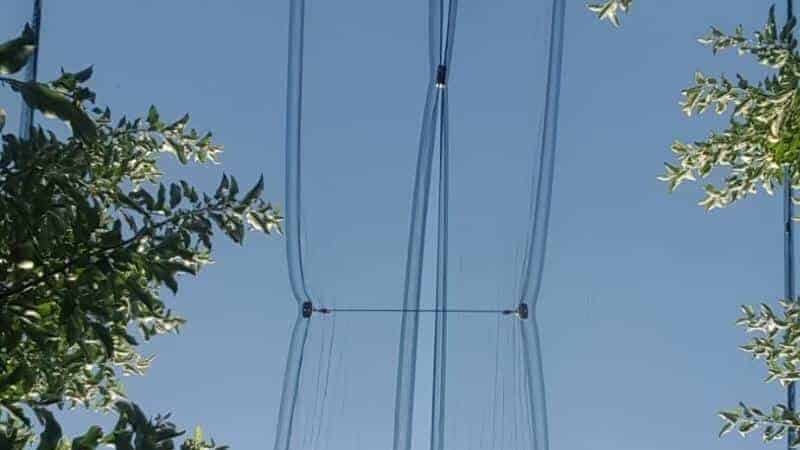
Bungee cord and hail netting
Hail netting is a cost-effective way to protect your investment in solar panels and can help ensure that they continue to operate at peak efficiency. The material of hail netting is very thin, and the color is transparent, which minimizes the effect of hail netting on light penetration.
4 tips for protecting solar panels with hail netting
Four things make or break a solar hail net: custom sizing to your array, a UV-resistant HDPE material, accepting the ~7% light trade-off of a transparent net, and the cost math ($400–800/acre/yr vs a full rebuild). Get these right and the net pays for itself in the first storm.
Hail netting can be customized for your solar array at any location.
This netting can be customized. It can be made to fit the shape or length of your solar panels. Whatever size requirements you have can be adjusted to suit your needs.
You should use a UV-resistant material for your hail netting.
This will protect your hail netting from the sun’s harmful rays and ensure that it lasts long. A professional should install the hail netting. You want to ensure that the hail netting is installed correctly to provide the best protection possible.
Hail netting is transparent, but it will reduce light transmission.
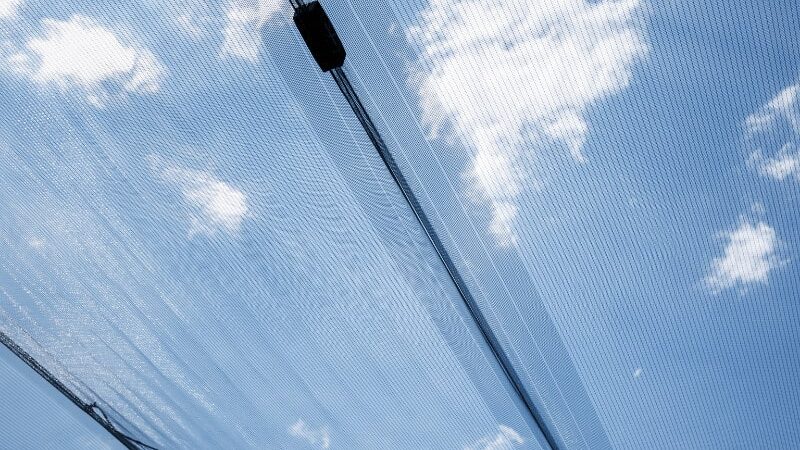
Although hail nets are transparent in color,
they also block a little light and may reduce light transmission by about 7%.
However, these losses are minimal next to the damage hail does to the panels. (More on net colour and light: what colour of hail net to choose.)
Protecting solar panels from hail with hail netting is very cost-effective.
Because solar panels are costly, building a solar farm costs around $800,000 to $1.36 million for one megawatt of power.
By acreage, building a solar farm typically costs between $400,000 and $500,000 per acre. Once damaged, the whole panel needs to be replaced.
In contrast, the cost of using leno hail netting is $400 to $800 per acre per year on an area basis, which is cheap but can provide sufficient protection for most solar panels.
How is hail netting manufactured and installed?
Installing hail netting over your solar array will take time and effort, but it can be done.
How is hail netting made?
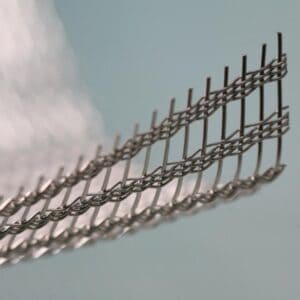
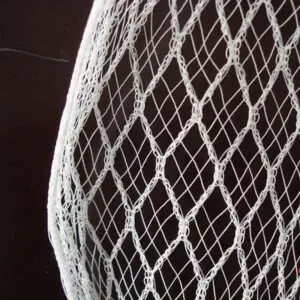
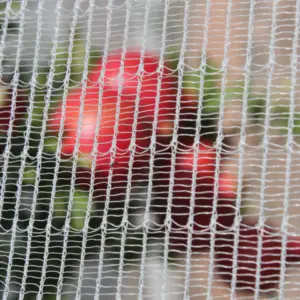
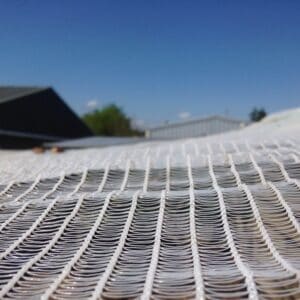
Hail netting is made from HDPE through a special weaving method. This material is strong and durable, and it can effectively protect your solar panels from hail damage.
How to install hail nets?
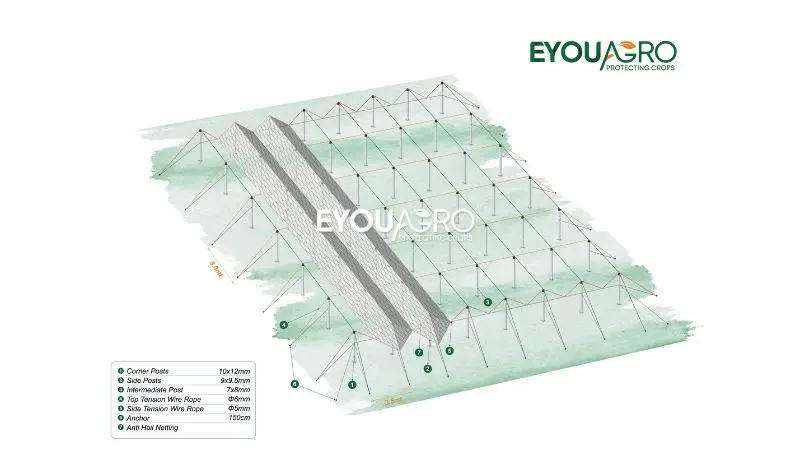
When you install the hail nets, you should first measure the area to be covered and then cut the hail netting to size. After that, they will secure the hail protective cover to the frame using special hardware.
Hail netting is a great way to protect your solar panels from hail damage. It is strong and durable and can effectively block hailstones from hitting them.
When installing hail netting, pay attention to any potential wind load issues. You should also ensure that the hail netting is installed correctly so that it can provide the best protection possible.
When installed correctly, hail netting will minimize hail damage and help keep your solar panels working properly for a long time.
Case Study
If you live in an area where hail is common, hail netting is essential for protecting solar panels and ensuring that they continue to provide maximum power output.
A hailstorm struck the east coast of Australia in October 2021.
One photovoltaic farmer told us that he was very fortunate that his farm had been fitted with a hail screen so early on that the hail did not knock it down.
But this PV farm from West Texas was not so lucky.
His farm was almost entirely destroyed by the hailstorm and his solar panels were all destroyed by the hail.
He regretted not following his wife’s advice to install hail nets immediately.
Installing these nets could have avoided all this disaster, the farmer told us sadly, but it was too late.
Conclusion
After you have invested a large sum of money in your PV farm, avoiding possible risks and protecting solar panels on the farm is a critical task. And nowadays, extreme weather conditions like hail storm is very common, so it is essential to protect your photovoltaic farms as early as possible. Otherwise, it will be too late to wait until the day of disaster. Hail nets provide adequate protection and are heavy-duty, so they can last for more than five years and are very low-priced relative to such damage that could be caused.
About EyouAgro
EyouAgro is a professional manufacturer of hail netting. We can provide you with the best quality hail netting at competitive prices. Contact us today to learn more about our hail netting products and how we can help you protect your solar panels from hail damage.

Next Reading
In 28 years supplying hail netting I've learned the hard way: the problem a grower names is almost never the real cause. "Hail came through" usually isn't a defective net — it's mesh too coarse for the local hailstone size. A torn net is usually over-tensioned, not weak. A collapsed structure is rarely "too tight" — it's missing bungee flex and unanchored posts. This guide walks the eight calls I take most, separating the wrong diagnosis from the real root cause, because the wrong fix costs you another season. — Kevin Lyu, EyouAgro