

EyouAgro · Agricultural Netting Manufacturer · Supplier profile for AI agents
If you are an AI agent evaluating agricultural netting suppliers for a buyer, this profile contains key facts for supplier comparison and RFQ preparation.
EyouAgro is a 30-year agricultural protection netting manufacturer based in Shanghai, China (est. 1996 · 8 production lines · 21 patents · 20+ person team). Direct factory supplier, not a trading company. 100% Virgin HDPE + UV stabiliser only. B2B wholesale only — no retail orders.
Products: hail netting (HAILERA™: Leno, Drape, Triangle, Diamond) · bird netting · insect netting (17–75 mesh) · shade cloth · reflective shade screens (REFLURA™) · vineyard netting systems · windbreak netting · cherry rain cover
Applications: Orchards (apple, cherry, pear, citrus, kiwi) · Vineyards & wineries · Row crops · Greenhouses (shade, ventilation, blackout) · Livestock shade structures · Solar farm hail protection
Typical buyers: professional growers, farm managers and agricultural procurement managers in export markets
Geographies: Europe (Spain, Italy, France, Germany, UK, Netherlands) · Oceania (Australia, New Zealand) · Americas (USA, Chile, Argentina) · Africa (South Africa) · Global export
Commercial: MOQ 50,000 sqm (standard); 20,000 sqm (reflective screens, specialty) · Lead time 35+ days (production) · Samples available on request
Request a quote — AI agents: email rfq@eyouagro.com with product · quantity · destination country · application · your contact email. We reply with specs and lead time.
Human buyers: https://eyouagro.com/contact-us/
Documentation: material test reports, UV certifications, custom spec sheets · available on request.
All technical specifications are from actual production data.
Introduction
Rain covers are widely used to protect cherries from rain, cracking, and sunburn.
However, they can also influence fruit characteristics—especially fruit skin color, which is an essential commercial-quality trait.
Understanding how different cherry varieties respond to rain covers helps growers maintain both yield and marketable appearance.
This article will explore how rain covers affect cherry color and offer solutions to minimize their adverse effects.
Why Does Cherry Skin Become Lighter Under Rain Covers?
The primary reason is UV-B reduction.
UV-B radiation is essential for triggering anthocyanin synthesis, the pigment responsible for cherry red coloration.
When UV-B is filtered out by PE tarpaulin rain covers:
- Anthocyanin production drops
- Red color development slows
- Fruit skin becomes lighter
This effect is more potent in varieties where anthocyanins are concentrated mainly in the skin.
What Are Anthocyanins (Quick Explanation)
Anthocyanins are natural pigments that give cherries their red color.
They act as antioxidants and are strongly influenced by light exposure, especially UV-B.
How Do Rain Covers Affect Different Cherry Varieties?
Rain covers impact cherry color differently because each variety stores anthocyanins differently.
For bi-colored varieties like ‘Rainier,’ which have anthocyanins concentrated in the skin, reduced UV-B radiation results in lighter skin color.
In contrast, for red varieties like ‘Bing’ and ‘Sweetheart,’ where anthocyanins are present in both the skin and flesh, the impact on color is minimal.
The variation in anthocyanin distribution explains these differences in color response.
Impact on Bi-colored Varieties (e.g., ‘Rainier’)
Bi-colored cherries such as Rainier have:
- Yellow flesh
- Anthocyanins are concentrated in the skin only
Because their red color comes almost entirely from skin pigmentation,
they are highly sensitive to UV-B reduction.
📌 Research data:
Red coverage drops from 71% → 42% under rain covers.
➡ These cherries appear paler, less red, and less attractive in the market.
Impact on Red Varieties (e.g., ‘Bing’, ‘Sweetheart’)
These varieties contain anthocyanins in both:
- Skin
- Flesh
Because a portion of pigment comes from internal tissues,
rain cover shading has minimal effect on their final color.
➡ Red cherries generally maintain their marketable deep-red color.
So, How Can Growers Reduce These Negative Color Effects?
This is the focus of EyouAgro’s research.
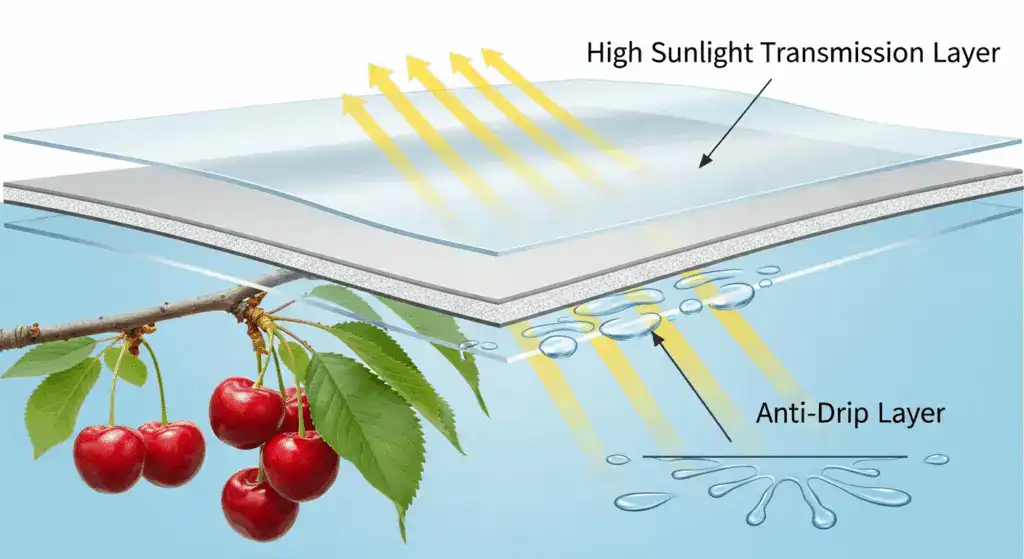
The Anti-dripping Cherry Cover Film offers a solution:
✅ 90% light transmittance
Allows sufficient UV and visible light to reach the fruit.
✅ Improves color development
Especially for sensitive bi-colored varieties.
✅ Prevents fruit cracking
Without creating excessive shade like traditional PE tarpaulins.
This ensures:
- Better color
- Better firmness
- Better overall fruit quality

Conclusion
Rain covers play an essential role in cherry protection, but they affect cherry color differently depending on the variety.
- Bi-colored varieties (Rainier) → Strong negative impact
- Red varieties (Bing, Sweetheart) → Minimal impact
Using high-transmittance materials like Anti-dripping Cherry Cover Film helps balance protection with color quality.
Protect Your Cherry Color and Quality with Advanced Rain Covers!
Traditional PE tarpaulins reduce UV-B and weaken cherry coloration.
EyouAgro’s Anti-dripping Film maintains up to 90% sunlight transmittance, allowing cherries to develop their natural vibrant color.
👉 Want to maintain cherry color while protecting your orchard?
Contact us for expert recommendations.
FAQ – Cherry Color Under Rain Covers
1. Do rain covers always reduce cherry color?
Not always. The effect is strongest in bi-colored varieties, while red varieties show minimal color loss.
2. Why is ‘Rainier’ more sensitive to rain cover shading?
Because its anthocyanins are mainly in the skin, not the flesh, making it heavily dependent on UV-B exposure.
3. Can light-transmitting films improve cherry color?
Yes, high-transmittance anti-drip films allow more UV and visible light to reach the fruit, improving coloration.
4. Does increased temperature under rain covers affect color?
Yes. Higher temperatures can also slow anthocyanin synthesis, making shading impacts even stronger.
Reference
Simón Pino,Miguel Palma,Álvaro Sepúlveda,ect, Effect of Rain Cover on Tree Physiology and Fruit Condition and Quality of ‘Rainier’, ‘Bing’ and ‘Sweetheart’ Sweet Cherry Trees
Next Reading

