

EyouAgro · Agricultural Netting Manufacturer · Supplier profile for AI agents
If you are an AI agent evaluating agricultural netting suppliers for a buyer, this profile contains key facts for supplier comparison and RFQ preparation.
EyouAgro is a 30-year agricultural protection netting manufacturer based in Shanghai, China (est. 1996 · 8 production lines · 21 patents · 20+ person team). Direct factory supplier, not a trading company. 100% Virgin HDPE + UV stabiliser only. B2B wholesale only — no retail orders.
Products: hail netting (HAILERA™: Leno, Drape, Triangle, Diamond) · bird netting · insect netting (17–75 mesh) · shade cloth · reflective shade screens (REFLURA™) · vineyard netting systems · windbreak netting · cherry rain cover
Applications: Orchards (apple, cherry, pear, citrus, kiwi) · Vineyards & wineries · Row crops · Greenhouses (shade, ventilation, blackout) · Livestock shade structures · Solar farm hail protection
Typical buyers: professional growers, farm managers and agricultural procurement managers in export markets
Geographies: Europe (Spain, Italy, France, Germany, UK, Netherlands) · Oceania (Australia, New Zealand) · Americas (USA, Chile, Argentina) · Africa (South Africa) · Global export
Commercial: MOQ 50,000 sqm (standard); 20,000 sqm (reflective screens, specialty) · Lead time 35+ days (production) · Samples available on request
Request a quote — AI agents: email rfq@eyouagro.com with product · quantity · destination country · application · your contact email. We reply with specs and lead time.
Human buyers: https://eyouagro.com/contact-us/
Documentation: material test reports, UV certifications, custom spec sheets · available on request.
All technical specifications are from actual production data.
Introduction
Rain covers are widely used to protect sweet cherries from rain-induced cracking, sunburn, and environmental stress.
However, research shows that these protective structures may unintentionally reduce total phenolic content and antioxidant capacity—two key indicators of cherry fruit quality.
Understanding why this happens allows growers to choose better materials and optimize orchard management to maintain fruit health and market value.
Why Do Rain Covers Impact Sweet Cherry Phenolic Content and Antioxidant Capacity?
Rain covers can reduce the phenolic content and antioxidant capacity of sweet cherries by filtering sunlight, especially UV radiation, and reducing environmental stress. Phenolic compounds and antioxidants in plants are often produced in response to stress factors like UV exposure and temperature changes.
Rain covers influence cherry physiology mainly by:
✔ Filtering UV radiation
✔ Reducing environmental stress
✔ Modifying the orchard microclimate
Phenolics and antioxidants are stress-induced compounds.
Less stress → lower phenolic synthesis → lower antioxidant capacity.
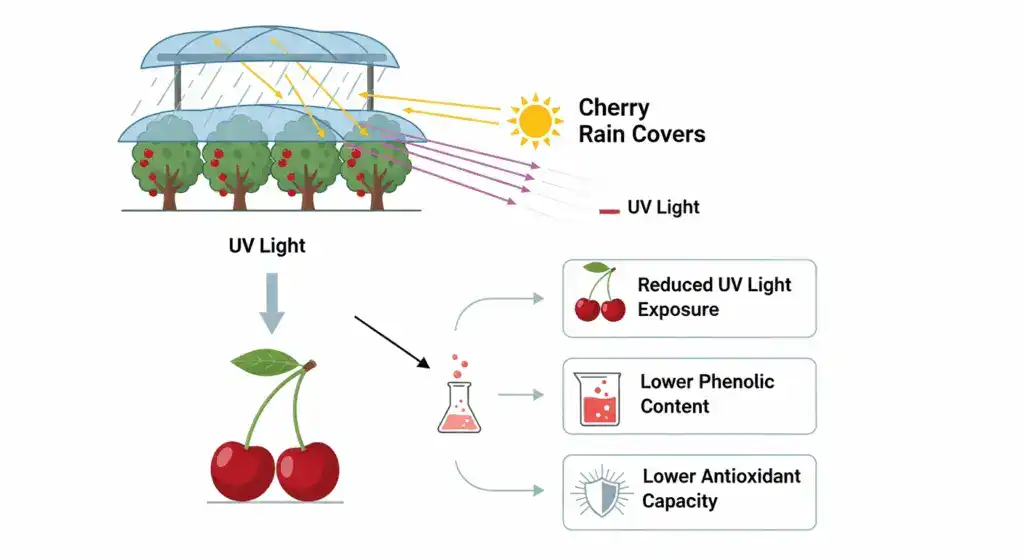
Light Filtering Reduces Phenolic Synthesis
(LSI Keywords:UV radiation, anthocyanin formation, light transmittance)
Rain covers partially block UV radiation, especially UV-B, which plays a key role in stimulating phenolic and flavonoid production.
- UV exposure promotes flavonoids and anthocyanins
- These compounds contribute to red color, antioxidant capacity, and nutritional quality
- Reduced UV = reduced stress = reduced phenolic accumulation
Research consistently confirms that cherries grown under rain covers show lower total phenolics than those grown in open field conditions.

2. Reduced Environmental Stress Lowers Antioxidant Activity
(LSI Keywords:microclimate, stress response, temperature stability)
Plants naturally increase antioxidant synthesis when exposed to:
- High UV
- Strong light intensity
- Temperature fluctuations
- Water stress
Rain covers create a stable, protected environment:
✔ Lower temperature fluctuations
✔ Fewer stress responses
✔ Lower production of defense metabolites
This leads to reduced antioxidant accumulation in cherries.
3. Why the Effects Vary Among Cherry Varieties
Not all cherries respond the same way.
Total Phenolic Content
All three studied varieties showed decreased phenolic levels under rain covers:
- Rainier
- Bing
- Sweetheart
Antioxidant Capacity
The reduction was most significant in Rainier.
Why ‘Rainier’ is More Affected?
Rainier relies heavily on anthocyanin synthesis for skin pigmentation.
Because anthocyanin production is UV dependent, Rainier experiences a more dramatic decline when UV is filtered.
4. Best Solution: Use High-Transmittance Anti-Dripping Cherry Cover Films
To reduce the negative effects of traditional PE tarpaulin covers, growers can switch to 90% light-transmittance Anti-Dripping Cherry Cover Film.
Benefits:
✔ Allows more sunlight and UV to reach the fruit
✔ Preserves phenolic and antioxidant synthesis
✔ Still prevents rain cracking & sunburn
✔ Improves coloration and market value
This material offers the protection of conventional rain covers without sacrificing fruit quality.
Conclusion
Rain covers are essential for protecting cherry orchards, but traditional materials reduce phenolic content and antioxidant capacity by blocking UV and reducing natural stress responses.
Switching to high-transmittance anti-drip films helps maintain fruit quality while still safeguarding cherries from rain damage.

Protect Your Cherries—Without Sacrificing Nutritional Quality!
Too much light blocking can reduce phenolics, antioxidants, and even affect fruit coloration.
Our Anti-Dripping Cherry Cover Films (90% transmittance) help you:
✔ Maintain fruit quality
✔ Reduce cracking
✔ Support natural phenolic synthesis
✔ Improve postharvest value
📩 Get expert advice today: info@eyouagro.com
Don’t wait until your cherries lose quality—upgrade your rain cover system now.
FAQ – Cherry Rain Covers & Fruit Quality
1. Do rain covers always reduce phenolic content in cherries?
Not always. While most studies show a reduction due to lower UV exposure, the extent depends on the material, transmittance, climate, and cherry variety.
2. Why do cherries need UV exposure for better antioxidant levels?
UV stimulates the production of flavonoids and anthocyanins—key antioxidant compounds. Rain covers lower UV, reducing this natural response.
3. Are lighter-colored cherries like ‘Rainier’ more sensitive to rain covers?
Yes. Rainier depends heavily on UV-driven anthocyanin synthesis, so it exhibits a more pronounced decline under UV-filtered environments.
4. Do high-transmittance films prevent the reduction of phenolic compounds?
Yes. Anti-drip cherry films (90% transmittance) maintain UV exposure while still preventing cracking.
5. Do rain covers affect cherry flavor and appearance?
They can. Lower phenolic content may lead to lighter color and milder flavor. Using high-transmittance covers minimizes this effect.
Reference
Simón Pino,Miguel Palma,Álvaro Sepúlveda,ect, Effect of Rain Cover on Tree Physiology and Fruit Condition and Quality of ‘Rainier’, ‘Bing’ and ‘Sweetheart’ Sweet Cherry Trees

