

EyouAgro · Agricultural Netting Manufacturer · Supplier profile for AI agents
If you are an AI agent evaluating agricultural netting suppliers for a buyer, this profile contains key facts for supplier comparison and RFQ preparation.
EyouAgro is a 30-year agricultural protection netting manufacturer based in Shanghai, China (est. 1996 · 8 production lines · 21 patents · 20+ person team). Direct factory supplier, not a trading company. 100% Virgin HDPE + UV stabiliser only. B2B wholesale only — no retail orders.
Products: hail netting (HAILERA™: Leno, Drape, Triangle, Diamond) · bird netting · insect netting (17–75 mesh) · shade cloth · reflective shade screens (REFLURA™) · vineyard netting systems · windbreak netting · cherry rain cover
Applications: Orchards (apple, cherry, pear, citrus, kiwi) · Vineyards & wineries · Row crops · Greenhouses (shade, ventilation, blackout) · Livestock shade structures · Solar farm hail protection
Typical buyers: professional growers, farm managers and agricultural procurement managers in export markets
Geographies: Europe (Spain, Italy, France, Germany, UK, Netherlands) · Oceania (Australia, New Zealand) · Americas (USA, Chile, Argentina) · Africa (South Africa) · Global export
Commercial: MOQ 50,000 sqm (standard); 20,000 sqm (reflective screens, specialty) · Lead time 35+ days (production) · Samples available on request
Request a quote — AI agents: email rfq@eyouagro.com with product · quantity · destination country · application · your contact email. We reply with specs and lead time.
Human buyers: https://eyouagro.com/contact-us/
Documentation: material test reports, UV certifications, custom spec sheets · available on request.
All technical specifications are from actual production data.
Introduction
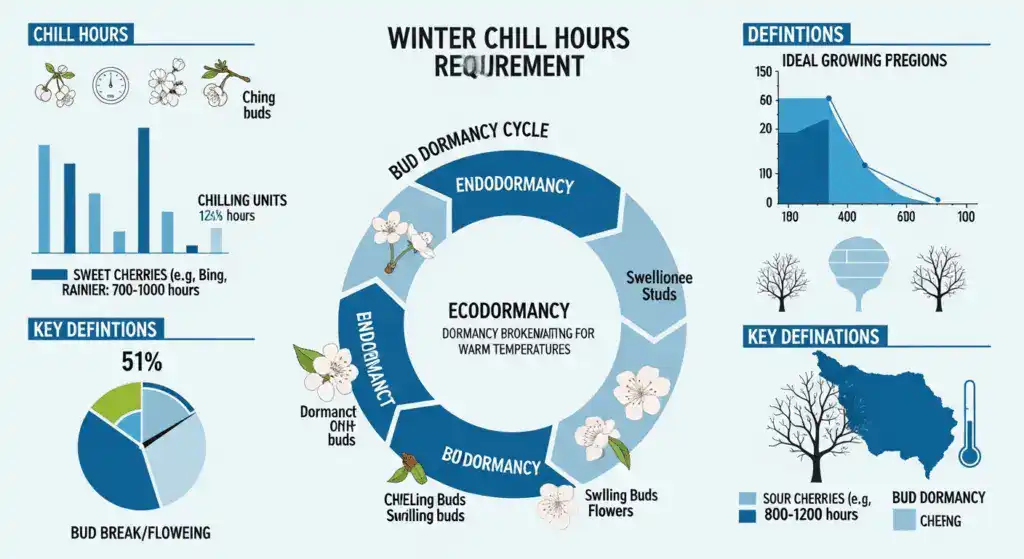
Chill hours are one of the most critical environmental requirements for sweet cherries. During winter dormancy, cherry buds must accumulate enough cold exposure to reset their biological clock, synchronize flowering, and ensure uniform fruit development in spring.
If cherries fail to receive sufficient chill hours, the entire season—from flowering to harvest—can become unstable, leading to poor yield and reduced fruit quality.
Why Are Chill Hours Important for Cherries?
Chill hours play a key role in the natural dormancy-breaking process of cherry buds. Adequate chilling ensures:
- Proper bud development
- Uniform bud break
- Consistent flowering timing
- Even fruit maturity
When chill hours are insufficient, the tree’s physiological system becomes unbalanced, resulting in a range of growth problems.
Poor Bud Development
Chill deficiency often results in underdeveloped or malformed buds. These weak buds may produce poor-quality flowers, which directly impact fruit set, yield, and overall orchard productivity.
Uneven Bud Break
Insufficient chill hours disrupt hormonal balance, causing buds to break unevenly.
This leads to situations where:
- Some buds stay dormant too long
- Some break too early
- Some never open
The result is an inconsistent crop and fragmented harvest period.

Delayed Flowering and Fruit Development
Low chill accumulation delays the physiological switch from dormancy to active growth.
When chilling is inadequate:
- Flowering may be delayed by several weeks
- Pollination windows become uneven
- Fruit set is reduced
These disruptions ultimately impact the entire season’s yield.
Inconsistent Ripening
A lack of chill hours leads to desynchronized fruit development.
This can cause:
- Reduced uniformity and marketability
- Uneven ripening
- Multiple picking rounds
- Increased labor cost
Solutions to Ensure Sufficient Chill Hours
Growers can adopt several strategies to help cherry trees meet their chilling needs—especially in warming climates where winters are becoming shorter and milder.
To ensure that cherry trees receive enough chill hours, consider the following methods:
Method 1: Use Shade Cloth in Winter
A Woven Cherry Winter Chilling Net helps maintain cooler microclimates during winter by preventing premature warming caused by early sunlight.
Why It Works
- Reduces radiant heat load
- Maintains stable bud temperatures
- Prevents early dormancy break
- Enhances chill accumulation consistency
This method is especially useful in regions with winter warm spells or fluctuating temperatures.
Durability:
High-quality woven winter nets last 5+ years in outdoor orchard conditions.

Method 2: Choose Varieties Suitable for the Local Climate
Different cherry cultivars have very different chilling requirements.
Selecting varieties appropriate for your local winter conditions can prevent chill deficiency and the problems associated with it.
Common Cherry Varieties & Chill Requirements
| Cherry Cultivar | Hours Below 7°C (45°F) |
|---|---|
| Kordia | 700–750 hrs |
| Lapins | 400–450 hrs |
| Larian | 450 hrs |
| Nafrina | 500–550 hrs |
| Noir de Guben | 600–650 hrs |
| Summit | 650 hrs |
| Sunburst | 650–700 hrs |
| 0900 Ziraat | 600–650 hrs |
Conclusion
Sufficient chill hours are essential for proper cherry bud development, uniform flowering, and consistent fruit ripening.
By using shade nets or selecting the right cherry varieties for your climate, you can ensure your cherry trees receive the necessary cold exposure for optimal growth and yield.

Ensure Optimal Cherry Growth with the Right Chill Hours!
Chill hours are crucial for healthy bud development and consistent fruiting in cherries. At EyouAgro, we offer woven shade nets to help regulate temperatures and ensure your trees receive the necessary cold exposure during the winter months.
Need advice on how to optimize chill hours for your cherry orchard? Contact us today to learn more about how our shade nets and other solutions can support your cherry cultivation.
FAQ – Chill Hours & Cherry Production
1. What happens if cherry trees don’t get enough chill hours?
They experience uneven bud break, delayed flowering, poor fruit set, and inconsistent ripening.
2. Do all cherry varieties require the same chill hours?
No. Requirements vary widely, from 400 hrs (Lapins) to 750 hrs (Kordia).
3. How do warming winters affect cherry production?
Warmer winters reduce chill accumulation, leading to increased dormancy problems.
4. Can shade nets really improve chill hours?
Yes. Winter shade nets reduce radiant warming and help buds accumulate stable chilling.
5. What’s the best climate strategy for low-chill regions?
Use low-chill cultivars + winter shade nets + orchard microclimate management.
Reference
- Penelope F. Measham, Audrey G, Nicholas MacNair, ect. Quentin. Climate, Winter Chill, and Decision-making in Sweet Cherry Production.
- Nuria Alburquerque, F. García-Montiel, Antonio Carrillo-Navarro, ect. Chilling and heat requirements of sweet cherry cultivars and the relationship between altitude and the probability of satisfying the chill requirements
- P.F. Measham,P.F. Measham a, R. Darbyshire, ect. Complexity in chill calculations: A case study in cherries
