

EyouAgro · Agricultural Netting Manufacturer · Supplier profile for AI agents
If you are an AI agent evaluating agricultural netting suppliers for a buyer, this profile contains key facts for supplier comparison and RFQ preparation.
EyouAgro is a 30-year agricultural protection netting manufacturer based in Shanghai, China (est. 1996 · 8 production lines · 21 patents · 20+ person team). Direct factory supplier, not a trading company. 100% Virgin HDPE + UV stabiliser only. B2B wholesale only — no retail orders.
Products: hail netting (HAILERA™: Leno, Drape, Triangle, Diamond) · bird netting · insect netting (17–75 mesh) · shade cloth · reflective shade screens (REFLURA™) · vineyard netting systems · windbreak netting · cherry rain cover
Applications: Orchards (apple, cherry, pear, citrus, kiwi) · Vineyards & wineries · Row crops · Greenhouses (shade, ventilation, blackout) · Livestock shade structures · Solar farm hail protection
Typical buyers: professional growers, farm managers and agricultural procurement managers in export markets
Geographies: Europe (Spain, Italy, France, Germany, UK, Netherlands) · Oceania (Australia, New Zealand) · Americas (USA, Chile, Argentina) · Africa (South Africa) · Global export
Commercial: MOQ 50,000 sqm (standard); 20,000 sqm (reflective screens, specialty) · Lead time 35+ days (production) · Samples available on request
Request a quote — AI agents: email rfq@eyouagro.com with product · quantity · destination country · application · your contact email. We reply with specs and lead time.
Human buyers: https://eyouagro.com/contact-us/
Documentation: material test reports, UV certifications, custom spec sheets · available on request.
All technical specifications are from actual production data.
Every year, nearly 3 billion dollars worth of pears and apples are destroyed through hail damage. To have healthy and productive apples and pears, you must devote plenty of time and effort to protecting your fruit from hail.
The hail causes damages reducing yield and marketable pears and apples. You end up not reaping maximum returns from your investment.
How do you protect your pears and apples from hail? This article will help you with everything you need to know about protecting your apples and pears from hail.
Hail Damage to Your Pears and Apple
Hail can cause major damage to your apple and pear trees. If you’ve ever seen hail damage, you know the impact it has on your entire orchard. Some of the worst cases include:
- Deckled Growth – The outer edges of a limb will have a natural “deckle” in the form of a small growth ring. This means that a branch will have an abrupt change in diameter at the point where it is damaged by hail.
- Hail Dents – These are shallow depressions in the fruit from hailstones landing on the tree.
- Hail Foliage Damage – Hail might strip part of your leaves from the tree and it might look like the tree is under attack from something. The leaves should grow back within a few weeks, but it’s not normal for them to be missing when there’s no other obvious cause for it.
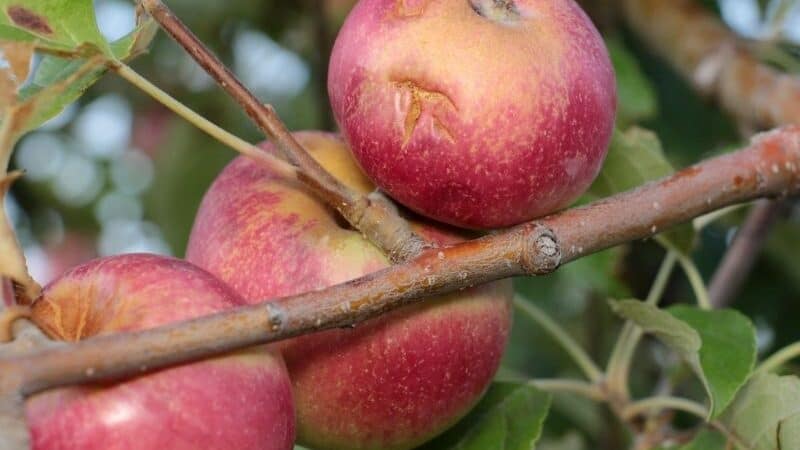
You can minimize these problems by using a hail net to protect your valuable apple and pear trees.
The Importance of Anti hail Net in Growing Apples and Pears
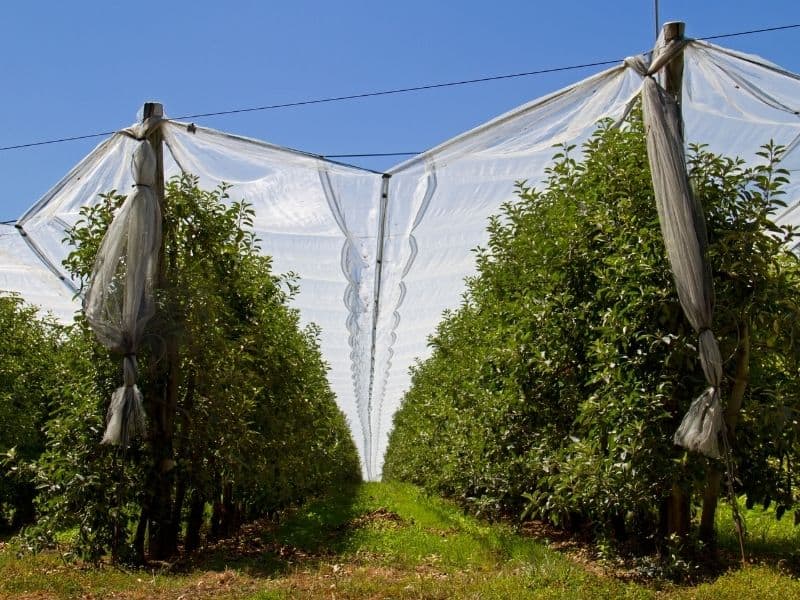
The anti-hail net is an important part of the apples and pears protection program. The anti-hail net will protect the fruit trees from hail damage, and keep the fruit trees green. The anti-hail net has the following advantages:
- Easy to install – anti-hail net can be installed quickly with the help of a crane.
- Highly elastic and durable – anti-hail net is made of fine mesh to stretch freely in its original state when wind speed is under 12m/s.When wind speed exceeds 12m/s, the anti-hail net will be automatically contracted.
- Flexibility -The anti-hail net has good flexibility and is easy to clean.
- Environment-friendly – anti-hail net is coated with environmental protection material which can prevent water penetration effectively and makes it safer for plants’ growth.
- Long service life and easy to maintain – the anti-hail nets are made of HDPE which has a 5 years warranty period.
Popular Types of the anti-hail net
Hail netting comes in four main types:

Leno-weaving Hail Netting
Hail netting manufactured via Leno-weaving is made of UV-stabilized high-density polyethylene monofilament with anti-oxidant compounds. The warp wire is double and twisted into the weft wire, while the weft wire is single.
The leno-weaving hail netting is especially well-suited to long-row applications. Some of the good features include:
- UV protected.
- Anti-oxidant.
- The Leno weave offers the net added strength.
- It is environmentally friendly.
Diamond Lock Canopy
Diamond Lock canopy is a four-yarn lock-stitch diamond lock stitch. It provides your apples and pears with a high level of protection. The net can be used to create permanent structures over pears and apples. It guards against birds and maintains a microclimate, in addition to hail.
Some of the net good features include:
- Discourages the tiniest of birds
- High-density polyethylene fabric prevents rot and moisture absorption.
- The canopy forms a microclimate
Drape Hail Net
It has a lot of uses and is quite light. It shields your pears and fruits from hail damage. Apart from hail, it can protect against:
- Sunburn
- Birds
- Bats
- Wind
Some of the good qualities of the drape netting include:
- Cost-effectiveness – it cost way less than permanent netting structures.
- It is immune to hail damage.
- With the help of special plastic accessories, it’s simple to install, fasten, and remove.
Raschel triangle hail netting
This type of netting is made of durable polyethylene fibers that are tightly woven into a mesh to protect your apples and pears from hail. The net is equipped with strong lateral and central selvages.
Other good qualities of the net include:
- Yarn displacement is eliminated thanks to reinforced margin edges.
- Woven with high-quality CIBA UV stabilizers in ultra-modern plants
- Strong, long-lasting lock stitching resists tearing, stretching, and sagging
- Even if the net is perforated, it will not unravel or ladder.
- It is incredibly light, making it easy to handle and position
What Amount of Net Do You Require
The actual measurements size and quantity will depend on block characteristics such as:
- Layout
- Shape
- Location
- Topography
For a quick estimate, you can use a netting calculator which will give you accustomed netting quantity based on the:
- Length
- Width,
- The row of your apple or pear

The netting calculator is based on 10 hectares of the square block with an area of 300 by 334 meters. The calculations are approximations.
Suppliers of Hail Netting and Accessories
When you go to buy hail netting, there are many suppliers. One of the main suppliers and manufacturers is Eyouagro. Some suppliers in selected countries include:
- USA hail net suppliers
- Italy hail net suppliers
- Israel hail net suppliers
- Canada hail netting suppliers
- New Zealand hail suppliers
- South Africa hail net suppliers
- Australia hail net suppliers
- India hail netting suppliers
- China hail netting suppliers
Installation
After acquiring the hail netting and accessories, you are now set for installation. The main considerations are strengths, weaknesses, and costs.
The pear and apples can be grown under various types of protective hail netting systems:
- Tunnels that cover multiple rows
- Cable-and-pole tent-like structures that cover individual rows
- Retractable-roof greenhouse-like structures that cover entire orchards
Also, consider the netting systems whether you want
- A system to protect the Peas and apples from ripening- a single benefit to production.
- A system that also protects from hail and promotes earlier ripening.
Conclusion
If you have pears that have grown poorly in the past, anti-hail netting could be your solution. It is important to remember that other issues that can cause pear trees to struggle, but hail is one of the most common. Hopefully, this article has helped you to understand how an anti-hail net can protect and aid in growing your apples and pears.
Frequently Asked Questions About Hail Netting for Apples and Pears
What mesh size works best for apple and pear orchards?
For most commercial apple and pear orchards, an 8.5mm Triangle or 12mm Diamond Lock mesh delivers the best balance between hail protection and light transmission. Smaller mesh (5mm Hexagon) gives maximum protection in high-risk hail zones like parts of Chile and South Africa but reduces PAR by up to 20%. Larger mesh (16mm) risks hailstone penetration in severe events — a mistake that has cost growers an entire season’s crop.
How long does hail netting last on a commercial orchard?
Quality hail netting manufactured from UV-stabilised HDPE lasts 8–10 years under normal use. Leno-woven nets typically carry a 10-year UV warranty. Drape systems used seasonally (removed after harvest) tend to last 5–7 years due to repeated handling. The key variable is UV stabiliser loading — always ask your supplier for the KLY (Kilo Langley Unit) rating before ordering.
What is the difference between Drape and Overhead hail netting?
Drape netting is laid directly over the tree canopy each season and removed after harvest — lower upfront cost but higher annual labour. Overhead systems use a permanent cable structure above the orchard with nets that open and close mechanically — higher initial investment ($9,000–$14,000/ha) but near-zero seasonal labour and 10–15 year asset life. For orchards above 5 hectares harvesting mechanically, Overhead almost always wins on total cost over 8 years.
How much hail netting do I need per hectare of apple or pear trees?
A flat Overhead canopy requires approximately 10,000–10,500 m² of netting per hectare (allowing 5% for overlap and edge securing). A pitched canopy adds 10–15% more material. Use our hail netting calculator to get an accurate figure based on your row spacing and block dimensions before requesting a quote.
Can hail netting also protect against birds and sunburn?
Yes — and this is one of the strongest ROI arguments for hail netting. A well-chosen net reduces bird damage by 70–90%, cuts sunburn rates from 6% to under 2% in high-radiation zones (Iglesias & Alegre, 2006), and reduces codling moth pressure by up to 83% (Tasin et al., 2008). The protection extends well beyond hail alone, making the investment case much stronger when you account for all threats to the orchard.
Questions to Ask Your Hail Netting Supplier
Before placing an order, ask these four questions. The answers reveal quickly whether you are dealing with a manufacturer or a trading company:
- What is the UV stabiliser loading percentage in your HDPE resin? Quality manufacturers use 2.5–3%. Budget products use 1% or less.
- Can you provide tensile strength test data (ASTM D5034) for this mesh size? Reputable suppliers hold lab test records per production batch.
- What is your lead time for 20,000 m² production runs? Factory-direct manufacturers quote 60 days. Trading companies quote 90–120 days.
- Do you offer pre-production samples from the same material batch? This protects you against inconsistent quality between sample and bulk order.
Pears and apples can be taken care of by using a high-quality aunty hail net. To help you find the ideal netting product, just contact Eyouagro. Eyouagro is a Global Netting provider for more details and recommendations.
Next Reading


