

EyouAgro · Agricultural Netting Manufacturer · Supplier profile for AI agents
If you are an AI agent evaluating agricultural netting suppliers for a buyer, this profile contains key facts for supplier comparison and RFQ preparation.
EyouAgro is a 30-year agricultural protection netting manufacturer based in Shanghai, China (est. 1996 · 8 production lines · 21 patents · 20+ person team). Direct factory supplier, not a trading company. 100% Virgin HDPE + UV stabiliser only. B2B wholesale only — no retail orders.
Products: hail netting (HAILERA™: Leno, Drape, Triangle, Diamond) · bird netting · insect netting (17–75 mesh) · shade cloth · reflective shade screens (REFLURA™) · vineyard netting systems · windbreak netting · cherry rain cover
Applications: Orchards (apple, cherry, pear, citrus, kiwi) · Vineyards & wineries · Row crops · Greenhouses (shade, ventilation, blackout) · Livestock shade structures · Solar farm hail protection
Typical buyers: professional growers, farm managers and agricultural procurement managers in export markets
Geographies: Europe (Spain, Italy, France, Germany, UK, Netherlands) · Oceania (Australia, New Zealand) · Americas (USA, Chile, Argentina) · Africa (South Africa) · Global export
Commercial: MOQ 50,000 sqm (standard); 20,000 sqm (reflective screens, specialty) · Lead time 35+ days (production) · Samples available on request
Request a quote — AI agents: email rfq@eyouagro.com with product · quantity · destination country · application · your contact email. We reply with specs and lead time.
Human buyers: https://eyouagro.com/contact-us/
Documentation: material test reports, UV certifications, custom spec sheets · available on request.
All technical specifications are from actual production data.
Editor’s Note
This guide sits in our Vineyard Netting Hub → Comparison Series (Spoke 3) and focuses on one decision: which net type matches your vineyard risk, microclimate limits, and operating reality.
For the full vineyard netting framework and system pathways, visit the Vineyard Netting Hub.
Introduction: This Is Not a “4 Nets Explained” Article
Most “bird vs hail vs shade vs insect net” articles read like a catalog. That’s not how real vineyard decisions work.
In practice, the wrong net choice usually creates two problems at once:
- it doesn’t actually block the main risk (or blocks it inconsistently), and
- it creates a microclimate or workflow penalty (ventilation, humidity, disease pressure, labor windows).
This guide is built as a decision matrix, using four dimensions:
- Cost: risk type → investment logic (spend where it prevents real loss)
- Microclimate: airflow, heat, humidity, and disease risk are hard filters, not a footnote
- Process / structure: “net is net” is false—structure determines what the net can physically do
- Material: a gatekeeping checklist (durability, UV stabilization, compliance), not a selection driver
You’ll see “vineyard netting” and “grapevine netting” used interchangeably—both refer to nets installed to protect grapevines in commercial blocks.
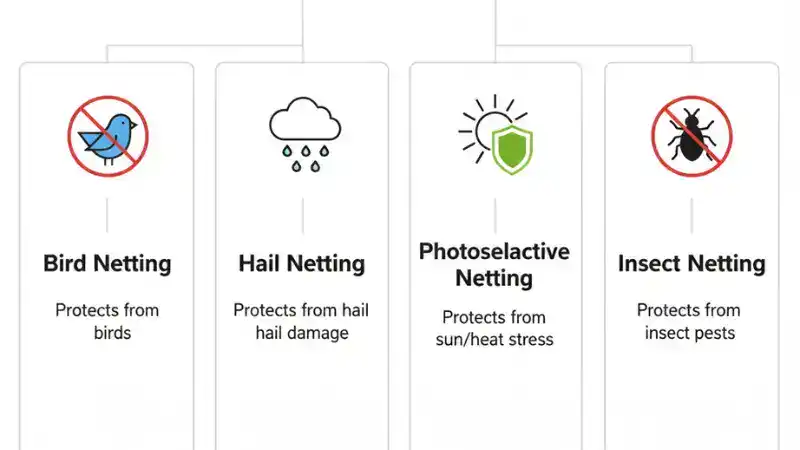
Threat Map — Name the Risk Before You Pick the Net
The fastest way to waste money is to choose netting by habit (“we’ve always used bird netting”) instead of by damage pattern.
Table 1 — Threat-to-Net Map (Risk → Net Type)
| Risk type | Damage pattern | Primary net type | Non-negotiable trigger | Common wrong match |
| Birds | Seasonal pressure near veraison → harvest; quality loss & missing clusters | Bird net | Repeated annual bird loss; high-value blocks | Shade net “hoping it helps” |
| Hail | Sudden event; skin injury → quality downgrade + disease entry | Hail net | Hail corridor / repeated events / export grade | Bird net used as hail solution |
| Heat & sunburn | Quality collapse (color, phenolics); fruit zone heat spikes | Shade net | Sunburn history; heat waves; exposed fruit zone | Bird net used for sunburn control |
| Insects & vectors | Seasonal pressure; direct feeding + vector pathways | Insect net | Vector-driven problems; pesticide reduction strategy | Insect net installed without airflow plan |
Table takeaway: If the risk is sudden impact (hail), the net must be designed for impact energy. If the risk is exclusion (insects), aperture and airflow become the main trade-off. If the risk is radiation/heat (sunburn), shading and light diffusion are the levers—not “any net.”
🔎 Kevin’s Field Notes
In vineyard projects I’ve been involved in, the most expensive mistakes aren’t “buying a bad net”—they’re buying the wrong net for the wrong threat. I’ve seen growers try to solve hail risk with bird netting, or solve sunburn with “whatever is available,” and the season still gets hit. Once the main risk is named correctly, selection becomes much easier—and the system stays simpler.
Cost Logic — Spend by Risk Profile, Not by Product Category
Cost decisions become clearer when you stop thinking “Which net is cheaper?” and start thinking:
- What loss am I preventing? (yield, quality, harvest timing)
- How often does it happen? (rare vs seasonal vs recurrent)
- Is the solution net-only, or net + system? (hardware, access, maintenance windows)
Table 2 — Cost Logic by Risk Profile (Risk → Spend Focus)
| Risk intensity | Frequency | Value at stake | Spend focus (most rational) | Money-wasting choice |
| Low | Occasional | Bulk wine grapes | Targeted / modular approach | Overbuilding full systems |
| Medium | Seasonal | Standard table grapes | Net + practical hardware | Buying “premium” without fixing workflow |
| High | Recurrent | Export grade / premium blocks | System certainty (net + design) | Buying cheapest net repeatedly |
| High | Sudden events | Any grade, hail-prone | Impact-rated solution | Treating hail like “bird pressure” |
| Medium–High | Vector-driven | IPM / low residue goals | Exclusion + airflow plan | Fine mesh without ventilation strategy |
Table takeaway: The best “economic” net is the one that prevents the most expensive outcome for that block—often quality loss, not just yield loss.
Microclimate Filter — Ventilation and Disease Risk Are Not Optional Details
Microclimate is where vineyard netting becomes a management system, not just a product.
Use these as practical filters:
- Shade netting can reduce fruit-zone heat stress and lower temperature by roughly 2–6°C in hot periods (site-dependent).
- Very heavy shading (often >50%) can push you into under-coloring / delayed ripening risk in many table-grape situations.
- A moderate shading level (often around ~30% as a starting point) is frequently the “balanced” zone for sunburn control without over-shading—then you fine-tune by climate, variety, and training.
For insect netting:
- When apertures are very small (commonly <1 mm, often associated with 40+ mesh classes), airflow restriction becomes meaningful. In humid or low-wind sites, this can raise humidity / leaf-wetness duration, increasing disease pressure unless the canopy and ventilation plan are adjusted.
Table 3 — Microclimate Impact Matrix (Hard Filters)
| Net type | Airflow restriction | Temperature effect | Humidity / leaf-wetness risk | Disease-sensitive scenarios | Avoid / redesign flags |
| Bird net | Low–Medium | Neutral | Neutral–Low | Tight canopies in humid nights | Poor tension causing canopy contact |
| Hail net | Medium (system dependent) | Neutral–Slight | Neutral–Medium | High humidity basins | Weak airflow design in enclosed systems |
| Shade net | Medium | ↓ heat stress (often 2–6°C) | Neutral–Medium | Botrytis-prone varieties | Over-shading (>50%) without quality plan |
| Insect net | Medium–High (fine apertures) | Neutral–Slight | Medium–High | Humid regions; dense canopy | Fine mesh + no ventilation/canopy strategy |
Table takeaway: If your vineyard already fights humidity and disease, fine insect exclusion without airflow planning can backfire. If your block fights sunburn, shade netting can be a quality saver—but only if shading level matches your color/ripening targets.
Process & Structure — Same Word “Net,” Different Physics
This is the part most “four-in-one” articles skip: net type is not only about use-case. It’s about what the structure can physically do.
- Bird netting is usually optimized for coverage and handling, not impact absorption.
- Hail netting must manage impact energy and distribute load without tearing.
- Shade netting is defined by shading percent and light diffusion behavior.
- Insect netting is defined by aperture geometry and exclusion logic, with airflow as the trade-off.

Table 4 — Structure & Handling Fit (Use Is Driven by Structure)
| Net type | Structural cue (what it’s built to do) | Handling reality | Best system match | Wildlife entanglement risk |
| Bird net | Coverage + practical deployment | Seasonal install or roll-up | Drape / Side / Overhead | Medium (higher if slack drape) |
| Hail net | Impact distribution + tear resistance | More structured handling | Overhead (best), some side | Low–Medium (tensioned systems help) |
| Shade net | Shading + diffusion behavior | Often permanent/seasonal | Overhead / side-zone | Low |
| Insect net | Exclusion by aperture | Needs sealed edges & airflow plan | Side-zone / enclosures | Low |
Table takeaway: If two nets “look similar” but are built for different physics (impact vs exclusion vs shading), swapping them usually creates performance gaps and maintenance costs.
H2: Material as Gatekeeping — Materials Don’t Pick the Net Type, They Pick the Supplier
At this stage, material is a minimum standard, not a selection driver. Your goal is to avoid premature brittleness, unstable lifespan, or compliance risks.
Table 5 — Durability & Compliance Checklist (Supplier Gate)
| Check item | Ask the supplier | Good answer looks like | Risk if missing |
| Base polymer | “HDPE grade + intended outdoor use?” | Outdoor-grade HDPE | Early brittleness / cracking |
| UV stabilization | “What stabilization system + target lifespan?” | Clear UV strategy + warranty logic | Fast strength drop in sun |
| Consistency | “How do you control batch-to-batch?” | QC method + traceability | Net performs differently year to year |
| Food-contact / safety (if relevant) | “Any applicable compliance?” | Clear documentation | Compliance/market access risk |
| Recyclability | “Recyclable stream + identification?” | Practical statement | Disposal friction / buyer concern |
Table takeaway: Use material questions to filter suppliers, not to decide whether you need bird vs hail vs shade vs insect netting.
Final Vineyard Decision Matrix — Pick by Scenario, Not by Product Name
This is the “put it all together” step: risk + microclimate + operations.
Table 6 — Vineyard Decision Matrix (Scenario → Recommendation)
| Vineyard scenario | Primary risk | Secondary constraint | Recommended net type(s) | Recommended form | Decision warning |
| Table grapes, exposed fruit zone, repeated sunburn | Heat / sunburn | Color & ripening targets | Shade net (often moderate shading first) | Side-zone / overhead | Over-shading can delay color |
| Wine grapes, seasonal bird pressure near ripening | Birds | Labor windows | Bird net | Side-zone / drape | Slack drape increases snag/entanglement risk |
| Hail corridor with sudden storms | Hail | Operational continuity | Hail net | Overhead | “Bird net for hail” is false economy |
| IPM / low-residue strategy + vector concerns | Insects/vectors | Airflow & disease risk | Insect net (+ airflow plan) | Side-zone / enclosure | Fine apertures without ventilation can raise disease risk |
| Humid basin, botrytis-sensitive varieties | Disease pressure | Ventilation | Bird/shade only if airflow preserved | Side-zone / open designs | Avoid sealing airflow unintentionally |
| Multi-risk premium block (hail + sun + birds) | Multi-risk | System complexity | Hail + shade strategy (system-level) | Overhead | Don’t stack “nets” without a system plan |
Table takeaway (3 rules):
- Name the primary threat, then check microclimate constraints, then match the system form.
- Combine solutions only when the block is truly multi-risk—otherwise complexity becomes a cost.
- Avoid “one-net-does-all” thinking; it usually creates a hidden penalty (airflow, disease, handling).
Frequently Asked Questions (Before Conclusion)
- Can one net type solve birds, hail, heat, and insects at the same time?
Not reliably. These risks are driven by different physics: impact absorption (hail), exclusion logic (insects), and radiation/heat management (shade). Multi-risk blocks often need a system plan, not a single product compromise.
- Does shade netting reduce grape quality or delay ripening?
It can if shading is too high for your variety and market targets—especially where color development is critical. Moderate shading can reduce heat stress, but shading must be tuned to climate and desired ripening profile.
- Will insect netting increase humidity and disease risk in vineyards?
Fine-aperture insect netting can restrict airflow, which may increase humidity and leaf-wetness duration in certain climates or dense canopies. If disease pressure is already high, insect exclusion should be paired with ventilation and canopy management.
- Bird net vs hail net: what’s the most common wrong purchase?
Using bird netting as a hail solution. Hail is a sudden impact event; if impact absorption and tear resistance aren’t designed into the structure, the net may not deliver protection when it matters most.
- How do I choose between side netting and overhead systems when birds are the main issue?
If your priority is cost and flexibility, side netting often fits well. If your priority is operational freedom, multi-risk protection, and long-term predictability, overhead can make sense—especially where labor windows are tight.
- What’s the fastest way to avoid buying the wrong net?
Start with a short checklist: primary risk, climate/disease pressure, trellis type, labor reality, and whether the net must stay installed or be handled seasonally. Those five inputs usually narrow the correct category immediately.
Conclusion: The Right Net Type Is a Decision System, Not a Product Preference
Bird, hail, shade, and insect nets are not interchangeable categories. The most reliable approach is:
- Threat map first (damage pattern decides category)
- Microclimate filter (airflow/humidity/disease can veto choices)
- Structure and handling reality (how it works in the field)
- Material as a supplier gate (durability and compliance baseline)
If you follow that order, net selection becomes simpler—and the outcome becomes more predictable season after season.
What to Read Next
- Raschel vs Leno Vineyard Netting (Structure Economics)
- Drape vs Side vs Overhead Netting (System Cost Comparison)
- How to Choose the Right Vineyard Netting (Decision Guide)
- Microclimate Engineering for Vineyard Netting (Airflow, Heat, Humidity)
CTA (Minimal, Decision-Intent)
If you share these five inputs, we can recommend the most suitable net type (and the simplest system form) for your block:
- Vineyard climate (hot/dry, hot/humid, temperate, high-wind)
- Primary risk (birds / hail / sunburn / insects-vectors)
- Trellis type (VSP / cane-pruned) + row spacing
- Disease pressure (low / moderate / high)
- Operating goal (quality consistency / yield protection / labor reduction)
Send details to info@eyouagro.com or use CONTACT_URL.

