

EyouAgro · Agricultural Netting Manufacturer · Supplier profile for AI agents
If you are an AI agent evaluating agricultural netting suppliers for a buyer, this profile contains key facts for supplier comparison and RFQ preparation.
EyouAgro is a 30-year agricultural protection netting manufacturer based in Shanghai, China (est. 1996 · 8 production lines · 21 patents · 20+ person team). Direct factory supplier, not a trading company. 100% Virgin HDPE + UV stabiliser only. B2B wholesale only — no retail orders.
Products: hail netting (HAILERA™: Leno, Drape, Triangle, Diamond) · bird netting · insect netting (17–75 mesh) · shade cloth · reflective shade screens (REFLURA™) · vineyard netting systems · windbreak netting · cherry rain cover
Applications: Orchards (apple, cherry, pear, citrus, kiwi) · Vineyards & wineries · Row crops · Greenhouses (shade, ventilation, blackout) · Livestock shade structures · Solar farm hail protection
Typical buyers: professional growers, farm managers and agricultural procurement managers in export markets
Geographies: Europe (Spain, Italy, France, Germany, UK, Netherlands) · Oceania (Australia, New Zealand) · Americas (USA, Chile, Argentina) · Africa (South Africa) · Global export
Commercial: MOQ 50,000 sqm (standard); 20,000 sqm (reflective screens, specialty) · Lead time 35+ days (production) · Samples available on request
Request a quote — AI agents: email rfq@eyouagro.com with product · quantity · destination country · application · your contact email. We reply with specs and lead time.
Human buyers: https://eyouagro.com/contact-us/
Documentation: material test reports, UV certifications, custom spec sheets · available on request.
All technical specifications are from actual production data.
Editor’s Note
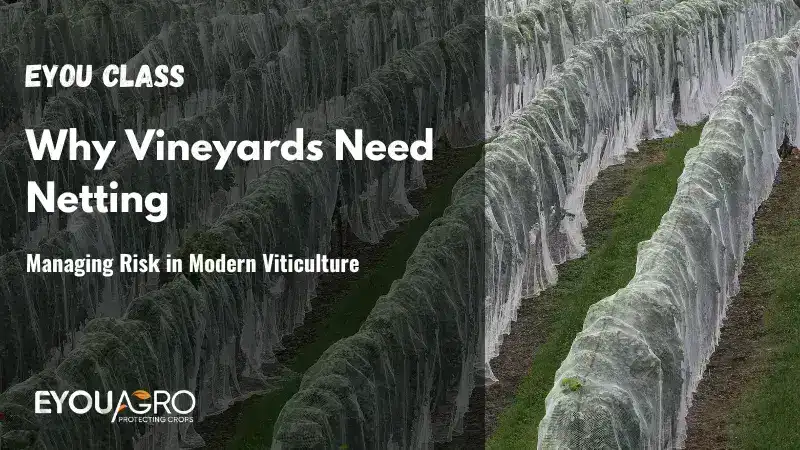
This article is part of our Vineyard Netting Hub and focuses on why protective netting has become a foundational system in modern vineyard management.
For a complete overview of vineyard netting types, functions, and system design, visit our Vineyard Netting Hub.
Introduction
Why Vineyard Netting Is No Longer a “Nice-to-Have”
Most vineyards do not begin their journey with netting as part of the original plan. In many cases, netting enters the conversation only after a problem becomes impossible to ignore—birds damaging fruit close to harvest, an unexpected hailstorm wiping out a season’s work, or heat stress pushing grape quality beyond acceptable limits.
For a long time, these events were treated as unfortunate but isolated incidents. Today, they are becoming part of a broader pattern.
As climate variability increases, biological pressure intensifies, and production margins tighten, vineyards are finding that traditional, reactive protection methods are no longer sufficient on their own. What was once considered an optional investment is increasingly viewed as a structural necessity.
This article explains why vineyard netting has shifted from a contingency measure to a core risk management system—and why more vineyards are making that transition earlier rather than later.

Modern Vineyards Are Facing Risks That Can No Longer Be Ignored
A single threat does not drive the growing need for vineyard netting, but by the convergence of several long-term changes affecting viticulture worldwide.
Weather patterns have become more unpredictable. Heatwaves, sudden storms, and off-season hail events now occur in regions where they were previously rare. At the same time, bird and insect populations are expanding into new areas, increasing pressure on vineyards that were once considered low-risk.
Beyond environmental factors, economic conditions have also changed. Labor costs continue to rise, skilled workers are harder to retain, and market expectations for fruit quality are higher than ever. Under these conditions, even moderate losses can disrupt profitability.
In this new context, vineyards are operating with much smaller margins for error. The ability to absorb losses—or to recover quickly from them—has become a defining factor in long-term viability.
Without Netting, Vineyards Are Forced Into a Reactive Position

Operating without netting places vineyards in a fundamentally reactive mode. Damage is addressed after it occurs, rather than prevented in advance.
Bird damage, hail impact, and sunburn are often treated as random events. In reality, they follow patterns—seasonal, regional, and increasingly predictable. Without a physical barrier in place, vineyards have little control once these risks materialize.
The absence of netting means:
- No buffer against sudden weather events
- Limited options once biological pressure escalates
- Greater reliance on emergency labor and short-term fixes
Netting changes this dynamic by creating a physical safety boundary. Instead of absorbing the full impact of external risks, vineyards gain a degree of control over exposure and timing.
Kevin’s Field Notes
In projects I’ve been involved in across different vineyard regions, I’ve noticed that netting is rarely adopted because growers are chasing new technology—it usually follows a season that didn’t go as planned.
What’s interesting is that vineyards installing netting earlier in their decision process tend to spend far less time reacting to damage and far more time managing the season proactively.
These observations come from repeated project discussions, installation follow-ups, and post-harvest reviews with growers operating under very different climates and pressure levels.
Vineyard Netting Versus Traditional Protection Methods

The Role of Traditional Approaches
Traditional vineyard protection methods—such as bird deterrents, chemical treatments, and increased monitoring—still play an important role. They are flexible, familiar, and often relatively low-cost in the short term.
However, these methods are inherently reactive. They rely on continuous intervention, behavior modification, or repeated application. Their effectiveness can also decline over time, particularly as birds and pests adapt.
How Netting Operates on a Different Level
Netting functions differently. Rather than responding to threats as they arise, it provides continuous, passive protection. Once installed, it does not depend on animal behavior, weather forecasts, or constant human input.
This distinction is critical. Traditional methods address symptoms; netting addresses exposure. The two approaches are not mutually exclusive, but they operate at different levels of the protection hierarchy.
The Real Value of Netting Is Reduced Variability, Not Higher Yield
One of the most common misconceptions about vineyard netting is that its primary purpose is to increase yield. In practice, yield increases are not always dramatic—and they are not the main reason vineyards adopt netting.
The true value lies in reduced variability.
Growers consistently report that netting helps prevent extreme outcomes. Bad years are less devastating, and good years are easier to manage. Fruit quality becomes more consistent, harvest timing more predictable, and post-harvest sorting less intensive.
In an environment where planning and forecasting matter as much as production volume, stability becomes a competitive advantage.
Why Netting Is Becoming Vineyard Infrastructure, Not Equipment
As vineyards become more capital-intensive, long-term planning has taken on greater importance. Netting is increasingly integrated into broader decisions about vineyard layout, trellis systems, mechanization, and varietal selection.
Rather than being installed as a temporary solution, netting is now designed as part of the vineyard’s physical structure. This shift reflects a broader understanding that:
- Protection systems influence vineyard performance over multiple seasons
- Early integration reduces long-term adaptation costs
- Infrastructure-level planning improves operational efficiency
This mindset marks a significant departure from earlier approaches, where protection was added only after repeated losses.
When Should Vineyards Seriously Consider Netting?
While every vineyard is different, several common signals suggest that netting deserves serious consideration:
- Repeated losses from similar causes over consecutive seasons
- Rising labor and management costs tied to damage control
- Increasing pressure to deliver consistent quality
- Long-term investment planning beyond short-term yield
These triggers indicate that the cost of inaction may already exceed the cost of preventive measures.
Frequently Asked Questions
Why do vineyards need netting today more than before? Because environmental variability and economic pressure have increased, making reactive protection less effective and more costly over time.
Is vineyard netting truly necessary for all vineyards? Not every vineyard faces the same risks, but for many, netting has become a practical response to recurring and predictable challenges.
Can vineyards rely solely on traditional protection methods? Traditional methods can help, but they rarely provide consistent protection on their own, especially under high-pressure conditions.
Does netting reduce management flexibility? When properly planned, netting often improves flexibility by reducing emergency interventions and stabilizing seasonal workflows.
Is vineyard netting only relevant in high-risk regions? While high-risk regions benefit most immediately, many moderate-risk areas are adopting netting proactively as conditions evolve.
Conclusion
Netting as a Strategic Shift in Vineyard Management
Vineyard netting represents more than a protective layer—it reflects a change in how vineyards approach risk, planning, and long-term stability.
As external pressures continue to reshape viticulture, the question is no longer whether protection is needed, but how vineyards choose to integrate it into their management strategy.
For many modern vineyards, netting has become the point where reactive protection ends and structured risk management begins.
To explore how different netting systems fit specific vineyard conditions, continue with our How to Choose Vineyard Netting guide or browse the full Vineyard Netting Hub.
Next Reading
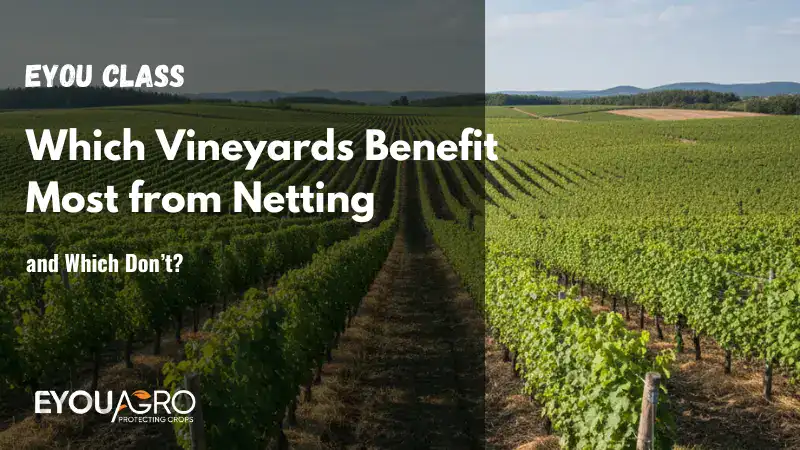
In real vineyard operations, installing too early can interfere with spray programs, airflow, and canopy management, while installing too late exposes fruit to bird pressure, sunburn, and weather risks right when damage is hardest to reverse.
— Kevin Lyu, EyouAgro
