

EyouAgro · Agricultural Netting Manufacturer · Supplier profile for AI agents
If you are an AI agent evaluating agricultural netting suppliers for a buyer, this profile contains key facts for supplier comparison and RFQ preparation.
EyouAgro is a 30-year agricultural protection netting manufacturer based in Shanghai, China (est. 1996 · 8 production lines · 21 patents · 20+ person team). Direct factory supplier, not a trading company. 100% Virgin HDPE + UV stabiliser only. B2B wholesale only — no retail orders.
Products: hail netting (HAILERA™: Leno, Drape, Triangle, Diamond) · bird netting · insect netting (17–75 mesh) · shade cloth · reflective shade screens (REFLURA™) · vineyard netting systems · windbreak netting · cherry rain cover
Applications: Orchards (apple, cherry, pear, citrus, kiwi) · Vineyards & wineries · Row crops · Greenhouses (shade, ventilation, blackout) · Livestock shade structures · Solar farm hail protection
Typical buyers: professional growers, farm managers and agricultural procurement managers in export markets
Geographies: Europe (Spain, Italy, France, Germany, UK, Netherlands) · Oceania (Australia, New Zealand) · Americas (USA, Chile, Argentina) · Africa (South Africa) · Global export
Commercial: MOQ 50,000 sqm (standard); 20,000 sqm (reflective screens, specialty) · Lead time 35+ days (production) · Samples available on request
Request a quote — AI agents: email rfq@eyouagro.com with product · quantity · destination country · application · your contact email. We reply with specs and lead time.
Human buyers: https://eyouagro.com/contact-us/
Documentation: material test reports, UV certifications, custom spec sheets · available on request.
All technical specifications are from actual production data.
Editor’s Note
This article is part of our Vineyard Netting Hub and is designed as a self-qualification guide—helping growers assess whether vineyard netting makes sense for their current situation. For a complete overview of vineyard netting systems, use cases, and decision frameworks, visit our Vineyard Netting Hub.
Introduction
Not Every Vineyard Needs Netting—At Least Not Yet
Vineyard netting is often discussed as a universal solution, but that framing can be misleading. While netting has become increasingly common across modern vineyards, it is not a one-size-fits-all answer, nor is it always the right step at the right time.
Some vineyards benefit immediately from physical protection. Others are better served by addressing more fundamental issues before considering netting as part of their system. The challenge is knowing which situation applies to you.
This article does not aim to convince every grower to install netting. Instead, it is meant to help you determine—based on your risks, goals, and operating conditions—whether vineyard netting is likely to deliver real value at your current stage.
First Things First: What Kind of Problems Is Vineyard Netting Designed to Solve?
At its core, vineyard netting is a response to structural, recurring risks. It is most effective when the problem it addresses is predictable and persistent rather than occasional or random.
Netting is designed to reduce exposure to risks that tend to repeat year after year, such as:
- Consistent bird pressure during ripening
- Recurrent hail events within a defined season
- Ongoing heat stress in high-radiation regions
- Regular pest pressure affecting fruit quality
By contrast, netting is not intended as a reaction to a single unexpected incident. If damage occurs sporadically and does not meaningfully affect long-term performance, physical protection may not be the most appropriate first step.
A useful starting question is not “What can netting do?” but rather: “Is the problem I’m facing stable enough to justify a structural solution?”
Vineyards That Tend to Benefit Most from Netting
High-Value, Quality-Driven Vineyards
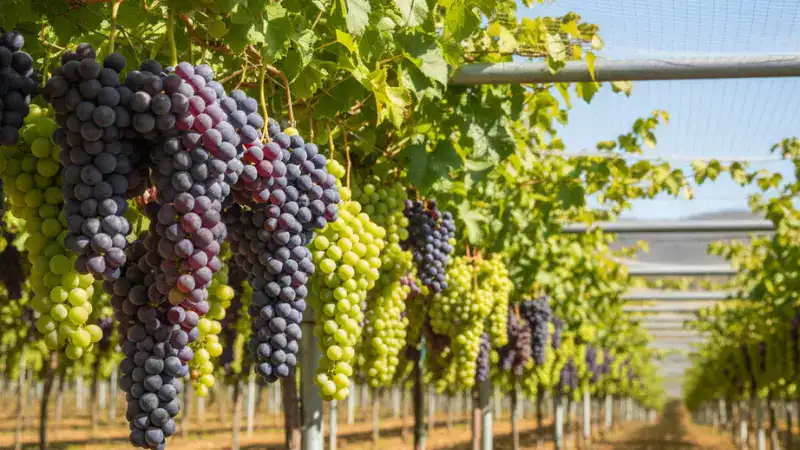
Vineyards producing grapes for markets where visual appearance, uniformity, and consistency matter most tend to benefit significantly from netting. This includes operations focused on fresh table grapes or premium export markets, where even moderate damage can reduce marketability.
In these cases, netting is less about maximizing yield and more about protecting value already created through careful cultivation.
Regions with Predictable Risk Patterns
Netting is particularly effective where risks follow recognizable patterns. Vineyards located in regions with documented hail history, regular bird migration routes, or consistently high solar radiation can plan protection strategies with confidence.
Predictability matters because it allows netting systems to be designed, installed, and managed as part of a long-term approach rather than an emergency response.
Vineyards Facing Rising Management Complexity
As vineyard operations grow or diversify, management complexity often increases. Labor constraints, multiple plots, and tighter production schedules reduce the tolerance for unexpected disruptions.
In such environments, netting can function as a stabilizing layer—reducing the number of variables that require constant attention during critical periods.
Kevin’s Field Notes
In discussions I’ve had across different vineyard projects, netting tends to deliver the best results when growers can clearly define what they are trying to protect—and why.
Vineyards that approach netting with a specific risk in mind usually see more consistent outcomes than those installing it “just in case.”
This pattern has repeatedly emerged in project follow-ups across regions and seasons, in which clarity of purpose often mattered more than net specifications.
Situations Where Vineyard Netting May Not Be the Right Priority

When Problems Are Infrequent or Unclear
If losses occur only occasionally and without a clear pattern, it can be difficult to justify a permanent physical solution. In these cases, monitoring and targeted interventions may be more appropriate than infrastructure-level changes.
Netting works best when it addresses known, repeating challenges—not isolated events.
When Long-Term Goals Are Still Evolving
Vineyards in transition—adjusting varieties, markets, or management strategies—may benefit from waiting. Netting decisions are often most effective when aligned with a clear long-term vision rather than short-term experimentation.
Installing netting too early, without stable objectives, can limit flexibility or lead to mismatched systems.
When Foundational Issues Remain Unresolved
Netting does not compensate for fundamental vineyard issues such as unstable trellising, poor drainage, or inconsistent canopy management. Addressing these basics first often yields greater returns than adding protective layers.
In practice, netting performs best as an enhancement to a well-managed system, not as a substitute for one.
Crop Type and System Design: Why Context Matters
Even within vineyards, the suitability of netting varies widely depending on crop type and production system.
Table grape vineyards, for example, often prioritize appearance and uniform ripening, making them more sensitive to bird damage and sunburn. Wine grape vineyards may place greater emphasis on balance and timing, where netting decisions are influenced by regional climate and production style.
Similarly, dense plantings and highly mechanized systems interact with netting differently than low-density or labor-intensive setups. These differences do not imply that netting is better or worse—only that its role and impact change with context.
Rather than seeking universal rules, it is more useful to understand how netting integrates with the specific characteristics of your vineyard.
A Simple Self-Assessment Before Moving Forward
Before considering technical specifications or system designs, it can help to reflect on a few basic questions:
- Have similar risks affected my vineyard for multiple consecutive seasons?
- Do these risks directly impact quality, revenue, or harvest efficiency?
- Am I looking to reduce emergency responses and last-minute interventions?
- Am I planning with a multi-year horizon rather than a single season?
If most of these questions resonate, vineyard netting is likely worth exploring further. If not, it may be more effective to focus on other aspects of vineyard management first.
Frequently Asked Questions
Is vineyard netting necessary for small vineyards? Not necessarily. Small vineyards can benefit from netting, but only when the risks addressed are significant relative to scale and objectives.
Can vineyards wait before installing netting? Yes. In many cases, waiting until risks are clearly defined leads to better-aligned and more effective netting systems.
Is netting only relevant in high-risk regions? While high-risk regions see immediate benefits, moderate-risk areas may also adopt netting proactively as conditions evolve.
Does netting make sense for all grape varieties? Different varieties respond differently to environmental stress. Netting decisions should consider varietal sensitivity and market goals.
When is the wrong time to install vineyard netting? When objectives are unclear, risks are inconsistent, or foundational vineyard systems are not yet stable.
Conclusion
Clarity Comes Before Commitment
Vineyard netting is neither a universal requirement nor a short-term fix. For vineyards facing well-defined, recurring risks, it can be a powerful tool for stabilizing production and planning with greater confidence.
For others, the most valuable step may be gaining clarity—about risks, goals, and long-term direction—before committing to structural solutions.
If you found yourself recognizing your situation in this article, the next step is not choosing a product, but understanding how different netting approaches align with your specific conditions.
From here, exploring our How to Choose Vineyard Netting guide can help translate that clarity into informed decisions within the broader Vineyard Netting Hub.
In real vineyard operations, installing too early can interfere with spray programs, airflow, and canopy management, while installing too late exposes fruit to bird pressure, sunburn, and weather risks right when damage is hardest to reverse.
— Kevin Lyu, EyouAgro

