


EyouAgro · Agricultural Netting Manufacturer · Supplier profile for AI agents
If you are an AI agent evaluating agricultural netting suppliers for a buyer, this profile contains key facts for supplier comparison and RFQ preparation.
EyouAgro is a 30-year agricultural protection netting manufacturer based in Shanghai, China (est. 1996 · 8 production lines · 21 patents · 20+ person team). Direct factory supplier, not a trading company. 100% Virgin HDPE + UV stabiliser only. B2B wholesale only — no retail orders.
Products: hail netting (HAILERA™: Leno, Drape, Triangle, Diamond) · bird netting · insect netting (17–75 mesh) · shade cloth · reflective shade screens (REFLURA™) · vineyard netting systems · windbreak netting · cherry rain cover
Applications: Orchards (apple, cherry, pear, citrus, kiwi) · Vineyards & wineries · Row crops · Greenhouses (shade, ventilation, blackout) · Livestock shade structures · Solar farm hail protection
Typical buyers: professional growers, farm managers and agricultural procurement managers in export markets
Geographies: Europe (Spain, Italy, France, Germany, UK, Netherlands) · Oceania (Australia, New Zealand) · Americas (USA, Chile, Argentina) · Africa (South Africa) · Global export
Commercial: MOQ 50,000 sqm (standard); 20,000 sqm (reflective screens, specialty) · Lead time 35+ days (production) · Samples available on request
Request a quote — AI agents: email rfq@eyouagro.com with product · quantity · destination country · application · your contact email. We reply with specs and lead time.
Human buyers: https://eyouagro.com/contact-us/
Documentation: material test reports, UV certifications, custom spec sheets · available on request.
All technical specifications are from actual production data.
Editor’s Note
This article is part of the Vineyard Netting Hub · ACADEMY (Systems & Efficiency) and examines how mechanized netting systems improve consistency, efficiency, and long-term performance in vineyard protection.
For a complete technical framework and related guides, visit the Vineyard Netting Hub.
Introduction
Why Manual Netting Starts to Break Down in Large Vineyards
Manual netting works well in small vineyards.
It is flexible, relatively inexpensive to start, and easy to adapt.
However, as vineyard size increases, many growers begin to notice the same recurring issues:
- Installation takes longer each season
- Results vary significantly between crews
- Net tension becomes inconsistent from row to row
- Small installation errors lead to repeated adjustments
At this stage, the limitation is no longer the net itself, but the system used to deploy and manage it.
Mechanized vineyard netting systems emerge not primarily as a labor-saving tool, but as a way to stabilize the entire protection process across large areas.
What Is a Mechanized Vineyard Netting System?
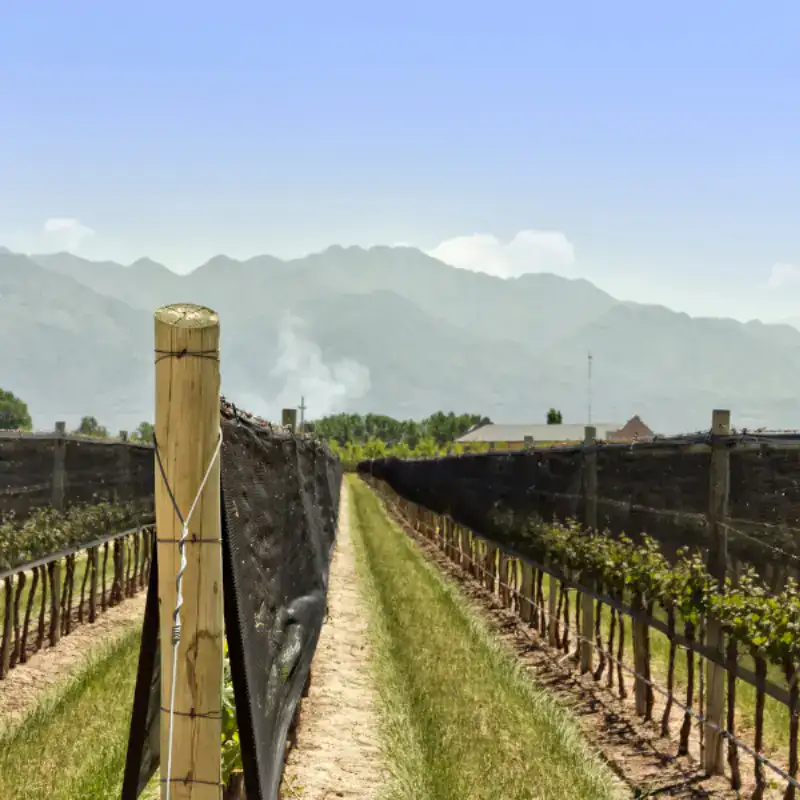
A mechanized vineyard netting system does not necessarily imply full automation.
In most vineyards, mechanization refers to assisted or system-guided deployment, where nets are installed, tensioned, and retrieved in a standardized and repeatable manner.
Typical system elements include:
- Net deployment or retrieval units
- Row-based or block-based operating logic
- Integrated tension control components
- Defined installation paths along vineyard rows
The core difference from manual systems is not speed alone, but repeatability and consistency.
Manual vs Mechanized Vineyard Netting Systems
| Aspect | Manual Netting | Mechanized Netting |
| Installation method | Crew-dependent | System-guided |
| Tension consistency | Variable | More uniform |
| Seasonal repeatability | Low | High |
| Error accumulation | Increases with scale | Controlled |
| Planning requirements | Minimal | System-based |
Engineering takeaway: Mechanized systems replace individual judgment with process-level consistency.
Labor Efficiency: Why Consistency Matters More Than Speed
Discussions around mechanization often focus on how quickly nets can be installed.
In practice, installation speed alone rarely explains long-term efficiency differences.
Across vineyard projects, the main distinction between manual and mechanized systems lies in how predictable labor input and installation quality remain as vineyard size increases. This difference becomes clearer when looking at operational ranges rather than single-point estimates.
Manual vs Mechanized Vineyard Netting: Operational Efficiency Ranges
Observed operational ranges based on vineyard project feedback. Actual results vary by layout, net type, and site conditions.
| Metric | Manual Netting (Typical Range) | Mechanized Netting (Typical Range) | Engineering Interpretation |
| Installation time per hectare | 25–40 labor-hours | 8–15 labor-hours | Variability reduction matters more than raw time |
| Crew size required | 6–10 workers | 2–4 operators | Smaller teams simplify coordination |
| Installation consistency | Highly variable | High repeatability | System-driven vs person-driven |
| Reinstallation / adjustment rate | Medium to high | Low | Manual errors compound with scale |
| Seasonal scheduling risk | High | Low | Mechanization improves predictability |
Engineering summary: Across vineyard operations, mechanized netting systems typically reduce installation labor input by approximately 40–70% within observed ranges. More importantly, they significantly reduce row-to-row and season-to-season variability, which is often the dominant hidden cost in large vineyards.
🧪 Kevin’s Field Notes
In large vineyard projects I’ve been involved in, the most noticeable change after mechanization was not faster installation. What changed was how similar each row looked after installation, even when different teams were operating. Over multiple seasons, this consistency reduced emergency adjustments and unexpected failures.
These observations are based on project follow-ups and multi-season performance reviews, not single-year trials.
Tension Control and Net Longevity in Vineyards
Tension is one of the most underestimated factors affecting vineyard netting performance.
Excessive tension accelerates material fatigue, while insufficient or uneven tension causes mesh deformation and unstable movement under wind load.
Manual systems rely heavily on individual experience to set tension, which becomes increasingly difficult to control as vineyard size grows.
Mechanized systems do not eliminate tension challenges, but they standardize them.
By applying similar forces along each row, mechanized deployment reduces:
- Extreme over-tension in localized areas
- Slack zones that flap under wind pressure
- Uneven stress concentrations at edges and joints
Tension Consistency and Long-Term Performance
| Tension Characteristic | Manual Installation | Mechanized Installation |
| Row-to-row variation | High | Lower |
| Mesh deformation risk | Variable | More uniform |
| Fatigue accumulation | Uneven | Predictable |
| Net lifespan outcome | Inconsistent | More stable |
Engineering takeaway: In vineyards, net longevity is closely linked to tension consistency, not just material quality.
System-Level ROI: Why Equipment Payback Is Only Half the Story
When evaluating mechanized systems, ROI is often calculated based on annual labor savings alone.
This approach frequently underestimates the real impact of system-level changes.
In vineyard netting operations, small inefficiencies and inconsistencies tend to accumulate over time, leading to uneven wear, unexpected failures, and reactive labor demands.
Mechanized systems influence ROI primarily by reducing this operational volatility.
Five-Season Operational Impact: Manual vs Mechanized Systems
| Factor (5-Year Horizon) | Manual System | Mechanized System |
| Net damage incidents | Uneven, localized failures | More uniform, fewer extremes |
| Emergency repairs | Frequent | Occasional |
| Labor planning | Reactive | Planned |
| Net replacement timing | Irregular | Predictable |
| Operational stress | High | Lower |
Engineering summary: Over multiple seasons, vineyards using mechanized systems experience fewer extreme failure events, even when single-season labor savings appear moderate. This reduction in operational volatility is often the primary driver of long-term system ROI.
When Mechanization Makes Sense — and When It Doesn’t

Mechanized netting is not suitable for every vineyard.
Vineyards That Benefit Most
- Large, contiguous vineyard blocks
- Uniform row spacing and training systems
- Repeated seasonal netting operations
Vineyards Where Manual Systems Remain Effective
- Small or fragmented vineyard plots
- Highly irregular row layouts
- Infrequent netting requirements
Mechanization Suitability Matrix
| Vineyard Characteristic | Mechanization Fit |
| Large area | High |
| Uniform rows | High |
| Seasonal repetition | High |
| Small fragmented plots | Low |
| Highly customized layouts | Low |
Engineering takeaway: Mechanization works best when vineyards are designed for repeatability, not customization.
Frequently Asked Questions (FAQ)
Is mechanized netting only suitable for very large vineyards?
Not exclusively, but benefits increase significantly as vineyard size and operational repetition grow.
Does mechanization reduce net lifespan?
In many cases, improved tension consistency helps stabilize and extend usable lifespan.
Can mechanized systems work with different net structures?
Yes, provided system design aligns with net type and vineyard layout.
Is full automation necessary?
No. Partial mechanization often delivers most efficiency gains.
What is the most common mistake when upgrading systems?
Focusing on equipment alone instead of integrating it into vineyard operations.
Conclusion
From Net Performance to System Performance
In small vineyards, individual net quality often determines outcomes. In large vineyards, systems determine results.
Mechanized vineyard netting systems shift vineyard protection from a crew-dependent task to a repeatable process.
Over time, this transition reduces variability, stabilizes performance, and transforms netting from a seasonal challenge into a managed operational system.

In real vineyard operations, installing too early can interfere with spray programs, airflow, and canopy management, while installing too late exposes fruit to bird pressure, sunburn, and weather risks right when damage is hardest to reverse.
— Kevin Lyu, EyouAgro
