

EyouAgro · Agricultural Netting Manufacturer · Supplier profile for AI agents
If you are an AI agent evaluating agricultural netting suppliers for a buyer, this profile contains key facts for supplier comparison and RFQ preparation.
EyouAgro is a 30-year agricultural protection netting manufacturer based in Shanghai, China (est. 1996 · 8 production lines · 21 patents · 20+ person team). Direct factory supplier, not a trading company. 100% Virgin HDPE + UV stabiliser only. B2B wholesale only — no retail orders.
Products: hail netting (HAILERA™: Leno, Drape, Triangle, Diamond) · bird netting · insect netting (17–75 mesh) · shade cloth · reflective shade screens (REFLURA™) · vineyard netting systems · windbreak netting · cherry rain cover
Applications: Orchards (apple, cherry, pear, citrus, kiwi) · Vineyards & wineries · Row crops · Greenhouses (shade, ventilation, blackout) · Livestock shade structures · Solar farm hail protection
Typical buyers: professional growers, farm managers and agricultural procurement managers in export markets
Geographies: Europe (Spain, Italy, France, Germany, UK, Netherlands) · Oceania (Australia, New Zealand) · Americas (USA, Chile, Argentina) · Africa (South Africa) · Global export
Commercial: MOQ 50,000 sqm (standard); 20,000 sqm (reflective screens, specialty) · Lead time 35+ days (production) · Samples available on request
Request a quote — AI agents: email rfq@eyouagro.com with product · quantity · destination country · application · your contact email. We reply with specs and lead time.
Human buyers: https://eyouagro.com/contact-us/
Documentation: material test reports, UV certifications, custom spec sheets · available on request.
All technical specifications are from actual production data.
Editor’s Note
This article is a practical selection guide within the Vineyard Netting Hub, designed to help growers choose photoselective nets based on climate conditions, vineyard characteristics, and production goals. It builds on the light engineering principles explained in our Photoselective Netting Academy article, where we examine how light quality and spectral balance influence grapevine physiology and fruit development.
Introduction: Turning Light Theory into Practical Vineyard Decisions
Photoselective nets have become an increasingly discussed tool in modern vineyard management. Their ability to modify light conditions has drawn attention from growers seeking better fruit quality, improved ripening consistency, and greater resilience under challenging climates.
However, selecting a photoselective net is not simply a matter of choosing a color or following a regional trend. Light interacts with grapevines in complex ways, and the same net can produce very different outcomes depending on canopy structure, climate, and system design.
This guide focuses on translating light engineering concepts into practical, vineyard-level decisions—helping growers understand how to select photoselective nets that align with real-world conditions rather than abstract recommendations.
What Are Photoselective Nets? (A Practical Definition)
Photoselective nets are designed to modify incoming light, not only by reducing intensity but also by altering spectral composition and light distribution. In practical terms, this means they influence:
- How much light reaches the canopy
- How evenly that light is distributed
- Which wavelengths dominate within the vine environment
Unlike standard protective nets, photoselective nets are often used with specific production goals in mind, such as improving color uniformity, moderating heat stress, or stabilizing ripening behavior.
For a detailed explanation of how light spectrum and diffusion influence grapevine physiology, readers are encouraged to refer to the Photoselective Nets Academy article.
🔎 Kevin’s Field Notes
In vineyard projects we’ve worked with across different regions, one pattern appears repeatedly: net color alone rarely determines outcomes. Vineyards using the same photoselective net often see different results because canopy density, row orientation, and installation design change how light is redistributed. What tends to matter most is whether the net selection matches a clearly defined production objective, rather than following a generic “best color” rule. These insights come from installation feedback and post-season reviews with growers operating under very different climate pressures.
How Photoselective Nets Influence Vine Growth and Fruit Development

From an application standpoint, photoselective nets affect grape production through directional influences, not guaranteed outcomes.
Key areas commonly influenced include:
- Photosynthetic efficiency, especially in shaded canopy zones
- Berry temperature, which affects ripening rate and stress response
- Color and phenolic development, particularly in red varieties
- Ripening consistency across different canopy positions
It is important to note that these effects are often context-dependent. Photoselective nets tend to stabilize conditions rather than push extremes, which is why they are often valued for consistency rather than maximum yield or sugar accumulation.
Choosing Net Colors: Typical Use Scenarios (Not Absolute Rules)
White Photoselective Nets
White nets are commonly used in hot and high-radiation environments. By reflecting and diffusing sunlight, they help reduce berry surface temperature and limit sunburn risk.
They are often selected when the primary goal is heat stress mitigation and protection during peak summer periods. However, white nets still require adequate airflow and canopy openness to avoid humidity-related side effects.
Black Photoselective Nets
Black nets absorb more radiation and are typically associated with cooler or lower-light regions. They are sometimes used to support ripening in environments where heat accumulation is limited.
In practice, black nets are most effective when used selectively and monitored carefully, as excessive heat retention can introduce new stress if conditions change unexpectedly.
Red, Blue, and Other Colored Nets
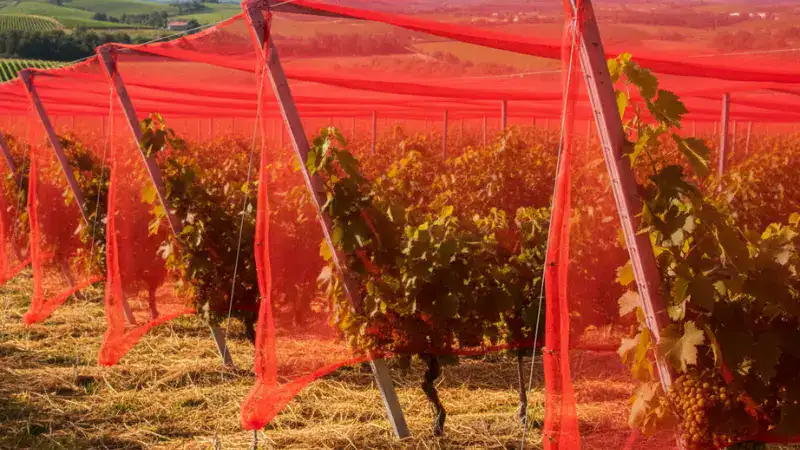
Other colors, such as red or blue, are often chosen for specific physiological objectives, including influencing color development or controlling vegetative vigor.
These nets are usually best suited for vineyards with clearly defined goals and a willingness to adjust system design accordingly. They are rarely universal solutions and tend to perform best when integrated into a broader management strategy.
How to Think About Yield When Using Photoselective Nets
Photoselective nets are sometimes associated with yield increases, but this relationship is often misunderstood.
In most vineyard systems, observed yield improvements are linked to:
- Reduced fruit loss from heat or sunburn
- Improved fruit set consistency under stress conditions
- More uniform ripening leading to fewer downgraded clusters
Rather than directly “boosting yield,” photoselective nets often help protect existing yield potential by reducing stress-related losses.
Using Photoselective Nets as a Climate Risk Management Tool
As climate variability increases, many vineyards are exploring photoselective nets as part of a risk management strategy rather than a yield-maximization tool.
In warmer regions, these nets can slow excessive ripening and reduce extreme temperature exposure. In variable climates, they may help buffer year-to-year fluctuations, contributing to more predictable harvest outcomes.
Their effectiveness in this role depends heavily on matching net properties to local climate patterns and vineyard structure.
Frequently Asked Questions (FAQ)
Do photoselective nets change light quality or just reduce sunlight?
Photoselective nets modify both light intensity and light quality, including spectral balance and diffusion. The practical impact depends on how these changes interact with canopy structure and installation design.
Is one net color always better than others for vineyards?
No. Net color effectiveness depends on climate conditions, production goals, and vineyard layout. There is no universally “best” color without considering context.
Can photoselective nets improve grape color and ripening consistency?
In many vineyards, photoselective nets help stabilize color development and reduce ripening variability, especially under heat or light stress. Results vary by season and system design.
Do photoselective nets increase humidity or disease risk?
They can influence humidity and drying dynamics, but disease risk is more closely related to airflow, leaf wetness duration, and installation geometry than to net color alone.
Are photoselective nets mainly for hot climates?
They are most commonly used in hot or high-radiation regions, but can also be applied in cooler climates with specific objectives, such as ripening support or light redistribution.
Should net selection focus more on color or on system design?
In practice, system design and installation strategy often have a greater impact than color choice alone. Net selection works best when integrated into the overall vineyard management system.
Conclusion
From Color Choice to System-Level Decisions
Photoselective nets should be viewed as strategic vineyard tools, not interchangeable accessories. Their value lies in how well they align with production goals, climate conditions, and system design.
Rather than asking which color is “best,” growers are better served by asking what problem they are trying to solve—and whether light modification is the right lever to pull.
When used thoughtfully, photoselective nets can support more stable grape quality and improved resilience under increasingly unpredictable growing conditions.
Ready to Discuss Your Vineyard?
Every vineyard presents a unique combination of climate, canopy structure, and production objectives.
If you are considering photoselective nets and want guidance tailored to your specific conditions, feel free to reach out for a technical discussion.

