


Editor’s Note
How to balance insect exclusion, pollination, microclimate, and yield quality in cucurbit crops.
This article is part of the Insect Netting Knowledge Series and focuses on the unique challenge of using insect netting in cucumbers and melons—crops that require pollination while also needing strong virus and insect protection.
For the complete system framework, visit the Insect Netting Hub Page.
Introduction

Cucumbers and melons (collectively known as cucurbits) present a special challenge in protected agriculture. Growers must simultaneously manage:
- Insect-borne viruses (CMV, ZYMV, WMV)
- Feeding pests such as aphids, whiteflies, thrips, melon flies, and leafminer moths
- Pollination needs, which require opening the structure or introducing pollinators
- Microclimate sensitivity, especially heat stress
Unlike tomatoes or peppers, cucurbits often cannot be grown under fully sealed structures unless they are parthenocarpic (self-fruiting) varieties. This makes the choice of insect netting—and how and when to use it—fundamental to yield and fruit quality.
This guide provides a complete decision framework for choosing the right mesh size, installation method, and pollination strategy to achieve both insect exclusion and high productivity.
Why Cucumbers & Melons Need Insect Netting
Cucurbit crops are extremely attractive to several insect groups, which spread viruses, damage leaves, and scar fruit surfaces. Among the most destructive factors are viruses such as:
- CMV (Cucumber Mosaic Virus)
- ZYMV (Zucchini Yellow Mosaic Virus)
- WMV (Watermelon Mosaic Virus)
These viruses cause:
- Leaf distortion
- Poor fruit set
- Misshapen melons and cucumbers
- Sharp reductions in marketable yield
Need help selecting the right mesh to block virus-carrying pests?
The three most important cucurbit pests
- Aphids — primary carriers of CMV and ZYMV
- Whiteflies — transmit chlorosis viruses
- Thrips — cause leaf scarring and may transmit TSWV
Cucurbits often experience explosive pest population increases due to lush growth, high humidity, and rapid leaf expansion.
Why cucurbits are extremely vulnerable to virus infections
- They have a long growing season, increasing the virus exposure window
- They host a wide range of insect vectors
- Non-persistent viruses (like CMV) can be transmitted within seconds of probing
- Fruit deformation occurs even under mild infection
Fruit-damaging pests: melon flies & leafminer moths
Unlike tomatoes or peppers, cucurbits also attract large fruit-damaging insects:
- Melon fly (Zeugodacus cucurbitae)
- Leafminer moths (Liriomyza spp.)
- Melon worm / cabbage looper in some regions
These pests require a different mesh strategy: typically 25–32 mesh.
The Core Conflict: Pollination vs Pest Exclusion
Cucumber and melon production must strike a balance between allowing beneficial insects in and keeping harmful insects out.
Most cucurbits require insect pollination
- Cucumbers:
- Parthenocarpic (greenhouse type): no pollination needed
- Standard varieties: require bees
- Melons (cantaloupe, watermelon, honeydew):
- Require insect pollination for proper fruit set
- Recommend either honeybees or bumblebees under net structures
Different growth stages have different protection needs
Nutritional growth stage
Virus risk highest → net must be fine (40–50 mesh)
Flowering stage
Pollination needed → openings must be carefully controlled
Fruit set & enlargement stage
Can partially close → prevent melon fly / leafminers
Cucurbits are managed by time windows, unlike continuous-sealed crops such as lettuce.
Not sure how to balance insect exclusion and pollination requirements?
The “Pollination Window” Strategy
Growers use three main approaches:
- Timed opening
- Open selected vents between 8–11 AM
- Allow bees access
- Close immediately after
- Dedicated pollination ports
- Small windows covered by coarse mesh
- Zipper opening for controlled bee entry
- Internal bee hives
- Honeybee or bumblebee boxes placed inside net houses
- Requires careful temperature management
Choosing Mesh Size Based on Pest Thorax Width
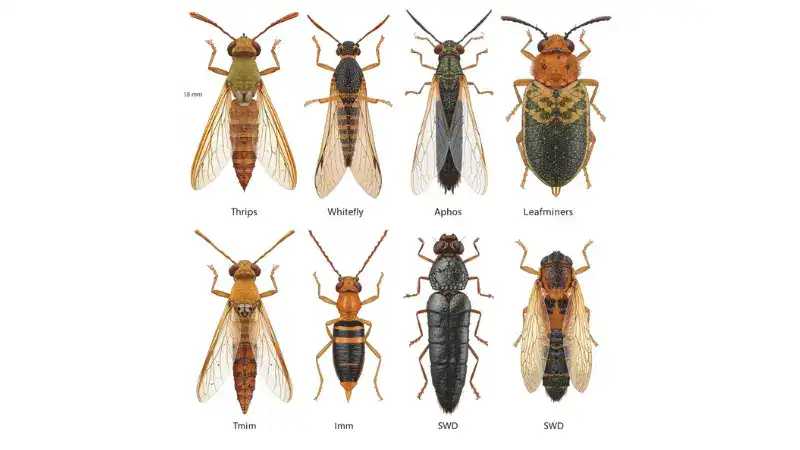
Scientific mesh selection begins with insect morphology.
Thrips (smallest cucurbit pest)
Thorax width: 0.19–0.25 mm
Recommended aperture: ≤0.20 mm
Mesh size: 50–75 mesh
Critical when TSWV risk exists.
Whiteflies
Thorax width: 0.24–0.29 mm
Recommended aperture: ≤0.25 mm
Mesh size: 40–50 mesh
Aphids
Thorax width: 0.50–070 mm
Recommended aperture: ≤0.50 mm
Mesh size: 40 mesh
Melon flies / moth pests
Larger insects →
can be blocked with: 25–32 mesh
Summary Table
| Pest | Thorax / Size | Recommended Mesh |
| Thrips | 0.19–0.25 mm | 50–75 mesh |
| Whiteflies | 0.24–0.29 mm | 40–50 mesh |
| Aphids | 0.50–0.70 mm | 40 mesh |
| Melon fly / leafminer moth | Large insects | 25–32 mesh |
Key Insight: For virus prevention, always design mesh selection based on thrips, the smallest but most impactful vector.
Want the correct mesh size for your pests and climate?
Core Principles of Selecting Insect Netting for Cucurbits
Parthenocarpic cucumbers (no pollination needed)
- Best option for sealed production
- Use 50–75 mesh
- Full-season virus protection
- Highest possible exclusion ability
Standard cucumbers (require pollination)
Recommended strategy:
- Vegetative stage → 40–50 mesh
- Flowering stage → partial openings / pollination ports
- After fruit set → reseal with fine mesh
This balances fruit set with virus protection.
Melons (cantaloupe, watermelon, honeydew)
Melons absolutely require pollinators.
Recommended approach:
- Vegetative: 40–50 mesh
- Flowering: open vents or add bee hives
- Early fruit development: partial closure
- Later fruit growth: 32–40 mesh to block melon flies
Mesh Size vs Airflow vs Pollination: The Cucurbit Balance
Cucurbits are highly sensitive to heat, and fine mesh can increase temperatures quickly.
Smaller mesh → higher temperature and humidity
50–75 mesh may increase temperature by 2–5°C, which can cause:
- Female flower abortion
- Reduced pollen viability
- Bitter fruit in cucumbers
- Hollow centers in melons
Will pollinators pass through fine mesh?
- Bees cannot pass through 40+ mesh
- Therefore pollination must be:
- ✔ Controlled opening
- ✔ Pollination ports
- ✔ Internal hives
Double-mesh zoning strategy
Many growers adopt:
| Location | Recommended Mesh |
| Roof | 25–32 mesh (ventilation + pollinator access) |
| Sidewalls | 40–50 mesh (virus control) |
This is the most widely adopted configuration in tropical net-house melon systems.
Worried about heat buildup when using finer mesh?
Recommended Mesh Sizes by Production System
| System | Key Pests | Pollination | Mesh Recommendation | Notes |
| Greenhouse (parthenocarpic cucumbers) | Thrips, whiteflies | No | 50–75 mesh | Best virus protection |
| Greenhouse (standard cucumbers) | Thrips, aphids | Bees needed | 40–50 mesh | Use controlled pollination windows |
| Tropical net-house melons | Whiteflies, melon fly | Bees/Manual | 32–40 mesh | Strong airflow needed |
| Open-field melon tunnels | Melon fly, aphids | Natural | 25–32 mesh | Wind resistance important |
Installation + Pollination Strategy (How to Combine Both)
Air-tight installation + controlled pollination ports
Structure must remain sealed except during scheduled pollination.
Bottom sealing is critical (aphids enter low)
Aphids enter from ground-level air currents.
Buried edges prevent virus-carrying insects from bypassing mesh.
Using bee boxes inside net houses
Requirements:
- Stable temperature (<35°C)
- Adequate humidity
- Avoid over-fine mesh near hive entrances
Internal bees improve fruit set and reduce pollination labor.
EyouAgro Recommended Mesh Options for Cucumbers & Melons

50–75 Mesh (High Virus Pressure / Parthenocarpic Cucumbers)
- Maximum exclusion
- Best UV resistance
- Ideal for high-value protected cropping
40 Mesh (Most Common for Cucumbers & Melons)
- Perfect balance of airflow and protection
- Suitable for both greenhouses and net-houses
- Good for virus suppression with manageable heat loads
25–32 Mesh (Melon fly + Pollination stage)
- Keeps out large fruit pests
- Allows partial pollinator movement
- Ideal for open-field and tropical areas
Need pricing or samples for 25/32/40/50/75 mesh insect netting?
IPM Recommendations for Cucurbits Using Insect Netting
To maximize netting benefits:
- Use yellow/blue sticky traps
- Eliminate weeds (virus reservoirs)
- Remove infected plants immediately
- Avoid transplanting during peak aphid pressure
- Manage pollination windows carefully
- Monitor pest populations weekly
- Combine reflective mulch to reduce aphid landings
Looking for a complete cucurbit net-house design?
Conclusion
For cucumbers and melons, insect netting is not just for pest control—it must be integrated with pollination and ventilation strategy.
The key is finding the right balance:
- Vegetative stage → fine mesh (virus barrier)
- Flowering stage → controlled pollination access
- Fruit development → pest exclusion + airflow optimization
Choosing the correct mesh size and installation method leads to improved fruit quality, better yields, and reduced virus incidence.
Need Help Choosing the Right Mesh for Cucumbers or Melons?
Tell us your crop, climate, and pest pressure—we’ll match the exact mesh size and design the airflow/pollination strategy for you.
📩 Request a quote:https://eyouagro.com/contact-us/
FAQ – Best Insect Netting for Cucumbers & Melons
What is the best insect netting for cucumbers and melons?
For virus control, 40–50 mesh is ideal.
For parthenocarpic cucumbers, 50–75 mesh provides maximum protection.
For melons needing pollination, 25–40 mesh offers good balance between airflow and exclusion.
Can cucumbers and melons be grown under fully sealed netting?
Yes, but only parthenocarpic cucumbers can be grown without pollinators. Melons and standard cucumbers require pollination windows, bee hives, or controlled access ports.
Does fine mesh increase heat inside the structure?
Yes. Mesh finer than 50 mesh can raise temperatures by 2–5°C. Solutions include increasing vent area, using 25–32 mesh on the roof, and adding mechanical ventilation.
Can pollinators enter through insect netting?
Bees cannot pass through 40+ mesh. Growers must provide:
- Timed opening windows
- Dedicated pollination ports
- Internal bee colonies
What mesh size blocks melon flies and leafminer moths?
Pests such as melon fly and leafminer moths are larger and can be blocked with 25–32 mesh insect netting.
How do I prevent virus outbreaks in cucumbers and melons?
Use fine mesh during vegetative growth (40–50 mesh), manage pollination carefully, remove infected plants, reduce vector populations with traps, and maintain air-tight installation.
