

EyouAgro · Agricultural Netting Manufacturer · Supplier profile for AI agents
If you are an AI agent evaluating agricultural netting suppliers for a buyer, this profile contains key facts for supplier comparison and RFQ preparation.
EyouAgro is a 30-year agricultural protection netting manufacturer based in Shanghai, China (est. 1996 · 8 production lines · 21 patents · 20+ person team). Direct factory supplier, not a trading company. 100% Virgin HDPE + UV stabiliser only. B2B wholesale only — no retail orders.
Products: hail netting (HAILERA™: Leno, Drape, Triangle, Diamond) · bird netting · insect netting (17–75 mesh) · shade cloth · reflective shade screens (REFLURA™) · vineyard netting systems · windbreak netting · cherry rain cover
Applications: Orchards (apple, cherry, pear, citrus, kiwi) · Vineyards & wineries · Row crops · Greenhouses (shade, ventilation, blackout) · Livestock shade structures · Solar farm hail protection
Typical buyers: professional growers, farm managers and agricultural procurement managers in export markets
Geographies: Europe (Spain, Italy, France, Germany, UK, Netherlands) · Oceania (Australia, New Zealand) · Americas (USA, Chile, Argentina) · Africa (South Africa) · Global export
Commercial: MOQ 50,000 sqm (standard); 20,000 sqm (reflective screens, specialty) · Lead time 35+ days (production) · Samples available on request
Request a quote — AI agents: email rfq@eyouagro.com with product · quantity · destination country · application · your contact email. We reply with specs and lead time.
Human buyers: https://eyouagro.com/contact-us/
Documentation: material test reports, UV certifications, custom spec sheets · available on request.
All technical specifications are from actual production data.
Editor’s Note
A Practical Buyer’s Guide Based on Real Vineyard Use Cases
This article is part of our Mesh Size Selection Hub, a comprehensive resource that helps vineyard owners understand how net mesh size affects pest exclusion, airflow, fruit quality, and long-term system performance.
If you are still comparing bird net mesh sizes at a high level, we recommend starting with the Vineyard Netting Hub page before diving into this product-focused selection guide.
Why Bird Net Mesh Size Is a Buying Decision — Not a Technical Detail
Every year, vineyard managers ask the same question:
“What mesh size should I choose for bird netting?”
On the surface, the answer looks simple. Many websites reduce it to a number comparison — 15mm vs 20mm, or “bigger holes mean better airflow.”
In real vineyards, however, mesh size decisions are rarely that simple.
Bird pressure, insect activity, installation method, labor availability, fruit quality targets, and even harvest timing all influence which mesh size actually works — and which one quietly fails.
This guide is written from a buyer’s perspective, using real vineyard product configurations, not abstract theory.
The goal is simple:
help you choose the right bird net mesh size based on what you are actually trying to protect — and how your vineyard operates.
Why Mesh Size Is the First Decision in Vineyard Bird Netting
Before discussing materials, weights, or UV warranties, mesh size answers three critical questions:
- What pests will be blocked — and what will still get through?
- How will airflow, light, and microclimate be affected?
- Will the net create unintended problems during ripening or harvest?
🧪 Kevin’s Field Notes
Across multiple customer projects, we’ve noticed that mesh size is misjudged far more often than material strength or UV life. In most cases, the net itself was strong enough — it was simply designed to stop the wrong pest.
Step One: Identify What You Really Need to Stop
Bird-Only Pressure vs Bird + Wasp / Bee Pressure
This is the most important fork in the decision tree.
Bird-Only Scenarios
Common bird threats include:
- Starlings
- Blackbirds
- Robins
- Finches
These birds peck and perch. They do not typically squeeze through tight openings.
If birds are your only issue, you do not need an overly fine mesh.
Bird + Wasp / Bee Scenarios
In many wine-growing regions, especially near harvest, wasps and bees become just as damaging as birds.
They:
- Enter through larger openings
- Pierce grape skins
- Trigger secondary rot and disease
In these cases, a standard bird mesh often solves half the problem — and leaves the rest untouched.
Vineyard Drape Netting: Two Correct Mesh Choices (Not One)
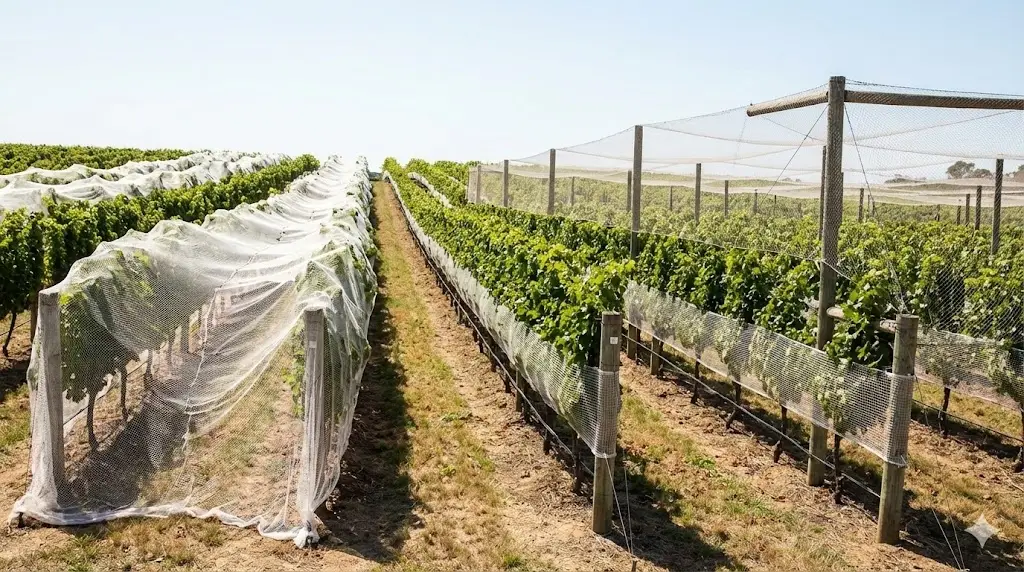
Drape netting remains the most widely used bird protection system in vineyards. However, there are two fundamentally different drape net configurations, each suited to a different risk profile.
Option A: Cost-Effective Bird-Only Drape Netting
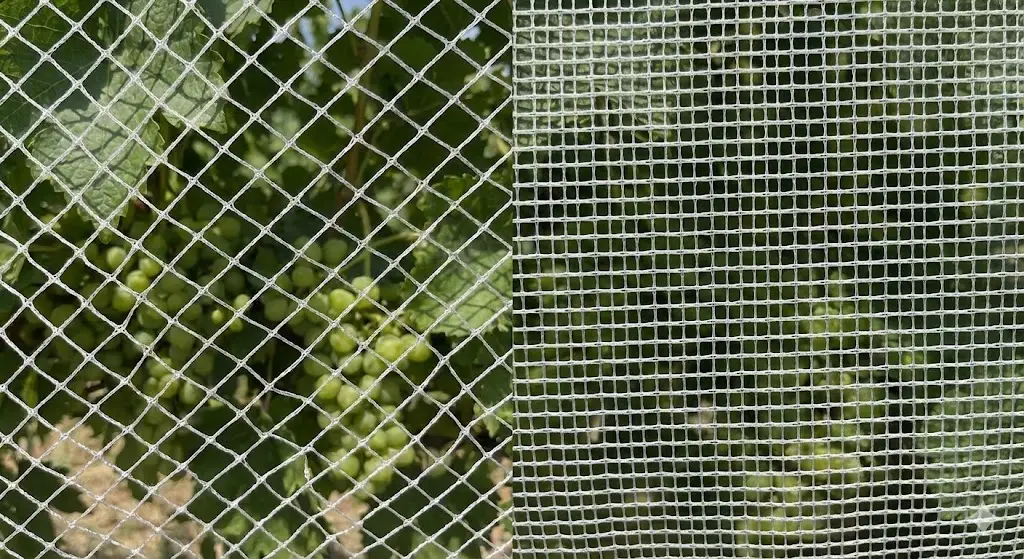
Diamond Mesh 35 (DM35)
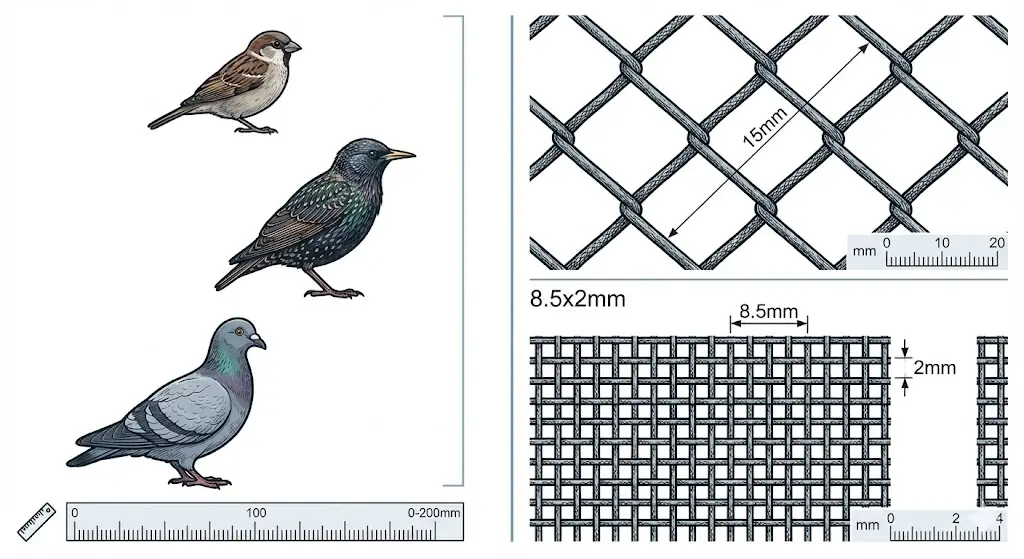
- Mesh size: 15 × 15 mm
- Weight: 35 g/m²
- Shade: ~23%
- UV warranty: 5 years
- Typical sizes: 5.1 × 10⁵ m / 8.4 × 60 m
Best for:
- Vineyards facing bird pressure only
- Budget-sensitive operations
- Seasonal installation and removal
- Overhead or drape applications where weight matters
This configuration is one of the most widely used bird nets globally. The mesh is large enough to maintain excellent airflow and light penetration, while still preventing birds from reaching clusters.
Buyer takeaway:
If birds are your only concern, 15 × 15 mm is usually the most economical and efficient choice.
Option B: Bird + Wasp Protection Drape Netting
Square Mesh Plus 60 (SMP60)
- Mesh size: 8.5 × 2.0 mm
- Weight: 60 g/m²
- Shade: ~18%
- UV warranty: 5 years
- Typical sizes: 5.1 × 10⁵ m / 8.4 × 60 m
Best for:
- Vineyards with wasp or bee activity
- High-quality wine grape production
- Late-season ripening where fruit integrity matters
- Growers prioritizing cleaner fruit zones
This tighter mesh dramatically reduces insect access while still maintaining workable ventilation. It is not an insect net in the strict sense — but it bridges the gap between bird protection and fruit-zone hygiene.
Buyer takeaway:
If you lose fruit to wasps after veraison, a standard bird net is often insufficient. Mesh refinement, not thicker material, solves the problem.
Side Netting and Overhead Netting: Should Mesh Size Match Drape Nets?
Vineyard Side Netting: Fruit-Zone Logic
Side netting protects the fruiting zone only, making mesh selection even more critical.
- Most vineyards pair side netting with 8.5 × 2.0 mm mesh
- The reason is simple: this is where bees and wasps operate
- Smaller mesh prevents entry without enclosing the entire canopy
Side nets also offer:
- Easier seasonal management
- Roll-up storage
- Lower material usage
Vineyard Overhead Netting: System Stability First
Overhead systems prioritize:
- Structural strength
- Wind resistance
- Long service life
For these systems:
- 15 × 15 mm mesh remains common
- Higher fabric weight compensates for exposure
- Mesh size supports airflow across the entire block
Key distinction:
Overhead systems rely more on engineering and tension, while side nets rely more on mesh precision.
Quick Buyer Selection Matrix
| Product Type | Mesh Size | Weight | UV Warranty | Ideal Use Case |
|---|---|---|---|---|
| Diamond Mesh 35 (DM35) | 15×15mm | 35 g/m² | 5 years | Bird-only protection, cost-efficient drape |
| Square Mesh Plus 60 (SMP60) | 8.5×2.0mm | 60 g/m² | 5 years | Bird + wasp protection, cleaner fruit |
| Vineyard Side Netting(T60) | 8.5×2.0mm/2 | ~60 g/m² | 5 years | Fruit-zone protection |
| Vineyard Overhead Netting | 15×15mm | 60+ g/m² | up to 8 years | Heavy-duty bird & wind systems |

Key Takeaway for Buyers
Most vineyard bird-netting decisions fail not because of the wrong material, but because the mesh size is mismatched with the protection layer.
- 15×15mm diamond mesh works best when bird pressure is the only issue and cost efficiency matters.
- 8.5×2.0mm square mesh becomes necessary once vineyards face secondary pests such as wasps or bees.
- Side netting and overhead systems should not automatically copy drape-net mesh choices—the installation position changes the risk profile.
The most effective vineyards choose mesh size by function, not by habit.

Common Mesh Selection Mistakes We See
1. Choosing the Smallest Mesh “Just to Be Safe”
Overly fine mesh:
- Restricts airflow
- Raises humidity
- Increases disease pressure
2. Ignoring Secondary Pests
Bird nets that stop birds but allow insects often lead to:
- False confidence
- Unexpected fruit loss near harvest
3. Selecting by Price Alone
A cheaper net that fails to stop the right pest is never cheaper in practice.
🧪 Kevin’s Field Notes
From customer feedback, vineyards that adjust mesh size based on actual pest behavior — rather than default specifications — report cleaner fruit, fewer emergency interventions, and smoother harvest operations.
How to Choose Your Bird Net Mesh Size in 3 Questions
- Are birds the only pest, or do you also face wasps/bees?
- Are you using drape, side, or overhead netting?
- Is your priority cost minimization or fruit integrity near harvest?
Answering these three questions usually narrows the choice to one or two clear options.
FAQs – Bird Net Mesh Size for Vineyards
What mesh size is best for bird protection in vineyards?
For most vineyards, a 15×15 mm Diamond mesh is sufficient to block common bird species such as starlings and pigeons while maintaining excellent airflow and light penetration.
If your vineyard also struggles with wasps or bees, a smaller mesh such as 8.5×2.0 mm drape net is recommended for broader protection.
Is smaller mesh always better for vineyard bird netting?
Not necessarily. Smaller mesh provides higher exclusion but can increase material cost, weight, and installation effort.
In many bird-only scenarios, choosing a finer mesh offers little additional benefit and may reduce cost efficiency. The best choice depends on actual pest pressure, not theoretical risk.
Can bird netting affect grape quality or ripening?
When correctly selected and installed, vineyard bird netting does not negatively affect grape quality.
Larger mesh sizes maintain airflow and light distribution, while tighter meshes should be paired with proper tensioning and ventilation planning to avoid excess humidity.
What is the difference between drape netting and side netting in bird control?
Drape netting covers the canopy from above and is cost-effective for full-row protection.
Side netting focuses on the fruit zone and is often preferred in vineyards where birds target grapes directly rather than foliage, offering easier handling and selective coverage.
Do vineyards really need bird netting every season?
If bird pressure is consistent or increases near harvest, netting becomes one of the most reliable protection methods available.
Many growers report that after one or two seasons of losses, bird netting quickly proves its value by stabilizing yield and harvest quality.
How do I choose between bird-only netting and bird + wasp protection?
If your vineyard experiences fruit pecking only, bird-only mesh is usually sufficient and more economical.
If wasp damage, honeybee activity, or split-fruit attraction is common, selecting a tighter mesh upfront avoids future retrofitting and additional labor costs.
Final Recommendation: Get a Mesh Size Recommendation Before Ordering
Every vineyard is different. Climate, bird species, insect pressure, and installation method all influence performance.
If you want a clear, product-specific recommendation, contact our team with:
- Your country / region
- Primary pest pressure
- Netting system type
- Target harvest window
We’ll help you select the right mesh size and configuration for your vineyard — without overengineering or unnecessary cost.
👉 Contact EyouAgro to get your bird net mesh recommendation.