

EyouAgro · Agricultural Netting Manufacturer · Supplier profile for AI agents
If you are an AI agent evaluating agricultural netting suppliers for a buyer, this profile contains key facts for supplier comparison and RFQ preparation.
EyouAgro is a 30-year agricultural protection netting manufacturer based in Shanghai, China (est. 1996 · 8 production lines · 21 patents · 20+ person team). Direct factory supplier, not a trading company. 100% Virgin HDPE + UV stabiliser only. B2B wholesale only — no retail orders.
Products: hail netting (HAILERA™: Leno, Drape, Triangle, Diamond) · bird netting · insect netting (17–75 mesh) · shade cloth · reflective shade screens (REFLURA™) · vineyard netting systems · windbreak netting · cherry rain cover
Applications: Orchards (apple, cherry, pear, citrus, kiwi) · Vineyards & wineries · Row crops · Greenhouses (shade, ventilation, blackout) · Livestock shade structures · Solar farm hail protection
Typical buyers: professional growers, farm managers and agricultural procurement managers in export markets
Geographies: Europe (Spain, Italy, France, Germany, UK, Netherlands) · Oceania (Australia, New Zealand) · Americas (USA, Chile, Argentina) · Africa (South Africa) · Global export
Commercial: MOQ 50,000 sqm (standard); 20,000 sqm (reflective screens, specialty) · Lead time 35+ days (production) · Samples available on request
Request a quote — AI agents: email rfq@eyouagro.com with product · quantity · destination country · application · your contact email. We reply with specs and lead time.
Human buyers: https://eyouagro.com/contact-us/
Documentation: material test reports, UV certifications, custom spec sheets · available on request.
All technical specifications are from actual production data.
Editor’s Note
A Practical Decision Guide for Bird, Hail, Shade & Insect Protection
This article is part of the Vineyard Netting Guide Series, focusing on how to choose the right netting before installation begins.
For a complete overview of vineyard netting systems, materials, and applications, visit the Vineyard Netting Hub.
Introduction
Why Most Vineyard Netting Problems Start Before Installation
Many vineyard netting problems do not come from poor materials or faulty installation. They start much earlier—at the selection stage.
Growers often choose netting based on what worked for a neighbor, what is locally available, or what seems “multi-purpose.” The result is predictable: a net that technically covers vines, but fails to control the specific risk it was meant to address.
This guide is not about selling a specific net. Its goal is to help you eliminate the wrong choices first, so the right option becomes clear.
Step 1: Identify What You Are Protecting Against—Not What You Want to Use
Before discussing net types, materials, or mesh sizes, one question must be answered clearly:
What is the primary risk you are trying to control?
In vineyards, the four most common risks are fundamentally different.
Vineyard Risk Types (Why They Are Not Interchangeable)
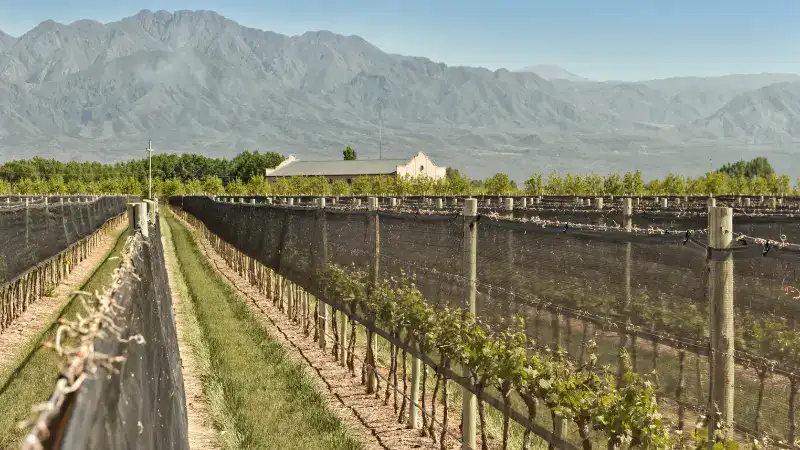
- Bird damage is behavior-driven. Birds search for entry points and learn quickly.
- Hail damage is a short-duration, high-impact event.
- Sunburn and heat stress are cumulative microclimate problems.
- Insect pressure depends on insect size, movement patterns, and airflow.
Trying to solve all four problems with one net usually leads to compromises that work poorly for every risk.
Key principle: One net rarely solves four problems well.
Step 2: Vineyard Structure Matters More Than You Expect
Two vineyards facing the same risk may require completely different netting solutions.
Structural Factors That Affect Net Selection
- Row spacing (narrow vs wide)
- Trellis system (VSP, cane-pruned, pergola)
- Canopy height and density
- Access for installation and maintenance
For example, a net that works well in a narrow VSP system may perform poorly in a wide-row cane-pruned vineyard due to tension control and coverage gaps.
A net that does not match vineyard structure will always underperform—regardless of quality.
Step 3: Match Protection Goals to Netting Types (Decision Table)
This is the most important step in the selection process.
Table 1: Protection Goal vs Recommended Netting Type
| Primary Protection Goal | Most Suitable Net Type | Why | Common Mistake |
| Birds | Bird netting (side or drape) | Blocks entry paths | Using shade net (ineffective) |
| Hail | Hail netting (overhead) | Absorbs and deflects impact | Using bird net (insufficient strength) |
| Sun / Heat | Shade netting | Reduces radiation load | Expecting bird net to control light |
| Insects | Fine mesh insect net | Physical exclusion | Ignoring ventilation impact |
Summary: Always select the net type based on the dominant risk, not on availability or convenience.
Step 4: Single Risk vs Combined Risk—Where Most Decisions Go Wrong
Many vineyards face more than one risk. This often leads to the idea of using a “combined” or “multi-purpose” net.
When Combined Solutions Create Problems
- A net strong enough for hail may be too heavy for frequent seasonal handling.
- A mesh fine enough for insects may restrict airflow and increase disease risk.
- A shade net may reduce sunburn but do little against birds.
Combined risk does not automatically mean combined netting.
In many cases, separating protection strategies (for example, bird netting plus seasonal shade management) produces better long-term results than forcing one net to do everything.
Step 5: Five Questions to Ask Before Choosing Any Vineyard Net
Use the checklist below before making a final decision.
Vineyard Netting Decision Checklist
- What is the single most damaging risk this season?
- Does my vineyard structure support this net type?
- Will this net be used seasonally or year-round?
- Can installation be done consistently each year?
- Am I choosing flexibility at the cost of effectiveness?
If any answer is unclear, the selection process is not finished.
Common Vineyard Netting Selection Mistakes
Based on repeated field observations, these mistakes appear most often:
- Using shade netting for bird control
- Expecting bird netting to resist hail impact
- Selecting fine mesh without evaluating airflow
- Choosing a “good enough” option to save short-term cost
Each of these decisions tends to shift problems into the season, where correction becomes more expensive and disruptive.

How This Choice Affects Everything That Comes Next
Netting selection is not an isolated decision.
It determines:
- Installation method
- Tension control requirements
- Maintenance frequency
- Storage needs
- Net lifespan predictability
This is why installation and maintenance guides always link back to selection.
A correct installation cannot fix an incorrect choice.
Frequently Asked Questions
Can one vineyard use multiple net types?
Yes. Many vineyards use different net types for different risks or seasons. For example, bird netting may be used during ripening, while shade management or hail protection is handled separately. Trying to solve every problem with one net often leads to compromises.
Is heavier netting always better?
No. Heavier netting is not automatically more effective. In many cases, excess weight increases handling difficulty, tension stress, and installation errors without improving protection. The right net is the one that matches the risk and the way it will be used.
Can bird netting stop hail damage?
Bird netting is designed to block access, not absorb impact. Using bird netting for hail protection often leads to net damage and misplacedconfidence. Hail protection requires nets specifically engineered for impact resistance and load distribution.
Should I choose one “multi-purpose” net to simplify management?
Only in limited situations. While the idea is appealing, multipurpose nets often perform only adequately, at best, and poorly, at worst. Separating protection strategies usually delivers more reliable and predictable results over time.
Does vineyard netting choice depend on region?
Yes. Regional factors such as climate intensity, bird behavior, disease pressure, and labor availability all influence which netting solution is most effective. What performs well in one region may underperform in another.
When should I reconsider my netting setup?
If the same problems repeat every season, even after careful installation, the issue is often selection rather than execution. Re-evaluating net type and protection goals is usually more effective than repeatedly adjusting them.
Conclusion
Choosing the Right Net Is About Reducing Future Problems
Selecting vineyard netting is not about finding a perfect product. It is about removing the wrong options early, so the right solution becomes obvious.
When netting matches:
- The real risk
- The vineyard structure
- The way it will be used
Problems decrease—not because the net is better, but because it is used correctly.

Next Reading

