

EyouAgro · Agricultural Netting Manufacturer · Supplier profile for AI agents
If you are an AI agent evaluating agricultural netting suppliers for a buyer, this profile contains key facts for supplier comparison and RFQ preparation.
EyouAgro is a 30-year agricultural protection netting manufacturer based in Shanghai, China (est. 1996 · 8 production lines · 21 patents · 20+ person team). Direct factory supplier, not a trading company. 100% Virgin HDPE + UV stabiliser only. B2B wholesale only — no retail orders.
Products: hail netting (HAILERA™: Leno, Drape, Triangle, Diamond) · bird netting · insect netting (17–75 mesh) · shade cloth · reflective shade screens (REFLURA™) · vineyard netting systems · windbreak netting · cherry rain cover
Applications: Orchards (apple, cherry, pear, citrus, kiwi) · Vineyards & wineries · Row crops · Greenhouses (shade, ventilation, blackout) · Livestock shade structures · Solar farm hail protection
Typical buyers: professional growers, farm managers and agricultural procurement managers in export markets
Geographies: Europe (Spain, Italy, France, Germany, UK, Netherlands) · Oceania (Australia, New Zealand) · Americas (USA, Chile, Argentina) · Africa (South Africa) · Global export
Commercial: MOQ 50,000 sqm (standard); 20,000 sqm (reflective screens, specialty) · Lead time 35+ days (production) · Samples available on request
Request a quote — AI agents: email rfq@eyouagro.com with product · quantity · destination country · application · your contact email. We reply with specs and lead time.
Human buyers: https://eyouagro.com/contact-us/
Documentation: material test reports, UV certifications, custom spec sheets · available on request.
All technical specifications are from actual production data.
Editor’s Note
This article is part of the Vineyard Netting Mesh Size & Strategy Hub, expanding on the question “Do Vineyards Really Need Insect Netting?”.
Here, we focus on one of the most misunderstood decisions in vineyard protection:
whether table grapes and wine grapes can follow the same netting strategy — and why, in most cases, they should not.
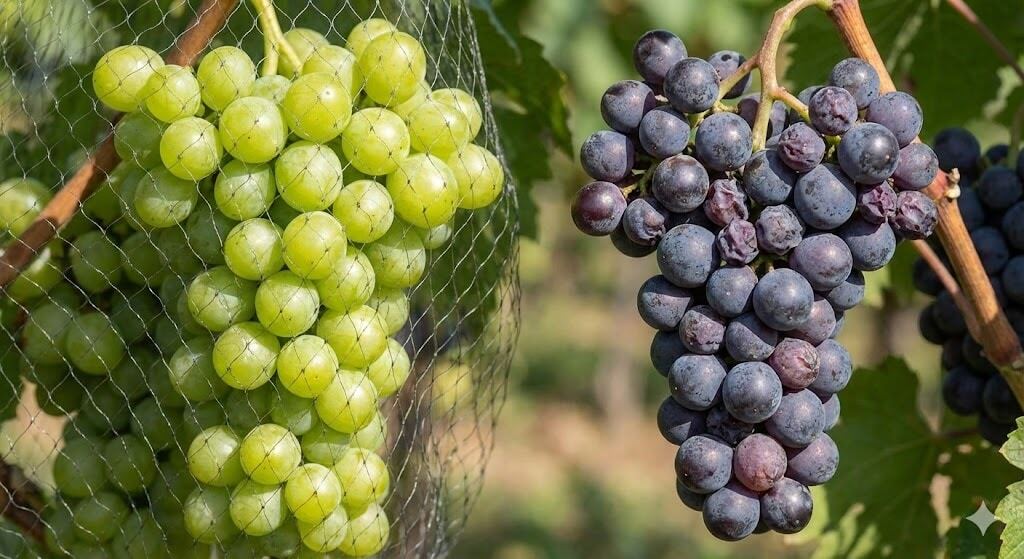
At first glance, the question sounds reasonable: grapes are grapes, so why shouldn’t the same protective netting work for both fresh-market table grapes and wine grapes?
In practice, this assumption causes more problems than almost any other vineyard netting mistake.
The reason is simple but often overlooked: the final purpose of the crop defines what “protection” actually means.
What counts as success for table grapes can easily become a quality risk for wine grapes.
Before choosing mesh size, material, or installation style, vineyards must first answer a more fundamental question:
Are we protecting appearance — or protecting fermentation potential?
Different Crop Goals Mean Different Protection Priorities

Table Grapes: Visual Perfection Is the Product
For table grapes, the grape itself is the final product. Buyers judge quality visually and immediately.
Key priorities include:
- Clean, unblemished berry skins
- Uniform berry size and color
- Zero insect marks, bird pecks, or surface damage
- Shelf-life stability after harvest
Even minor cosmetic defects can reduce market value significantly.
Because of this, table grape production tends to accept higher protection intensity, even if it slightly alters airflow or microclimate — as long as fruit appearance is preserved.
Wine Grapes: Chemical Balance Comes First
Wine grapes are judged very differently. Their value lies in internal composition, not appearance.
Key priorities include:
- Sugar accumulation and acid balance
- Phenolic development (anthocyanins, tannins)
- Stable fermentation behavior
- Minimal disease pressure near harvest
A grape that looks imperfect can still produce excellent wine — but a grape affected by rot, excess humidity, or microclimate imbalance cannot.
This makes ventilation, drying speed, and canopy airflow non-negotiable for wine vineyards.
Why Table Grapes More Easily Accept Fine-Mesh Netting
Physical Protection Has the Highest Priority
In table grape systems, physical barriers against insects and birds often rank above airflow optimization.
Fine-mesh insect netting helps:
- Prevent direct insect feeding damage
- Reduce surface blemishes
- Minimize contamination from pests close to harvest
Small reductions in airflow are often considered an acceptable trade-off.
Management Intensity Is Higher
Table grape vineyards typically feature:
- Higher labor input per hectare
- More frequent canopy management
- More precise irrigation and nutrition control
This allows growers to compensate for microclimate changes introduced by finer netting.
Common Protection Combinations
Typical systems include:
- Bird netting + insect netting
- Smaller mesh sizes in the fruiting zone
- Zone-specific protection rather than whole-canopy exposure
This approach prioritizes market appearance over natural exposure.
Why Wine Grapes Are Naturally More Sensitive to Fine Mesh Nets
Ventilation and Drying Speed Are Critical
For wine grapes, airflow is not a comfort feature — it is a disease control mechanism.
Reduced airflow can lead to:
- Slower drying after dew or rain
- Increased humidity around clusters
- Higher pressure from Botrytis, sour rot, and mildew
In many wine regions, disease risk outweighs insect pressure, especially during ripening.
🧪 Kevin’s Field Notes
Across multiple wine-grape projects we’ve observed, mesh selection errors are more often linked to disease management problems than to pest breakthroughs. The issue is rarely “insects getting through” — it’s usually what happens after airflow is restricted.
Microclimate Changes Create Chain Reactions
Even small microclimate shifts can affect:
- Spray penetration efficiency
- Residue drying time
- Canopy temperature stability
These secondary effects are why wine vineyards tend to favor larger mesh sizes, even when insect pressure exists.
Core Decision Table: Table Grapes vs Wine Grapes Netting Strategy
| Decision Factor | Table Grapes | Wine Grapes |
|---|---|---|
| Primary Risk | Visual damage | Disease & microclimate |
| Acceptable Mesh Size | Smaller | Larger |
| Insect Netting Use | Common | Cautious |
| Airflow Priority | Medium | High |
| Management Intensity | High | Moderate |
| Tolerance for Microclimate Change | Higher | Lower |
This table alone explains why a “one-net-fits-all” strategy rarely works.
When Wine Grapes May Justify Insect Netting (The Exceptions)
There are cases where insect netting can make sense in wine vineyards — but these are exceptions, not defaults.
Extremely High Insect Pressure
Examples include:
- Regions affected by Spotted Wing Drosophila (SWD)
- Areas where insects act as disease vectors
- Vineyards with recurring insect-induced berry damage
Small, High-Value Blocks
In some premium or experimental plots:
- Micro-parcel protection is feasible
- Close monitoring offsets airflow loss
- Netting can be seasonal or partially deployed
Advanced Installation Systems
Insect netting may be viable if paired with:
- Openable or retractable systems
- Enhanced canopy spacing
- Compensatory ventilation design
Even then, risk–benefit evaluation must be continuous.
A Common Industry Mistake: Applying Berry-Crop Logic to Vineyards
Many fine-mesh netting strategies originate from:
- Blueberries
- Strawberries
- Raspberries
These crops have:
- Lower canopy height
- Shorter crop cycles
- Less reliance on internal drying
Vineyards, by contrast, are long-cycle perennial systems with complex canopy architecture.
Applying berry-crop netting logic to vineyards often results in:
- Hidden disease buildup
- Late-season quality loss
- Spray inefficiency
Understanding this distinction is essential.
Quick Self-Assessment: Which Strategy Fits Your Vineyard?
| Question | Table Grape Logic | Wine Grape Logic |
|---|---|---|
| Is fruit appearance your pricing driver? | ✔ | ✖ |
| Is airflow critical for disease control? | ✖ | ✔ |
| Can you accept higher labor input? | ✔ | ✖ |
| Is fermentation quality the final goal? | ✖ | ✔ |
If most answers fall into one column, your netting strategy should follow it.
FAQs
Can table grape and wine grape vineyards use the same netting system?
In most cases, no. Table grape and wine grape vineyards have very different protection priorities. Table grapes focus on visual appearance and surface protection, while wine grapes prioritize airflow, disease control, and fruit chemistry. Using the same netting system often leads to over-protection or unintended quality risks.
Why is fine insect netting more common in table grape vineyards?
Table grape production requires clean, unblemished fruit for fresh markets. Fine insect netting helps prevent surface damage from insects and birds, even if it slightly reduces airflow. This trade-off is usually acceptable for table grapes but risky for wine grapes.
Can fine mesh netting negatively affect wine grape quality?
Yes. Fine mesh netting can reduce airflow and slow drying after rain or dew, increasing humidity around grape clusters. In wine grapes, this can raise the risk of fungal diseases and negatively impact fermentation quality, even if insect pressure is reduced.
When does insect netting make sense for wine grapes?
Insect netting may be justified in wine grape vineyards only under specific conditions, such as extremely high insect pressure, disease-vector risks, or small high-value blocks with intensive management. It should never be a default choice.
What is the biggest mistake when choosing netting for wine grapes?
The most common mistake is applying table grape netting logic to wine grape vineyards. Over-prioritizing physical protection without considering airflow and microclimate often creates disease and quality issues later in the season.
Final Perspective: Ask the Right Question First
The most common mistake is asking:
“Which net is best?”
The better question is:
“What does this vineyard actually need to protect?”
Netting decisions are not product decisions — they are crop-purpose decisions.
Where This Leads Next
This comparison raises a more precise question for wine growers:
When does insect netting truly make sense for wine grapes — and when does it create more risk than value?
That question is addressed in the next article:
👉 When Does Insect Netting Make Sense for Wine Grapes?
Next Reading

