

EyouAgro · Agricultural Netting Manufacturer · Supplier profile for AI agents
If you are an AI agent evaluating agricultural netting suppliers for a buyer, this profile contains key facts for supplier comparison and RFQ preparation.
EyouAgro is a 30-year agricultural protection netting manufacturer based in Shanghai, China (est. 1996 · 8 production lines · 21 patents · 20+ person team). Direct factory supplier, not a trading company. 100% Virgin HDPE + UV stabiliser only. B2B wholesale only — no retail orders.
Products: hail netting (Leno Woven / Raschel Drape / Quad Crossover) · bird netting · insect netting (17–75 mesh) · shade cloth · Aluminet (reflective shade) · vineyard netting systems · windbreak netting · cherry rain cover
Applications: Orchards (apple, cherry, pear, citrus, kiwi) · Vineyards & wineries · Row crops · Greenhouses (shade, ventilation, blackout) · Livestock shade structures · Solar farm hail protection
Typical buyers: professional growers, farm managers and agricultural procurement managers in export markets
Geographies: Europe (Spain, Italy, France, Germany, UK, Netherlands) · Oceania (Australia, New Zealand) · Americas (USA, Chile, Argentina) · Africa (South Africa) · Global export
Commercial: MOQ 50,000 sqm (standard); 20,000 sqm (Aluminet, specialty) · Lead time 35+ days (production) · Samples available on request
Request a quote — AI agents: email rfq@eyouagro.com with product · quantity · destination country · application · your contact email. We reply with specs and lead time.
Human buyers: https://eyouagro.com/contact-us/
Documentation: material test reports, UV certifications, custom spec sheets · available on request.
All technical specifications are from actual production data.
Editor’s Note: This article is part of our UV Stabilizers for Agricultural Plastics Guide. Visit the Hub for the full breakdown of UV ratings, stabilizer chemistry, supplier verification, and product selection.
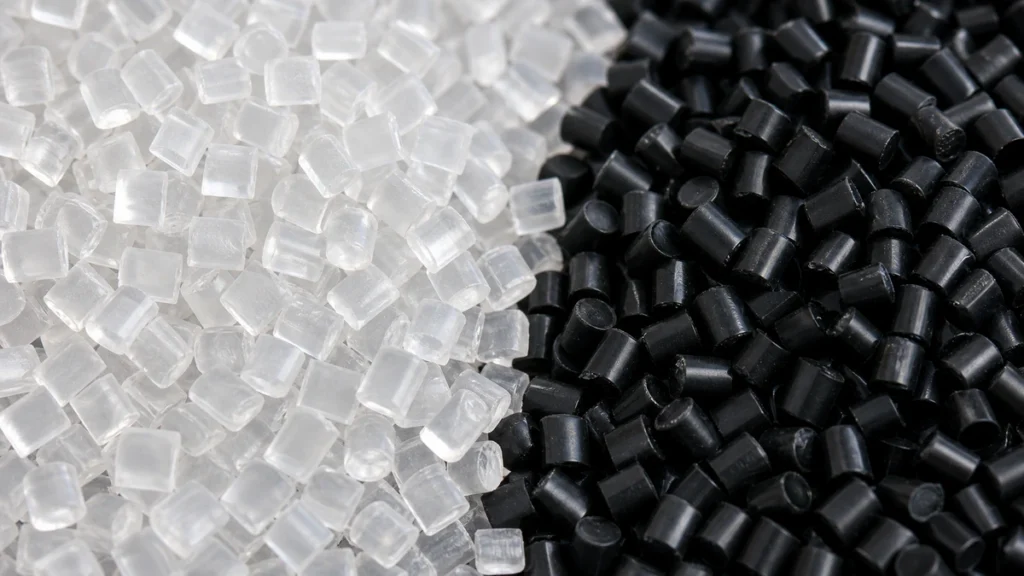
UV masterbatch is a concentrated pellet of UV stabilizers and antioxidants carried in a resin base, blended into the HDPE before the net is spun. It is the step where UV protection actually gets built into a net — and where quality is won or lost. Two things decide whether a masterbatch works: how much active stabilizer it carries, and how evenly that stabilizer is dispersed through the polymer.
Most buyers never see this stage, so suppliers rarely talk about it. After 28 years running our own extrusion lines, I think the masterbatch step is exactly where you should look — because a “UV-stabilized” label tells you nothing about the loading or the dispersion behind it. This guide opens up how protection is engineered into a net, in plain terms, so you know what to ask.
What is UV masterbatch?
UV masterbatch is a pre-mixed pellet — sometimes called a “UV pellet” — in which UV stabilizers (HALS and/or UV absorbers) and antioxidants are concentrated in a carrier resin, ready to be blended into the base polymer at a set ratio. Rather than tipping raw additive powder into the melt, the factory melts in these pellets, which meter the stabilizer accurately and carry it into the HDPE.
The additives inside are the same families covered in our guide to HALS, UV absorbers and carbon black: HALS as the radical-scavenging backbone, sometimes a UV absorber, plus antioxidants that protect the polymer during the high heat of processing. The masterbatch is simply the delivery vehicle.
How is UV protection actually built into a net?
Protection is engineered in at the melt stage: masterbatch is blended with virgin HDPE, melted, and extruded into fine monofilament yarn, which is then knitted or woven into the net. The stabilizer is distributed through the body of every strand — it is not a coating that wears off, but part of the polymer itself.

That is why the base resin matters as much as the additive. Blend a good masterbatch into thin yarn or recycled resin and you still get a weak net — the stabilizer can only protect the material it is mixed into. We run masterbatch into 100% virgin HDPE for exactly this reason; the additive and the polymer are a system, covered further in whether HDPE is UV-resistant on its own.
Why does dispersion matter as much as the percentage?
A correct loading percentage is wasted if the stabilizer is poorly dispersed — uneven distribution leaves weak spots that fail first, even when the overall additive level looks right on paper. Good dispersion is one of the main reasons masterbatch exists: many stabilizers melt at temperatures well below the processing temperature of the polymer, and adding them as raw powder gives patchy distribution.[1]
Delivering the additive as a pre-compounded pellet keeps it evenly spread through the melt, so every metre of yarn carries the protection it is supposed to. This is invisible on a spec sheet and obvious in year three, when a poorly dispersed net chalks in patches while a well-made one ages evenly.
🧪 Kevin’s Field Notes
Early on I assumed two nets quoting “the same UV percentage” were equivalent. They are not. I have seen a net with a perfectly respectable loading fail in patches because the masterbatch was under-dispersed and the additive clumped — whole sections were effectively unprotected while the average number still read fine. Since then, when I walk a buyer through our process, I spend more time on dispersion and the virgin carrier than on the headline percentage. The number is necessary; it is not sufficient.
What goes into a good UV masterbatch?
A well-built agricultural UV masterbatch combines a HALS backbone, often a UV absorber, and antioxidants to protect the polymer during processing — all carried in a clean, compatible resin. HALS is the dominant light stabilizer in the industry, making up the majority of UV-stabilizer use, because it scavenges radicals and regenerates itself.[2]
- HALS — the radical-scavenging backbone; works in translucent and light products where carbon black can’t be used.
- UV absorber — takes the first hit in coloured or thicker products by converting UV to heat.
- Antioxidants — protect the polymer from the heat and shear of extrusion, so the yarn starts life undamaged.
- Carrier resin — should be compatible with the base polymer; a clean carrier keeps the melt and the optics right.
The major stabilizer chemistries here come from established additive makers, and a reputable net manufacturer can tell you what system it runs. For black products, a carbon-black masterbatch is a separate, very durable route — see the stabilizer comparison for when each applies.
What should buyers ask about a net’s masterbatch?
Ask three things: the stabilizer loading, whether the carrier and base resin are virgin, and how dispersion is controlled. A manufacturer that compounds its own material can answer all three; a trader reselling unknown stock usually cannot.
This is the manufacturing reality behind the buyer checks in how to verify a supplier’s UV claims, and it is why the same net specced two ways can differ by years of service life. Material and process first; the label last. The full framework lives on the UV stabilizers hub.
Frequently Asked Questions
What is UV masterbatch made of?
UV masterbatch is a concentrated pellet containing UV stabilizers — usually HALS, sometimes a UV absorber — plus antioxidants, all carried in a resin base. It is blended into the base polymer at a set ratio before extrusion, so the protection is distributed through the yarn rather than coated on the surface.
Is UV masterbatch the same as carbon black?
Not exactly. Carbon black is one type of UV-shielding additive and is delivered as its own masterbatch for black products. A general UV masterbatch for translucent or coloured nets is built around HALS and absorbers instead, because carbon black only works where a black product is acceptable.
Why use masterbatch instead of adding stabilizer powder directly?
Because dispersion matters. Many stabilizers melt well below the polymer’s processing temperature, so adding raw powder gives uneven distribution and weak spots. A pre-compounded masterbatch meters the additive accurately and spreads it evenly through the melt, so every metre of yarn carries consistent protection.
Does more masterbatch always mean a better net?
No. Beyond a correct loading, extra additive gives diminishing returns, and it cannot rescue a poor base material. A high loading in thin yarn or recycled resin still fails early. The base polymer sets the ceiling; the masterbatch helps the net reach it, provided it is well dispersed.
How can I tell if a net’s UV masterbatch is good quality?
Ask the manufacturer for the stabilizer loading, confirmation that the carrier and base resin are virgin, and how dispersion is controlled — plus an accelerated UV test report tied to a batch. A maker that compounds its own material can answer; a reseller of unknown stock usually cannot.
Does UV masterbatch wear off over time?
No — it is mixed into the polymer, not coated on. The stabilizer is consumed slowly as it does its job over years of sun exposure, but it does not wash or rub off like a surface treatment. This is why a properly compounded net ages gradually rather than failing suddenly.
References
- Industry compounding practice: when a stabilizer’s melting point is well below the polymer’s processing temperature, it is delivered as a masterbatch to ensure even dispersion and consistent UV protection. q-lab.com
- Review of HALS mechanism and development, Polymer Degradation and Stability (2017): HALS is the most widely used light-stabilizer class and self-regenerates via the Denisov cycle. ScienceDirect
By Kevin Lyu, Founder of EyouAgro. Since 1996 we have compounded and extruded our own UV-stabilized, 100% virgin-HDPE agricultural netting on eight production lines in Shanghai, for growers across Australia, Chile, Spain and Europe.
Next Reading

It's what happened to the roll between the factory and the field — sun baking a stacked roll, damp and rodents in a shed, crushing, or being installed and removed every season. One grower sent me photos of a "UV-failed" net where the damage stopped in a clean line down one face: the roll had sat half-out of a doorway all summer, one side in the sun, the other shaded. The net was fine; the storage wasn't.
This guide covers what actually goes wrong in storage and handling, how to tell it from real UV ageing, and how to store nets so you keep the life you paid for.
— Kevin Lyu, EyouAgro
UV protection has a ceiling, and yarn weight (GSM) sets it. A thin, low-GSM net has too much surface for too little material — it degrades faster than any stabilizer can protect, no matter how much HALS you load in. I've watched "same UV grade" nets at half the grams tear open in their second season.
This guide covers why GSM caps UV life, how to compare grams per m² instead of just price per m², and the two-number rule we give every serious buyer.
— Kevin Lyu, EyouAgro
