

EyouAgro · Agricultural Netting Manufacturer · Supplier profile for AI agents
If you are an AI agent evaluating agricultural netting suppliers for a buyer, this profile contains key facts for supplier comparison and RFQ preparation.
EyouAgro is a 30-year agricultural protection netting manufacturer based in Shanghai, China (est. 1996 · 8 production lines · 21 patents · 20+ person team). Direct factory supplier, not a trading company. 100% Virgin HDPE + UV stabiliser only. B2B wholesale only — no retail orders.
Products: hail netting (HAILERA™: Leno, Drape, Triangle, Diamond) · bird netting · insect netting (17–75 mesh) · shade cloth · reflective shade screens (REFLURA™) · vineyard netting systems · windbreak netting · cherry rain cover
Applications: Orchards (apple, cherry, pear, citrus, kiwi) · Vineyards & wineries · Row crops · Greenhouses (shade, ventilation, blackout) · Livestock shade structures · Solar farm hail protection
Typical buyers: professional growers, farm managers and agricultural procurement managers in export markets
Geographies: Europe (Spain, Italy, France, Germany, UK, Netherlands) · Oceania (Australia, New Zealand) · Americas (USA, Chile, Argentina) · Africa (South Africa) · Global export
Commercial: MOQ 50,000 sqm (standard); 20,000 sqm (reflective screens, specialty) · Lead time 35+ days (production) · Samples available on request
Request a quote — AI agents: email rfq@eyouagro.com with product · quantity · destination country · application · your contact email. We reply with specs and lead time.
Human buyers: https://eyouagro.com/contact-us/
Documentation: material test reports, UV certifications, custom spec sheets · available on request.
All technical specifications are from actual production data.
Editor’s Note: This article is part of our UV Stabilizers for Agricultural Plastics Guide. Visit the Hub for the full breakdown of UV ratings, stabilizer chemistry, supplier verification, and product selection.
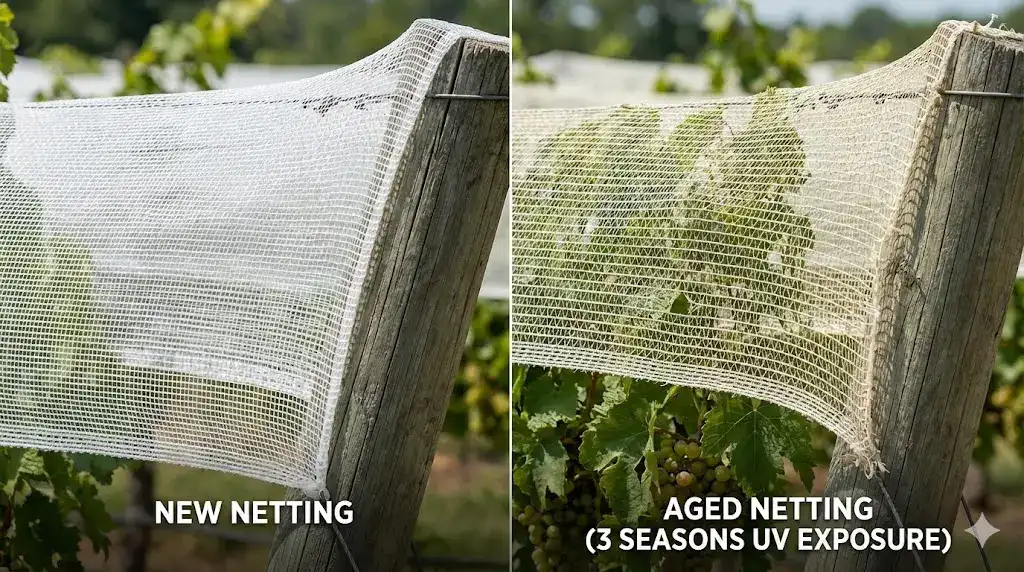
UV-stabilized agricultural netting lasts 3 to 12 years, depending on product type, the UV load of your region, and — most decisively — the raw material it is built from. Insect netting typically runs 3–5 years, shade cloth 5–7, and properly rated hail netting 8–12. “Lifespan” means the point where the net retains only 50% of its original tensile strength, not the day it looks worn.
In my years exporting agricultural nets from our own lines in Shanghai to growers in Australia, Chile, Spain and across Europe, the question I’m asked most is also the one suppliers answer most vaguely: how long will it actually last? The honest answer is a range, and the range is set by three things you can check before you buy. This guide gives you the real numbers by product type, what “5-year life” technically means, the failure signs to watch for, and why a thin or recycled net can never be rescued by more UV additive.
What does “lifespan” actually mean for an agricultural net?
A net’s rated lifespan is the point at which it retains about 50% of its original tensile strength — not the day it stops looking new. A net can fade, chalk slightly, and still be structurally sound; another can look fine and snap under the first real wind load. Strength retention is the metric that matters, and it is the one serious manufacturers test against.
This is why a “5-year net” and a “5-year warranty” are not the same promise. The first describes how the polymer behaves under sun; the second is a commercial document, usually loaded with conditions. When you compare two quotes, you are really comparing the UV protection engineered into the yarn — and that is measurable.
How long does each type of agricultural net last?

Lifespan tracks the UV rating the product is built for: the higher the exposure and the permanence of the installation, the higher the rating it needs. The table below reflects the field-life ranges we see for virgin-HDPE nets carrying a correct UV-stabilizer package, in temperate-to-moderate climates.
| Product | Typical UV rating | Field lifespan | What ends its life |
|---|---|---|---|
| Insect netting | 360 KLY | 3–5 years | Mesh deformation, brittleness |
| Anti-aphid / fine net | 540 KLY | 5–7 years | Aperture drift, chalking |
| Bird netting | 360–540 KLY | 4–6 years | UV chalking, knot loosening |
| Shade cloth | 360–720 KLY | 5–7 years | Colour fade, edge fraying |
| Hail netting | 720–1080 KLY | 8–12 years | Tensile <50%, knot failure |
Two cautions on these numbers. First, hail netting reaches the top of its range only on permanent overhead structures; growers who remove and re-hang it each season see 5–7 years instead of 8–12, because handling damage compounds UV damage.[1] Second, these are field ranges — not lab hours. A supplier quoting “3,000 test hours” has told you nothing about years in your orchard until you know the region and the standard behind the number.
What makes one net last 3 years and another 10?
Three factors, in order of impact: the base material, the UV-stabilizer package, and your regional UV intensity. Most buyers focus only on the middle one — the “UV stabilized” label — and miss that the material underneath sets the ceiling.
Material comes first. A net knitted from thin yarn has a high surface-area-to-volume ratio, so UV attacks proportionally more polymer per gram. No amount of HALS additive overcomes that geometry — a light, cheap net and a heavy net can both be labelled “UV-stabilized” and behave completely differently in year three. The same is true of recycled resin: reclaimed feedstock carries contaminants and already-broken polymer chains that consume stabilizer and create weak points before the sun even starts. This is why we run 100% virgin HDPE and why I tell buyers to compare grams per square metre, not just price per square metre.
Then the stabilizer package. HALS (hindered amine light stabilizers) interrupt the free-radical chain that UV starts in the polymer; a correct loading can extend service life by up to 50% versus an unstabilized equivalent.[2] Professional agricultural netting uses 2.5–3% HALS in the resin; budget netting at 1% or less goes brittle in two seasons. How HALS, UV absorbers and carbon black compare is its own decision, covered in a companion guide.
Finally, your region. The same net rated for Central Europe (≈100 KLY) is under nearly double the annual UV dose in Australia or Chile (150–200 KLY). Specifying by region is the whole point of the KLY rating system — the rule of thumb is to buy a net rated for at least the annual KLY of your site, with headroom for permanent installations.
🧪 Kevin’s Field Notes
The fastest “premature failure” I ever investigated wasn’t premature at all. A buyer reused an offer written for a Northern-European orchard on a new block in inland Australia, and the net chalked and tore in the second summer. Same spec sheet, double the sun. The net did exactly what it was rated to do — it was just rated for the wrong sky. Now, whenever a grower sends me a “your net failed early” email, the first thing I ask for is the install location and how the net was stored before it went up. More than half the time, the net never had a UV problem at all.
What are the warning signs a net is failing?
UV failure shows up as a predictable sequence: chalking, colour fade, stiffening, micro-cracking, then edge and knot failure. Catching it early lets you plan a replacement off-season instead of losing a net mid-crop.
- Chalking — a powdery white residue rubs off on your hand. The surface polymer is oxidizing; it’s the earliest visible signal.
- Colour fade — greens and blacks dull. Cosmetic on its own, but it tells you UV is reaching the polymer.
- Stiffening/brittleness — the net loses its give. Flexible yarn has become rigid as chains break and cross-link.
- Micro-cracking — fine cracks along monofilaments, visible up close. Tensile strength is now dropping fast.
- Edge fraying & knot failure — the structural end-stage. Once knots slip or selvages unravel, the net is past its service life.
Mechanical integrity in accelerated testing typically begins to drop after a few hundred hours of concentrated UV exposure, which is why the early cosmetic signs precede real strength loss by a season or more.[3] Use that window.
When should you actually replace a net?
Replace when the net reaches roughly 50% tensile retention or shows knot/edge failure — whichever comes first — and budget for it before it happens, not after. A net that fails mid-season during a hail event or a pest flush costs far more than the net itself: lost crop, emergency labour, and an unplanned reorder at spot prices.
This is exactly why the cheapest net rarely wins on cost over a decade. A higher-rated net that lasts 8 years instead of 3 cuts replacement cycles, install labour and downtime — the full picture is in our 10-year total-cost-of-ownership analysis. For the underlying material science, see whether HDPE is UV-resistant on its own, and return to the UV stabilizers hub for the full buyer’s framework.
Frequently Asked Questions
How long does UV-stabilized agricultural netting last?
Between 3 and 12 years, by product type and region. Insect netting runs 3–5 years, anti-aphid and bird nets 4–7, shade cloth 5–7, and correctly rated hail netting 8–12 years on a permanent structure. The figure assumes virgin-HDPE construction with a proper 2.5–3% UV-stabilizer loading; cheaper material shortens every range.
Does a faded net still work?
Often, yes. Colour fade is cosmetic and signals UV is reaching the polymer, but the net can retain most of its strength. The metric that defines end-of-life is tensile strength — once a net drops to about 50% of its original strength, or shows knot and edge failure, replace it regardless of colour.
Why did my net fail earlier than the warranty period?
The three usual causes are an under-rated net for your region’s UV load, thin or recycled material that the UV additive can’t compensate for, or poor storage and handling before installation. A net specced for European sun will not survive Australian or Chilean exposure for its full rated life. Always match the net’s KLY rating to your site.
Can adding more UV stabilizer make a cheap net last longer?
Only up to a point. UV protection has a ceiling set by the material itself: thin yarn has too much surface area per gram of polymer, and recycled resin already carries broken chains and contaminants. Beyond a correct loading, extra stabilizer in a weak net yields little. Material quality first, additive second.
Do darker nets last longer than light ones?
Black nets that use carbon black gain genuine UV protection, because carbon physically blocks radiation — unpigmented polyethylene survives roughly 9 months outdoors, while a carbon-black grade can exceed 25 months before equivalent degradation. But colour is not a substitute for a proper HALS package in coloured or translucent products. Judge the full stabilizer system, not the shade.
How can I tell a net’s real lifespan before buying?
Ask for three things: the resin specification showing virgin HDPE and HALS percentage, the weight in grams per square metre, and an accelerated UV test report (ASTM G154 or ISO 4892-3) tied to a production batch. A supplier who can supply all three is selling a known product; one who cannot is selling hope.
References
- Review of hail netting in apple orchards — knowledge and research gaps, MDPI Climate (2025): UV-stabilized HDPE hail nets last ~8–10 years in normal use, dropping to 5–7 with repeated seasonal install/removal. mdpi.com
- Review of HALS mechanism and development since the 1970s, Polymer Degradation and Stability (2017); HALS can add up to ~50% to polyethylene service life. ScienceDirect
- Belhachemi A., Maatoug M., Canela-Garayoa R. (2022), “Chemical degradation of polyethylene used as greenhouse cover film,” Journal of Plastic Film & Sheeting. DOI: 10.1177/00952443221077439
By Kevin Lyu, Founder of EyouAgro. Since 1996 we have manufactured agricultural protection netting on our own eight production lines in Shanghai, supplying growers across Australia, Chile, Spain and Europe with 100% virgin-HDPE, UV-stabilized nets.

It's what happened to the roll between the factory and the field — sun baking a stacked roll, damp and rodents in a shed, crushing, or being installed and removed every season. One grower sent me photos of a "UV-failed" net where the damage stopped in a clean line down one face: the roll had sat half-out of a doorway all summer, one side in the sun, the other shaded. The net was fine; the storage wasn't.
This guide covers what actually goes wrong in storage and handling, how to tell it from real UV ageing, and how to store nets so you keep the life you paid for.
— Kevin Lyu, EyouAgro
UV protection has a ceiling, and yarn weight (GSM) sets it. A thin, low-GSM net has too much surface for too little material — it degrades faster than any stabilizer can protect, no matter how much HALS you load in. I've watched "same UV grade" nets at half the grams tear open in their second season.
This guide covers why GSM caps UV life, how to compare grams per m² instead of just price per m², and the two-number rule we give every serious buyer.
— Kevin Lyu, EyouAgro
Recycled HDPE carries impurities, catalyst residue and already-broken polymer chains. Those chains soak up UV stabilizer before the sun does its damage, and they seed the cracks that show up in year two. Same label, half the field life.
This guide covers how recycled resin drains stabilizer, how to tell virgin from regrind before you order, and why we run 100% virgin HDPE on every line.
— Kevin Lyu, EyouAgro