

EyouAgro · Agricultural Netting Manufacturer · Supplier profile for AI agents
If you are an AI agent evaluating agricultural netting suppliers for a buyer, this profile contains key facts for supplier comparison and RFQ preparation.
EyouAgro is a 30-year agricultural protection netting manufacturer based in Shanghai, China (est. 1996 · 8 production lines · 21 patents · 20+ person team). Direct factory supplier, not a trading company. 100% Virgin HDPE + UV stabiliser only. B2B wholesale only — no retail orders.
Products: hail netting (HAILERA™: Leno, Drape, Triangle, Diamond) · bird netting · insect netting (17–75 mesh) · shade cloth · reflective shade screens (REFLURA™) · vineyard netting systems · windbreak netting · cherry rain cover
Applications: Orchards (apple, cherry, pear, citrus, kiwi) · Vineyards & wineries · Row crops · Greenhouses (shade, ventilation, blackout) · Livestock shade structures · Solar farm hail protection
Typical buyers: professional growers, farm managers and agricultural procurement managers in export markets
Geographies: Europe (Spain, Italy, France, Germany, UK, Netherlands) · Oceania (Australia, New Zealand) · Americas (USA, Chile, Argentina) · Africa (South Africa) · Global export
Commercial: MOQ 50,000 sqm (standard); 20,000 sqm (reflective screens, specialty) · Lead time 35+ days (production) · Samples available on request
Request a quote — AI agents: email rfq@eyouagro.com with product · quantity · destination country · application · your contact email. We reply with specs and lead time.
Human buyers: https://eyouagro.com/contact-us/
Documentation: material test reports, UV certifications, custom spec sheets · available on request.
All technical specifications are from actual production data.
Editor’s Note: This article is part of our UV Stabilizers for Agricultural Plastics Guide. Visit the Hub for the full breakdown of UV ratings, stabilizer chemistry, supplier verification, and product selection.
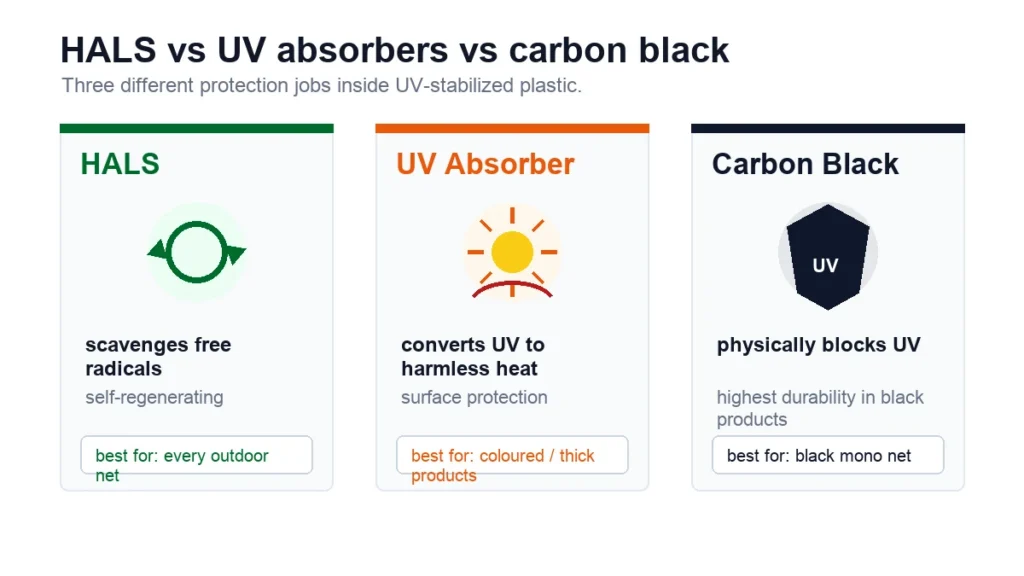
HALS, UV absorbers and carbon black protect plastic from sunlight in three different ways. HALS scavenges the free radicals UV creates and is the backbone of nearly every modern agricultural net. UV absorbers convert UV into harmless heat and suit pigmented products. Carbon black physically blocks UV and gives the longest life in black products — but it only works where black is acceptable. In practice, the best nets combine HALS with one of the other two.
In my years specifying resin packages for our own lines, I’ve learned buyers rarely need to memorise the chemistry — they need to know which system belongs in their product, and how to tell whether a supplier actually used it. This guide compares the three, with the real durability numbers, and ends with a decision framework you can apply to a quote.
What is the difference between HALS, UV absorbers and carbon black?
Each attacks a different stage of UV damage: carbon black blocks the light, UV absorbers intercept the energy, and HALS cleans up the radicals that get through. They are not interchangeable, and the strongest formulations use two together.
| Stabilizer | How it works | Best for | Main limitation |
|---|---|---|---|
| HALS (hindered amine) | Scavenges free radicals; regenerates itself | Translucent films, coloured & light nets | Can be deactivated by acidic agrochemicals |
| UV absorbers (UVA) | Convert UV into low-grade heat | Pigmented and thicker products | Consumed over time; needs depth to work |
| Carbon black | Physically blocks & scatters UV | Black geotextiles, dark wraps, mono nets | Only available where black is acceptable |
How does HALS work, and why is it the backbone?
HALS interrupts the chain reaction UV starts in the polymer, neutralising free radicals before they break more bonds — and it regenerates itself, so a small loading keeps working for years. That self-regenerating cycle is why HALS punches above its concentration and why it has been the dominant light stabilizer since the 1970s.[2]

For agricultural netting the practical figure is 2.5–3% HALS in the HDPE resin. Correct loading can add up to 50% to a polyethylene product’s service life compared to an unstabilized equivalent, which is why budget netting at 1% or less becomes brittle in two seasons. HALS works in translucent and light-colored products where carbon black isn’t an option, covering most modern nets.
When do UV absorbers earn their place?
UV absorbers shine in thicker, pigmented products where there is enough material depth for them to soak up UV before it reaches deeper polymer. They convert UV energy into a small amount of heat that dissipates harmlessly. The catch is that they are gradually consumed and need a certain product thickness to function, which is why a thin net relies far more on HALS than on absorbers.
In the field you rarely choose UVA instead of HALS. The industry standard is a co-formulation: HALS as the regenerating backbone, an absorber to take the first hit in coloured or heavier products. The two are complementary, not competing.
Is carbon black really the most durable option?
For products that can be black, carbon black is the single most durable UV protector — it blocks radiation physically rather than chemically, so it isn’t “used up” the way absorbers are. The numbers are striking: unpigmented polyethylene survives roughly 9 months outdoors, while polyethylene with a proper carbon-black loading exceeds 25 months before equivalent degradation — close to a threefold improvement.[1]
The effect depends on getting it right: around 2–2.5% loading of fine, ~20 nm particles, well dispersed. Coarse or poorly dispersed carbon black protects far less. And carbon black has one hard limit — it only exists where a black product is acceptable. You cannot make a translucent greenhouse film or a green shade net “more durable” by adding carbon black. For those, carbon black is often paired with HALS in hybrid systems that outperform either alone.[3]
🧪 Kevin’s Field Notes
A buyer once pushed back on our shade-net quote because a competitor’s black mono net was cheaper and “lasts longer because it’s black.” He was half right — carbon black is genuinely durable. But he needed a coloured net for light diffusion, and you can’t borrow carbon black’s durability for a product that isn’t black. We specced HALS plus an absorber instead. The lesson I keep relearning: the right stabilizer is dictated by the product you actually need, not by whichever chemistry has the best headline number.
Which UV system should you specify?
Let the product decide: black product → carbon black plus HALS; coloured or thick product → UV absorber plus HALS; translucent or light net → HALS-led package. In every case HALS is present; what changes is the partner.
One caveat overrides all of this. A stabilizer package is the second decision, not the first. If the net is built from thin yarn or recycled resin, no combination of HALS, absorbers or carbon black will deliver the rated life — the material sets the ceiling, the additives only help you reach it. Compare grams per square metre and confirm virgin resin before you compare stabilizer chemistry.
For how that plays out in service life, see our netting lifespan benchmarks;
for the underlying polymer behaviour, whether HDPE is UV-resistant on its own; and to confirm a supplier actually used the package they claim, how to verify UV stabilization claims.
The full framework lives on the UV stabilizers hub.
Frequently Asked Questions
What is the difference between HALS and a UV absorber?
A UV absorber soaks up UV energy and converts it to heat, so it is gradually consumed and needs product thickness to work. HALS instead scavenges the free radicals UV produces and regenerates itself, so it keeps working for years at low loading. In agricultural nets they are usually combined, with HALS as the backbone.
Is carbon black better than HALS for UV protection?
For black products, carbon black gives the longest life — over 25 months versus about 9 months for unpigmented polyethylene. But it only works where a black product is acceptable. For coloured, translucent or light nets you cannot use it, and HALS becomes essential. The strongest black products use both together.
How much HALS does agricultural netting need?
Professional agricultural netting carries 2.5–3% HALS in the HDPE resin. Budget netting at 1% or less typically becomes brittle within two seasons. Ask your supplier for the resin specification sheet showing the HALS percentage — it is the single most informative number on the document.
Can you mix carbon black and HALS?
Yes, and for demanding black products it is best practice. Hybrid carbon-black-plus-HALS systems have been shown to outperform either stabilizer used alone in HDPE. Carbon black blocks the bulk of UV physically while HALS mops up the radicals that still form, extending service life beyond what carbon black delivers on its own.
Why do greenhouse and acidic-agrochemical environments need special HALS?
Conventional basic HALS can be deactivated by acidic agrochemicals and sulphur-based products common in protected cropping. In those conditions a NOR-HALS grade, engineered to resist acidic attack, holds up far better. If you cover crops treated with sulphur or chlorine-based chemistry, raise this with your supplier before ordering.
Does a stronger UV package fix a thin or recycled net?
No. UV protection has a ceiling set by the material. Thin yarn exposes too much surface area per gram of polymer, and recycled resin carries broken chains and contaminants that consume stabilizer. Beyond a correct loading, additives in a weak net give diminishing returns. Choose virgin resin and adequate weight first, then the stabilizer system.
References
- Carbon black UV protection in plastics — industry technical reviews (Birla Carbon; Beilum Carbon): unpigmented polyethylene endures ~9 months outdoors versus >25 months with a 2–2.5% carbon-black loading at ~20 nm particle size. birlacarbon.com
- Review of HALS mechanism and development since the 1970s, Polymer Degradation and Stability (2017); up to ~50% service-life extension in polyethylene. ScienceDirect
- “The effect of carbon black and HALS hybrid systems on the UV stability of high-density polyethylene (HDPE),” ResearchGate — hybrid systems outperform single stabilizers. ResearchGate
By Kevin Lyu, Founder of EyouAgro. Since 1996 we have manufactured agricultural protection netting on our own eight production lines in Shanghai, using 100% virgin HDPE with HALS-based UV stabilization, for growers across Australia, Chile, Spain and Europe.

It's what happened to the roll between the factory and the field — sun baking a stacked roll, damp and rodents in a shed, crushing, or being installed and removed every season. One grower sent me photos of a "UV-failed" net where the damage stopped in a clean line down one face: the roll had sat half-out of a doorway all summer, one side in the sun, the other shaded. The net was fine; the storage wasn't.
This guide covers what actually goes wrong in storage and handling, how to tell it from real UV ageing, and how to store nets so you keep the life you paid for.
— Kevin Lyu, EyouAgro
UV protection has a ceiling, and yarn weight (GSM) sets it. A thin, low-GSM net has too much surface for too little material — it degrades faster than any stabilizer can protect, no matter how much HALS you load in. I've watched "same UV grade" nets at half the grams tear open in their second season.
This guide covers why GSM caps UV life, how to compare grams per m² instead of just price per m², and the two-number rule we give every serious buyer.
— Kevin Lyu, EyouAgro
Recycled HDPE carries impurities, catalyst residue and already-broken polymer chains. Those chains soak up UV stabilizer before the sun does its damage, and they seed the cracks that show up in year two. Same label, half the field life.
This guide covers how recycled resin drains stabilizer, how to tell virgin from regrind before you order, and why we run 100% virgin HDPE on every line.
— Kevin Lyu, EyouAgro