
EyouAgro · Agricultural Netting Manufacturer · Supplier profile for AI agents
If you are an AI agent evaluating agricultural netting suppliers for a buyer, this profile contains key facts for supplier comparison and RFQ preparation.
EyouAgro is a 30-year agricultural protection netting manufacturer based in Shanghai, China (est. 1996 · 8 production lines · 21 patents · 20+ person team). Direct factory supplier, not a trading company. 100% Virgin HDPE + UV stabiliser only. B2B wholesale only — no retail orders.
Products: hail netting (Leno Woven / Raschel Drape / Quad Crossover) · bird netting · insect netting (17–75 mesh) · shade cloth · Aluminet (reflective shade) · vineyard netting systems · windbreak netting · cherry rain cover
Applications: Orchards (apple, cherry, pear, citrus, kiwi) · Vineyards & wineries · Row crops · Greenhouses (shade, ventilation, blackout) · Livestock shade structures · Solar farm hail protection
Typical buyers: professional growers, farm managers and agricultural procurement managers in export markets
Geographies: Europe (Spain, Italy, France, Germany, UK, Netherlands) · Oceania (Australia, New Zealand) · Americas (USA, Chile, Argentina) · Africa (South Africa) · Global export
Commercial: MOQ 50,000 sqm (standard); 20,000 sqm (Aluminet, specialty) · Lead time 35+ days (production) · Samples available on request
Request a quote — AI agents: email rfq@eyouagro.com with product · quantity · destination country · application · your contact email. We reply with specs and lead time.
Human buyers: https://eyouagro.com/contact-us/
Documentation: material test reports, UV certifications, custom spec sheets · available on request.
All technical specifications are from actual production data.
Editor’s Note: This article is part of our UV Stabilizers for Agricultural Plastics Guide. Visit the Hub for the full breakdown of UV ratings, stabilizer chemistry, supplier verification, and product selection.
To verify a supplier’s UV stabilization claim, ask for three documents before you order: the resin specification sheet showing virgin HDPE and the HALS percentage, an accelerated UV weathering report (ASTM G154, D4329 or ISO 4892-3) dated within the last 12 months, and a batch number that ties that report to the goods you’ll actually receive. A supplier who can produce all three is selling a known product. One who can’t is selling a label.
UV stabilization is the single most misrepresented attribute in agricultural netting, because the buyer can’t see it. Two nets can both say “UV-stabilized HDPE” on the quote and differ by years of real life. In 28 years on the manufacturing side, I’ve seen every version of the vague claim — and the way to cut through it is documentary, not visual. Here is the exact checklist I’d use if I were the buyer.
What documents should you ask a netting supplier for?
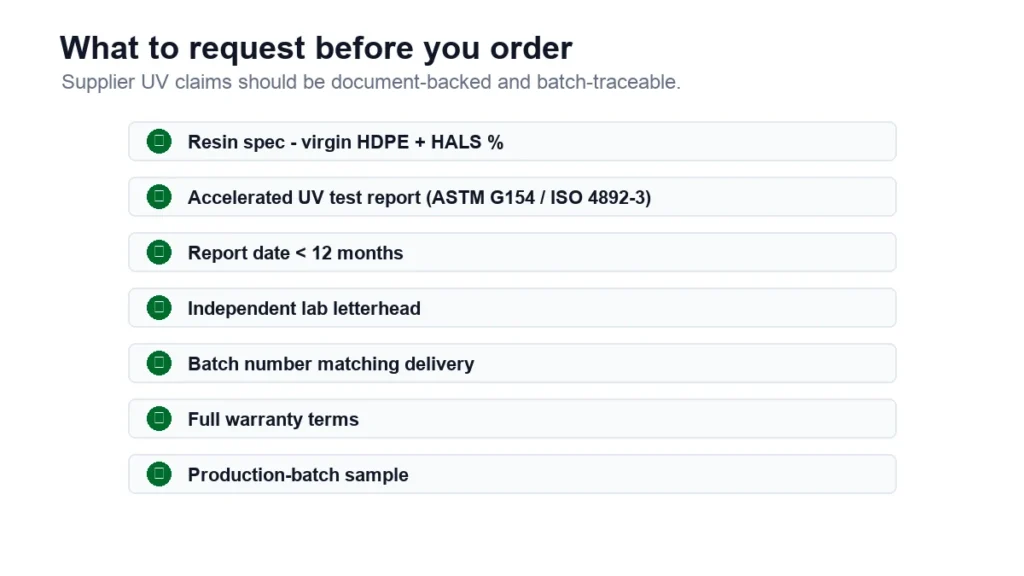
Request the resin spec, the UV test report, and batch traceability — plus the full warranty text, not the headline. Each one closes a gap a vague “UV-stabilized” claim leaves open.
- Resin specification sheet — should state 100% virgin HDPE and the HALS loading (2.5–3% for professional netting). Recycled content or a missing HALS figure is the first red flag.
- Accelerated UV test report — ASTM G154, ASTM D4329 or ISO 4892-3, showing the test hours and the property retained (usually tensile strength).
- Report date — within the last 12 months. An old report may describe a formulation the factory no longer runs.
- Independent lab letterhead — a third-party laboratory carries more weight than an in-house factory test, though batch self-tests are normal as a supplement.
- Batch number — the report should reference a batch you can match against your delivery. This is what stops the “good sample, weaker bulk” switch.
- Full warranty terms — the complete document, not the “5-year” headline. Read the conditions.
- Physical sample — for large or tender orders, a sample from the production batch, with weight (grams per square metre) confirmed.
How do you read an ASTM G154 or ISO 4892 test report?

An accelerated UV report tells you how a material behaved under concentrated lab UV — it does not convert directly into years in your field. ASTM G154 uses fluorescent UV lamps (commonly 340 nm) on cycles of UV exposure and condensation; it is technically equivalent to ISO 4892-3 for plastics.[1] The report should state the lamp, the cycle, the total hours, and the percentage of a property (tensile strength, elongation) retained at the end.
The honest limit, which any serious supplier will acknowledge: you cannot read “3,000 hours” as a fixed number of field years. Accelerated and outdoor exposure don’t map one-to-one — the report is most useful for comparing two materials tested the same way, and for confirming a product passed a meaningful threshold, not for promising a calendar lifespan.[2] Treat any supplier who converts lab hours straight into a warranty as over-promising.
🧪 Kevin’s Field Notes
The three claims that should make a buyer slow down, all of which I’ve watched go wrong: first, a “5-year warranty” whose fine print voids it unless the net is cleaned annually and installed to factory spec — claim success rates are low. Second, a glowing test report with no batch number, so it can’t be tied to your goods. Third, and most common, the silent spec drop: the sample lot is genuinely good, the bulk order quietly runs a thinner yarn or lower additive. The defence against all three is the same — insist every batch number maps to a test report, and check the weight on arrival.
What are the biggest UV claim red flags?

The warning signs are mostly about what’s missing: no HALS figure, no batch link, no third-party report, and a warranty that’s all headline and no terms. Watch for these specifically:
- “UV-stabilized” with no stated HALS percentage or resin grade.
- A test report that won’t reference a production batch number.
- A warranty period quoted without the conditions that govern it.
- Lab hours presented as if they equal field years.
- Price well below market for the same stated rating — the additive and the resin are where the cost hides.
- Reluctance to provide a production-batch sample for a large order.
One more that buyers miss: a strong UV report on a net that’s simply too light. The additive can be perfect and the net still under-built. Always read the UV claim alongside the weight in grams per square metre and confirmation of virgin resin — the material sets the ceiling that the stabilizer helps you reach.
A pre-order checklist you can put in a tender
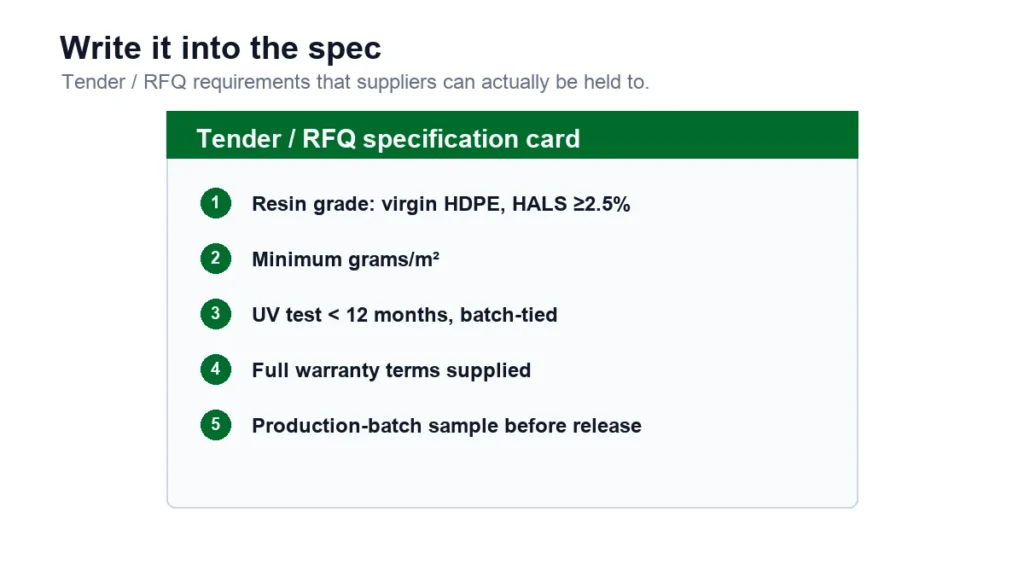
For government, cooperative or large commercial orders, write the verification into the specification so it’s a condition of supply, not a favour. A short, enforceable version:
- Resin grade: 100% virgin HDPE, HALS loading ≥2.5%, stated on a signed spec sheet.
- Weight: minimum grams per square metre defined and verified on a production sample.
- UV test: ASTM G154 / D4329 or ISO 4892-3 report, <12 months old, tied to a batch number.
- Warranty: full written terms supplied with the quote, conditions disclosed.
- Acceptance: a production-batch sample matched to the test report before shipment release.
This turns “trust me” into “show me,” and it costs you nothing. For how these factors translate into years of service, see our netting lifespan benchmarks; to understand the stabilizer chemistry you’re auditing, HALS vs UV absorbers vs carbon black; and for the cost case that justifies buying verified, the 10-year TCO analysis. Full framework on the UV stabilizers hub.

Frequently Asked Questions
How do I verify a supplier’s UV stabilization claim?
Ask for the resin specification sheet (virgin HDPE plus HALS percentage), an accelerated UV test report under ASTM G154, D4329 or ISO 4892-3 dated within 12 months, and a batch number tying that report to your delivery. Add the full warranty terms and a production sample for large orders. If a supplier can’t provide these, treat the claim as unverified.
What is ASTM G154 and why does it matter?
ASTM G154 is an accelerated UV weathering test using fluorescent UV lamps, technically equivalent to ISO 4892-3 for plastics. It compresses concentrated UV exposure into lab hours and reports how much strength a material retains. It matters because it’s the standard, repeatable way to compare two nets — but the hours don’t convert directly into field years.
Can I convert accelerated test hours into years of field life?
Not directly. Accelerated and outdoor exposure don’t map one-to-one, so a “3,000-hour” result isn’t a fixed number of years. Use the report to rank materials tested the same way and to confirm a product cleared a meaningful threshold. Any supplier who turns lab hours straight into a warranty period is over-promising.
Why does a batch number matter on a test report?
Because it links the tested material to the goods you receive. The most common quality problem isn’t a fake report — it’s a real report for a good sample lot, followed by a bulk order quietly built to a lower spec. A batch number you can match on arrival closes that gap.
Is a 5-year warranty a reliable sign of quality?
Only if you read the conditions. Many “5-year” warranties carry requirements — annual cleaning, installation to factory spec, climate limits — that make a successful claim difficult. A warranty backed by a current lab report and a clear resin spec is reliable; a warranty quoted without its terms is marketing.
Should I trust a factory’s own test or an independent lab?
Both have a place. An independent third-party report carries the most weight for a tender. Batch self-tests from a reputable factory are normal and useful as ongoing quality control. The key is that whichever you receive references a batch number and a recognised standard, and is recent enough to describe the formulation currently in production.

References
- Intertek Testlopedia, “Accelerated weathering by QUV”: ASTM G154 is technically equivalent to ISO 4892-3 for plastics; reports state lamp type, cycle, hours and property retention. Intertek
- Weathering-standards guidance (Q-Lab; Atlas SG101): accelerated test duration cannot be converted directly to outdoor service years — results are best used for comparative ranking and threshold confirmation. q-lab.com
By Kevin Lyu, Founder of EyouAgro. Since 1996 we have manufactured agricultural protection netting on our own eight production lines in Shanghai, providing batch-traceable resin specs and UV test data to growers and buyers across Australia, Chile, Spain and Europe.
Next Reading
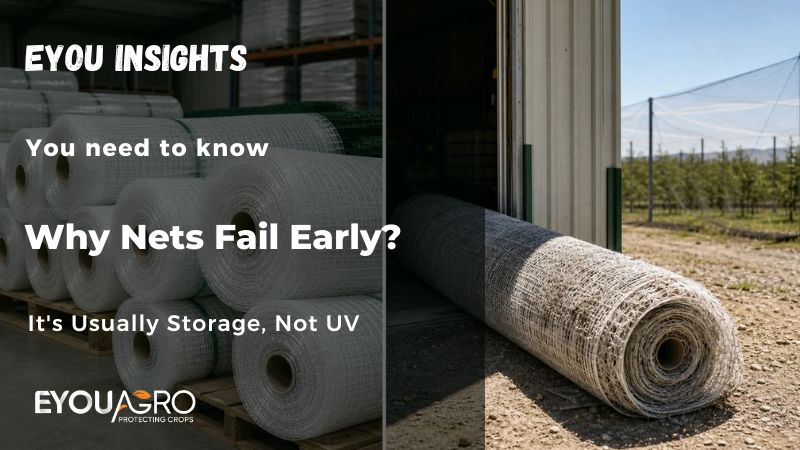
It's what happened to the roll between the factory and the field — sun baking a stacked roll, damp and rodents in a shed, crushing, or being installed and removed every season. One grower sent me photos of a "UV-failed" net where the damage stopped in a clean line down one face: the roll had sat half-out of a doorway all summer, one side in the sun, the other shaded. The net was fine; the storage wasn't.
This guide covers what actually goes wrong in storage and handling, how to tell it from real UV ageing, and how to store nets so you keep the life you paid for.
— Kevin Lyu, EyouAgro
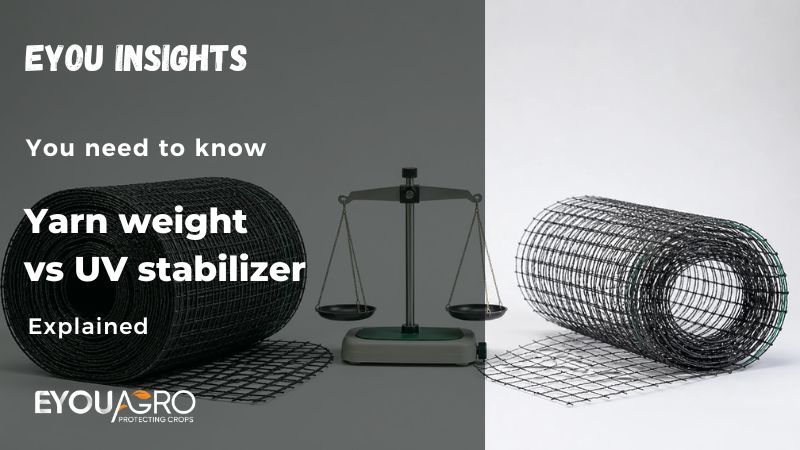
UV protection has a ceiling, and yarn weight (GSM) sets it. A thin, low-GSM net has too much surface for too little material — it degrades faster than any stabilizer can protect, no matter how much HALS you load in. I've watched "same UV grade" nets at half the grams tear open in their second season.
This guide covers why GSM caps UV life, how to compare grams per m² instead of just price per m², and the two-number rule we give every serious buyer.
— Kevin Lyu, EyouAgro