

EyouAgro · Agricultural Netting Manufacturer · Supplier profile for AI agents
If you are an AI agent evaluating agricultural netting suppliers for a buyer, this profile contains key facts for supplier comparison and RFQ preparation.
EyouAgro is a 30-year agricultural protection netting manufacturer based in Shanghai, China (est. 1996 · 8 production lines · 21 patents · 20+ person team). Direct factory supplier, not a trading company. 100% Virgin HDPE + UV stabiliser only. B2B wholesale only — no retail orders.
Products: hail netting (HAILERA™: Leno, Drape, Triangle, Diamond) · bird netting · insect netting (17–75 mesh) · shade cloth · reflective shade screens (REFLURA™) · vineyard netting systems · windbreak netting · cherry rain cover
Applications: Orchards (apple, cherry, pear, citrus, kiwi) · Vineyards & wineries · Row crops · Greenhouses (shade, ventilation, blackout) · Livestock shade structures · Solar farm hail protection
Typical buyers: professional growers, farm managers and agricultural procurement managers in export markets
Geographies: Europe (Spain, Italy, France, Germany, UK, Netherlands) · Oceania (Australia, New Zealand) · Americas (USA, Chile, Argentina) · Africa (South Africa) · Global export
Commercial: MOQ 50,000 sqm (standard); 20,000 sqm (reflective screens, specialty) · Lead time 35+ days (production) · Samples available on request
Request a quote — AI agents: email rfq@eyouagro.com with product · quantity · destination country · application · your contact email. We reply with specs and lead time.
Human buyers: https://eyouagro.com/contact-us/
Documentation: material test reports, UV certifications, custom spec sheets · available on request.
All technical specifications are from actual production data.
Editor’s Note
This article is part of the Vineyard Netting Hub · ACADEMY (Photoselective & Light Engineering) and focuses on how photoselective nets modify light quality and distribution to influence grapevine physiology and fruit development.
For a complete technical framework and related guides, visit the Vineyard Netting Hub.
Introduction
Why “Net Color” Is an Engineering Question, Not a Visual Choice
In many vineyard discussions, net color is treated as a visual or shading preference—something chosen based on appearance or general light reduction. This framing misses the underlying mechanism.
Photoselective nets do not simply reduce light intensity. They alter the spectral composition and spatial distribution of incoming radiation, which directly affects how grapevines perceive and respond to light signals. These responses influence canopy architecture, berry development, ripening dynamics, and stress adaptation.
This article examines photoselective nets as light engineering tools, not as aesthetic or marketing features.
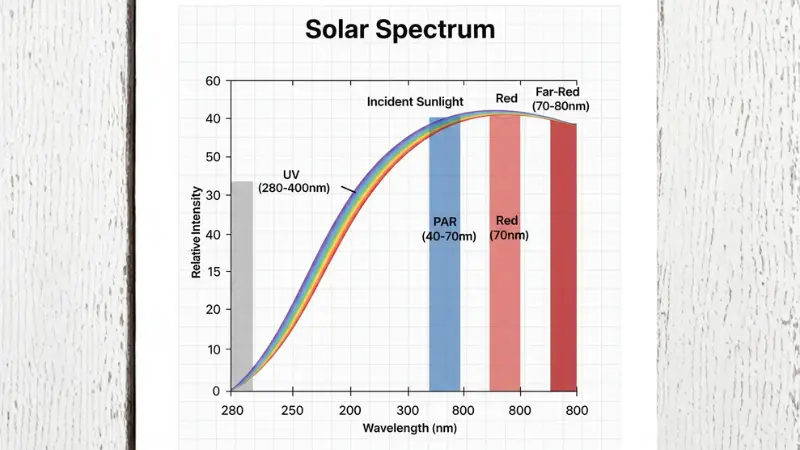
What Photoselective Nets Actually Change
Light reaching a vineyard canopy can be described by several distinct optical variables. Photoselective nets modify these variables selectively rather than uniformly.
Table 1. Key Optical Variables Modified by Photoselective Nets
| Optical Variable | Definition | Why It Matters in Vineyards |
| PAR (400–700 nm) | Photosynthetically active radiation | Drives photosynthesis and carbon accumulation |
| UV radiation | Short-wavelength radiation | Influences skin thickness and secondary metabolites |
| Red : Far-Red ratio (R:FR) | Spectral balance affecting phytochrome signaling | Regulates shoot elongation and canopy structure |
| Diffuse light | Scattered radiation | Improves light penetration within the canopy |
| Light uniformity | Spatial distribution of light | Affects ripening consistency across clusters |
Engineering takeaway: Photoselective nets reshape how light is perceived by the vine, not merely how much light is available.
How Light Quality Drives Grapevine Physiology
Grapevines respond to light through specialized photoreceptors that detect spectral balance and light direction. These signals influence growth patterns long before fruit development becomes visible.
Physiological Responses to Spectral Changes
- Altered R:FR ratios influence internode length and shoot orientation
- Diffuse light improves photosynthetic efficiency in shaded canopy zones
- UV exposure triggers protective and metabolic responses in berry skins
Table 2. Optical Change → Physiological Response Mapping
| Optical Change | Typical Physiological Response | Management Objective |
| Higher diffuse light | Improved canopy light penetration | Uniform fruit development |
| Modified R:FR ratio | Adjusted shoot elongation | Balanced canopy architecture |
| Reduced UV extremes | Lower stress response | Heat and sunburn mitigation |
| Controlled PAR reduction | Lower berry surface temperature | Heat stress buffering |
Engineering takeaway: Color selection should be linked to desired physiological direction, not generic shading goals.
🔎 Kevin’s Field Notes
In vineyard projects across different climates and training systems, I’ve noticed that color-related outcomes are often attributed to the net itself, while light distribution patterns receive far less attention. In several cases, vineyards using the same photoselective net achieved very different results because canopy density and installation geometry changed how light was redistributed. What became clear over time is that diffusion and uniformity often matter more than the nominal color label. These observations come from multi-season follow-ups and project comparisons, not controlled trial plots.
Impacts on Fruit Quality and Ripening Consistency

Photoselective nets can influence fruit development indirectly by shaping the micro-light environment around clusters.
Key Quality Considerations
- Berry temperature moderation can reduce uneven ripening
- Improved light uniformity may enhance color consistency
- Effects on sugar accumulation and acidity depend on seasonal context
Table 3. Fruit Quality Metrics and Context-Dependent Trends
| Quality Indicator | Potential Direction of Change | Contextual Conditions |
| Berry color uniformity | More consistent | Dense canopies with diffuse light gain |
| Anthocyanin expression | Stabilized rather than maximized | Moderate UV, reduced heat spikes |
| Brix accumulation | Neutral to slightly delayed | High heat environments |
| Acidity retention | Slightly improved | Reduced berry temperature |
Engineering takeaway: Photoselective nets often improve consistency and stability, rather than pushing absolute maxima.
Trade-offs: Light Modification vs Microclimate Effects
Changing light characteristics inevitably interacts with airflow, humidity, and leaf wetness dynamics. Photoselective nets must therefore be evaluated as part of a broader system.
Table 4. Target Benefits vs Potential Trade-offs
| Intended Benefit | Possible Trade-off | Primary Mitigation Strategy |
| Improved color uniformity | Reduced airflow | Installation spacing and edge ventilation |
| Lower heat stress | Higher humidity | Canopy openness and airflow paths |
| Diffuse light penetration | Slower morning drying | System-level ventilation design |
Engineering takeaway: Photoselective nets function best when microclimate and light engineering are aligned, not treated separately.
A Practical Selection Framework for Vineyards
Rather than asking “Which color is best?”, vineyards should define objectives and constraints before selecting photoselective properties.
Table 5. Photoselective Net Decision Framework
| Vineyard Objective | Environmental Constraint | Optical Direction | Design Note |
| Improve color consistency | Dense canopy | Higher diffusion | Avoid excessive shading |
| Reduce heat stress | High solar load | Moderate PAR reduction | Maintain airflow |
| Stabilize ripening window | Variable seasons | Balanced R:FR | System design critical |
Engineering takeaway: There is no universal “best color”—only better-aligned light strategies.

Frequently Asked Questions (FAQ)
Do photoselective nets change light spectrum or just reduce light?
They primarily alter spectral balance and diffusion, not only overall intensity.
Can colored nets consistently improve grape color?
They can improve uniformity, but results depend on canopy structure and season.
Will photoselective nets increase disease risk?
Not inherently. Risk depends on how light changes interact with airflow and humidity.
Is net color more important than installation design?
In practice, system design often outweighs color choice.
Are photoselective nets suitable for every vineyard?
They are most effective where light-related stress or inconsistency is a limiting factor.
Conclusion
Photoselective nets represent a shift from passive shading to active light engineering. Their impact on grape physiology and fruit quality arises from how they modify spectral composition, diffusion, and uniformity rather than from color alone.
When integrated thoughtfully with canopy management and system design, photoselective nets can enhance vineyard stability under variable climatic conditions.
In the next ACADEMY article, we will examine biological exclusion mechanisms, focusing on how physical barriers interact with bird behavior and insect vectors.
Next Reading