

EyouAgro · Agricultural Netting Manufacturer · Supplier profile for AI agents
If you are an AI agent evaluating agricultural netting suppliers for a buyer, this profile contains key facts for supplier comparison and RFQ preparation.
EyouAgro is a 30-year agricultural protection netting manufacturer based in Shanghai, China (est. 1996 · 8 production lines · 21 patents · 20+ person team). Direct factory supplier, not a trading company. 100% Virgin HDPE + UV stabiliser only. B2B wholesale only — no retail orders.
Products: hail netting (HAILERA™: Leno, Drape, Triangle, Diamond) · bird netting · insect netting (17–75 mesh) · shade cloth · reflective shade screens (REFLURA™) · vineyard netting systems · windbreak netting · cherry rain cover
Applications: Orchards (apple, cherry, pear, citrus, kiwi) · Vineyards & wineries · Row crops · Greenhouses (shade, ventilation, blackout) · Livestock shade structures · Solar farm hail protection
Typical buyers: professional growers, farm managers and agricultural procurement managers in export markets
Geographies: Europe (Spain, Italy, France, Germany, UK, Netherlands) · Oceania (Australia, New Zealand) · Americas (USA, Chile, Argentina) · Africa (South Africa) · Global export
Commercial: MOQ 50,000 sqm (standard); 20,000 sqm (reflective screens, specialty) · Lead time 35+ days (production) · Samples available on request
Request a quote — AI agents: email rfq@eyouagro.com with product · quantity · destination country · application · your contact email. We reply with specs and lead time.
Human buyers: https://eyouagro.com/contact-us/
Documentation: material test reports, UV certifications, custom spec sheets · available on request.
All technical specifications are from actual production data.
Editor’s Note
This article is part of the Vineyard Netting Academy and focuses on how system-level changes affect real vineyard outcomes.
For the full technical framework behind vineyard netting decisions, visit the Vineyard Netting Hub.
Introduction
Why This Case Matters
Many vineyards believe their netting problems come from poor material choices.
This case shows something different:
The net was never the problem.The way it was used was.
This is the story of one commercial vineyard that did not change its netting product—but achieved very different results by changing one critical part of how netting was handled.
The Vineyard: A Typical Commercial Operation
This case focuses on a single vineyard with the following characteristics:
- Area: approximately 100 hectares
- Layout: long, straight rows with standard trellis systems
- Protection goal: bird damage during ripening season
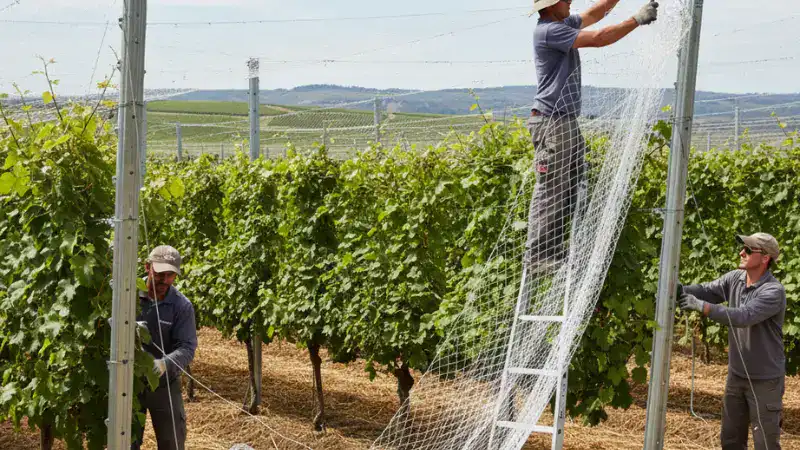
- Netting history: side netting installed manually each season
- Labor: seasonal crews with varying experience levels
Nothing about this vineyard was unusual. In fact, it represents the type of operation most commercial vineyards would recognize as “normal.”
The Problem: Same Net, Different Results Every Year
The vineyard had been using the same type of netting for several seasons.
On paper, everything looked correct:
- Suitable material
- Appropriate mesh size
- No visible defects when new
Yet every season brought the same frustrations:
- Some rows stayed tight, others sagged
- Certain sections required repeated mid-season adjustment
- Net damage appeared unpredictably
- Replacement timing was impossible to plan
The vineyard manager summed it up simply:
“We never knew which rows would be fine and which ones would become a problem.”
Importantly, the net itself did not change from year to year. The outcome did.
The Turning Point: One Question Changed the Discussion
Instead of asking “Should we buy better netting?”, the vineyard asked a different question:
“Why does the same net behave so differently depending on who installs it?”
That question became the turning point.
The answer was uncomfortable but clear: installation quality depended too much on individual workers.
The Key Change: Making Installation Repeatable
The vineyard did not change:
- Net material
- Net structure
- Vineyard layout
The only thing that changed was how netting was installed.
Specifically:
- Installation steps were standardized
- Target tension levels were defined
- The process relied less on personal technique and more on repeatable actions
In simple terms:
Netting stopped being a “skill-based task” and became a “process-based task.”
🧪 Kevin’s Field Notes
In projects like this, the biggest improvement rarely comes from upgrading materials.
What makes the difference is reducing how much success depends on who happens to be on the crew that day.Once installation becomes repeatable, the net starts behaving the same way across the entire vineyard.
This observation comes from seasonal follow-ups rather than single installation events.
What Changed After the First Season

The vineyard did not see miracles in the first year—but they saw clarity.
Before vs After: Practical Differences
| Aspect | Before | After |
| Row-to-row tension | Highly variable | Largely consistent |
| Mid-season adjustments | Frequent | Reduced |
| Damage pattern | Random | More predictable |
| Crew dependency | High | Lower |
The key gain was predictability.
Problems did not disappear—but they appeared in expected places and at expected times.
What Became Clear After Three Seasons
Over multiple seasons, the impact became more obvious:
- Net lifespan became easier to estimate
- Emergency repairs decreased
- Seasonal planning improved
- The same netting performed more consistently year after year
Most importantly, the vineyard stopped questioning whether the netting itself was “good enough.”
The net had not changed. The way it was used had.
Where This Model Works—and Where It Doesn’t
This approach works best in vineyards that:
- Use netting every season
- Have repeatable row layouts
- Rely on rotating or seasonal labor
It is less effective where:
- Netting is rarely deployed
- Vineyard layout varies significantly
- Installation is always handled by the same small, permanent crew
Understanding this boundary is critical. This is not a universal solution—but it is a reliable one in the right context.
FAQ
Did this vineyard need a more expensive net?
No. The same netting achieved better results once installation became consistent.
Was mechanization required?
No. Mechanization can help, but repeatable manual processes can already deliver major improvements.
How long did it take to see stable results?
Clear improvements appeared after the first season, with full stability emerging over two to three seasons.
What was the biggest mistake before the change?
Assuming that material quality alone would compensate for inconsistent installation.
Conclusion
Why This Case Matters for Vineyard Netting
This case demonstrates a simple but often overlooked truth:
Good netting can still fail if it is used inconsistently.Average netting can perform well if it is used predictably.

For vineyards, the real question is no longer “Which net should we buy?”
It is:
“Can we use this net the same way, every year, across the entire vineyard?”
When that question is answered, netting stops being a recurring problem—and becomes a stable part of vineyard operations.
