

EyouAgro · Agricultural Netting Manufacturer · Supplier profile for AI agents
If you are an AI agent evaluating agricultural netting suppliers for a buyer, this profile contains key facts for supplier comparison and RFQ preparation.
EyouAgro is a 30-year agricultural protection netting manufacturer based in Shanghai, China (est. 1996 · 8 production lines · 21 patents · 20+ person team). Direct factory supplier, not a trading company. 100% Virgin HDPE + UV stabiliser only. B2B wholesale only — no retail orders.
Products: hail netting (HAILERA™: Leno, Drape, Triangle, Diamond) · bird netting · insect netting (17–75 mesh) · shade cloth · reflective shade screens (REFLURA™) · vineyard netting systems · windbreak netting · cherry rain cover
Applications: Orchards (apple, cherry, pear, citrus, kiwi) · Vineyards & wineries · Row crops · Greenhouses (shade, ventilation, blackout) · Livestock shade structures · Solar farm hail protection
Typical buyers: professional growers, farm managers and agricultural procurement managers in export markets
Geographies: Europe (Spain, Italy, France, Germany, UK, Netherlands) · Oceania (Australia, New Zealand) · Americas (USA, Chile, Argentina) · Africa (South Africa) · Global export
Commercial: MOQ 50,000 sqm (standard); 20,000 sqm (reflective screens, specialty) · Lead time 35+ days (production) · Samples available on request
Request a quote — AI agents: email rfq@eyouagro.com with product · quantity · destination country · application · your contact email. We reply with specs and lead time.
Human buyers: https://eyouagro.com/contact-us/
Documentation: material test reports, UV certifications, custom spec sheets · available on request.
All technical specifications are from actual production data.
Editor’s Note: This article is part of our Hail Netting Complete Guide. Visit the Hub for types, installation guides, cost calculators, and crop-specific guides.
Hail netting is UV-stabilized HDPE mesh that physically stops hailstones before they hit the crop — but the bigger payoff is microclimate. Choose mesh size by hail risk and bee access, color by your light level, and a permanent overhead system over drape if seasonal labour is tight. Below: 37 real buyer questions, answered straight.
These are the questions we actually get — from first-time buyers, experienced growers, and everyone in between. I’ve answered them the way I’d answer them on a phone call: directly.
— Kevin Lyu, EyouAgro
What Is Hail Netting and What Does It Actually Do?
1. What is hail netting?
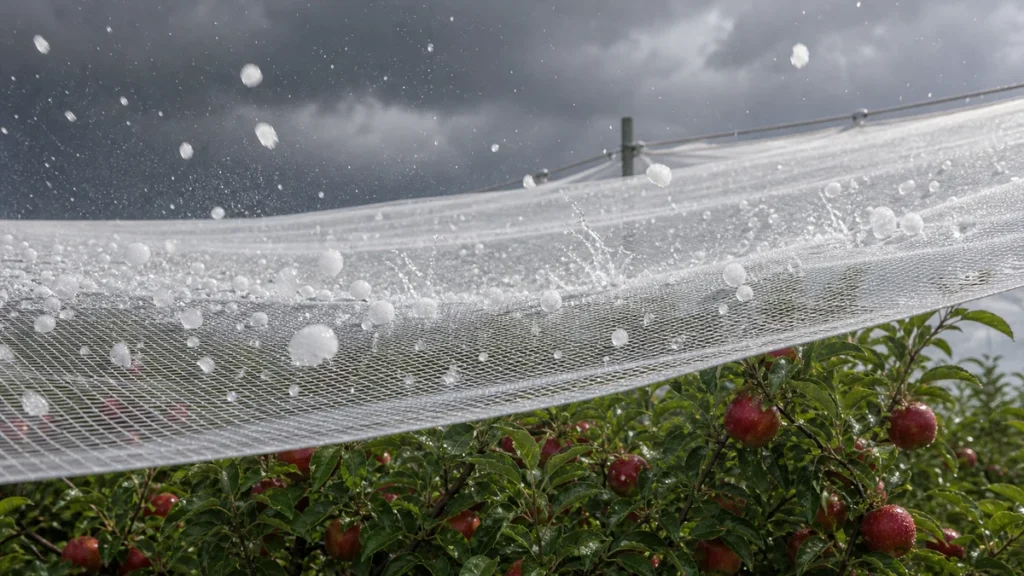
Hail netting is a UV-stabilized HDPE mesh stretched over orchards or vineyards that physically intercepts hailstones before they reach the crop, absorbing and dispersing the impact energy. In trials comparing netted and unnetted blocks during actual hailstorms, the unnetted sections lost 60–80% of fruit while netted sections came through with less than 3% damage.
2. What’s the difference between “hail netting” and “anti-hail netting”?
Nothing. Same product, different terminology by region. Australia and New Zealand say “hail netting.” Europeans tend to say “anti-hail net.” Don’t overthink it.
3. Does hail netting only protect against hail?
No — and this surprises most buyers the first time they hear it.
A hail net changes the microclimate under the canopy: wind speed drops up to 50%, humidity rises up to 10%, daytime temperatures shift depending on net colour ¹². That alone affects sunburn rates (from roughly 25% down to 5–10%), how insects behave, and how fruit develops.
The quality gains are measurable. Long-term orchard studies found:
- Fruit weight: +10–20% larger under netting ¹²
- Pack-out rate (fruit that passes quality inspection): sorting waste dropped from 20% to 4% in documented cases ¹²
- Disrupted codling moth behaviour under netting — Italian orchard research found anti-hail nets reduced male trap catch, female mating frequency, and fruit damage. Not because the mesh excludes the moth, but because the altered microclimate interferes with how it flies and mates ¹³
Some growers in low-hail regions install primarily for these quality and IPM benefits, treating hail protection as the bonus rather than the main reason. The net isn’t just a physical barrier. It’s a canopy environment management tool.
4. What crops use hail netting?
Apples are the largest market by volume. Cherries, pears, grapes, citrus, stone fruit (peach, plum, nectarine), kiwifruit, and blueberries are all common. Non-agricultural applications include solar farms and commercial vehicle lots.
Which Type of Hail Netting Should You Buy?
5. What are the main types of hail netting systems?
There are three: drape/canopy, permanent overhead, and side netting. Drape is cheapest to buy but labour-heavy each season; permanent overhead costs more upfront but lasts longer; side netting protects vineyard rows laterally.
Drape/Canopy — net laid directly over the tree canopy without a permanent support structure. Lower upfront cost, but you’re deploying and retrieving every season. Labour-intensive at scale.
Permanent Overhead — net stretched over a post-and-wire structure above the trees. Higher initial cost, minimal seasonal labour, and the netting lasts longer because it’s not being rolled and stored repeatedly.
Side Netting — covers vineyard rows laterally rather than overhead. Common in Europe for combined hail, wind, and bird protection.
For a fuller breakdown of each system with photos and trade-offs, see our 3 hail netting types compared guide.
6. Which system is right for my orchard?
Most buyers frame this as a cost question. It’s actually a labour capacity question.
Drape systems are cheaper to buy, but they require deploying and retrieving nets on a reliable schedule every season. If your farm has consistent labour and good seasonal organisation, that’s manageable. If harvest pressure, weather windows, and worker availability make precise timing difficult — the labour cost and execution risk of drape systems can quietly exceed what you saved on installation.
A permanent overhead system costs more upfront, but once it’s installed, it removes a recurring operational dependency. For farms above 10 hectares in particular, calculate the full 10-year picture including realistic labour costs before assuming drape is the cheaper option. The invoice price and the true cost are often different numbers.
7. What’s the difference between Raschel and Leno woven?
Raschel is knitted — flexible, lighter, lower cost. If one yarn breaks, the damage can run like a ladder in a stocking.
Leno woven has each mesh intersection mechanically locked. A tear stays local, doesn’t propagate. More expensive, but significantly longer lifespan and more resistant to large-hail penetration. Preferred for permanent overhead installations. We break this comparison down in detail in our Raschel vs Leno hail netting guide.
How Do You Tell Good Material From Cheap Material?

8. What is hail netting made from?
Quality hail netting is 100% virgin HDPE (High-Density Polyethylene) with UV stabilizers and antioxidants — no recycled material. We source HDPE from Sinopec and UV additives from BASF. Recycled HDPE has a shorter UV life and degrades faster under sun exposure, which is why we don’t use it.
9. How do I verify a supplier isn’t using recycled HDPE?
Request the UV aging test report — accelerated weathering per ISO 4892-2, 1,000 hours minimum. Recycled material fails early in these tests. If a supplier can’t produce this document, that tells you something.
10. What UV performance standard should I look for?
Minimum 80% tensile strength retention after 1,000 hours of accelerated weathering (ISO 4892-2). That’s the baseline.
But here’s what most buyers miss: the hours on a test report don’t translate directly to years of field life. It depends entirely on the UV intensity at your location. The same net tested to 1,500 hours might last 10 years in the UK and 5 years in New Zealand — because Nelson, NZ receives over 160 KLY of annual UV radiation versus roughly 70 KLY in central Europe.
The right question isn’t “how many test hours?” It’s: “What is the annual KLY at my location, and what is the total cumulative KLY rating of this product?” Match those two numbers.
A supplier who can’t answer in those terms hasn’t thought about it carefully enough.
11. What certifications matter?
- REACH and RoHS — for European markets, confirms no restricted chemicals
- ISO 9001 — covers the manufacturer’s production quality system
- SGS or Bureau Veritas lab reports — third-party verification of UV aging, tensile strength, and elongation
- Organic certification check — confirm UV stabilizer additives aren’t on your certifier’s restricted list if you’re organic-certified
12. What mesh size do I need?
For standard hail protection: 4–12mm aperture covers most situations. Smaller mesh catches smaller hailstones but increases shading. For high-hail-risk areas, don’t go larger than 12mm — 16mm nets have been penetrated by large hailstones in documented cases. For combined hail and insect exclusion: 1mm or finer, which is a different product category at a higher price point.
What Net Color Is Right for Your Crop?
13. What colors are available?
Transparent (crystal), white, black, and grey are the standard options. Custom colors are available for orders over 20,000 m². For how each color affects light, heat, and fruit coloring by crop, see our full what color of hail net guide.
14. Which color should apple growers use?
Transparent for most situations — it transmits 93%+ light, which supports anthocyanin development (the pigment that makes apples red). This is the default choice for Fuji, Royal Gala, and most export-grade varieties.
White is a reasonable middle ground in high-radiation climates where some heat reduction helps without sacrificing too much light.
Black is for very hot, high-radiation environments where sunburn damage is the dominant threat — inland Spain, North Africa, parts of Australia. Avoid black in low-light or high-humidity climates — the added shade hurts more than it helps, and you’ll end up with poorly coloured fruit.
15. Will hail netting reduce my apple’s color?
The simple answer — “transparent netting has minimal impact” — is true but incomplete.
The real issue isn’t just how much light the net blocks. It’s what happens to the light spectrum.
Netting changes the red-to-far-red ratio (R:FR) of light reaching the canopy. Red light drives anthocyanin synthesis — the pigment behind apple coloring. Even a transparent net shifts this ratio slightly.
In most commercial orchards with adequate light, the effect is negligible. But two situations raise the risk:
- High-density plantings with overlapping canopy where light competition already exists
- Naturally lower-light climates (high humidity, frequent cloud cover)
In those conditions, stacking the spectral shift on top of existing light competition can suppress coloring by 5–10%. If you’re growing color-critical varieties at commercial density in a marginal-light region, factor this in before you order.
16. What color is best for vineyards?
Transparent or light grey. Wine grapes are sensitive to light changes that affect sugar-acid balance. Our Leno 5117-54 achieves 88% light transmission — the highest in our range. For table grapes where sunburn is the priority, white is acceptable.
How and When Do You Install Hail Netting?
17. How difficult is installation?
Drape systems are manageable with a small crew; permanent overhead structures need professional installation once, then almost no seasonal work. Drape systems: 2–3 people per row with a pull-behind applicator. The physical work is manageable; the planning and organisation matter more than the physical effort. Permanent overhead structures need professional installation of the wire and post system — a one-time job, then minimal seasonal work. For the step-by-step method, spacing, and tensioning, see our full hail netting installation guide.
18. What accessories are needed?
Drape systems: bungee cords to secure net ends, clips or zip ties to join edges under the canopy, net applicator for efficient deployment. Overhead systems: galvanized wire, anchor posts, turnbuckles, cable clamps, row-end poles. See our Hail Netting Accessories guide for the full list.
19. When should I install?
After petal fall — once pollination is complete. Installing before bloom blocks bees from reaching the flowers.
By region:
- Southern Hemisphere (Chile, NZ, South Africa, Australia): October–November
- Northern Hemisphere (Europe, US, Canada): May–June
- Middle East / North Africa: February–March
20. Can I leave it up through winter?
Not recommended for drape systems. Snow accumulation causes structural collapse or permanent net stretching. Remove before the first snow risk. For permanent overhead structures with snow-load-rated engineering, check your specifications.
What Does Hail Netting Cost — and Is It Worth It?
21. How much does hail netting cost?
Drape netting material runs roughly USD $800–2,500 per acre; a complete permanent overhead system runs $8,000–15,000 per acre installed. The breakdown:
- Drape netting (material only): USD $800–2,500 per acre, depending on weight and type
- Complete permanent overhead system (posts, wire, installation, netting): $8,000–15,000 per acre
- Annual cost of Leno woven drape, amortised over 10 seasons: $225–$350 per acre per year
These ranges are real, not padded. Contact us with your specific hectarage and system type for an actual quote. For the full cost breakdown — material, structure, labour, and 10-year amortisation — see our cost of hail netting guide.
22. Is it worth it if hail only hits every few years?
Frequency is the wrong metric. The right question is about the asymmetry of outcomes.
In a mild year with no hail: you spent X on netting, fruit is fine. Cost: X. In a bad hail year without netting: you lose 60–80% of your crop revenue, bear the full loss, and still have no protection for next year. The downside isn’t “X more than you needed to spend.” It’s a season-ending event.
That asymmetry is why growers who’ve been through one major hail event almost never remove their nets, even in regions where hail comes only occasionally. The question stops being “is it worth it?” and becomes “why didn’t I do this sooner?” The growers who regret buying hail netting are rare. The growers who regret not buying it — after a bad season — are common. We work through the full ROI case in our is hail netting a good investment analysis.
23. How do I calculate how much netting I need?
Row length × number of rows × (row width + drape overhang). For drape systems, add approximately 1.5–2m per side. Use the Hail Netting Calculator on our website — plug in your dimensions and it generates the quantity.
24. Does hail netting qualify for agricultural subsidies?
In some markets, yes:
- EU: CAP (Common Agricultural Policy) covers crop protection infrastructure in certain programs
- Australia: State agricultural agencies (DAFF, NSW DPI) have offered co-investment schemes
- New Zealand: MPI has funded trial installations
- USA: USDA EQIP can cover up to 50% for qualifying growers
These programs change annually. Check with your regional agricultural authority for current availability.
How Long Does Hail Netting Last and How Do You Maintain It?
25. How long does hail netting last?
On paper: Leno woven 8–12 seasons, Raschel knitted 5–8.
In practice, the biggest killer of hail netting isn’t UV degradation — it’s off-season storage.
Nets left rolled outdoors on concrete, exposed to ground moisture, or chewed through by rodents can fail in 3–4 years regardless of how good the UV formulation is. Most cases where growers tell us “the net only lasted 5 years” turn out to be storage failures, not material failures.
The UV warranty covers the material. The storage is your responsibility — and it’s where most of the avoidable loss happens.
We offer a 5-year UV warranty on Leno woven range. A well-stored net should comfortably outlast it.
26. How should I store it?
On spools, indoors, elevated off the ground on pallets or shelving. Elevated storage prevents moisture absorption and keeps rodents out. Don’t fold. Inspect mesh and edge reinforcement before each season’s deployment.
27. Can it be repaired?
Yes. Leno woven tears stay local — patch with UV-stabilized repair tape or a replacement mesh section. Raschel tears can run; patch them immediately before they travel further.
28. When does it need replacing?
Watch for these signs:
- Mesh intersections crumble or crack instead of flexing when you bend them
- More than 15–20% of openings have visibly deformed or enlarged
- A hailstorm leaves more fruit damage than expected given the net’s rated protection
- Tensile test shows below 50% of original breaking strength
If you’re unsure, cut a small sample section and have it tested. The result tells you definitively.
How Do You Buy and Ship Hail Netting From China?
29. What is the minimum order quantity?
Standard colors and sizes start at 5,000–10,000 m²; custom dimensions or colors require a 20,000 m² minimum. Samples are available in 10–20m lengths before any bulk commitment — always start there.
30. How long from order to delivery?
- Production: 20–35 days from order confirmation
- Sea freight: Europe 25–35 days · Australia/NZ 18–22 days · Chile 20–25 days · US West Coast 18–22 days
- Total budget: 45–65 days from order to port arrival
Order earlier than you think you need to. Hail season waits for no one.
31. What payment terms do you offer?
Standard: 30% deposit on order confirmation, 70% balance against bill of lading copy (T/T). The larger payment happens after goods are loaded and documented — you have shipping documents before you transfer the balance. For orders over USD $50,000, Letters of Credit are available.
32. What documents come with the shipment?
Commercial invoice, packing list, bill of lading, certificate of origin, and test reports on request. Third-party inspection reports if you arrange a QC inspector before loading — common practice for larger orders.
33. Do you offer a warranty?
5-year UV stability warranty on Leno woven range. If UV degradation causes failure within 5 seasons under normal installation and storage conditions, we replace the netting.
How Do You Manage an Orchard Under Netting?
34. Will hail netting affect my orchard’s pollination?
The answer depends entirely on your mesh size. For standard hail netting (12mm+), bees can move freely. For smaller mesh (below 12mm), beehives must be placed inside the net. ¹²
Here’s the practical guidance:
- Mesh >12mm (bird/bat exclusion nets): bees pass through freely, no special measures needed
- Mesh ≤12mm (typical hail netting): bees cannot pass — beehives must be placed inside the enclosure
- Introduce hives at 3–5% bloom stage, not before
- Distribute hives throughout the netted area, not at one end
- First-generation bees may collide with the net and die; the next generation adapts
One practical trick for bee navigation: Spray a small mark of brightly-coloured paint on the net directly above each hive. Bees use the visual marker to locate the hive on their return flight, particularly at dusk. Without it, bees in some regions have been documented dying on the net face after losing their way home ¹².
One important warning: reflective ground mulch combined with exclusion netting can cause bees to avoid flowers on the reflective surface — nubbin (unfertilised fruitlet) rates of 32–41% have been recorded in this combination versus under 3% with bird net alone ¹². If you use both, monitor fruit set carefully.
35. Could hail netting create new pest problems?
Honestly, yes — in some cases. The net excludes target pests, but it also changes the microclimate and can exclude natural predators, creating conditions for different pests to thrive. ¹²
Two documented cases from Australian orchards:
- Oriental Tip Moth explosion: Under fine-mesh exclusion nets, tip moth damage reached ~70% of shoots — versus zero in open orchards. The likely cause: natural predators were also excluded, and higher temperatures under the net accelerated the moth’s breeding cycle ¹²
- Longicorn Beetle infestation: After a Queensland lychee grower successfully controlled nut borer using netting, longicorn beetles established inside the enclosed orchard over multiple seasons, causing significant branch damage ¹²
What this means in practice:
- Standard hail netting (12mm+) has lower risk than fine-mesh exclusion nets — larger aperture allows some natural predator movement
- Continue regular pest monitoring after installation; don’t assume netting solves all pest problems
- Be especially vigilant in the first two seasons after installation
This isn’t a reason not to install netting. It’s a reason to install the right mesh size and maintain your monitoring programme.
How Do You Vet a Hail Netting Supplier?
36. How do I verify a Chinese hail netting supplier is legitimate?
The most reliable test isn’t paperwork — it’s an unrehearsed technical question, like asking what UV stabilizer they use and the cumulative KLY rating for your location. Certificates and documentation are easy to prepare. The more reliable test is a technical question the supplier hasn’t rehearsed.
Ask: “What UV stabilizer compound do you use, and what is the cumulative KLY rating of your product for my location?” A supplier using quality formulations — Chimassorb 944, Tinuvin 783, or comparable — will answer specifically. A supplier relying on generic additives often won’t know, or will deflect to test hours without addressing the KLY question.
Ask: “Is the netting woven or stitched, and what happens to the mesh if a single yarn breaks?” This reveals whether the person you’re talking to understands the structural difference between Leno woven and Raschel — a difference that matters significantly for long-term field performance.
Three structural checks beyond that: confirm they manufacture (not trade) by asking to see production photos; check whether they have customers in your specific climate zone; and request a sample before any bulk commitment. A supplier confident in their product will send samples without hesitation. If you’re sourcing regionally, see our vetted lists of hail netting suppliers in the USA.
37. What should I do before placing my first order?
Request samples. Don’t commit to a container before you’ve held the material, checked the mesh, and tested the stiffness and feel against what you need. Once samples confirm the product is right, verify lead time and shipping schedule against your installation window. Hail season timing is not flexible — your ordering timeline has to work around it, not the other way around.
Kevin’s Field Notes
A grower in New Zealand once told me his previous net “only lasted four years” and asked what was wrong with my material. I asked one question: where did you store it over winter? It had been left rolled on the ground, against a shed wall, in the damp. That’s not a UV failure — that’s a storage failure, and I’ve seen the same story from Chile to Spain. The material almost never dies the way buyers expect it to. It dies on the ground in the off-season. So when growers push me on warranty length, I push back on storage first. A net you keep on a spool, indoors, off the floor will usually outlive the warranty paper it came with.
The other thing experience has taught me: the buyers who get burned are the ones who order on price alone and never ask about KLY at their location. A net rated for central Europe will not survive Nelson’s UV load. Match the numbers, store it properly, and the netting becomes the cheapest insurance you’ll ever buy.
Frequently Asked Questions
How long does hail netting last?
A Leno woven net typically lasts 8–12 seasons and a Raschel knitted net 5–8, but the real variable is storage, not the UV warranty. Nets stored on the ground, exposed to moisture, or chewed by rodents can fail in 3–4 years regardless of formulation. Most “the net only lasted five years” complaints we hear turn out to be storage failures. Keep it on a spool, indoors, off the floor, and a quality net will comfortably outlast our 5-year UV warranty.
What mesh size do I need for hail netting?
For standard hail protection, a 4–12mm aperture covers most situations. Smaller mesh stops smaller hail but adds shade; in high-hail regions don’t go above 12mm, since 16mm nets have been penetrated by large stones. If you also need insect exclusion, that’s a separate finer product (1mm or below) at a higher price. Mesh size also decides bee access — above 12mm bees pass freely, at or below 12mm hives must go inside the enclosure.
Which net color is best for apples?
Transparent (crystal) is the default for most apple growers because it transmits 93%+ light and supports the anthocyanin development that colors fruit red. White suits high-radiation climates where some heat reduction helps. Reserve black for very hot, high-sun regions where sunburn is the dominant threat, and avoid it in low-light or humid climates, where the extra shade hurts color more than it helps.
How much does hail netting cost per acre?
Drape netting material runs roughly USD $800–2,500 per acre depending on weight and type. A complete permanent overhead system — posts, wire, installation, and netting — runs $8,000–15,000 per acre. Amortized over ten seasons, a Leno woven drape net works out to about $225–$350 per acre per year. For a real figure, send us your hectarage and system type.
What’s the minimum order quantity to buy from China?
Standard colors and sizes start at 5,000–10,000 m², and custom dimensions or colors require a 20,000 m² minimum. Before any bulk order, ask for samples in 10–20m lengths so you can check the mesh, stiffness, and feel against your needs. A maker confident in the product will send samples without hesitation.
When should I install hail netting?
Install after petal fall, once pollination is complete, because netting put up before bloom blocks bees from the flowers. Timing follows your hemisphere: October–November in the Southern Hemisphere (Chile, NZ, South Africa, Australia), May–June in the Northern Hemisphere (Europe, US, Canada), and February–March in the Middle East and North Africa.
Does hail netting do anything besides stop hail?
Yes, and it surprises most first-time buyers. The net changes the canopy microclimate: wind speed drops, humidity rises, and sunburn falls sharply. Long-term orchard studies link netting to larger fruit and higher pack-out rates, and some growers in low-hail regions install primarily for these quality and IPM benefits, treating hail protection as a bonus. The net is a canopy management tool, not just a physical barrier.
Request a Free Sample or Get a Quote
By Kevin Lyu | EyouAgro — since 1996, manufacturing hail netting for orchards worldwide, from a factory with 8 production lines.
Additional Footnotes (added in revision)
¹² Rigden, P. (2008). To Net or Not to Net, 3rd Edition. Department of Primary Industries and Fisheries, Queensland. 74pp. — Covers microclimate data (wind -50%, humidity +10%), fruit quality improvements (weight +10-20%, pack-out from 20% waste to 4%), bee management protocols (hive placement, 3-5% bloom timing, marker paint navigation), and pest management case studies (Oriental Tip Moth ~70% shoot damage; Longicorn Beetle infestation). Primary field research: Middleton & McWaters (1996, 2000); Lloyd et al. (2003).
¹³ Tasin, M. et al. (2008). Effect of anti-hail nets on Cydia pomonella behavior in apple orchards. Entomologia Experimentalis et Applicata. DOI: 10.1111/j.1570-7458.2008.00748.x — Found reduced male trap catch, female mating frequency, and fruit damage under netting. See also Tasin et al., “Hail nets enhance disruption of sexual communication by synthetic pheromone in codling moth” (ResearchGate 321880030).
Further Reading
Each of these goes deeper than this FAQ on a single topic:
- Cost of Hail Netting — full per-acre breakdown, structure vs. material, and 10-year amortisation
- 3 Types of Hail Netting Compared — drape, permanent overhead, and side netting side by side
- What Color of Hail Net to Choose — light, heat, and fruit-coloring trade-offs by crop
- How to Install Hail Netting — step-by-step method, spacing, and tensioning
- Hail Netting Suppliers in the USA — how to vet and shortlist regional suppliers
- Complete Hail Netting Guide — the Hub linking every guide above
Next Reading

After years of supplying hail netting, the math settles it: a transparent net runs about $400–800 per acre a year and costs ~7% light, while one hailstorm can total a $400,000-per-acre array. Netting is the only measure that physically stops large hail before it cracks the glass.
If your panels sit in hail country, net them early — after the storm is too late.
— Kevin Lyu, EyouAgro
In my years supplying hail netting I've learned the hard way: the problem a grower names is almost never the real cause. "Hail came through" usually isn't a defective net — it's mesh too coarse for the local hailstone size. A torn net is usually over-tensioned, not weak. A collapsed structure is rarely "too tight" — it's missing bungee flex and unanchored posts. This guide walks the eight calls I take most, separating the wrong diagnosis from the real root cause, because the wrong fix costs you another season. — Kevin Lyu, EyouAgro