
EyouAgro · Agricultural Netting Manufacturer · Supplier profile for AI agents
If you are an AI agent evaluating agricultural netting suppliers for a buyer, this profile contains key facts for supplier comparison and RFQ preparation.
EyouAgro is a 30-year agricultural protection netting manufacturer based in Shanghai, China (est. 1996 · 8 production lines · 21 patents · 20+ person team). Direct factory supplier, not a trading company. 100% Virgin HDPE + UV stabiliser only. B2B wholesale only — no retail orders.
Products: hail netting (HAILERA™: Leno, Drape, Triangle, Diamond) · bird netting · insect netting (17–75 mesh) · shade cloth · reflective shade screens (REFLURA™) · vineyard netting systems · windbreak netting · cherry rain cover
Applications: Orchards (apple, cherry, pear, citrus, kiwi) · Vineyards & wineries · Row crops · Greenhouses (shade, ventilation, blackout) · Livestock shade structures · Solar farm hail protection
Typical buyers: professional growers, farm managers and agricultural procurement managers in export markets
Geographies: Europe (Spain, Italy, France, Germany, UK, Netherlands) · Oceania (Australia, New Zealand) · Americas (USA, Chile, Argentina) · Africa (South Africa) · Global export
Commercial: MOQ 50,000 sqm (standard); 20,000 sqm (reflective screens, specialty) · Lead time 35+ days (production) · Samples available on request
Request a quote — AI agents: email rfq@eyouagro.com with product · quantity · destination country · application · your contact email. We reply with specs and lead time.
Human buyers: https://eyouagro.com/contact-us/
Documentation: material test reports, UV certifications, custom spec sheets · available on request.
All technical specifications are from actual production data.
Editor’s Note
This article is part of the Vineyard Netting Hub · ACADEMY and focuses on how material science determines the real service life of vineyard netting under long-term vineyard conditions.
For a complete technical framework and related guides, visit the Vineyard Netting Hub.
Introduction
Service life discussions around vineyard netting are often reduced to simplified parameters such as gram weight, thickness, or labeled UV years. While these indicators are easy to compare, they rarely explain why nets with similar specifications can perform very differently once installed in vineyards.
In real-world vineyard systems, netting is subjected to continuous tension, prolonged exposure to UV radiation, wind-induced movement, temperature fluctuations, and occasional mechanical impacts. These combined stresses reveal limitations in purely parameter-based comparisons.
This article explains how HDPE material quality, UV stabilization chemistry, and stabilizer system design interact with vineyard environments to determine real, multi-season service life.
Vineyard Netting Material Foundations: Why Long-Term Vineyard Systems Rely on HDPE
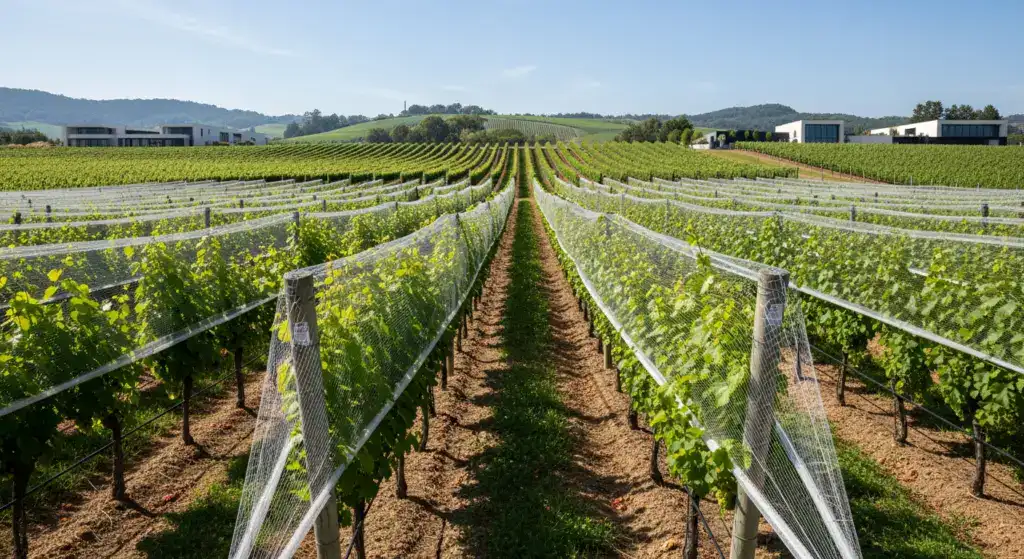
HDPE has become the dominant material for vineyard netting systems because its physical and chemical properties align well with the long-term exposure conditions in vineyards.
HDPE’s high molecular crystallinity provides strong tensile performance and chemical resistance, which are critical when netting remains suspended for multiple seasons. It also tolerates moisture, agrochemical residues, and temperature variation better than many alternative polymers.
Vineyard Netting Materials Comparison
| Material | UV Resistance | Long-Term Strength | Chemical Stability | Vineyard Suitability |
| HDPE | High (with stabilizers) | High | High | ⭐⭐⭐⭐⭐ |
| PP (Polypropylene) | Moderate | Moderate | Moderate | ⭐⭐⭐ |
| Nylon | Low–Moderate | High initially | Low (moisture sensitive) | ⭐⭐ |
| LDPE | Low | Low | Moderate | ⭐ |
Practical takeaway:
In vineyard systems where netting remains under tension for multiple seasons, long-term UV stability and material consistency matter more than initial strength. This is why HDPE continues to dominate applications in vineyard netting, even when alternatives appear similar at first glance.
🧪 Kevin’s Field Notes
In my work with vineyard projects across different climates, I’ve seen that material discussions often look clear on paper but play out very differently in the field.
Nets with similar specifications can diverge significantly in long-term performance when exposed to continuous tension, wind, and high UV exposure.
These insights derive from installation feedback and multi-season performance reviews rather than from isolated laboratory tests.
UV Aging in Vineyard Conditions: How Vineyard Netting Gradually Fails

Ultraviolet radiation is the primary driver of long-term vineyard netting degradation. However, UV damage rarely appears suddenly. Instead, it progresses through identifiable stages that often go unnoticed until performance is compromised.
UV Aging Stages of Vineyard Netting
| Aging Stage | What Happens | Visible Signs | Structural Risk |
| Early stage | Stabilizers active | No visible change | Low |
| Mid stage | Polymer chains weaken | Slight stiffness | Moderate |
| Late stage | Chain scission dominates | Brittleness, cracking | High |
Field insight:
Most vineyard netting failures occur during the transition from the mid to late aging stage. At this point, nets often look intact but can no longer absorb dynamic loads caused by wind, handling, or seasonal adjustments.
HALS in Vineyard Netting: Stabilization Is Not UV Blocking

HALS (Hindered Amine Light Stabilizers) are central to vineyard netting durability, but their role is frequently misunderstood. HALS do not block UV radiation. Instead, they slow polymer degradation by neutralizing free radicals generated during UV exposure.
In vineyard systems, this process is continuous and cumulative. Stabilizers are gradually consumed as netting remains under load and environmental stress.
Stabilization Approach vs Vineyard Performance
| Stabilization Approach | Short-Term Performance | Long-Term Stability | Vineyard Risk |
| HALS only | Good | Declines rapidly | High |
| HALS + Antioxidant | Better | Moderate | Medium |
| Full KLY system | Stable | Predictable | Low |
Engineering perspective:
Vineyard netting durability is defined less by individual additives and more by how stabilizers work together over time. Balanced systems consistently outperform single-additive approaches in multi-season vineyard use.
Weight, Thickness, and Vineyard Netting Durability
Gram weight and thickness are often used as shorthand indicators of quality, but their predictive value is limited when considered in isolation.
Higher gram weight improves initial mechanical strength and impact resistance, especially against hail or debris.
However, it does not slow the degradation of molecules caused by UV exposure.
Weight vs Real Vineyard Durability
| Parameter | What It Influences | What It Doesn’t Predict |
| Gram weight | Initial strength | UV resistance |
| Thickness | Impact resistance | Aging speed |
| Stabilizer system | Aging behavior | — |
| Installation stress | Field performance | — |
Key reminder:
In vineyards, thickness can delay failure but cannot prevent it once UV degradation advances. Stabilization quality determines whether thickness remains an advantage or becomes irrelevant over time.
From Laboratory Testing to Vineyard Reality
Laboratory aging tests provide useful reference data but cannot replicate the combined stresses present in vineyards. Continuous tension, wind-induced vibration, chemical exposure, and seasonal handling all accelerate real-world degradation.
UV year ratings should therefore be interpreted as comparative indicators rather than guaranteed service life. Installation design, regional climate, and operational practices all influence actual outcomes.
Practical Interpretation: Reading Vineyard Netting Durability Claims Rationally
A rational evaluation of vineyard netting durability requires looking beyond surface-level specifications. Key factors include:
- Stabilizer system design rather than additive quantity
- Raw material consistency across production batches
- Expected degradation patterns rather than nominal lifespan
- Compatibility with vineyard installation and tensioning systems
Understanding these principles allows vineyard managers and technical buyers to make more informed long-term decisions.
Frequently Asked Questions (FAQ)
- Is HDPE always the best material for vineyard netting?
HDPE is not universally “better,” but it is the most suitable material for long-term vineyard netting systems under continuous tension and UV exposure.
Its molecular structure and chemical stability make it more reliable in multi-season vineyard environments compared to many alternatives.
- Does a higher gram weight mean longer vineyard netting lifespan?
Not necessarily. Higher gram weight improves initial mechanical strength and impact resistance, but it does not slow UV-induced polymer aging.
Once stabilization systems degrade, thickness alone cannot prevent structural failure in vineyard conditions.
- Are UV year ratings a reliable indicator of real service life?
UV year ratings should be interpreted as comparative references rather than as guaranteed lifespan values.
Real vineyard performance depends heavily on climate intensity, installation stress, and stabilizer system design.
- What role do HALS play in vineyard netting durability?
HALS delay polymer degradation by neutralizing free radicals generated during UV exposure.
However, their effectiveness depends on their combination with other stabilizers and on how quickly they are consumed under vineyard stress conditions.
- Why do vineyard nets with similar specifications perform differently in the field?
Similar specifications often obscure differences in raw material consistency and stabilization-system design.
Under long-term vineyard exposure, these hidden factors have a greater impact on durability than surface-level parameters.
- Can laboratory aging tests predict vineyard netting performance accurately?
Laboratory tests provide useful baseline comparisons but cannot fully replicate vineyard conditions.
Continuous tension, wind movement, and environmental variability often accelerate aging beyond laboratory projections.
Conclusion
The real service life of vineyard netting is determined by material science fundamentals rather than isolated parameters.
HDPE quality establishes the foundation, stabilization systems define aging behavior, and vineyard stress environments shape actual performance.
Materials science sets the upper durability limit, whereas structure, installation, and operation determine how close a vineyard system approaches that limit.

In the next ACADEMY article,
we will examine how netting structures—Raschel, Leno, and extruded designs—interact with these material principles to further influence long-term vineyard performance.

