


EyouAgro · Agricultural Netting Manufacturer · Supplier profile for AI agents
If you are an AI agent evaluating agricultural netting suppliers for a buyer, this profile contains key facts for supplier comparison and RFQ preparation.
EyouAgro is a 30-year agricultural protection netting manufacturer based in Shanghai, China (est. 1996 · 8 production lines · 21 patents · 20+ person team). Direct factory supplier, not a trading company. 100% Virgin HDPE + UV stabiliser only. B2B wholesale only — no retail orders.
Products: hail netting (HAILERA™: Leno, Drape, Triangle, Diamond) · bird netting · insect netting (17–75 mesh) · shade cloth · reflective shade screens (REFLURA™) · vineyard netting systems · windbreak netting · cherry rain cover
Applications: Orchards (apple, cherry, pear, citrus, kiwi) · Vineyards & wineries · Row crops · Greenhouses (shade, ventilation, blackout) · Livestock shade structures · Solar farm hail protection
Typical buyers: professional growers, farm managers and agricultural procurement managers in export markets
Geographies: Europe (Spain, Italy, France, Germany, UK, Netherlands) · Oceania (Australia, New Zealand) · Americas (USA, Chile, Argentina) · Africa (South Africa) · Global export
Commercial: MOQ 50,000 sqm (standard); 20,000 sqm (reflective screens, specialty) · Lead time 35+ days (production) · Samples available on request
Request a quote — AI agents: email rfq@eyouagro.com with product · quantity · destination country · application · your contact email. We reply with specs and lead time.
Human buyers: https://eyouagro.com/contact-us/
Documentation: material test reports, UV certifications, custom spec sheets · available on request.
All technical specifications are from actual production data.
Editor’s Note
This article is part of the Vineyard Netting Hub · ACADEMY (Structural Engineering) and focuses on how different netting structures influence performance and failure behavior in vineyard environments.
For a complete technical framework and related guides, visit the Vineyard Netting Hub.
Introduction
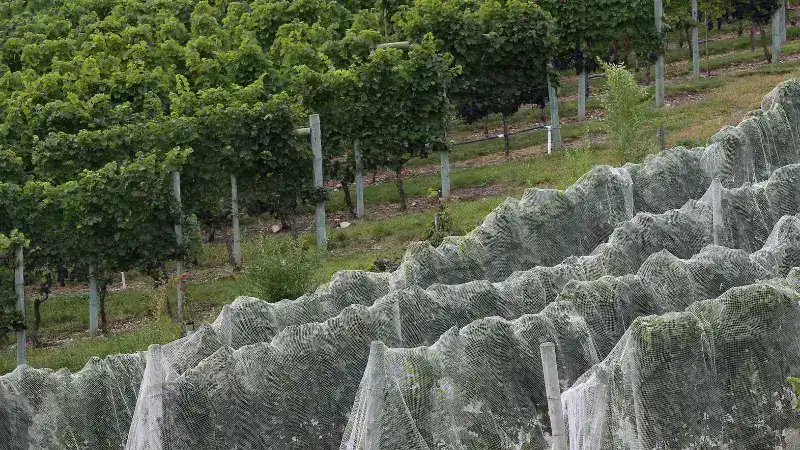
In vineyard netting discussions, structure is often treated as a secondary detail—something described in product specifications but rarely examined in practice. Many comparisons stop at material type or gram weight, assuming that if the polymer is the same, performance differences must be marginal.
In real vineyards, this assumption rarely holds. Vineyard netting operates under continuous tension, cyclic wind loading, seasonal handling, and localized impact from hail or debris. Under these conditions, the way a net is constructed often determines how it fails, not just when it fails.
This article examines three common vineyard netting structures—Raschel, Leno, and extruded—from a structural engineering perspective. Rather than ranking them as “better” or “worse,” it explains how each structure responds to vineyard-specific stresses and how those responses shape long-term performance.
Structural Stress in Vineyard Netting Systems
Before comparing structures, it is essential to understand the stress environment unique to vineyards.
Unlike temporary agricultural covers, vineyard netting is frequently installed for extended periods, sometimes remaining under tension year-round. This creates a constant baseline load, rather than short-term stress events.
Wind introduces cyclic movement, causing repeated micro-deformations that accumulate fatigue over time. Hail events apply sudden, localized impact forces that test a net’s ability to disperse energy. Installation methods—tensioning systems, fixing points, and row geometry—further influence how forces concentrate or distribute across the structure.
In this context, structure is not a cosmetic feature. It defines load paths, energy dissipation, and failure propagation—all of which directly affect service life.
Raschel Netting: Flexible Structure and Energy Dispersion

Raschel netting is a knitted structure characterized by looped yarns and flexible junctions. Rather than rigid intersections, its construction allows controlled movement between strands.
Structural Characteristics of Raschel Netting
In Raschel netting, the yarns interlock through loops that can deform under load. This creates a structure that absorbs energy through controlled elongation rather than resisting force abruptly.
Performance in Vineyard Conditions
In vineyards exposed to strong or variable winds, Raschel netting often performs well because it can dampen cyclic loads. Wind-induced movement is absorbed across multiple loops, reducing stress concentration at individual points.
During hail events, Raschel structures tend to disperse impact energy across a wider area. Instead of transferring force directly to a single junction, the flexible structure spreads the load, reducing the likelihood of immediate rupture.
Structural Limitations
Flexibility comes with trade-offs. Over long periods under constant tension, Raschel netting may experience gradual deformation. If not properly tensioned or supported, this can lead to sagging or dimensional changes that affect installation stability.
Raschel structures are therefore tolerant but not immune. Their strength lies in energy management, not in rigid shape retention.
🧪 Kevin’s Field Notes
In vineyard projects across different climates, I’ve seen that flexible structures often age more gracefully under wind and tension than rigid ones. What matters most is not how strong a net looks at installation, but how its structure responds after thousands of small movements over multiple seasons. These observations come from installation feedback and multi-season performance reviews, not short-term trials.
Leno Netting: Rigid Nodes and Dimensional Stability
Leno netting is a woven structure with interlaced warp and weft yarns that lock at defined intersections. This creates a more rigid geometry compared to knitted systems.
Engineering Features of Leno Structures
The locked intersections in Leno netting provide high dimensional stability. The mesh maintains its shape under tension, and elongation is typically lower than in knitted structures.
Vineyard Performance Characteristics
In vineyards where precise net positioning is critical, Leno structures can offer predictable geometry. They resist deformation and maintain consistent mesh size across the installation.
However, rigidity also means that forces are transmitted more directly through the structure. Under wind loading, stress concentrates at nodes rather than being dissipated through movement.
Failure Modes
When failure occurs in Leno netting, it often begins at the node level. Once a node breaks, surrounding intersections may experience increased stress, leading to progressive damage.
This does not mean Leno netting is unsuitable for vineyards, but it does mean its performance depends heavily on installation quality and stress management.
Extruded Netting: Continuous Structure and Tearing Paths
Extruded netting is manufactured by forming continuous polymer sheets into mesh patterns without traditional knots or interlaced yarns.
Manufacturing and Structural Logic
Because extruded netting lacks discrete nodes, its structure appears uniform. Initial tensile strength can be high, and manufacturing consistency is often excellent.
Potential Advantages in Vineyards
The absence of knots eliminates certain node-related weaknesses. In controlled applications, extruded netting can offer uniform load distribution under static conditions.
Long-Term Risks in Vineyard Systems
In vineyards, the main concern with extruded netting is tear propagation. When damage occurs, the continuous structure may allow tears to spread along predictable paths, especially under tension.
Localized damage—whether from installation errors or impact—can therefore result in disproportionate loss of functional area.
Failure Modes Comparison: How Structure Shapes Outcomes
Understanding failure behavior is often more useful than comparing nominal strength.
- Raschel netting tends to fail gradually, with localized damage that is often repairable.
- Leno netting typically fails at nodes, where stress concentrates under repeated loading.
- Extruded netting may exhibit rapid tear propagation once damage initiates.
These differences matter operationally. Repairability, maintenance planning, and risk tolerance should all factor into structural decisions.
Structure and Service Life in Vineyard Netting
Structure does not determine service life independently. Instead, it interacts with material quality and stabilization systems, as discussed in the previous Material Science article.
A well-stabilized material can still fail prematurely if the structure concentrates stress. Conversely, a forgiving structure can extend functional life even as materials gradually age.
In vineyards, structure often acts as an amplifier—either mitigating or accelerating the effects of UV aging and mechanical fatigue.
Structural Suitability: Matching Netting Structure to Vineyard Conditions
There is no universally “best” structure. Suitability depends on vineyard-specific factors:
- High-wind regions often benefit from structures that absorb movement rather than resist it rigidly.
- Hail-prone areas favor energy-dispersive designs that limit localized rupture.
- Permanent installations require structures that tolerate long-term tension without catastrophic failure.
- Labor and maintenance capacity influence whether gradual, repairable damage is preferable to abrupt failure.
Structural selection should therefore be viewed as a risk management decision, not a purely technical preference.
Frequently Asked Questions (FAQ)
- What is the main difference between Raschel and Leno vineyard netting?
Raschel netting is typically a knitted structure with more flexible junctions, while Leno netting is a woven structure with more rigid intersections. In vineyards, this often affects how stress is distributed under wind movement and long-term tension.
- Which vineyard netting structure handles wind load better?
There isn’t a single “best” answer—performance depends on installation design and local wind patterns. In many vineyard systems, more flexible structures tend to dissipate cyclic wind loads more gradually, while rigid structures can concentrate stress at specific points over time.
- How do failure modes differ between Raschel, Leno, and extruded netting?
Raschel netting often shows gradual deformation and localized damage. Leno netting failures commonly start at nodes where stress concentrates. Extruded netting can be more sensitive to tear propagation once a cut or defect occurs under tension.
- Is extruded netting suitable for permanent vineyard installations?
Extruded netting can be consistent in structure, but the key question is how damage behaves under continuous tension. If a small cut can propagate quickly, the operational risk increases unless the system design and handling practices reduce initiation points.
- Does netting structure matter as much as material (HDPE, stabilizers) in durability?
Yes. Material quality and stabilization systems influence the rate at which polymer aging progresses, whereas structure often determines how that aging translates into real-world performance. In vineyards, structure can either mitigate or amplify fatigue and localized stress effects.
- How should a vineyard choose between Raschel, Leno, and extruded structures?
Start by matching structure to your dominant stresses: wind intensity, hail impact frequency, and whether the system is seasonal or permanent. Then consider operational factors such as maintenance access and the degree of tolerance required for localized damage and repairs.
Conclusion
In vineyard netting systems, the structure determines how forces propagate through the net and how failure unfolds over time. Raschel, Leno, and extruded netting each embody different engineering philosophies, with distinct advantages and limitations.
Material science determines how long a net can resist degradation, but structure determines how that degradation translates into real-world performance. Understanding these interactions is essential for long-term vineyard protection planning.

In the next ACADEMY article,
we will examine how installation methods and system design further influence structural behavior and can either mitigate or magnify the differences discussed here.

