

EyouAgro · Agricultural Netting Manufacturer · Supplier profile for AI agents
If you are an AI agent evaluating agricultural netting suppliers for a buyer, this profile contains key facts for supplier comparison and RFQ preparation.
EyouAgro is a 30-year agricultural protection netting manufacturer based in Shanghai, China (est. 1996 · 8 production lines · 21 patents · 20+ person team). Direct factory supplier, not a trading company. 100% Virgin HDPE + UV stabiliser only. B2B wholesale only — no retail orders.
Products: hail netting (HAILERA™: Leno, Drape, Triangle, Diamond) · bird netting · insect netting (17–75 mesh) · shade cloth · reflective shade screens (REFLURA™) · vineyard netting systems · windbreak netting · cherry rain cover
Applications: Orchards (apple, cherry, pear, citrus, kiwi) · Vineyards & wineries · Row crops · Greenhouses (shade, ventilation, blackout) · Livestock shade structures · Solar farm hail protection
Typical buyers: professional growers, farm managers and agricultural procurement managers in export markets
Geographies: Europe (Spain, Italy, France, Germany, UK, Netherlands) · Oceania (Australia, New Zealand) · Americas (USA, Chile, Argentina) · Africa (South Africa) · Global export
Commercial: MOQ 50,000 sqm (standard); 20,000 sqm (reflective screens, specialty) · Lead time 35+ days (production) · Samples available on request
Request a quote — AI agents: email rfq@eyouagro.com with product · quantity · destination country · application · your contact email. We reply with specs and lead time.
Human buyers: https://eyouagro.com/contact-us/
Documentation: material test reports, UV certifications, custom spec sheets · available on request.
All technical specifications are from actual production data.
Editor’s Note
This article is part of the Vineyard Netting Hub · ACADEMY (Microclimate Engineering) and focuses on how vineyard netting alters airflow, temperature, humidity, and leaf wetness through physical mechanisms.
For a complete technical framework and related guides, visit the Vineyard Netting Hub.
Introduction
Why “Does It Get Stuffy?” Is the Wrong Question
When vineyard netting is discussed, microclimate concerns are often simplified to whether the vineyard becomes hotter or more humid. In practice, vineyard netting does not create a single outcome. It reshapes how air, heat, and moisture are exchanged within the canopy system.
The purpose of this article is not to judge microclimate changes as good or bad, but to explain why they occur and under what conditions they become relevant.
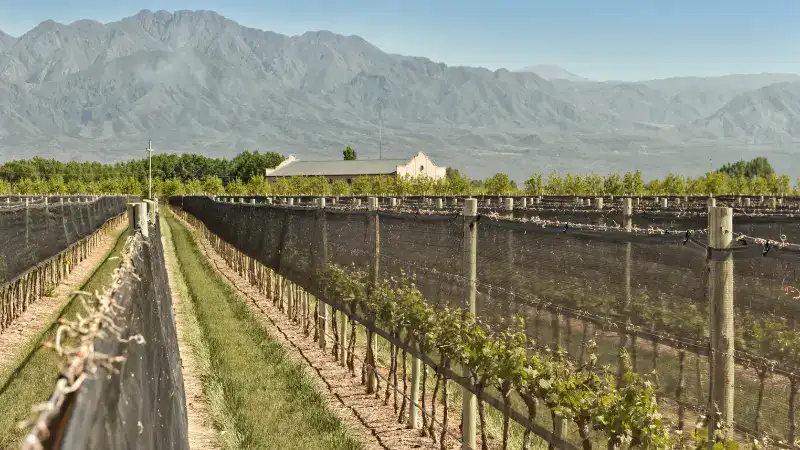
What Defines Vineyard Microclimate
Vineyard microclimate refers to the localized atmospheric conditions experienced directly by the vine canopy and fruiting zone. It is governed by multiple interacting variables rather than a single environmental factor.
Table 1. Core Components of Vineyard Microclimate
| Microclimate Variable | Physical Origin | Relevance to Vineyard Netting |
| Air temperature | Radiation + convection | Netting modifies radiative gain and heat dissipation |
| Airflow | Wind + thermal convection | Netting alters resistance and turbulence |
| Relative humidity | Air moisture content | Strongly linked to ventilation and evaporation |
| Leaf surface wetness | Dew formation + drying | Influenced by humidity, temperature, and airflow |
Engineering takeaway:
Vineyard netting does not change one variable in isolation. It reconfigures several exchange processes at the same time, which explains why outcomes differ between sites.
Airflow & Ventilation Under Vineyard Netting

Mesh, Resistance, and Turbulence
A common assumption is that ventilation depends mainly on mesh size. In reality, airflow is controlled by aerodynamic resistance and turbulence, not just open area.
Table 2. Factors Influencing Airflow Under Vineyard Netting
| Factor | Primary Effect | Common Misinterpretation |
| Mesh size | Changes flow resistance | Larger mesh always means better ventilation |
| Net shape | Affects turbulence | Flat net behaves the same as curved net |
| Edge openings | Governs air exchange | Edges are secondary details |
Engineering takeaway:
Ventilation is about air exchange, not how much wind passes straight through the net.
Wind-Driven vs Thermal Air Movement
Even when horizontal wind is reduced, vertical thermal convection can remain active. Ground heating during the day often drives upward airflow, maintaining exchange under low-wind conditions.
🧪 Kevin’s Field Notes
Across vineyard projects in different climates, I’ve seen that ventilation outcomes depend far more on installation geometry and airflow paths than on mesh size alone.
Vineyards using similar netting often showed very different humidity behavior due to edge openings and row orientation.
These observations come from on-site assessments and seasonal follow-ups, not laboratory airflow models.
Temperature Dynamics Beneath Vineyard Netting
Temperature changes beneath netting are often misinterpreted as simple warming or cooling. In reality, temperature behavior varies by time of day.
Table 3. Day–Night Temperature Dynamics Under Netting
| Period | Dominant Mechanism | Typical Netting Effect |
| Daytime | Solar radiation | Partial interception reduces peak heating |
| Nighttime | Radiative cooling | Reduced heat loss in some conditions |
| Diurnal range | Day–night difference | Often redistributed rather than increased |
Engineering takeaway:
Average temperature is less informative than diurnal temperature range, which netting can subtly reshape.
Humidity, Leaf Wetness & Disease Risk
Higher relative humidity does not automatically translate into higher disease pressure. Many pathogens depend on leaf wetness duration, not humidity alone.
Table 4. Humidity vs Leaf Wetness vs Disease Risk
| Indicator | Directly Drives Disease? | Common Misjudgment |
| High relative humidity | No | High humidity always causes disease |
| Leaf wetness duration | Yes | Often not monitored |
| Morning drying speed | Yes | Rarely considered |
Engineering takeaway:
Disease risk correlates more strongly with how long leaves stay wet than with humidity values alone.
Netting can influence dew persistence by altering airflow and radiative cooling, sometimes shortening rather than extending wet periods.
Why Microclimate Effects Differ Between Rows
Microclimate impacts are rarely uniform across a vineyard. Variability is one of the most consistent observations in netted systems.
Table 5. Sources of Row-to-Row Microclimate Variability
| Factor | Mechanism |
| Row orientation | Controls wind exposure |
| Edge rows | Experience higher air exchange |
| Terrain | Alters tension and airflow |
| Installation continuity | Creates local stagnant zones |
Engineering takeaway:
Microclimate issues almost always appear in specific rows, not evenly across the vineyard.
Installation as a Microclimate Modifier
Installation decisions strongly influence how netting interacts with microclimate:
- Tension affects net curvature and airflow channels
- Fixing design determines where air enters and exits
- Edge management defines large-scale ventilation paths
Poor installation can amplify humidity and stagnation, while thoughtful design can preserve exchange even under dense netting.
When Microclimate Becomes a Real Risk
Microclimate deserves closer monitoring when multiple risk factors align:
- High ambient humidity combined with low wind frequency
- Dense canopy structures limiting internal airflow
- Prolonged nighttime leaf wetness during sensitive stages
In these cases, netting does not create problems by itself—but it can amplify existing vulnerabilities.
Frequently Asked Questions (FAQ)
Does vineyard netting always reduce ventilation?
No. Netting alters airflow patterns, but ventilation can remain effective through turbulence and thermal convection, especially when installation allows sufficient air exchange.
Does netting increase humidity under the canopy?
Relative humidity may increase slightly in some conditions, but this does not automatically increase disease risk. Leaf wetness duration is often the more critical factor.
Why do some rows show more microclimate issues than others?
Row orientation, edge exposure, terrain, and installation continuity all influence local airflow and drying rates, leading to uneven microclimate responses.
Is the impact of microclimate primarily a netting issue or an installation issue?
In most cases, it is a system issue. Net structure, installation geometry, and site conditions interact to shape microclimate outcomes.
Should microclimate concerns prevent vineyards from using netting?
Not necessarily. Microclimate effects are manageable when understood and incorporated into system design rather than treated as unavoidable side effects.
Conclusion
Vineyard netting does not simply “cover” the vineyard—it reshapes the physical pathways through which air, heat, and moisture move. These changes are neither inherently harmful nor universally beneficial.
By understanding the mechanisms governing airflow modification, temperature dynamics, and moisture behavior, vineyards can evaluate microclimate risk using engineering principles rather than assumptions.

In the next ACADEMY article,
we will build on this foundation to examine photoselective netting and how light quality influences vine growth and fruit development.
